NIS2 Incident Reporting Requirements UK: A 2026 Compliance Orchestration Guide

Michael Iyiola
Co-Founder, CWORT
Master the NIS2 incident reporting requirements UK. Our 2026 compliance guide helps you meet the 24-hour deadline and avoid £17m fines with an orchestrated p...

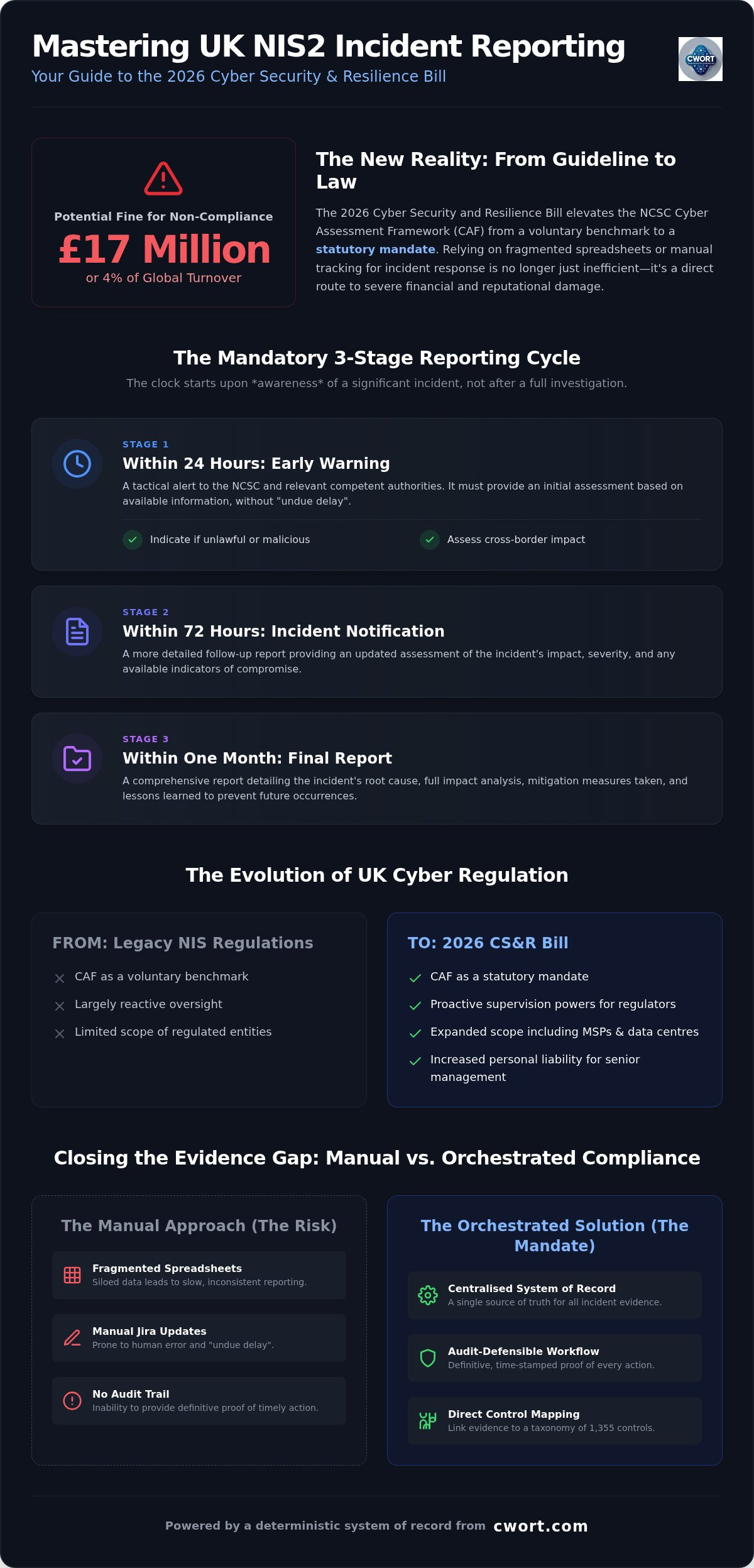
If your incident response plan still relies on fragmented spreadsheets and manual Jira updates, you aren't just risking a slow recovery; you're inviting a £17 million fine. The 2026 Cyber Security and Resilience Bill transforms the NCSC Cyber Assessment Framework (CAF) from a voluntary benchmark into a statutory mandate with uncompromising timelines. Meeting the NIS2 incident reporting requirements UK demands more than a frantic scramble. It requires a deterministic system of record that replaces the fear of "undue delay" with auditable certainty.
We recognise the anxiety of facing a 24-hour notification window whilst your evidence is scattered across siloed security tools. This guide provides the strategic orchestration needed to master the 24-hour, 72-hour, and one-month reporting cycles with board-ready assurance. You'll learn how to link granular technical evidence directly to regulatory outcomes, ensuring every notification is defensible and every deadline is met. We will examine the shift to CAF 4.0, the expanded scope for managed service providers, and the precise steps to move from administrative tracking to definitive, evidence-based proof.
Key Takeaways
- Master the rigorous three-stage notification cycle, ensuring your organisation can transition from an initial 24-hour warning to a detailed final report within 30 days.
- Navigate the NIS2 incident reporting requirements UK introduced by the 2026 Cyber Security and Resilience Bill to mitigate the risk of severe financial penalties.
- Replace fragmented manual tracking in Jira or Excel with a centralised system of record that provides definitive proof of timely action during a significant incident.
- Leverage the NCSC Cyber Assessment Framework (CAF) to build an audit-defensible workflow that satisfies the new statutory technical standards.
- Shift from reactive response to orchestrated compliance by mapping incident evidence directly to a comprehensive taxonomy of 1,355 controls.
Table of Contents
- The Evolution of UK NIS to the 2026 Cyber Security and Resilience Bill
- NIS2 Incident Reporting Timelines: Navigating the 24-Hour Rule
- The Evidence Integrity Gap: Why Manual Reporting Jeopardises Compliance
- Designing an Audit-Defensible Reporting Workflow via NCSC CAF
- CWORT: Orchestrating Deterministic NIS2 Incident Validation
The Evolution of UK NIS to the 2026 Cyber Security and Resilience Bill
The UK's regulatory environment is undergoing its most significant transformation since 2018. The transition from the Network and Information Systems (NIS) Regulations to the 2026 Cyber Security and Resilience (CS&R) Bill represents a shift from reactive oversight to proactive, statutory enforcement. Whilst the UK is no longer bound to transpose EU directives, the government has prioritised alignment with the NIS2 Directive to maintain economic resilience. This alignment ensures that UK-based entities aren't perceived as more vulnerable than their European counterparts, protecting the integrity of the digital supply chain.
From NIS1 to NIS2: What has changed for UK Entities?
The 2026 Bill broadens the classification of "Essential" and "Important" entities, bringing managed service providers (MSPs) and data centres under direct regulation for the first time. This expansion acknowledges that a single breach in a critical supplier can cause systemic failure across multiple sectors. Senior management now faces increased personal liability for cyber risk management failures. Regulators like the ICO and NCSC no longer rely on voluntary cooperation; they're empowered with proactive supervision capabilities and a two-tiered penalty regime. The ICO remains the competent authority for digital providers, whilst the NCSC provides the technical standard for assessment. Serious failures, including breaches of NIS2 incident reporting requirements UK, can now result in fines of up to £17 million or 4% of global annual turnover.
The Cyber Security and Resilience Bill 2026 Objectives
The Bill's primary objective is to strengthen the UK's cross-sector cyber security framework by placing the NCSC’s Cyber Assessment Framework (CAF) on a statutory footing. It mandates more granular incident reporting to provide the NCSC with a real-time view of the national threat landscape. This structural integrity is vital. In the year preceding September 2025, the NCSC managed 429 incidents, with nationally significant events more than doubling. By enforcing stricter NIS2 incident reporting requirements UK, the government aims to close the "evidence gap" that leaves boards blind to their actual risk posture. Meeting these obligations requires a move from manual tracking to orchestrated validation using platforms like CWORT to ensure audit-readiness and defensible compliance.
NIS2 Incident Reporting Timelines: Navigating the 24-Hour Rule
Compliance hinges on the speed of your initial response. Under the 2026 Cyber Security and Resilience Bill, the clock starts the moment your organisation becomes aware of a significant incident. This awareness isn't defined by the completion of a full forensic investigation. It's triggered by the suspicion that an event has crossed the threshold of significance. To meet the NIS2 incident reporting requirements UK, you must execute a three-stage reporting cycle: the Early Warning, the Incident Notification, and the Final Report. Failing to adhere to this sequence risks not only operational disruption but also the maximum tier of financial penalties.
Significant incidents are defined by their impact on service continuity or their potential for cross-border effects. If an incident disrupts an essential service or compromises the data of users in multiple jurisdictions, the obligation to report is absolute. You can't wait for total certainty. Proving that "undue delay" was avoided requires a pre-configured workflow that triggers notifications automatically as soon as specific impact thresholds are met.
The 24-Hour Early Warning: What must be included?
Submit your initial notification within 24 hours of awareness. This report is a tactical alert, not a comprehensive analysis. You must indicate whether the disruption appears to be the result of unlawful or malicious acts. It's also vital to provide a preliminary assessment of any cross-border impact. This allows the NCSC and relevant competent authorities to coordinate a wider national response. Don't delay the report whilst waiting for granular evidence. High-stakes governance requires you to report with the information available, provided you follow up as the situation evolves. To ensure your team is prepared for this 24-hour sprint, explore an orchestrated compliance demo to see how evidence can be aggregated in real-time.
The 72-Hour Notification and the One-Month Final Report
Provide a more detailed assessment within 72 hours of the initial alert. This second stage must update the earlier information, offering a clearer view of the incident’s severity and the scale of the impact. If the incident remains ongoing, you're required to submit progress reports at the request of the competent authority. This phase is where alignment with the NCSC Cyber Assessment Framework (CAF) becomes critical, as it provides the structured language needed to describe technical failures and resilience gaps accurately.
Conclude the process with a Final Report no later than one month after the initial notification. This document serves as the definitive record for auditors. It must include a thorough description of the incident, the identified root cause, and the specific mitigation measures applied to prevent recurrence. This isn't merely an administrative task. It's a formal validation of your organisation's maturity. By using a deterministic system to link incident data to specific CAF controls, you move from a state of reactive panic to one of auditable certainty. Mastering the NIS2 incident reporting requirements UK ensures your board-ready assurance is backed by reproducible, evidence-based truth.
The Evidence Integrity Gap: Why Manual Reporting Jeopardises Compliance
Reporting an incident is a tactical necessity, but proving you met the NIS2 incident reporting requirements UK is a regulatory obligation. Many organisations mistakenly conflate the two. They rely on the same operational tools used for ticket management to satisfy high-stakes auditors. This creates a dangerous integrity gap. When an auditor asks for proof that the 24-hour notification window was met without "undue delay", a collection of Jira comments and spreadsheet timestamps will not suffice. These tools lack the structural rigour required to provide a defensible, immutable audit trail.
Fragmented evidence is the primary cause of compliance failure. During a 2026 regulatory audit, the burden of proof lies entirely with the entity. If your evidence is scattered across disparate systems, reconstructing a precise timeline becomes an exercise in guesswork. This manual reconstruction introduces significant board-level risk. It suggests a lack of control and oversight, which regulators view as a failure of governance. Beyond the risk of inaccuracy, manual systems often fail the "Separation of Duties" requirement. Incident validation must be independent of the response team to ensure objective reporting.
The Failure of Spreadsheet-Based Compliance
Traditional tracking tools are inherently non-deterministic. They allow for retrospective editing, which invalidates their use as a source of regulatory truth. Regulators increasingly reject non-deterministic compliance claims because they cannot be independently verified or reproduced. Without a direct, automated link between a real-time security event and a control outcome, your compliance posture remains theoretical. You need a system that binds evidence to specific regulatory obligations at the point of origin, ensuring that every timestamp and log entry is preserved in a tamper-proof environment.
Replacing Fragmented Tracking with Orchestration
Shift your focus from administrative tracking to a single orchestrated system. This transition ensures the Board has access to a "Single Version of Truth" that is both auditable and reproducible. By implementing Regulatory Compliance Workflow Automation, you eliminate the risk of human error in the reporting chain. An orchestrated engine sits above your SIEM and EDR tools, aggregating evidence and mapping it to the 1,355 controls in the CWORT taxonomy. This approach transforms the NIS2 incident reporting requirements UK from a source of anxiety into a disciplined, execution-based reality. It ensures that when an incident occurs, the process of validation and reporting is an inevitable outcome of your system design rather than a desperate manual effort.
Designing an Audit-Defensible Reporting Workflow via NCSC CAF
Building a resilient reporting infrastructure requires moving beyond policy and into technical orchestration. The NCSC Cyber Assessment Framework (CAF) provides the official technical standard for meeting the NIS2 incident reporting requirements UK. By placing this framework on a statutory footing, the 2026 Bill demands that organisations demonstrate not just the intent to report, but the proven capability to do so accurately. This necessitates a workflow that maps incident response controls directly to the 217 domains in the taxonomy library, ensuring that every detection event is automatically aligned with a regulatory obligation.
NCSC CAF Maturity and Incident Resilience
Proving your organisation can meet the 24-hour reporting window requires an objective assessment of both capability and capacity. You must identify whether your current detection tools can surface significant incidents fast enough to trigger the "Early Warning" stage. Using maturity heat-maps allows leadership to visualise gaps in incident response before they result in a regulatory failure. This proactive approach transforms compliance from a post-incident scramble into a state of continuous readiness. To streamline this process, organisations should utilise specialised NCSC CAF Assessment Software to validate their maturity against the 4.0 standard.
Effective orchestration also enforces a strict separation of duties. Responders focus on containment, whilst compliance validators use an automated system of record to verify reporting accuracy. This is achieved by automating evidence collection from SIEM, EDR, and IAM tools. By pulling logs directly into a central engine, you eliminate the risk of narrative bias or manual error. This ensures that the evidence used in your 72-hour notification is both comprehensive and tamper-proof.
Binding Evidence to NIS2 Control Outcomes
A deterministic link between technical logs and regulatory reports is the only way to satisfy the "undue delay" clause. In a high-stakes audit, reproducibility is paramount. Identical sets of evidence must yield the same regulatory result every time, removing the subjectivity that often plagues manual reporting. This structured approach is particularly valuable for entities managing overlapping regimes. By adopting an "Assess once, report many" strategy, you can satisfy the NIS2 incident reporting requirements UK whilst simultaneously meeting DORA obligations. This creates a unified evidence base that serves multiple masters without duplicating effort. To see how your organisation can achieve this level of auditable certainty, request a demo of our orchestration platform.
CWORT: Orchestrating Deterministic NIS2 Incident Validation
Orchestrate your response rather than merely tracking it. The CWORT platform transforms the NIS2 incident reporting requirements UK from a set of abstract obligations into a series of structured, execution-based activities. By sitting above your existing security stack, the platform aggregates the necessary evidence to satisfy the 2026 Cyber Security and Resilience Bill without the need for manual reconstruction. It replaces the frantic scramble for logs with a disciplined engine that provides definitive, evidence-based proof of compliance at every stage of the 24-hour, 72-hour, and one-month reporting cycle. This systematic approach ensures that when a significant incident occurs, the path to a successful regulatory outcome is already paved.
The CWORT Compliance Intelligence Engine
Utilise a robust taxonomy of 1,355 controls to achieve rapid alignment with the new UK mandate. The CWORT NIS2 Compliance Platform UK maps every incident control across multiple frameworks, including UK NIS, ISO 27001, and the NCSC CAF. With 98.6% of active controls carrying direct framework references, the engine provides total coverage across your entire digital estate. This multi-framework mapping is particularly vital for entities managing the "assess once, report many" requirement. It allows you to satisfy both the UK’s CS&R Bill and the EU’s NIS2 Directive using a single, unified evidence base. You no longer need to manage fragmented spreadsheets; instead, you maintain a single version of truth that satisfies auditors, boards, and regulators alike.
Achieving Audit-Defensible Assurance
Defensible truth is the only currency that matters during a regulatory audit. CWORT enforces this by creating immutable audit histories that prove control effectiveness over time. Every action, validation, and piece of evidence is preserved in a deterministic system, ensuring that identical inputs always yield the same reproducible result. This removes the narrative bias that often leads to reporting failures. To support continuous improvement, the platform incorporates AI advisory capabilities. These tools suggest tactical optimisations to your incident response workflow without altering the underlying deterministic results. The result is a transition from the anxiety of potential failure to the calm of auditable certainty. To begin this transition, book a working session to map your NIS2 programme and see how orchestration can secure your 2026 compliance posture.
Securing Your 2026 Regulatory Standing Through Orchestration
The 2026 Cyber Security and Resilience Bill removes the luxury of administrative ambiguity. Organisations must now move from reactive spreadsheets to a deterministic system of record that guarantees precision under pressure. By aligning your internal workflows with the NCSC Cyber Assessment Framework, you ensure that every notification stage is backed by immutable technical evidence. Mastering the NIS2 incident reporting requirements UK isn't merely about avoiding fines; it's about establishing a state of operational resilience that withstands the scrutiny of both regulators and the Board.
CWORT provides the structural rigour required for this transition. With 1,355 controls mapped across 42 frameworks, our platform is specifically designed for the complexities of UK Critical National Infrastructure. It replaces fragmented tracking with deterministic, reproducible scoring that serves as audit-defensible proof of your compliance posture. Don't leave your regulatory standing to chance during a significant incident. Orchestrate your NIS2 compliance with CWORT today and replace the anxiety of the 24-hour window with the calm of auditable certainty. Your path to total assurance starts with a single, orchestrated version of truth.
Frequently Asked Questions
What is the 24-hour early warning rule under NIS2 in the UK?
The 24-hour early warning rule requires organisations to notify their competent authority and the NCSC within 24 hours of becoming aware of a significant incident. This isn't a full forensic report but a tactical alert indicating whether the event was malicious and its potential cross-border impact. It's the first stage of the mandatory reporting cycle under the NIS2 incident reporting requirements UK. Timely execution is vital to avoid the highest tier of financial penalties.
Who is responsible for incident reporting under the Cyber Security and Resilience Bill 2026?
Senior management and boards carry ultimate responsibility for ensuring reporting obligations are met. The Bill expands the scope of previous regulations to include managed service providers (MSPs) and data centres alongside traditional operators of essential services. Failure to report can lead to personal liability for leadership. Organisations must designate clear accountability structures to ensure that technical teams and compliance validators collaborate effectively during the 24-hour notification window.
What constitutes a "significant incident" for NIS2 reporting requirements?
An incident is classified as significant if it causes substantial operational disruption or has a cross-sectoral or cross-border impact. Specific thresholds include the number of users affected, the duration of the disruption, and the potential for the incident to compromise public safety. Determining significance requires a deterministic assessment against the NCSC CAF standard. If an event threatens service continuity or involves malicious actors, it likely triggers the NIS2 incident reporting requirements UK.
Can I use Jira or Excel to manage NIS2 incident reporting?
Whilst many firms use Jira or Excel for internal tracking, these tools are insufficient for proving regulatory compliance. They lack immutable audit trails and cannot bind real-time evidence to specific control outcomes. Regulators require a deterministic system of record that provides reproducible proof of timely action. Using fragmented spreadsheets creates an integrity gap that jeopardises your ability to prove you avoided undue delay during a high-stakes 2026 audit.
What are the penalties for non-compliance with UK NIS2 reporting timelines?
The 2026 Bill introduces a two-tiered penalty regime with significant financial deterrents. For serious failures, including breach of incident reporting timelines, the maximum fine is the greater of £17 million or 4% of global annual turnover. Less serious infringements carry a maximum penalty of £10 million or 2% of turnover. These fines align the UK's cyber regulations with GDPR, reflecting the government's commitment to enforcing rigorous national security standards through aggressive enforcement.
How does NCSC CAF relate to NIS2 incident reporting requirements?
The NCSC Cyber Assessment Framework (CAF) is the official technical standard for assessing cyber resilience in the UK. The 2026 Bill places the CAF on a statutory footing, making it a legal requirement for regulated entities. Adherence to CAF 4.0 provides the structured language and evidence base needed to satisfy reporting obligations. It serves as the benchmark for proving that your organisation maintains the technical capability to detect and report significant incidents without delay.
What is the difference between an Incident Notification and a Final Report?
An Incident Notification is a detailed report due within 72 hours of the initial 24-hour warning. It provides an updated assessment of severity and impact whilst the event may still be ongoing. The Final Report is the definitive record submitted no later than one month after the initial notification. This concluding document must include a thorough description of the incident, a root cause analysis, and the specific mitigation measures implemented to prevent recurrence in the future.
Does NIS2 require reporting of "near misses" or only successful breaches?
The 2026 Bill prioritises the reporting of significant incidents that have already occurred, but it also empowers regulators to demand information on threats and vulnerabilities. Whilst the 24-hour rule focuses on active disruptions, maintaining a record of averted incidents is a core component of CAF maturity. Proactive reporting of significant threats helps the NCSC coordinate a national response, potentially preventing widespread failure across the UK's critical national infrastructure and digital supply chains.
Disclaimer
The content on this site is provided for general information and educational purposes only. It does not constitute legal, regulatory, financial, or professional advice. CWORT provides AI-assisted insights and workflow automation, but all compliance decisions remain the responsibility of your organisation and its management. Always seek qualified legal or regulatory guidance for decisions relating to the UK NIS Regulations, CAF, DORA, NIS2, ISO 27001, or other obligations.
Related posts
NIS2 Compliance Platform UK: Orchestrating Evidence-Based Validation in 2026
Struggling with NIS2? Ditch spreadsheets for a NIS2 compliance platform UK leaders trust. Orchestrate evidence, automate reporting & achieve auditable certai...
NCSC CAF Assessment Software: Orchestrating UK Cyber Resilience in 2026
Ditch spreadsheets. Discover how NCSC CAF assessment software helps you meet the 2026 Cyber Resilience Bill, automate reporting, and build a defensible audit...
NIS2 Compliance for Critical Infrastructure: A Strategic Guide to Evidence-Based Validation (2026)
Master NIS2 compliance for critical infrastructure. Our guide helps you move beyond manual tracking to build an auditable, evidence-based system and avoid hu...
Article by
Michael Iyiola
Co-Founder, CWORT
Michael Iyiola is a co-founder of CWORT and a Cyber and AI Security Engineer with deep experience in vulnerability management, detection engineering and operational resilience across UK critical national infrastructure, including rail, energy and financial services. At CWORT, he designs scalable, evidence-driven workflows that help teams meet modern regulatory and security demands.
Build Your Foundation of Auditable Certainty
Take control of your regulatory obligations and secure your infrastructure with CWORT.