The Critical Challenges with Manual Compliance Tracking in 2026

Michael Iyiola
Co-Founder, CWORT
Facing challenges with manual compliance tracking? Discover why spreadsheets fail in 2026 and learn to build an audit-defensible system for complete certainty.

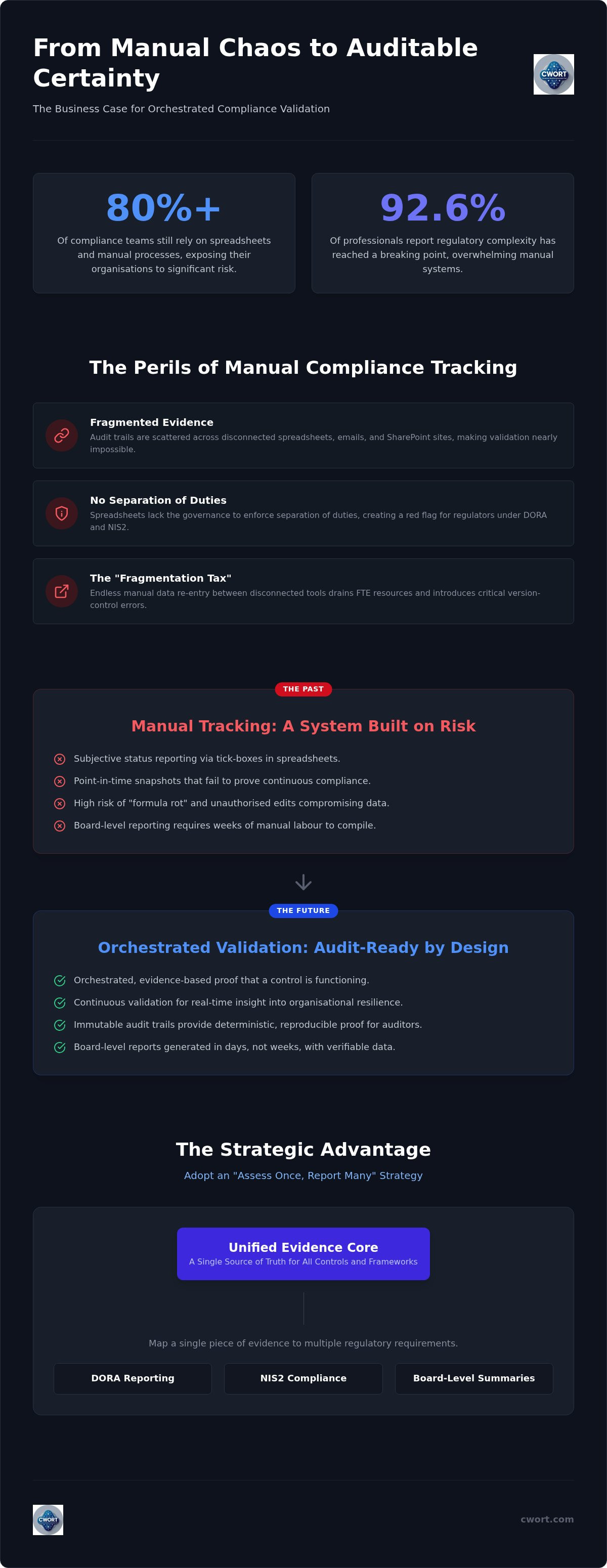
More than 80% of compliance teams still rely on spreadsheets and manual processes in 2026 according to Regology, even whilst 92.6% of professionals report that regulatory complexity has reached a breaking point. You likely recognise the mounting anxiety caused by fragmented evidence and the exhaustion of manual data re-entry across disconnected tools. It's a significant burden to prove separation of duties to regulators when your audit trail is scattered; board-level reporting shouldn't require weeks of manual labour to compile. These specific challenges with manual compliance tracking have evolved from simple administrative hurdles into structural liabilities that cannot withstand modern scrutiny.
This article provides a definitive business case for moving away from legacy tracking toward an orchestrated, audit-defensible validation model. You'll learn to bridge the gap between basic oversight and a disciplined system that enforces accountability by design. We outline a clear roadmap for evidence management that replaces the fear of failure with the calm of auditable certainty. Discover how to shift your focus from mere tracking to a systematic approach that ensures every control is mapped, every outcome is verified, and every audit is defensible.
Key Takeaways
- Understand why the fragmented use of spreadsheets and emails fails to satisfy the rigorous evidence requirements of the 2026 regulatory landscape, including DORA and NIS2.
- Analyse the technical challenges with manual compliance tracking, specifically the difficulty of enforcing a true separation of duties and cross-walking controls across multiple frameworks.
- Evaluate the operational drain caused by compliance inertia, focusing on the FTE costs of manual data collection and the high risks associated with remediation fatigue.
- Implement a roadmap to transition from reactive tracking to an orchestrated validation model that replaces siloed data with a unified, defensible evidence system.
- Adopt an "assess once, report many" strategy to ensure your compliance posture is always audit-ready and capable of meeting board-level reporting requirements in days rather than weeks.
Table of Contents
- The Fragility of Manual Compliance Tracking in a High-Stakes Era
- Core Challenges with Manual Compliance Tracking: A Technical Breakdown
- Assessing the Operational Cost of Compliance Inertia
- Transitioning from Reactive Tracking to Proactive Validation
- The CWORT Solution: Orchestrating Defensible Compliance Proof
The Fragility of Manual Compliance Tracking in a High-Stakes Era
Manual compliance tracking is the fragmented use of spreadsheets, emails, and non-specialised task managers to manage complex risk. Whilst these tools were once standard, the inherent challenges with manual compliance tracking in the 2026 regulatory landscape have rendered them structurally obsolete. For UK enterprises, Regulatory compliance is no longer a passive administrative exercise; it's a high-stakes operational mandate. The implementation of DORA and NIS2 demands a level of precision that manual methods simply cannot sustain. The strategic urgency to move beyond administrative tracking is palpable. It's no longer about staying organised. It's about survival in a landscape where regulatory fines are tied to operational resilience. Manual systems create a false sense of security that evaporates the moment an auditor asks for cross-framework validation.
The core issue lies in the distinction between "status reporting" and "compliance validation." Status reporting offers a subjective, often optimistic view of progress through tick-boxes. In contrast, compliance validation requires orchestrated, evidence-based proof that a control is functioning as intended. Moving from one to the other is the only way to satisfy modern regulatory scrutiny.
The Shift from Periodic Audits to Continuous Validation
Regulators have moved beyond accepting annual "point-in-time" snapshots as proof of security; they now demand real-time insight into an organisation's resilience. Maintaining evidence integrity is impossible when data sits in disconnected silos or personal folders. Manual lag-time creates a "compliance debt" that grows silently behind the scenes. This debt is often impossible to clear when an audit deadline looms, leaving leadership vulnerable to enforcement actions. Transitioning to a model of continuous validation ensures that evidence is bound to outcomes in real-time, providing total visibility and control.
Why Spreadsheets Fail the Deterministic Proof Test
Modern regulatory scrutiny requires deterministic results. This concept dictates that identical evidence must yield the same result every time, ensuring the assessment is reproducible and objective. Spreadsheets fail this fundamental test. They are susceptible to "formula rot," where hidden errors compound over months, and unauthorised edits in shared Excel workbooks that compromise data integrity. Manual data entry lacks the immutable audit trail required to prove a rigorous "separation of duties" to an auditor. One of the greatest challenges with manual compliance tracking is this lack of traceability. By moving to an orchestrated platform like CWORT, organisations replace the fragility of human error with a disciplined, systematic approach to evidence management. This shift replaces the anxiety of potential failure with the calm of auditable certainty.
Core Challenges with Manual Compliance Tracking: A Technical Breakdown
Manual tracking isn't merely inefficient; it's technically incapable of providing the deterministic proof required by modern regulators. One of the most significant challenges with manual compliance tracking is the systemic inability to enforce a true "separation of duties." In a spreadsheet environment, there's no technical barrier to prevent the person responsible for a control from also being the one who validates its success. This lack of governance creates an immediate red flag for auditors under DORA and NIS2, who require immutable proof of oversight. When your compliance posture relies on the honour system of a shared Excel workbook, you aren't managing risk; you're documenting a liability.
Organisations also pay a heavy "fragmentation tax" when trying to synchronise disconnected systems. Teams often find themselves trapped in a loop of manual data re-entry between Jira tickets, SharePoint folders, and master spreadsheets. This doesn't just drain resources; it introduces version-control errors that compromise the entire audit trail. If your status says "compliant" but the evidence is buried in an email thread from three months ago, you have an evidence-binding gap that will fail under professional scrutiny.
The Impossible Task of Multi-Framework Mapping
Modern enterprises must navigate a labyrinth of overlapping requirements. Manually mapping 1,355 controls across 42 different frameworks, such as ISO 27001 and DORA, is a recipe for operational collapse. Without an orchestrated system, "assess once, report many" remains a theoretical concept rather than a functional reality. Manual teams often end up with contradictory control statuses across different departments, leading to conflicting reports that undermine board-level confidence. To see how orchestration replaces this manual fragmentation, you might explore a live demonstration of evidence-binding in action.
Evidence Integrity and the "Audit-Ready" Myth
The "audit-ready" claim of many manual trackers is often a myth. These systems fail to bind specific evidence to individual control outcomes at the moment of validation. This leads to the dangerous practice of "reconstructed evidence," where teams scramble to gather proof weeks or months after a control was supposedly verified. Regulators increasingly reject these retrospective accounts, favouring systems that maintain a governed digital environment where evidence is captured and locked in real-time. This technical rigour is the only way to overcome the inherent challenges with manual compliance tracking and achieve definitive, defensible proof of compliance.
Assessing the Operational Cost of Compliance Inertia
Inertia is not a neutral state; it is an active drain on enterprise resources. The financial burden of maintaining legacy systems is often hidden within the "Full-Time Equivalent" (FTE) hours wasted on manual data collection. Compliance teams spend thousands of hours yearly chasing evidence across departments, a process that yields little strategic value. These challenges with manual compliance tracking create a "remediation fatigue" that sets in when gaps are discovered too late. Instead of proactive risk management, organisations find themselves in a perpetual cycle of crisis response. The cost of a failed DORA or NIS2 assessment far exceeds the price of modernising your infrastructure. Reputational damage and heavy regulatory fines are the inevitable results of relying on a fragile manual foundation.
Board-level reporting highlights the starkest contrast in operational efficiency. A manual compilation of compliance posture typically takes weeks of intensive labour to verify and format. By the time the board sees the report, the data is already obsolete. Orchestrated systems provide the same level of insight in seconds, offering a real-time, defensible view of the organisation's resilience. This speed allows leadership to make informed decisions based on current reality rather than historical approximations.
Capability vs Capacity: The Manual Blind Spot
Manual tracking often suffers from a critical blind spot: it focuses on "what" was done rather than "how well" it was executed. Subjective manual scoring frequently leads to an over-estimation of maturity. An organisation might mark a control as "complete" without considering if the people and skills are in place to sustain it. Orchestration engines address this by measuring capacity alongside capability. They evaluate whether the coverage is sufficient and if the underlying processes are robust enough to withstand operational stress. This move from subjective opinion to deterministic proof is essential for modern governance.
Fragmentation vs Orchestration: A Strategic Comparison
Traditional GRC tools act primarily as systems of record, focused on administrative record-keeping. They track tasks but fail to validate the effectiveness of controls. In contrast, regulatory compliance workflow automation eliminates manual hand-offs by binding evidence directly to outcomes. This orchestration ensures that every control is verified by design rather than by chance. Whilst manual methods struggle with the challenges with manual compliance tracking across siloed teams, an orchestrated model provides a unified, explainable view. It shifts the focus from "tracking a task" to "validating a control," ensuring that your compliance posture is not just documented, but actually defensible.
Transitioning from Reactive Tracking to Proactive Validation
Moving from a reactive posture to a proactive validation model requires a disciplined, four-stage lifecycle. You cannot simply automate a broken process; you must first diagnose the current maturity level and identify evidence gaps hidden within manual silos. This diagnosis exposes the technical challenges with manual compliance tracking that previously remained obscured. Following this, you must design a target operating model that replaces fragile spreadsheets with governed, reproducible workflows. The delivery phase involves automated control mapping using a centralised taxonomy library of 1,355 controls, ensuring every obligation is matched to a verifiable action. Finally, you must demonstrate effectiveness through board-ready, audit-defensible reporting that provides a real-time view of your resilience.
Implementing a "Bring Your Own Content" (BYOC) Strategy
Many organisations possess extensive existing compliance models but lack the environment to enforce their execution. Implementing a "Bring Your Own Content" (BYOC) strategy allows you to import these legacy models into a governed digital workflow. This is not a mere data transfer; it's a transition to a governed reusable model service. Version control and an immutable history are non-negotiable for BYOC. They ensure that every modification is tracked and every previous state is reproducible, satisfying the most rigorous audit requirements whilst maintaining the integrity of your original content.
Enforcing Discipline through Orchestration
True orchestration automates the "roll-up" of data from operational tools like SIEM, EDR, and IAM directly into your compliance framework. This eliminates the risk of human error and ensures that your evidence reflects current operational reality rather than a month-old snapshot. Within this system, AI acts as an advisory layer, identifying anomalies and suggesting improvements without ever altering deterministic scores. Setting up ISO 27001 control mapping provides the essential foundation for this broader resilience, allowing you to scale your efforts across multiple frameworks like DORA and NIS2 with absolute certainty. This shift replaces the anxiety of the unknown with a structured, defensible reality.
To see how this transformation replaces administrative fatigue with strategic control, you can schedule a technical validation session today.
The CWORT Solution: Orchestrating Defensible Compliance Proof
CWORT is an enterprise platform that transforms cyber-security into a measurable, governed operating model. It replaces fragmented manual tracking with a disciplined orchestration layer, allowing leadership to move from the anxiety of potential failure to the calm of auditable certainty. It addresses the fundamental challenges with manual compliance tracking by enforcing accountability by design. Unlike traditional GRC systems that act as passive repositories, CWORT sits above your existing security stack to aggregate evidence into a single, explainable view. This ensures that every piece of proof is bound to a specific outcome in real-time, providing a definitive source of truth for both internal stakeholders and external regulators.
The platform operates on an "Assess Once, Report Many" philosophy. This approach is essential for UK enterprises navigating the overlapping mandates of UK NIS, NIS2, and DORA. By mapping evidence to a centralised library of 1,355 controls, CWORT eliminates the redundant labour and human error that compromise manual processes. It provides the technical rigour required to satisfy modern standards, shifting the focus from administrative record-keeping to definitive, evidence-based validation.
Strategic Outcomes for UK Enterprises
Achieving a "common language" for maturity is vital for alignment between executive boards and technical delivery teams. CWORT facilitates this by producing board-ready maturity reports that require no manual reconstruction or data manipulation. This systematic approach is the only reliable way of ensuring compliance evidence integrity during intense regulator scrutiny. It transforms compliance from a cost centre into a strategic asset by providing a transparent and reproducible audit trail that stands up to the most rigorous professional examination.
The Path to Regulatory Resilience
In 2026, "audit-defensible" is the only metric that carries weight. Compliance is no longer a periodic obligation; it's a continuous state of structural resilience. The path to achieving this begins by acknowledging the inherent challenges with manual compliance tracking and committing to a systematic, automated alternative. CWORT offers a clear roadmap for this transition, beginning with a controlled pilot on a single sub-function before scaling across the wider organisation. This methodical progression ensures that discipline is enforced at every level. It's time to replace legacy inertia with a proactive system of validation. Explore the CWORT platform for your organisation and secure your path to definitive, auditable truth.
Mastering Regulatory Resilience through Orchestration
Legacy reliance on spreadsheets has transitioned from a mere inefficiency to a structural liability. The challenges with manual compliance tracking create evidence gaps that modern regulators will not overlook. You've explored how moving from reactive status reporting to proactive validation replaces administrative fatigue with definitive, orchestrated control. It's time to bridge the gap between abstract requirements and a concrete, defensible reality.
Achieving total assurance requires a system built for the rigour of DORA, NIS2, and ISO 27001. CWORT delivers a deterministic, reproducible scoring model utilising a taxonomy library of 1,355 controls mapped across 42 frameworks. This level of orchestration ensures your compliance posture is always transparent and audit-ready. Don't let fragmented data compromise your organisation's resilience. Replace your manual trackers with CWORT’s audit-defensible orchestration engine and lead your team toward a state of auditable certainty.
Frequently Asked Questions
What are the main risks of using Excel for DORA compliance tracking?
Excel lacks the immutable audit trail and version control essential for DORA’s operational resilience mandates. Relying on shared workbooks introduces technical vulnerabilities such as hidden formula errors and unverified data entries that compromise integrity. These challenges with manual compliance tracking mean that spreadsheets cannot provide the deterministic proof regulators demand. A manual document is a static record; it fails to offer the tenant isolation or evidence protection required to satisfy high-stakes oversight.
How does manual compliance tracking impact audit readiness?
Relying on manual methods forces teams into a reactive posture where evidence is reconstructed retrospectively rather than captured in real-time. This creates a compliance debt that is often impossible to clear before an audit deadline. Without a governed digital environment, auditors cannot verify the provenance of evidence or the timeline of control validation. This lack of traceability turns every audit into a high-pressure scramble, replacing certainty with the anxiety of potential failure.
Can Jira be used as a primary regulatory compliance orchestration tool?
Jira is a task management tool, not a compliance orchestration engine. Whilst it tracks what is being done, it lacks the capability to map controls across 42 frameworks or enforce a deterministic scoring model. Relying on Jira for compliance leads to fragmented data silos and a lack of evidence integrity. CWORT sits above tools like Jira to aggregate evidence into a single, explainable view that satisfies regulators and senior leadership.
What is the difference between compliance tracking and compliance validation?
Distinguishing between compliance tracking and validation is essential for modern governance. Tracking is a passive administrative exercise that merely records task completion, whereas validation is a disciplined, evidence-based process that proves a control achieved its specific outcome. This shift is vital for overcoming the challenges with manual compliance tracking, moving from subjective, tick-box status updates to definitive, auditable proof that an organisation remains structurally resilient.
How much time do organisations typically waste on manual compliance reporting?
Teams often spend hundreds of hours annually chasing evidence across siloed departments to compile static reports. This manual labour creates a significant FTE drain that yields little strategic value for the business. By the time these documents reach the board, the information is typically outdated. An orchestrated engine automates this process, generating real-time insights that allow leadership to pivot from administrative record-keeping to proactive risk management and strategic resource allocation.
What happens if a manual tracker contains inconsistent evidence during a NIS2 audit?
Inconsistent evidence during a NIS2 audit can lead to heavy regulatory fines and a loss of board-level confidence. If an auditor identifies contradictory control statuses or unverified data, the entire compliance posture is deemed unreliable. Manual trackers are prone to these errors due to the fragmentation of data across disconnected tools. Without a single, orchestrated source of truth, an organisation cannot demonstrate the structural integrity required to prove resilience.
How does an orchestration engine solve the problem of "separation of duties"?
An orchestration engine enforces separation of duties through technical barriers like role-based and attribute-based access controls. It ensures that the person executing a control is distinct from the person validating its success. Manual trackers like Excel cannot technically prevent these conflicts, relying instead on the honour system. By automating this governance, CWORT creates an immutable audit history that proves rigorous oversight to regulators, ensuring that every control is verified by design.
Is it possible to migrate manual maturity models into an automated platform like CWORT?
Migrating manual models into CWORT is achievable through the Bring Your Own Content capability. This allows you to import proprietary maturity models into a governed digital workflow with full version control. You retain your existing intellectual property whilst benefiting from CWORT’s analytics and automated roll-ups. This transition removes the friction of manual hand-offs and ensures that your unique assessment criteria are backed by immutable evidence and reproducible scoring.
Disclaimer
The content on this site is provided for general information and educational purposes only. It does not constitute legal, regulatory, financial, or professional advice. CWORT provides AI-assisted insights and workflow automation, but all compliance decisions remain the responsibility of your organisation and its management. Always seek qualified legal or regulatory guidance for decisions relating to the UK NIS Regulations, CAF, DORA, NIS2, ISO 27001, or other obligations.
Related posts
Jira for Compliance vs Orchestration: Why Task Tracking Fails Regulatory Audits
Discover why Jira fails DORA & NIS2 audits. In the debate of Jira for compliance vs orchestration, learn why task tracking isn't proof & how to automate assu...
Automated Compliance Proof Generation: Transitioning from Manual Tracking to Validated Evidence
Ditch manual spreadsheets. Learn how automated compliance proof generation creates regulator-ready, validated evidence for DORA & NIS2, ensuring a defensible...
The Shift to Compliance Orchestration Platforms: Beyond Enterprise GRC Automation
Struggling with DORA & NIS2? Move beyond failing GRC tools with a compliance orchestration platform for automated, auditor-ready evidence and real-time overs...
Article by
Michael Iyiola
Co-Founder, CWORT
Michael Iyiola is a co-founder of CWORT and a Cyber and AI Security Engineer with deep experience in vulnerability management, detection engineering and operational resilience across UK critical national infrastructure, including rail, energy and financial services. At CWORT, he designs scalable, evidence-driven workflows that help teams meet modern regulatory and security demands.
Build Your Foundation of Auditable Certainty
Take control of your regulatory obligations and secure your infrastructure with CWORT.