Automated ICT Risk Management Reporting: A Strategic Framework for 2026 Compliance

Michael Iyiola
Co-Founder, CWORT
Master 2026 compliance with a strategic framework for automated ICT risk management reporting. Move beyond manual tracking to generate regulator-ready proof.

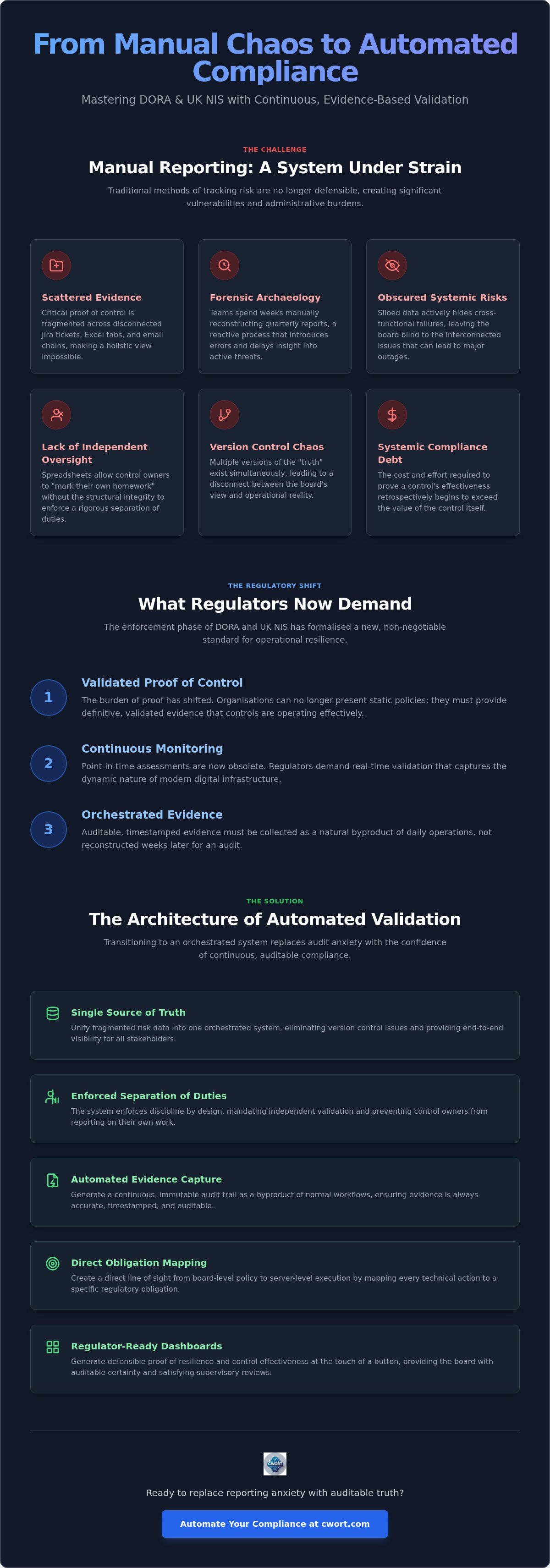
Manual spreadsheets are no longer just an administrative burden; in the current regulatory climate, they represent a systemic vulnerability. If your evidence remains scattered across Jira tickets and Excel tabs, you cannot prove control effectiveness with the rigour required by DORA or the UK NIS. Transitioning to automated ICT risk management reporting is the only way to replace forensic archaeology with definitive, auditable truth. You need a system that enforces discipline by design, ensuring that every control is validated and every separation of duties is documented without manual intervention.
It's understandable that the complexity of the DORA RTS creates a sense of professional anxiety. You've likely spent weeks manually reconstructing quarterly reports, only to worry if the data would survive a deep-dive audit. This article provides a strategic framework to master the shift from reactive tracking to continuous, regulator-ready validation. We'll examine how to orchestrate your compliance workflows to generate defensible proof of resilience at the touch of a button, significantly reducing your manual overhead whilst satisfying the most stringent supervisory reviews.
Key Takeaways
- Understand why manual data reconstruction fails under the current DORA enforcement phase and how to transition towards continuous, evidence-based validation.
- Master the architecture of automated ICT risk management reporting to generate defensible proof of control effectiveness without administrative lag.
- Learn to enforce rigorous separation of duties and accountability at the point of data entry, ensuring your risk reports are auditor-ready by design.
- Identify the essential components of a board-level ICT risk dashboard that maps granular evidence directly to specific regulatory obligations.
- Discover how to replace fragmented Excel and Jira tracking with a single orchestrated system to eliminate reporting anxiety and manual compliance overhead.
Table of Contents
- The Crisis of Manual ICT Risk Reporting in 2026
- The Architecture of Automated ICT Risk Validation
- A Template for Regulator-Ready ICT Risk Reports
- Validation vs. Visibility: Why Your Current Tools Are Not Enough
- Implementing CWORT for Automated Compliance Validation
The Crisis of Manual ICT Risk Reporting in 2026
The regulatory landscape of 2026 has reached a definitive tipping point. For years, organisations relied on "best efforts" to satisfy auditors, often presenting static policies as proxies for actual protection. Under the current enforcement phases of DORA and UK NIS, this passive approach is no longer defensible. Regulators now demand validated proof of operational resilience, shifting the burden of proof from the auditor to the firm. Relying on manual data reconstruction creates a dangerous reporting lag that leaves leadership blind to emerging threats. When you spend weeks piecing together evidence from disparate systems, you aren't managing risk; you're performing forensic archaeology.
Fragmented reporting does more than just increase administrative overhead; it actively obscures systemic vulnerabilities. When risk data is siloed across Jira tickets and spreadsheet tabs, the board cannot see the cross-functional failures that lead to total system outages. Adopting automated ICT risk management reporting isn't merely an efficiency play. It's a strategic necessity to ensure that the data presented to the board is accurate, timely, and, most importantly, defensible under intense regulatory scrutiny.
The Limitations of Spreadsheet-Based Compliance
Excel and Jira were never designed to serve as a robust ICT risk management framework. They lack the structural integrity required to enforce a strict separation of duties, allowing control owners to effectively mark their own homework without independent oversight. Version control failures are common, leading to a fragmented "truth" where the board sees one reality whilst the technical teams operate in another. This reliance on manual tracking creates a state of systemic compliance debt where the cost of proving a control's effectiveness exceeds the value of the control itself.
Why Regulators Now Demand Orchestrated Evidence
The 2026 Supervisory Review and Evaluation Process (SREP) guidelines have formalised the requirement for continuous monitoring. Point-in-time assessments are now viewed as obsolete because they fail to capture the dynamic nature of modern digital infrastructure. Regulators expect automated ICT risk management reporting to provide real-time validation of control execution. It's no longer enough to show that a policy exists; you must provide auditable, timestamped evidence that the policy was followed yesterday, today, and every hour in between. Moving beyond "best efforts" requires a transition to orchestrated evidence that is collected as a natural byproduct of your daily operations.
The Architecture of Automated ICT Risk Validation
Effective automated ICT risk management reporting requires a fundamental shift in how compliance is architected. It's no longer sufficient to treat regulatory mandates as a static checklist. Instead, organisations must decompose complex requirements into granular, executable activities. This process ensures that every technical action is mapped back to a specific legal obligation, creating a direct line of sight from board-level policy to server-level execution. Aligning these activities with established standards like NIST's Risk Management Framework provides a rigorous foundation for this mapping, ensuring that your internal controls meet international benchmarks for excellence.
By shifting from retrospective data collection to proactive orchestration, firms can enforce a strict separation of duties at the point of data entry. This architectural approach prevents the common pitfall where the same individual who executes a control is also responsible for reporting its success. A robust system mandates independent validation, ensuring that evidence is captured automatically as a byproduct of the workflow itself. This creates a continuous audit trail, eliminating the need for manual reconstruction and replacing audit anxiety with the confidence of auditable certainty.
Obligation Translation and Execution
Translating the high-level requirements of the DORA RTS and UK NIS into actionable tasks is the first step toward operational resilience. You must distribute accountability across the organisation, ensuring that control owners in IT, security, and operations understand their specific contributions to the compliance posture. Automated workflows play a critical role here. They act as a digital safety net, ensuring no obligation is missed and that every task is completed according to its predefined schedule. This decentralised execution, combined with central oversight, ensures that the organisation remains compliant whilst maintaining operational speed.
Evidence Binding: The Key to Defensible Reporting
Evidence binding is the technical mechanism that links a specific event, such as a successful patch deployment or a firewall change, directly to a regulatory control outcome. In the 2026 regulatory environment, the integrity of this evidence is paramount. Metadata and cryptographic timestamps are essential to prove that the data hasn't been altered after the fact. Automated binding creates an immutable link between technical activity and control outcomes, effectively preventing the retrospective evidence tampering that often occurs during manual audit preparation. This level of traceability is what transforms a simple report into a defensible record of truth. To see how this architecture functions in practice, you can explore our orchestration platform.
A Template for Regulator-Ready ICT Risk Reports
Generating a report that satisfies both a non-technical board and a rigorous regulatory auditor requires a dual-layered approach to data presentation. A singular, dense document often fails because it either lacks the granular evidence needed for validation or overwhelms leadership with technical minutiae. Transitioning to automated ICT risk management reporting allows you to bifurcate your data, providing high-level strategic insights whilst maintaining an immutable link to the underlying technical proof. This structure ensures that every metric presented to the board is backed by a defensible audit trail that can be interrogated by regulators at a moment's notice.
Modern risk reporting must also extend beyond the internal perimeter. As firms become increasingly reliant on complex ecosystems, integrating ICT supply chain risk management data into your central reporting engine is vital. This holistic view ensures that third-party vulnerabilities are not treated as isolated incidents but as integrated components of your overall operational resilience posture. Just as Computer Market Research uses cloud-based automation to streamline channel management and marketing funds for global firms, orchestration engines provide the structural integrity needed to manage complex digital supply chains. By moving beyond simple pass/fail indicators, you can provide a nuanced view of risk that accounts for the interdependencies of the entire digital supply chain.
Tier 1: The Board-Level Strategic Summary
Leadership requires a clear understanding of residual risk and how it impacts the organisation's strategic objectives. This summary should visualise compliance trends across different business units, identifying areas where resilience is maturing and where it is stagnating. Rather than focusing on individual technical failures, highlight critical gaps that require strategic investment or resource reallocation. This level of reporting transforms compliance from a cost centre into a strategic enabler, providing the board with the calm of auditable certainty in a volatile threat landscape.
Tier 2: The Auditor-Ready Validation Report
The second tier of your reporting template must provide the granular proof that regulators now demand. This includes providing specific system logs that demonstrate DORA separation of duties enforcement, ensuring that no single individual can bypass critical security controls. Every enforced control should be mapped directly to the relevant articles within the DORA technical standards compliance framework. This level of detail eliminates the need for manual data reconstruction during an audit, as the evidence is already bound to the reporting output by design. Automated ICT risk management reporting ensures that when an auditor asks for proof of control effectiveness, you can provide a timestamped, validated record immediately.
Validation vs. Visibility: Why Your Current Tools Are Not Enough
Visibility is not validation. A common industry pitfall is assuming that a comprehensive dashboard of vulnerabilities constitutes a compliant posture. It doesn't. Whilst technical visibility tools tell you what is broken, automated ICT risk management reporting proves that you are fixing it according to your defined policy. Regulators in 2026 are no longer satisfied with seeing a list of risks; they demand to see the orchestrated process that managed those risks from identification to remediation. This is why automated ICT risk management reporting must be built upon an orchestration engine rather than a static database.
Many organisations invest heavily in GRC platforms, only to find they've purchased expensive filing cabinets for dead data. These systems track information but do not enforce the discipline required by NIS2 or DORA. Bridging the gap between IT operations and compliance requires an orchestration engine that moves beyond mere tracking to active validation. This is how you address the complexity of modern frameworks: by automating the workflow itself rather than just the reporting of its outcome. It ensures that compliance is a byproduct of daily operations, not a separate, manual effort.
The "Scanning Trap" in ICT Risk Management
A clean scan is a snapshot, not a strategy. It often fails to account for the procedural controls that regulators now scrutinise, such as the approval chain for an exception or the verification of a patch deployment. Process validation is the missing link. Whilst your security tools provide the technical data, CWORT complements this by providing the final "Proof" that the entire risk management lifecycle was executed correctly. It transforms raw technical data into a validated record of operational resilience.
Moving from GRC Tracking to Orchestrated Validation
Passive monitoring is the enemy of auditable certainty. To survive a DORA or NIS2 review, you must move toward active enforcement of your internal standards. Building a regulatory compliance workflow automation ensures that every step of your risk management framework is followed by design. This creates "Defensible Truth", a state where your reporting is not just a collection of numbers, but a validated record of professional maturity. This level of structural integrity is what separates market leaders from those vulnerable to regulatory fines. If you are ready to move beyond visibility and achieve total assurance, book a demo of our compliance orchestration platform.
Implementing CWORT for Automated Compliance Validation
Transitioning from fragmented tracking to a single orchestrated system is the final step in securing your regulatory posture for 2026. CWORT replaces the "forensic archaeology" of manual data collection with a proactive engine that enforces discipline by design. By integrating your technical environment directly with regulatory obligations, the platform ensures that automated ICT risk management reporting is no longer a quarterly burden but a continuous state of readiness. This structural integrity allows leadership to shift focus from administrative survival to strategic resilience, knowing that every control is backed by a defensible record of truth.
The onboarding process is designed for rigour and precision. It begins by mapping your organisation's custom control models and internal standards directly to the CWORT orchestration engine. This ensures that the platform doesn't just provide a generic template but reflects the unique operational reality of your business. Whether you are aligning with ISO 27001, the NCSC CAF, or specific DORA technical standards, CWORT translates these abstract requirements into concrete, executable activities that produce validated evidence without manual intervention.
Orchestrating the Compliance Lifecycle
CWORT manages the entire compliance lifecycle by distributing accountability amongst subject matter experts and internal auditors. It moves beyond simple task tracking to enforce a strict workflow where evidence collection is mandatory and timestamped. This centralised oversight ensures that no obligation is missed, whilst the system's flexibility allows you to customise reporting outputs for different regulatory bodies. Whether you need to satisfy the FCA's operational resilience requirements or provide the NCSC with a maturity assessment, the platform generates the specific evidence packages required by each authority.
Achieving Audit Readiness with CWORT
In the high-stakes environment of financial services, the ability to produce a validated report in minutes rather than weeks is a significant competitive advantage. CWORT functions as your central bank audit compliance software, providing a single source of truth that regulators can trust. It eliminates the risk of human error in data reconstruction and provides an immutable audit trail of every control execution. This future-proofs your organisation against the expanding scope of NIS2 and UK NIS, ensuring that as regulations evolve, your automated ICT risk management reporting evolves with them. If you're ready to replace compliance anxiety with auditable certainty, request a demo of the CWORT orchestration engine.
Secure Your Defensible Truth for 2026
The transition from passive monitoring to active, orchestrated validation is the only way to survive the current regulatory climate. Manual data collection is too slow and too prone to error to meet the rigorous demands of the DORA enforcement phase. By implementing automated ICT risk management reporting, you replace the anxiety of potential audit failure with the calm of auditable certainty. You move beyond simple visibility and begin enforcing the discipline required to prove control effectiveness at a moment's notice.
CWORT provides UK-based expert orchestration designed to bridge the gap between technical operations and board-level oversight. Our DORA and NIS2 ready frameworks ensure your evidence is timestamped, validated, and ready for supervisory review. You can finally eliminate weeks of manual reconstruction and deliver auditor-ready outputs at the touch of a button. Take control of your compliance lifecycle and ensure your organisation remains resilient against both threats and scrutiny.
Book a CWORT Demo to Automate Your ICT Risk Reporting and secure your professional standing today.
Frequently Asked Questions
What is automated ICT risk management reporting?
Automated ICT risk management reporting is the systematic use of orchestration software to collect, validate, and present risk data without manual intervention. It replaces static spreadsheet tracking with a dynamic system that binds technical evidence directly to regulatory controls in real-time. This ensures that your reporting is based on live operational data rather than retrospective data reconstruction.
How does automation help with DORA compliance validation?
Automation ensures that every control execution is recorded with immutable cryptographic timestamps and metadata. This provides the definitive proof required by DORA's Regulatory Technical Standards, shifting your posture from "best efforts" to "validated resilience". It allows you to prove to regulators that your incident management and operational testing are functioning exactly as your policies claim.
Can automated reporting replace manual internal audits?
It doesn't replace the auditor's strategic oversight, but it does eliminate the forensic archaeology phase of an audit. Auditors no longer need to spend weeks manually verifying data samples across disparate systems. Instead, they can focus on high-level verification of the automated ICT risk management reporting streams, significantly reducing the time and cost of the audit process.
Is automated reporting compliant with UK NIS and NIS2 standards?
Yes, it's specifically designed to meet the continuous monitoring and proactive risk management requirements of these frameworks. By providing real-time evidence of control effectiveness, an automated system aligns with the 2026 SREP guidelines and NCSC CAF assessments. It ensures that your reporting remains current as your infrastructure and the threat landscape evolve.
How does automated reporting handle separation of duties?
The system enforces discipline by design through orchestrated workflows. It ensures that the individual executing a technical task is not the same person validating the control outcome. Every action is logged immutably, providing a clear audit trail that proves separation of duties was maintained at the point of data entry, satisfying a critical requirement of modern governance.
What is the difference between a GRC tool and a compliance validation platform?
A GRC tool acts as a passive filing cabinet for static data and policies. In contrast, a compliance validation platform is an active orchestration engine that enforces compliance workflows and captures live evidence of control execution. Whilst GRC tools track what you should be doing, a validation platform provides defensible proof that you are actually doing it.
How do I generate a board-ready ICT risk report?
You must utilise a reporting template that bifurcates your data for different audiences. Provide a Tier 1 strategic summary for the board that focuses on residual risk and operational resilience trends. This should be backed by a Tier 2 granular deep-dive for auditors, ensuring that every high-level metric is supported by auditable, technical evidence.
Can I integrate my existing security tools into an automated reporting system?
Modern orchestration platforms are designed to ingest data from your existing security stack, including vulnerability scanners, patch management systems, and firewalls. This integration allows you to consolidate fragmented data into a single, orchestrated source of truth. It ensures that your automated ICT risk management reporting reflects the actual state of your technical environment without requiring manual data entry.
Disclaimer
The content on this site is provided for general information and educational purposes only. It does not constitute legal, regulatory, financial, or professional advice. CWORT provides AI-assisted insights and workflow automation, but all compliance decisions remain the responsibility of your organisation and its management. Always seek qualified legal or regulatory guidance for decisions relating to the UK NIS Regulations, CAF, DORA, NIS2, ISO 27001, or other obligations.
Related posts
Enterprise Compliance Evidence Management: A 2026 Checklist for Regulated Firms
Is your firm ready for DORA & NIS2? Our 2026 checklist for enterprise compliance evidence management shows how to replace manual tracking with a defensible, ...
DORA Separation of Duties Enforcement: Moving from Policy to Validated Proof
Achieve effective DORA separation of duties enforcement. This guide shows how to replace manual tracking with an automated system for validated, audit-ready ...
Managing Compliance Evidence in Excel: Comparison and Strategic Risks for 2026
Is managing compliance evidence in excel a risk for 2026? Learn why spreadsheets jeopardise DORA & NIS2 validation and get a roadmap to an audit-ready system.
Article by
Michael Iyiola
Co-Founder, CWORT
Michael Iyiola is a co-founder of CWORT and a Cyber and AI Security Engineer with deep experience in vulnerability management, detection engineering and operational resilience across UK critical national infrastructure, including rail, energy and financial services. At CWORT, he designs scalable, evidence-driven workflows that help teams meet modern regulatory and security demands.
Build Your Foundation of Auditable Certainty
Take control of your regulatory obligations and secure your infrastructure with CWORT.