Managing Compliance Evidence in Excel: Comparison and Strategic Risks for 2026

Michael Iyiola
Co-Founder, CWORT
Is managing compliance evidence in excel a risk for 2026? Learn why spreadsheets jeopardise DORA & NIS2 validation and get a roadmap to an audit-ready system.

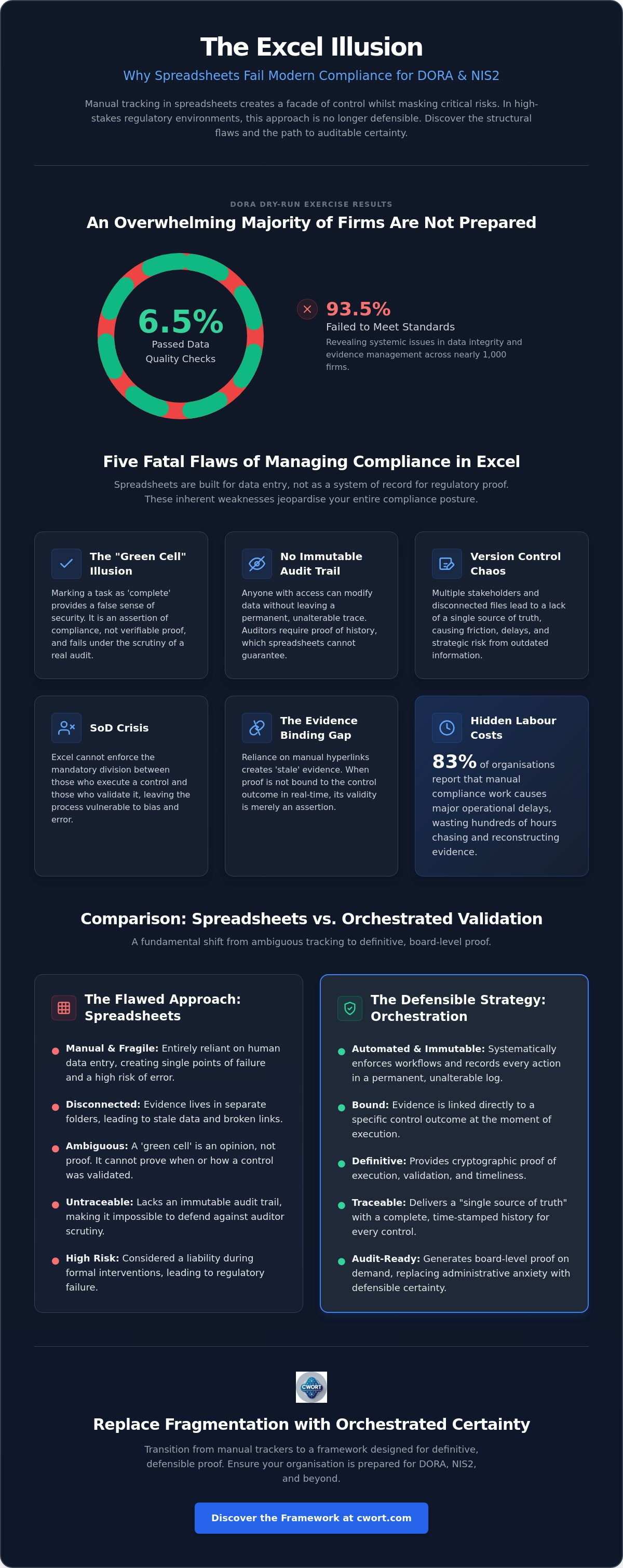
Only 6.5% of nearly 1,000 firms passed the European Supervisory Authorities’ DORA data quality checks during a recent dry-run exercise. This staggering failure rate confirms a hard truth for 2026: managing compliance evidence in excel is no longer a defensible strategy for high-stakes regulatory environments. Whilst spreadsheets offer a familiar interface, they lack the immutable audit trails and structural integrity required by the DORA and NIS2 enforcement cycles.
You likely recognise the friction of version control nightmares amongst multiple stakeholders and the mounting manual labour costs of reconstructing evidence. The anxiety of presenting disconnected data during a live audit is a strategic risk that threatens both operational resilience and executive accountability. This article explores why manual tracking jeopardises your regulatory validation and how to transition to an orchestrated, audit-ready framework. We will provide a definitive roadmap for binding evidence to control outcomes, ensuring your board maintains a state of total, defensible certainty.
Key Takeaways
- Understand why the "Green Cell" illusion in manual trackers creates a false sense of security that fails under rigorous DORA and NIS2 validation requirements.
- Identify the fatal structural flaws inherent in managing compliance evidence in excel, specifically the absence of automated Separation of Duties and the persistent gap between requirements and proof.
- Evaluate the critical distinction between mere control visibility and actual control execution to ensure your compliance framework scales across thousands of complex obligations.
- Learn a structured two-phase transition strategy to move from fragmented spreadsheets to a disciplined system that binds evidence directly to specific control outcomes.
- Discover how to replace administrative anxiety with auditable certainty by implementing an orchestrated framework designed for definitive, board-level proof.
Table of Contents
- The Reality of Managing Compliance Evidence in Excel for 2026
- Structural Limitations: Why Excel Fails Evidence Integrity
- Comparison Framework: Spreadsheets vs. Orchestrated Validation
- Transitioning from Manual Trackers to Defensible Proof
- CWORT: Replacing Fragmentation with Orchestrated Certainty
The Reality of Managing Compliance Evidence in Excel for 2026
Relying on manual spreadsheets for high-stakes regulatory validation is a systemic vulnerability. In 2026, managing compliance evidence in excel provides a facade of order whilst masking deep operational gaps. Many organisations still treat their Risk register as a static document rather than a dynamic validation tool. This results in the "Green Cell" illusion; a state where a project manager marks a task as complete without ever verifying the underlying technical proof. It's administrative theatre, not security.
Manual data entry is inherently fragile. It creates a single point of failure where the integrity of the entire compliance posture rests on individuals who "own" the master file. If those stakeholders leave, the context and the audit trail often vanish with them. The hidden labour costs are equally damaging. According to June 2026 data from CWORT, 83% of organisations report that manual compliance work causes major delays. Teams spend hundreds of hours chasing evidence via email and manually reconstructing timelines, a process that is reactive and prone to human error.
The Illusion of Control in Manual Spreadsheets
Distinguish between tracking a task and validating a control. A spreadsheet records an assertion, but it doesn't provide proof. Static evidence stored in disconnected folders fails to meet the technical standards required for 2026. Risk managers now face a psychological toll. The constant version control anxiety amongst stakeholders stems from a lack of a "single source of truth." When evidence is disconnected from the control outcome, certainty is impossible.
Regulatory Expectations: UK NIS and DORA Reality
Regulators have moved beyond "best effort" expectations. For those overseeing UK NIS Framework Management or DORA Compliance Validation, the shift to evidence-based validation is absolute. During a formal intervention, a manual spreadsheet is viewed as a liability. It cannot prove that evidence hasn't been tampered with or that the control was executed consistently. The European Supervisory Authorities' dry-run exercise revealed that only 6.5% of firms passed data quality checks. By 2026, regulators expect an orchestrated approach that guarantees the integrity of every data point. Best efforts are no longer enough.
Structural Limitations: Why Excel Fails Evidence Integrity
Excel serves as a ledger for data entry, but it fails as a system of record for regulatory proof. When managing compliance evidence in excel, you lack an immutable audit trail. Any stakeholder with access can modify cell contents, overwrite formulas, or delete timestamps without leaving a permanent, unalterable trace. This absence of traceability is a critical failure in high-stakes environments. Auditors require proof of history, not just a static snapshot of the present. Without systemic logs, you cannot definitively verify who changed the data or when the validation occurred.
The Separation of Duties (SoD) Crisis
Enforce accountability by design. DORA mandates a clear division between the personnel executing a control and those validating the outcome. DORA compliance validation is the systematic process of ensuring technical proof is verified by an independent authority to prevent conflicts of interest. Excel is incapable of enforcing this. It permits the same individual to perform the task and mark it as 'Pass' without any systemic restriction. This structural flaw renders your compliance posture vulnerable to internal bias and human error, as there is no programmatic way to block unauthorised self-validation.
The Evidence Binding Problem
Binding evidence involves linking technical proof directly to a control outcome in real-time. Excel relies on manual hyperlinks to external file repositories, creating a persistent risk of 'stale' evidence. This disconnection leads to the dangers of incomplete spreadsheets, where leadership makes strategic decisions based on outdated or missing files. Managing the lifecycle of proof amongst disparate UK departments requires a synchronised environment. If the evidence isn't bound to the outcome at the moment of execution, the validation is merely an assertion rather than a defensible fact.
The Failure of 2D Mapping
Mapping ISO 27001 controls to DORA or UK NIS requirements in a 2D grid is a logistical nightmare. Grids lack the relational depth required to manage overlapping obligations across different regulatory bodies. This leads to redundant labour, as teams manually map the same evidence to multiple framework cells. You end up with duplicated work and fragmented data silos that obscure the true risk posture of the organisation. To resolve these structural limitations, you might examine an orchestrated validation framework that replaces fragmentation with disciplined execution.
Comparison Framework: Spreadsheets vs. Orchestrated Validation
Transition from recording history to enforcing it. Whilst managing compliance evidence in excel might suffice for a handful of controls, it collapses under the weight of enterprise-scale obligations. In 2026, the gap between 'control visibility' and 'control execution' is the difference between a successful audit and a regulatory intervention. Excel provides visibility into what has been recorded, yet it offers zero control over the execution itself. Orchestration platforms, by contrast, enforce the process, ensuring that evidence is captured at the point of origin and validated by the correct authority.
Scalability is the primary breaking point. Managing 10 controls in a spreadsheet is manageable; managing 1,000 across DORA and NIS2 is a recipe for systemic failure. Board-level reporting highlights this disparity most clearly. Directors require real-time dashboards that reflect the current risk posture, not manual PowerPoint reconstructions that are outdated by the time they're presented. Audit readiness shouldn't be a frantic four-week evidence hunt. It should be a 'push-button' certainty where proof is already bound to every outcome.
Tracking vs. Orchestration: A Functional Breakdown
Compare your current use of Jira or Excel to a dedicated regulatory compliance workflow automation system. Generic tracking tools merely record that a task was supposedly completed. An orchestrated system enforces the workflow, preventing a control from being marked as 'Pass' until the required evidence is uploaded and the Separation of Duties is verified. Automated alerts and obligation triggers replace manual follow-up emails, ensuring that no requirement is overlooked amongst shifting priorities. This shift from passive recording to active enforcement is essential for modern governance.
Cost and Resource Analysis
Avoid the 'Free' tool trap. Calculate the FTE hours your senior risk and compliance talent spends on spreadsheet maintenance, email chasing, and evidence collation. These manual labour costs often far exceed the investment in a disciplined orchestration engine. Reducing audit friction is a strategic priority for UK financial firms. By moving away from fragmented trackers, you save hundreds of hours during external assessments and provide the board with definitive proof of compliance. Strategic value lies in reclaiming this time for high-level risk mitigation rather than administrative firefighting.
- Excel: Passive assertions, manual updates, and disconnected file paths.
- Orchestration: Active validation, automated triggers, and immutable evidence binding.
Effective leadership requires moving beyond the limitations of 2D grids. Secure your organisation's future by replacing manual uncertainty with an orchestrated framework that guarantees auditable truth.
Beyond compliance, many global enterprises look to automate other data-heavy workflows; you can learn more about Computer Market Research to see how SaaS platforms streamline channel management and improve data accuracy across partner networks.
Transitioning from Manual Trackers to Defensible Proof
Break the cycle of administrative friction. Transitioning away from managing compliance evidence in excel requires a phased approach that shifts focus from recording status to enforcing execution. This evolution is not merely about changing tools; it's about re-engineering the culture of accountability within your risk function. Moving to a defensible framework ensures that every regulatory obligation is backed by a verified, timestamped artifact rather than a subjective manual update.
Phase 1 involves mapping regulatory obligations into structured execution activities. You must decompose complex legal text into granular, repeatable tasks. Phase 2 requires defining the exact evidence needed for each specific control outcome. This prevents the collection of "junk data" that fails to satisfy auditors during a live assessment. By establishing these requirements early, you create a clear standard for what constitutes a successful validation.
Step 1: Obligation Decomposition
Translate DORA or NIS2 text into actionable execution tasks. Every obligation must have a designated owner responsible for execution and a separate validator responsible for verifying the proof. This structural discipline is fundamental to ensuring compliance evidence integrity from the moment of inception. Without this decomposition, your compliance posture remains a collection of abstract goals rather than a disciplined operational reality.
Phase 3 focuses on assigning duties and enforcing the execution workflow through systemic constraints. Finally, Phase 4 moves your organisation from static, disconnected folders to a centralised evidence repository where every file is bound to its respective control. This transition eliminates the "single point of failure" risks associated with managing compliance evidence in excel, ensuring that the audit trail remains intact even amongst staff turnover.
Step 2: Orchestrating the Evidence Workflow
Implement automated triggers for evidence collection to eliminate the need for manual email chasing. Link evidence directly to the "Pass/Fail" outcome of a control; if the evidence is missing or insufficient, the control cannot be validated. This prepares your team for a "Regulator-Ready" output that requires zero manual intervention before a board meeting or an external audit. By automating the transition from obligation to evidence, you replace the anxiety of potential failure with the calm of auditable certainty.
Take the first step toward a disciplined, orchestrated framework. Request a demo of our compliance orchestration platform to see how we transform manual trackers into defensible proof.
CWORT: Replacing Fragmentation with Orchestrated Certainty
End the era of manual assertion. CWORT transforms regulatory obligations into a disciplined execution engine, moving beyond the inherent weaknesses of managing compliance evidence in excel. Whilst spreadsheets record what you believe happened, CWORT enforces what must happen. By binding evidence directly to control outcomes, the platform provides definitive, auditable proof that satisfies the most rigorous supervisory scrutiny. You no longer have to hunt for files across disconnected directories; the proof is already there, validated and timestamped.
Speed is a strategic advantage. Producing board-level and regulator-ready reports takes seconds rather than weeks of manual reconstruction. CWORT supports a unified approach to governance, facilitating ISO 27001 control mapping alongside DORA and UK NIS Framework Management. This single-platform approach eliminates the data silos that typically plague large-scale compliance projects, ensuring that a single piece of evidence can validate multiple overlapping obligations across different frameworks.
The CWORT Orchestration Engine
Enforce Separation of Duties by design. Unlike a spreadsheet, where a single user can manipulate the entire record, CWORT programmatically prevents the person executing a task from being the one who validates it. It automates the collection and validation of evidence, replacing fragmented Jira tickets and rows of text with a single source of truth. This systemic discipline ensures that every "Pass" status is earned through technical proof, not just a manual update. It's a proactive system that enforces accountability by design.
Achieving Strategic Resilience
Shift your focus from administrative GRC to strategic compliance validation. This proactive stance is essential for meeting NCSC CAF assessment software requirements, where continuous proof is the standard. CWORT closes the loop between regulatory obligation and auditable certainty. It replaces the anxiety of potential failure with a state of total control, providing leadership with the defensible truth they need to secure the organisation's future in an increasingly complex regulatory landscape. By replacing fragmentation with order, you achieve a level of professional maturity that manual trackers can't replicate.
Secure Your Regulatory Future with Orchestrated Validation
The regulatory landscape of 2026 leaves no room for the structural vulnerabilities inherent in managing compliance evidence in excel. As DORA and NIS2 move into active enforcement cycles, the shift from manual assertions to definitive technical proof is a strategic necessity. Fragmented spreadsheets create single points of failure and version control nightmares that jeopardise your audit readiness. Replacing these manual trackers with a disciplined execution engine isn't just an operational upgrade; it's a commitment to defensible truth and executive accountability.
CWORT is engineered to navigate this complexity with precision. The platform enforces Separation of Duties automatically and maps evidence across DORA, NIS2, and ISO 27001 within a single, immutable source of truth. You can generate regulator-ready evidence reports in seconds, replacing administrative anxiety with auditable certainty. It's time to move beyond the limitations of 2D grids and embrace a framework designed for the gravity of modern governance.
Book a CWORT Demo to see how we replace Excel with orchestrated certainty. Take control of your compliance posture today and lead your organisation toward a state of total, resilient security.
Frequently Asked Questions
Is managing compliance evidence in Excel still acceptable for DORA audits?
No, manual spreadsheets are increasingly viewed as a liability rather than a valid control record. DORA mandates high data quality and continuous validation, requirements that static spreadsheets cannot meet due to their lack of immutable audit trails. During the 2024 European Supervisory Authorities' dry-run, only 6.5% of firms passed all data quality checks, highlighting that managing compliance evidence in excel fails to provide the structural integrity regulators now demand.
What are the biggest risks of using spreadsheets for NIS2 compliance?
The primary risks include fragmentation, version control failures, and the "Green Cell" illusion where status updates are recorded without verified proof. NIS2 introduces personal liability for management, meaning that a lack of visibility into actual control execution becomes a significant professional risk. Spreadsheets cannot prevent unauthorised edits or provide the real-time evidence binding necessary to defend your compliance posture during a formal intervention.
How do I ensure Separation of Duties (SoD) when using Excel?
You cannot programmatically enforce Separation of Duties within a standard spreadsheet. Excel relies entirely on policy and trust, as it lacks the technical constraints to prevent the same individual from both executing a task and marking it as 'Pass'. To meet modern standards, you must move to an orchestrated system that enforces these boundaries by design, ensuring that validation is always performed by an independent authority.
What is the difference between a compliance tracker and a validation platform?
A compliance tracker is a passive ledger that records assertions about what has supposedly happened in the past. In contrast, a validation platform is an active execution engine that enforces the workflow and binds technical proof to every outcome. Trackers provide visibility into recorded data, whilst validation platforms provide definitive, auditable proof of control execution, replacing subjective updates with defensible facts.
Can I import my existing Excel compliance checklists into CWORT?
Yes, CWORT is designed to ingest existing obligations and checklists to facilitate a seamless transition from fragmented trackers to orchestrated certainty. The platform maps your current requirements into structured execution activities, ensuring that every row in your old spreadsheet is transformed into an actionable, verifiable task. This process closes the gap between abstract requirements and concrete, defensible reality.
How does evidence binding improve my audit readiness?
Evidence binding links technical proof directly to a control outcome at the moment of execution, ensuring that proof is never "stale" or disconnected. This eliminates the traditional four-week evidence hunt before an audit because the audit trail is constructed in real-time. When a regulator requests proof, you can produce a "regulator-ready" report in seconds, providing total certainty that every obligation is backed by a verified artifact.
Why do UK regulators prefer orchestrated workflows over manual spreadsheets?
Regulators prioritise orchestrated workflows because they provide an immutable record of history that cannot be tampered with or retroactively edited. Manual spreadsheets are prone to human error and lack the systemic logs required to prove the integrity of evidence over time. Orchestration ensures that every control is executed according to a disciplined process, providing the professional maturity and traceability that UK financial authorities expect.
How much time can enterprise teams save by moving away from Excel?
Enterprise teams can save hundreds of manual labour hours by automating evidence collection and eliminating the need for email chasing. Since 83% of organisations report that manual compliance work causes major delays, moving to an orchestrated framework allows senior risk talent to focus on high-level mitigation rather than administrative firefighting. This shift significantly reduces the cost of audit preparation and provides the board with real-time, definitive proof of resilience.
Disclaimer
The content on this site is provided for general information and educational purposes only. It does not constitute legal, regulatory, financial, or professional advice. CWORT provides AI-assisted insights and workflow automation, but all compliance decisions remain the responsibility of your organisation and its management. Always seek qualified legal or regulatory guidance for decisions relating to the UK NIS Regulations, CAF, DORA, NIS2, ISO 27001, or other obligations.
Related posts
Jira for Compliance vs Orchestration: Why Task Tracking Fails Regulatory Audits
Discover why Jira fails DORA & NIS2 audits. In the debate of Jira for compliance vs orchestration, learn why task tracking isn't proof & how to automate assu...
Automated Compliance Proof Generation: Transitioning from Manual Tracking to Validated Evidence
Ditch manual spreadsheets. Learn how automated compliance proof generation creates regulator-ready, validated evidence for DORA & NIS2, ensuring a defensible...
NIS2 Audit Readiness Tool: Orchestrating Evidence-Based Compliance in 2026
Is your NIS2 compliance built on spreadsheets? Discover how a dedicated NIS2 audit readiness tool orchestrates evidence to deliver auditable proof and certai...
Article by
Michael Iyiola
Co-Founder, CWORT
Michael Iyiola is a co-founder of CWORT and a Cyber and AI Security Engineer with deep experience in vulnerability management, detection engineering and operational resilience across UK critical national infrastructure, including rail, energy and financial services. At CWORT, he designs scalable, evidence-driven workflows that help teams meet modern regulatory and security demands.
Build Your Foundation of Auditable Certainty
Take control of your regulatory obligations and secure your infrastructure with CWORT.