NIS2 Audit Readiness Tool: Orchestrating Evidence-Based Compliance in 2026

Michael Iyiola
Co-Founder, CWORT
Is your NIS2 compliance built on spreadsheets? Discover how a dedicated NIS2 audit readiness tool orchestrates evidence to deliver auditable proof and certai...

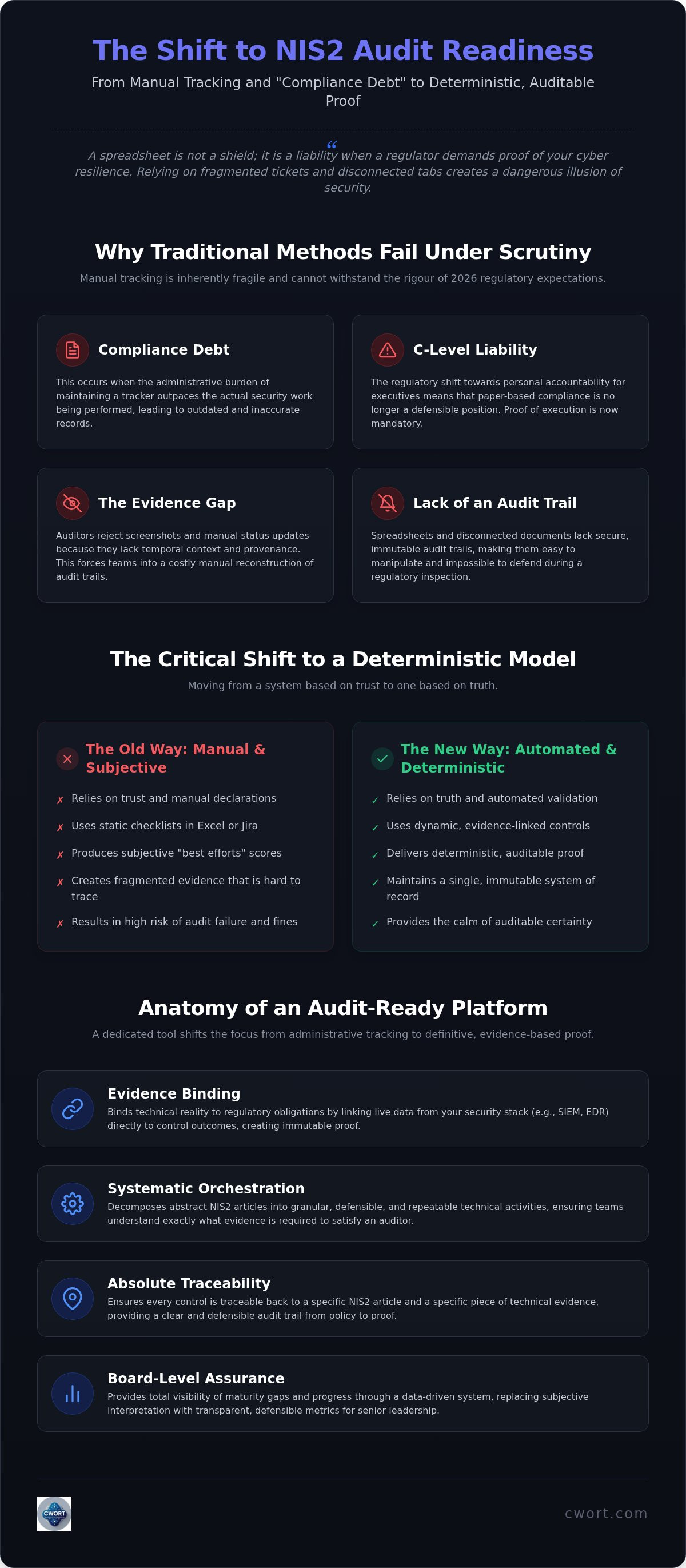
A spreadsheet is not a shield; it is a liability when a regulator demands proof of your cyber resilience. Relying on fragmented Jira tickets and disconnected Excel tabs to track compliance creates a dangerous illusion of security whilst leaving C-level executives exposed to personal accountability and severe fines. To survive the 2026 landscape, your organisation requires more than a simple checklist. You need a dedicated NIS2 audit readiness tool that orchestrates evidence directly from your security stack to provide a definitive, auditable truth that stands up to the most rigorous external scrutiny.
We recognise that mapping complex NIS2 requirements to existing ISO 27001 or CAF controls often feels like an exercise in administrative frustration. It's time to replace the anxiety of potential failure with the calm of auditable certainty. This article demonstrates how to transition from static trackers to a deterministic operating model that satisfies both regulators and your board. You'll learn how to build an audit-ready evidence repository and gain total visibility of maturity gaps through a repeatable system that eliminates manual overhead and enforces professional discipline by design.
Key Takeaways
- Understand why static spreadsheets fail to defend against regulatory scrutiny and how to eliminate the "compliance debt" whilst consolidating fragmented tracking.
- Learn how to deploy a NIS2 audit readiness tool that transforms abstract regulatory requirements into a deterministic operating model for technical teams.
- Discover the mechanics of evidence binding, which utilises live data from your security stack to provide immutable, audit-ready validation.
- Implement a structured seven-step assessment programme to bridge maturity gaps and provide the board with transparent, data-driven assurance.
- Adopt a high-integrity platform that functions as both an operating model and intelligence layer, eliminating subjective interpretation in compliance scoring.
Table of Contents
- What is a NIS2 Audit Readiness Tool and Why Do Checklists Fail?
- Beyond Gap Analysis: Orchestrating a Deterministic NIS2 Operating Model
- Evidence-Based Validation: The Anatomy of an Audit-Ready NIS2 Tool
- From Discovery to Board-Level Assurance: Implementing Your Readiness Strategy
- CWORT: The Strategic Choice for Defensible NIS2 Resilience
What is a NIS2 Audit Readiness Tool and Why Do Checklists Fail?
Audit readiness is not a static destination or a point-in-time assessment; it's a persistent state of operational discipline. Under the NIS2 Directive, the definition of compliance has evolved from a passive "best efforts" approach to a requirement for continuous validation. A robust NIS2 audit readiness tool shifts the focus from administrative tracking to definitive, evidence-based proof. It acts as an orchestration layer that binds technical reality to regulatory obligations, ensuring that every control is backed by immutable data rather than manual declarations.
Traditional spreadsheets fail because they create "compliance debt." This occurs when the administrative burden of maintaining a tracker outpaces the actual security work being performed. For senior leadership, the distinction between paper-based compliance and evidence-based orchestration is critical. Paper-based systems rely on trust and manual updates, whilst orchestration relies on truth and automated validation. As we approach 2026, the regulatory shift toward personal liability for C-level executives makes this distinction a matter of corporate survival. Regulators are no longer satisfied with a policy document; they demand proof of execution.
The Limitations of Manual NIS2 Tracking
Manual tracking is inherently fragile. Excel-based trackers suffer from version control issues and lack a secure audit trail, making them easy to manipulate and difficult to defend. This creates an "Evidence Gap" where auditors reject screenshots or manual status updates because they lack temporal context or provenance. If your team spends weeks manually reconstructing an audit trail during a regulator's visit, you've already lost the battle. The cost of this manual reconstruction is not just measured in hours, but in the increased risk of discovery for unmitigated gaps.
Regulatory Expectations for 2026 Audits
By 2026, regulators will expect deterministic proof of compliance. They require reproducible results where identical evidence always yields the same maturity score. Best efforts are no longer sufficient for essential and important entities. Organisations must demonstrate a repeatable system of record that links live data from SIEM or EDR tools directly to control outcomes. Utilising a NIS2 compliance platform UK leaders can trust is the only way to establish a baseline of audit-defensible truth. This approach replaces the anxiety of subjective interpretation with the calm of auditable certainty.
- Move from checklists to controls: Replace static lists with dynamic, evidence-linked activities.
- Enforce separation of duties: Ensure that those performing the work are not the same individuals validating the evidence.
- Prioritise traceability: Every control must be traceable back to a specific NIS2 article and a specific piece of technical evidence.
Beyond Gap Analysis: Orchestrating a Deterministic NIS2 Operating Model
A simple gap analysis is merely a snapshot of what you lack; it does nothing to enforce the discipline required for continuous compliance. To achieve true resilience, organisations must move beyond static assessments and adopt "Operating Model Intelligence." This approach transforms your NIS2 audit readiness tool from a passive record-keeper into a proactive system that orchestrates security activities across the entire enterprise. By utilising a unified taxonomy of 1,355 pre-mapped controls, you ensure that every regulatory requirement is anchored to a specific, repeatable technical action.
Translating the high-level mandates found in the European Commission's NIS2 Directive policy into structured execution is where most projects stall. You can't simply hand a legal directive to a system administrator and expect an audit-ready result. Instead, you must decompose abstract articles into granular, defensible activities. This systematic translation ensures that technical teams understand exactly what evidence is required to satisfy an auditor, removing the ambiguity that often leads to compliance failure.
Turning Obligations into Execution
Success depends on breaking down NIS2 requirements into manageable daily, weekly, and monthly tasks. This rhythm ensures that compliance becomes a standard business function rather than a frantic pre-audit scramble. Within a sophisticated NIS2 audit readiness tool, you must enforce a strict "Separation of Duties." This governance mechanism ensures that the individual performing a security task is not the same person validating the evidence. Crucially, the system must rely on deterministic scoring, a process where identical sets of evidence must always yield the same maturity result, eliminating the risk of subjective human bias.
Framework Cross-walking and Efficiency
The modern regulatory landscape is cluttered with overlapping requirements. Adopting an "Assess Once, Report Many" philosophy is the only way to maintain efficiency whilst managing multiple frameworks. By mapping NIS2 obligations to existing outcomes in an ISO 27001 control mapping tool, you can achieve global consistency without duplicating effort. This cross-walking capability allows UK-based entities to leverage the NCSC CAF whilst remaining fully compliant with EU mandates. Reusing evidence across DORA, Cyber Essentials, and NIS2 reduces the burden on subject matter experts and ensures your defensive posture remains unified. If you are ready to see this orchestration in practice, you might find it useful to explore a live demonstration of these cross-walks.
Evidence-Based Validation: The Anatomy of an Audit-Ready NIS2 Tool
Validation is the cornerstone of any defensible compliance strategy. Traditional GRC tools often act as passive repositories, requiring manual uploads that are disconnected from the actual technical environment. In contrast, a sophisticated NIS2 audit readiness tool functions as an orchestration layer. It employs an "Evidence Binding" mechanism, which creates a direct, verifiable link between live data from your SIEM or EDR tools and specific regulatory outcomes. This ensures that compliance status is derived from technical reality rather than administrative assertion.
Central to this architecture is the Assurance Evidence Register. This serves as a single source of truth for both internal stakeholders and external auditors. Every change in compliance status must be recorded with an immutable audit history, capturing who made the change, what evidence was provided, and the specific timestamp. This level of traceability is what separates a mature operating model from a vulnerable paper-based system. It provides the professional discipline required to stand up to the most rigorous regulatory deep-dives.
Aggregating Data from Existing Security Tooling
An effective orchestration platform sits strategically above your EDR, IAM, and vulnerability scanners. It consumes data from these tools automatically, which significantly reduces the risk of manual reporting errors. This automated ingestion is vital for maintaining compliance evidence integrity through defensive content processing. By validating evidence as it enters the system, the platform ensures that only high-fidelity data is used to calculate maturity scores. This proactive approach prevents the common pitfall where manual compliance efforts are undermined by stale or inaccurate data.
Board-Level vs. Auditor-Level Reporting
Reporting must serve two distinct masters: the board and the regulator. For senior leadership, the system generates heat-map dashboards that highlight strategic maturity gaps and prioritise remediation efforts. These high-level visualisations allow the board to exercise their oversight duties with confidence. Conversely, the regulator requires granular, technical evidence logs. The NIS2 audit readiness tool produces these deep-dive reports instantly, replacing the need for manual reconstruction with real-time, deterministic data. This dual-layered reporting ensures that leadership stays informed whilst auditors remain satisfied with the depth and integrity of your evidence.
From Discovery to Board-Level Assurance: Implementing Your Readiness Strategy
Implementation demands a rigorous transition from strategic theory to governed execution. A high-integrity NIS2 audit readiness tool must facilitate a structured "Diagnose → Design → Deliver → Demonstrate" lifecycle to ensure total accountability across the enterprise. This systematic approach allows leadership to assign specific scopes, owners, and participants within a controlled digital environment. For organisations operating with bespoke requirements, the platform supports "Bring Your Own Content" (BYOC). This ensures that internal maturity models are integrated into the broader regulatory framework without losing historical context or structural integrity.
Success in 2026 depends on your ability to move from a fragmented collection of tasks to a unified system of record. By defining the model at the outset, you establish the "rules of engagement" for your technical teams. This involves selecting relevant controls from a taxonomy library and mapping them to the specific business units under the NIS2 scope. This level of preparation ensures that the subsequent data collection is targeted, relevant, and, most importantly, defensible during an external audit.
The CWORT 7-Step Assessment Workflow
The CWORT 7-step workflow provides a linear path to assurance. Steps one through three focus on defining the organisational blueprint and assigning rigorous ownership. This stage enforces the separation of duties necessary for governance integrity by ensuring no single individual controls both the task and the validation. Steps four and five involve capturing stakeholder responses whilst simultaneously binding technical evidence to calculate maturity confidence. This deterministic approach ensures that scoring is based on reality rather than optimism. Finally, steps six and seven shift the focus toward prioritising improvements based on business risk and tracking remediation progress in real-time.
Prioritising Remediation for Maximum Impact
Effective remediation isn't about fixing every minor flaw simultaneously. It requires a prioritisation engine that ranks actions by risk, technical effort, and expected audit value. This ensures your team addresses the gaps that matter most for audit-defensibility rather than wasting resources on low-impact activities. By utilising regulatory compliance workflow automation, you can move from a reactive posture to a proactive state of readiness. This transition replaces the chaos of manual tracking with a disciplined system of record that provides the board with a clear view of residual risk. If you want to see how this workflow can be tailored to your specific infrastructure, you should request a professional demonstration today.
CWORT: The Strategic Choice for Defensible NIS2 Resilience
CWORT represents a fundamental shift in how organisations approach regulatory obligations. It is not merely a passive utility; it is a proactive system designed to enforce discipline by design. As a premier NIS2 audit readiness tool, it eliminates the subjectivity inherent in manual assessments by employing deterministic scoring. This ensures that identical evidence always yields the same result, providing a level of auditable certainty that AI-driven guesswork simply cannot match. Backed by the UK-based expertise of Lapace Services UK Ltd, the platform is engineered to orchestrate compliance for the most complex critical national infrastructure environments.
Why CWORT Outperforms Traditional GRC
Traditional GRC tools focus on "tracking" status, which often leads to stale data and unverified claims. CWORT focuses on "enforcing" controls through a governed operating model. With a taxonomy library of 1,355 controls, the platform provides a depth of coverage that generic toolkits cannot match. Every control is mapped with precision, ensuring that technical teams aren't left to interpret abstract requirements on their own. Professional implementation fees cover the cost of designing custom control models, ensuring your compliance framework is perfectly aligned with your technical reality. This rigorous approach transforms compliance from a administrative burden into a strategic advantage.
- Enforced Accountability: Separation of duties is built into the workflow, ensuring high-integrity validation.
- Evidence Integration: Automated data consumption from SIEM and EDR tools removes human error from the reporting cycle.
- Framework Versatility: Multi-framework cross-walking allows you to assess once and report across 42 standards.
Securing Your 2026 Compliance Posture
The 2026 enforcement landscape will not be forgiving to those relying on best-effort documentation. Preparing now is a strategic necessity. CWORT provides a common language for maturity, bridging the gap between high-level executive oversight and granular technical delivery. This unified view ensures that every stakeholder, from the server room to the boardroom, understands the current state of resilience. Transitioning to an evidence-based model is the only way to replace the anxiety of potential failure with the calm of auditable certainty.
We invite organisations to participate in a pilot programme to demonstrate the power of end-to-end NIS2 validation within their own environments. This is the most effective way to identify maturity gaps and establish a repeatable system of record before the regulator arrives. To move beyond checklists and achieve a state of total assurance, Book a CWORT NIS2 Readiness Assessment and secure your organisation's defensible future.
Master the Shift to Evidence-Based Cyber Resilience
Compliance is no longer a paper exercise; it's a technical reality that demands professional discipline. You've seen how a robust NIS2 audit readiness tool moves your organisation beyond the fragility of spreadsheets and into a state of continuous validation. By utilising a library of 1,355 controls mapped to 42 frameworks, you can eliminate the administrative burden of manual tracking whilst enforcing a strict separation of duties. This system provides the deterministic, audit-defensible scoring required to satisfy both regulators and the board.
Trusting in a platform already utilised by UK Critical National Infrastructure ensures your defensive posture is anchored in proven expertise. It's time to replace the anxiety of potential regulatory failure with the calm of auditable certainty. Take the first step toward total assurance and ensure your leadership is protected from personal liability. Book a CWORT NIS2 Readiness Assessment today and transform your compliance obligations into a resilient strategic asset. You have the tools and the framework to lead your organisation toward a secure and certain future.
Frequently Asked Questions
What is the primary difference between a NIS2 checklist and an audit readiness tool?
A checklist is a passive, point-in-time document; a NIS2 audit readiness tool is a proactive operating model that enforces continuous validation. Whilst checklists offer a static snapshot that quickly becomes stale, a readiness tool binds technical activities to regulatory outcomes. This transition ensures that compliance is a persistent state of resilience rather than a frantic exercise performed only when an audit looms.
How does CWORT handle evidence binding for NIS2 audits?
CWORT binds evidence by creating a deterministic link between live security data and specific control requirements. It ingests telemetry directly from your existing stack to provide immutable proof of execution within an Assurance Evidence Register. This eliminates subjective interpretation and ensures that identical evidence always yields the same maturity score for auditors to verify with total confidence.
Can I use CWORT to map NIS2 requirements to my existing ISO 27001 framework?
You can absolutely map NIS2 requirements to ISO 27001 using our multi-framework cross-walk capabilities. The platform supports 42 different standards, allowing you to reuse evidence across overlapping frameworks. This "Assess Once, Report Many" efficiency reduces audit fatigue and ensures global consistency across your entire governance, risk, and compliance landscape.
Does NIS2 readiness require a full replacement of my current security tools?
No, achieving readiness does not require replacing your existing security stack. The platform acts as an orchestration layer that sits strategically above your current EDR, IAM, and vulnerability scanners. It enhances your existing investments by translating their technical outputs into defensible, board-ready compliance evidence without disrupting your established operational workflows.
How does CWORT ensure the 'Separation of Duties' required by regulators?
CWORT enforces "Separation of Duties" by design within its governed digital environment. It strictly partitions roles between those performing technical tasks and those responsible for validating the evidence provided. This structural integrity prevents conflicts of interest and satisfies the rigorous governance standards demanded by external regulators and internal audit committees alike.
What kind of board-level reporting does a NIS2 audit readiness tool provide?
The tool provides high-level heat-map dashboards designed specifically for strategic oversight and executive decision-making. These reports highlight maturity gaps and residual risks in a non-technical format that allows the board to exercise their fiduciary duties effectively. It replaces manual report reconstruction with real-time, data-driven visibility into the organisation's resilience posture.
Is CWORT suitable for UK organisations following the NCSC CAF?
CWORT is specifically designed for UK organisations that must align with the NCSC CAF whilst remaining NIS2 compliant. The platform bridges the gap between these frameworks, ensuring that your maturity assessments satisfy both domestic guidance and broader European mandates. This is particularly critical for entities managing critical national infrastructure that face overlapping regulatory scrutiny.
How long does it take to get 'audit-ready' using an orchestration platform?
The timeline depends on your organisational scope, but the process is accelerated by our structured 7-step assessment workflow. By following the "Diagnose, Design, Deliver, Demonstrate" lifecycle, you can move from discovery to a state of total assurance far more efficiently than through manual methods. It transforms a complex, multi-month project into a disciplined and repeatable professional process.
Disclaimer
The content on this site is provided for general information and educational purposes only. It does not constitute legal, regulatory, financial, or professional advice. CWORT provides AI-assisted insights and workflow automation, but all compliance decisions remain the responsibility of your organisation and its management. Always seek qualified legal or regulatory guidance for decisions relating to the UK NIS Regulations, CAF, DORA, NIS2, ISO 27001, or other obligations.
Related posts
NIS2 Audit Readiness Tool: Orchestrating Evidence-Based Validation for 2026
Ditch spreadsheets for the 2026 audit. A NIS2 audit readiness tool provides orchestrated, evidence-based validation for total compliance certainty.
Managing Compliance Evidence in Excel: Comparison and Strategic Risks for 2026
Is managing compliance evidence in excel a risk for 2026? Learn why spreadsheets jeopardise DORA & NIS2 validation and get a roadmap to an audit-ready system.
How to Implement NIS2 Technical Standards: A Guide to Software Orchestration
Move beyond manual NIS2 checklists. Learn how dedicated NIS2 technical standards software can orchestrate compliance, automate evidence, and eliminate audit ...
Article by
Michael Iyiola
Co-Founder, CWORT
Michael Iyiola is a co-founder of CWORT and a Cyber and AI Security Engineer with deep experience in vulnerability management, detection engineering and operational resilience across UK critical national infrastructure, including rail, energy and financial services. At CWORT, he designs scalable, evidence-driven workflows that help teams meet modern regulatory and security demands.
Build Your Foundation of Auditable Certainty
Take control of your regulatory obligations and secure your infrastructure with CWORT.