NIS2 Audit Readiness Tool: Orchestrating Evidence-Based Validation for 2026

Michael Iyiola
Co-Founder, CWORT
Ditch spreadsheets for the 2026 audit. A NIS2 audit readiness tool provides orchestrated, evidence-based validation for total compliance certainty.

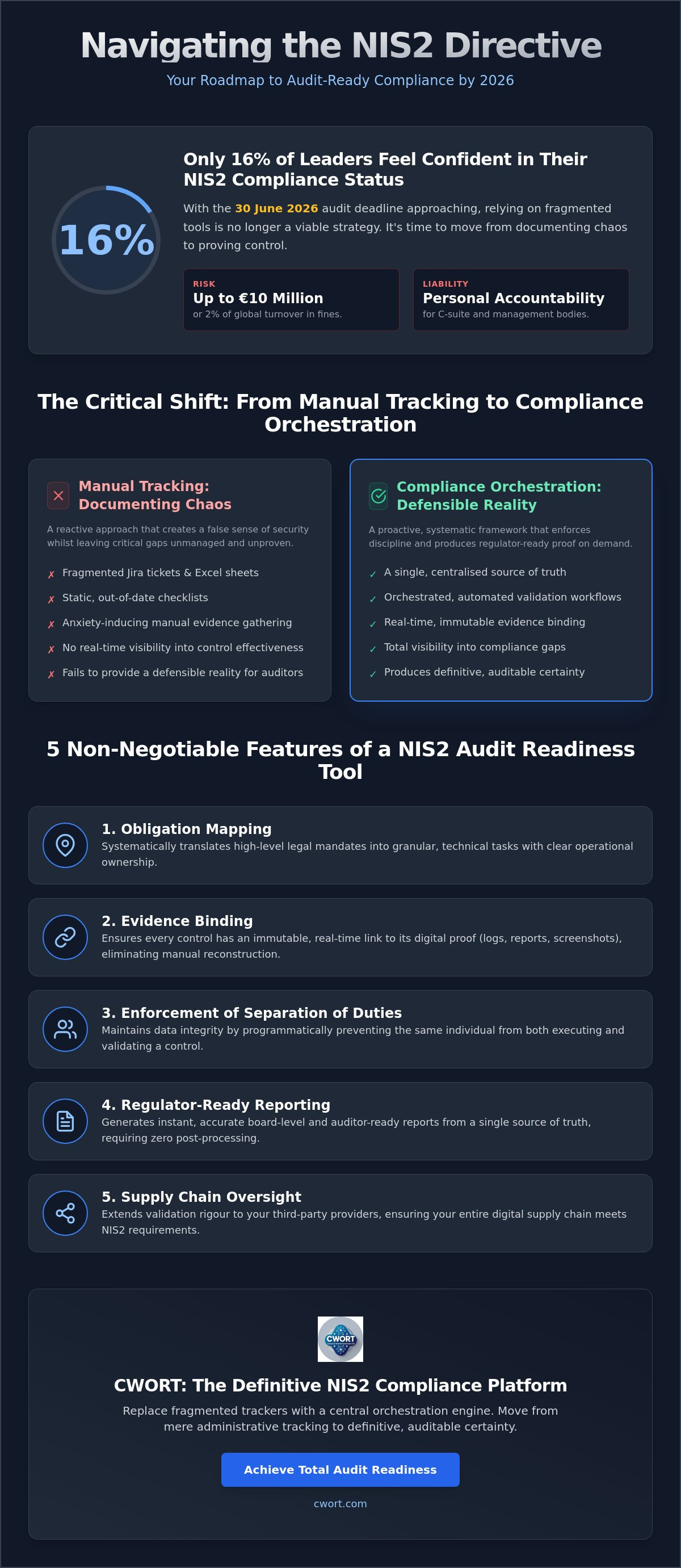
Only 16% of business leaders required to comply with the directive are confident in their status, even as the 30 June 2026 audit deadline passes. If your compliance strategy relies on fragmented Jira tickets and disconnected Excel spreadsheets, you aren't managing risk; you're merely documenting chaos. A sophisticated NIS2 audit readiness tool must do more than track tasks. It must enforce discipline and provide a defensible reality through orchestrated validation that proves control effectiveness in real-time.
You likely recognise that manual evidence reconstruction is a recipe for anxiety and regulatory friction. We'll show you how to transition from these fragile, static checklists to a systematic framework that produces regulator-ready proof on demand. This guide outlines the path to achieving a single source of truth, eliminating manual assembly and providing total visibility into your compliance gaps before the auditor arrives. Discover how to move from mere administrative tracking to definitive, auditable certainty.
Key Takeaways
- Understand the critical shift from policy-based assurance to evidence-based proof required to meet 2026 regulatory standards.
- Identify the five non-negotiable features of a high-calibre NIS2 audit readiness tool, including automated evidence binding and technical obligation mapping.
- Recognise the operational risks inherent in manual spreadsheet tracking and how compliance orchestration enforces accountability by design.
- Follow a structured roadmap to transition your organisation from initial obligation discovery to a state of total audit readiness.
- Discover how the CWORT platform serves as a central orchestration engine, replacing fragmented trackers with a single source of defensible truth.
Table of Contents
- What is a NIS2 Audit Readiness Tool and Why is it Essential in 2026?
- Evaluating NIS2 Readiness Tools: 5 Non-Negotiable Features
- Comparison: Manual Tracking vs. Compliance Orchestration
- A Strategic Roadmap to NIS2 Audit Readiness
- CWORT: The Definitive NIS2 Compliance Platform for UK Enterprises
What is a NIS2 Audit Readiness Tool and Why is it Essential in 2026?
A NIS2 audit readiness tool isn't a passive repository for documentation; it's a dynamic orchestration system designed to translate the complex legal requirements of the NIS2 Directive into precise, executable activities. It replaces the ambiguity of regulatory text with a disciplined, high-stakes workflow. Organisations can no longer survive on "best efforts" reporting. By 2026, the standard for compliance has shifted fundamentally from mere policy-based assurance to definitive, evidence-based proof.
The strategic urgency for this transition is absolute. Essential and important entities now face significant financial exposure, with fines reaching up to €10 million or 2% of total worldwide annual turnover. Manual tracking via spreadsheets or generic task managers is insufficient because it lacks the structural integrity required by modern auditors. You need a system that bridges the gap between high-level governance and granular technical execution. A robust tool provides the framework to ensure every control isn't just documented, but validated.
Core components of a professional readiness system include:
- Obligation Mapping: The systematic translation of NIS2 technical standards into specific organisational tasks.
- Execution Workflows: Automated processes that direct teams to perform necessary validations at the correct intervals.
- Evidence Repositories: Centralised, tamper-proof stores for logs, screenshots, and reports that serve as a single source of truth.
The Evolution of Regulatory Scrutiny
The 2024 "grace period" has ended, giving way to the 2026 "enforcement era". Regulators now demand real-time validation of control effectiveness rather than annual snapshots. This shift places personal accountability directly on management bodies. Under the directive, the C-suite isn't just responsible for signing off on budgets; they're legally liable for the organisation's cybersecurity risk management failures. Auditors now look for a continuous trail of evidence that proves your security posture is active, not theoretical.
Beyond Static Checklists
Static checklists fail because they don't capture operational reality. They provide a false sense of security whilst the underlying evidence grows stale in the background. Traditional GRC tools often suffer from this "documentation lag", where a control is marked as "compliant" despite the technical evidence being months out of date. Orchestration ensures that every requirement has a corresponding, validated action. By using a platform like CWORT, you replace manual trackers with an orchestration engine that enforces discipline by design. This approach ensures that evidence is always fresh, auditable, and ready for regulatory inspection at a moment's notice.
Evaluating NIS2 Readiness Tools: 5 Non-Negotiable Features
Selecting a NIS2 audit readiness tool requires a fundamental shift in perspective. You aren't merely purchasing a tracker; you're investing in an orchestration engine. To withstand the scrutiny of a 2026 audit, your platform must possess five specific, non-negotiable capabilities. These features transform compliance from a reactive administrative burden into a proactive, defensible state of control. Without these pillars, your organisation remains vulnerable to the gaps that manual tracking inevitably creates.
- Obligation Mapping: The system must translate the high-level mandates found in the official NIS2 Directive policy into granular, technical tasks. This ensures every legal requirement has a corresponding operational owner.
- Evidence Binding: Every control outcome requires an immutable link to its digital proof. Automated binding ensures that logs, screenshots, and reports are captured in real-time, not reconstructed months later.
- Enforcement of Separation of Duties: The platform must prevent the same individual from both executing a task and validating its success. This "four-eyes" principle is essential for maintaining the integrity of your compliance data.
- Regulator-Ready Reporting: Generate board-level and auditor-ready exports instantly. Manual reconstruction is the enemy of accuracy; your tool should provide a single source of truth that requires zero post-processing.
- Supply Chain Oversight: Extend your validation rigour to third-party providers. A professional tool manages and validates the security posture of your suppliers with the same intensity as your internal infrastructure.
The Criticality of Evidence Binding
Evidence binding creates an immutable link between a regulatory requirement and its corresponding proof. This technical bridge is the only way to eliminate the "audit scramble", that frantic period where teams hunt for logs or screenshots weeks before an inspection. By ensuring compliance evidence integrity throughout the year, you maintain a state of permanent readiness. If you cannot prove a control was effective on a specific date six months ago, the auditor will assume it failed. Binding ensures that the proof is always attached to the obligation, creating a trail of defensible reality that requires no manual intervention.
Orchestrating Separation of Duties
Auditors routinely reject compliance data that lacks independent validation. A credible NIS2 audit readiness tool enforces the "four-eyes" principle across all workflows, ensuring that execution and oversight are strictly partitioned. Software orchestration achieves this by design, using automated alerts to maintain organisational discipline. This systemic rigour prevents the human error or bias that often taints manual spreadsheets. You can observe these validation workflows in practice by requesting a platform demonstration to see how orchestration replaces trust with proof.
Comparison: Manual Tracking vs. Compliance Orchestration
Relying on manual gap analysis is a point-in-time exercise that becomes obsolete almost immediately. A professional NIS2 audit readiness tool replaces this "snapshot" approach with continuous validation, ensuring that your security posture is defensible every day of the year. Whilst manual tracking relies on the hope that spreadsheets remain accurate, compliance orchestration enforces systemic rigour. This shift is essential for organisations that must prove control effectiveness under the NIS2 Directive without the friction of constant manual updates.
The risk of human error in Excel is a significant liability during a regulatory inspection. Spreadsheets lack version control, tamper-proof logs, and the ability to bind evidence directly to obligations. An orchestration engine, by contrast, automates the collection of digital proof. This reduces the time-to-audit from weeks of frantic manual assembly to minutes of automated report generation. For leadership, this transition replaces the anxiety of potential failure with the calm of auditable certainty.
Cost implications become even more pronounced during multi-framework audits. If your organisation is balancing NIS2 alongside DORA or ISO 27001, manual reconstruction for each framework is an expensive waste of resource. Orchestrated systems allow for cross-framework synergy, where a single validated action satisfies multiple regulatory requirements. This efficiency eliminates the "compliance tax" that often drains technical teams of their productive capacity.
Why Jira and Excel are Not Audit Readiness Tools
General-purpose project management software lacks the necessary regulatory context to manage high-stakes compliance. Jira and Excel cannot enforce the "four-eyes" principle or maintain an immutable audit trail required by auditors. Fragmented tools lead to "compliance debt", where documentation exists but the underlying evidence is stale or missing. This fragmentation increases auditor suspicion and suggests a lack of organisational discipline. You cannot build a defensible reality on tools designed for simple task tracking.
The Efficiency of a Single Source of Truth
Centralising your NIS2 technical standards software within a single platform creates a unified source of truth for all evidence. This consolidation ensures that every stakeholder, from the C-suite to the technical implementer, views the same real-time data. It streamlines the validation process and ensures that gaps are identified and remediated before they become regulatory failures. By integrating your workflows, you achieve a level of professional maturity that manual trackers simply cannot match.
A Strategic Roadmap to NIS2 Audit Readiness
Transitioning from theoretical compliance to a state of auditable certainty requires a disciplined, phased approach. You cannot hope to achieve readiness through ad-hoc efforts. A structured roadmap ensures that every technical requirement is accounted for and every control is validated by design. This methodical progression replaces the chaos of manual tracking with a professional, orchestrated workflow.
- Phase 1: Obligation Discovery. Begin by mapping the directive to your specific sector, such as Energy or Transport. This process defines the technical standards your organisation is legally bound to uphold.
- Phase 2: Gap Assessment. Deploy a NIS2 audit readiness tool to identify where your current security controls lack defensible evidence. This automated scan highlights critical vulnerabilities in your documentation before they become regulatory liabilities.
- Phase 3: Workflow Implementation. Distribute validated execution activities to the relevant technical owners. This step moves compliance from a central risk function to the front lines of your operation.
- Phase 4: Evidence Collection and Binding. Ensure every output is captured and immutably linked to the NIS2 framework. This creates a permanent, tamper-proof record of compliance that is always ready for inspection.
- Phase 5: Pre-Audit Validation. Execute a simulated audit using regulator-ready report exports. This final check confirms that your evidence is complete and your reporting is flawless.
Tailoring Readiness for Critical Infrastructure
Managing NIS2 compliance for critical infrastructure involves balancing high-availability requirements with stringent security mandates. For UK-based entities, integrating the NCSC CAF (Cyber Assessment Framework) into your roadmap is essential. This ensures your technical controls meet the specific rigour demanded by national regulators whilst maintaining operational uptime. You must treat infrastructure security as a continuous validation exercise rather than a periodic check.
Maintaining Continuous Readiness
Move beyond the cycle of annual panic by instilling a culture of daily discipline. Use automated triggers for recurring evidence collection, such as quarterly access reviews or monthly patch reports. Real-time dashboards keep the board informed, replacing vague progress updates with definitive, data-driven proof of your security posture. This level of transparency builds confidence amongst stakeholders and ensures that gaps are closed as they appear. Secure your organisation's future by requesting a demonstration of our orchestration platform today.
CWORT: The Definitive NIS2 Compliance Platform for UK Enterprises
CWORT operates as the definitive orchestration engine for UK enterprises facing the 2026 deadline. It isn't a passive document store but a proactive system that enforces accountability by design. As a premier NIS2 audit readiness tool, the platform translates abstract legal obligations into structured, auditable activities. This ensures that every technical requirement has a corresponding owner and a validated outcome, replacing the ambiguity of manual tracking with a disciplined, results-driven workflow.
The platform provides the necessary rigour for high-stakes environments, specifically managing complex requirements like NIS2 compliance for the energy sector. In these regulated industries, "best efforts" are insufficient. CWORT produces regulator-ready evidence that survives intense scrutiny, ensuring that your organisation remains defensible even under the most rigorous inspection. It bridges the gap between governance and granular technical execution, providing leadership with total visibility into their compliance posture.
The CWORT Advantage: Evidence Integrity
CWORT enforces the "four-eyes" principle at the workflow level, ensuring that the individual performing a task is never the one validating it. This systemic separation of duties is a core requirement for modern auditors who routinely reject self-certified compliance data. The platform's mechanism for binding evidence directly to control outcomes creates a "defensible truth" that is immutable and transparent. Organisations using CWORT often report a transition from four weeks of manual audit preparation to just four hours of automated report generation. This efficiency replaces the anxiety of potential failure with the calm of auditable certainty.
Get Audit Ready with CWORT
Your journey to total assurance begins with framework mapping and moves rapidly into full orchestration. CWORT supports both internal enterprise teams and external consultants within a unified environment, ensuring that everyone works from a single source of truth. This collaborative approach eliminates the communication gaps that lead to compliance debt and stale evidence. You'll gain a partner that is both a bold innovator and a meticulous guardian of standards. Don't leave your regulatory standing to chance. Book a CWORT demonstration today to see how we replace fragmented trackers with validated, evidence-based execution.
Achieve Auditable Certainty Before the 2026 Deadline
The 2026 audit deadline represents a fundamental shift in how organisations must prove their cybersecurity posture. Relying on fragmented Jira tickets or manual Excel trackers creates significant regulatory risk and unnecessary administrative friction. True readiness requires a transition to an orchestrated system where every obligation is bound to immutable, digital proof. By deploying a robust NIS2 audit readiness tool, you replace the anxiety of manual reconstruction with a defensible, real-time source of truth.
Success depends on enforcing a disciplined workflow that includes automated separation of duties and regulator-ready evidence binding. These pillars ensure your reporting survives the most intense scrutiny whilst reducing the compliance burden on your technical teams. You now have the clear path required to lead your organisation from a state of reactive panic to one of professional maturity and auditable certainty.
Orchestrate your NIS2 audit readiness with CWORT and ensure your enterprise is prepared for the next era of regulatory enforcement. You can face the upcoming audit cycle with absolute confidence in your data.
Frequently Asked Questions
What is the difference between a NIS2 gap analysis tool and an orchestration platform?
A gap analysis tool identifies what your organisation lacks at a specific point in time, whilst an orchestration platform enforces continuous execution and validation. A NIS2 audit readiness tool based on orchestration ensures that once a gap is closed, it remains closed through automated workflows. It moves beyond the static snapshot of a gap analysis to a state of permanent, auditable execution that proves control effectiveness every day.
Can I use ISO 27001 evidence to prove NIS2 compliance?
You can leverage ISO 27001 evidence, but it is rarely sufficient on its own to satisfy the directive. NIS2 introduces specific mandates around supply chain security and strict incident reporting timelines that exceed standard ISO 27001 controls. Use control mapping to identify overlaps and focus your validation efforts on the unique technical requirements of the directive to ensure your evidence is truly regulator-ready.
How does a NIS2 audit readiness tool handle supply chain security?
Supply chain security is managed by extending validation workflows to your third-party providers. A professional NIS2 audit readiness tool allows you to assign specific activities to suppliers and capture their digital proof directly within your platform. This ensures that your entire ecosystem meets the same rigorous standards as your internal infrastructure, providing a unified view of risk across your entire supply chain.
Is evidence binding a mandatory requirement under the NIS2 directive?
Evidence binding isn't explicitly named in the directive's text, but it is a functional requirement for defensibility during an inspection. Auditors demand a clear, immutable link between a regulatory obligation and the technical proof of its effectiveness. Without binding, you risk presenting disconnected or stale evidence that fails to prove real-time control integrity, which can lead to a loss of regulatory trust.
How much time can an automated readiness tool save during a regulator audit?
Automated tools can reduce audit preparation time from several weeks of manual assembly to just a few hours. By maintaining a single source of truth and automating the generation of board-level reports, you eliminate the need for frantic evidence reconstruction. This efficiency allows your technical teams to remain focused on operational security rather than being diverted into high-stakes administrative documentation tasks.
Does the tool help in identifying Important vs Essential entity obligations?
The tool automatically classifies your obligations based on whether your organisation is an "Essential" or "Important" entity. This distinction is critical because Essential entities face stricter supervisory regimes and higher potential fines. The platform filters the technical standards to ensure your team only focuses on the specific mandates applicable to your sector and classification, preventing wasted effort on irrelevant tasks.
Can CWORT manage DORA and NIS2 compliance simultaneously?
CWORT manages DORA and NIS2 compliance simultaneously through a unified orchestration engine. By mapping overlapping controls across both frameworks, you eliminate redundant activities and ensure a single validated action satisfies multiple regulatory requirements. This cross-framework synergy is essential for UK enterprises operating across sectors, as it significantly reduces the overall compliance tax on your technical and risk functions.
What happens if an auditor rejects our manually collected evidence?
Rejection of manually collected evidence typically results in formal non-compliance findings and significant financial penalties. Auditors often view disconnected spreadsheets with suspicion due to the lack of tamper-proof logs and independent validation. Failing to provide a defensible truth can lead to increased regulatory oversight and a mandate for immediate, often costly, remediation to address the identified systemic failures.
Disclaimer
The content on this site is provided for general information and educational purposes only. It does not constitute legal, regulatory, financial, or professional advice. CWORT provides AI-assisted insights and workflow automation, but all compliance decisions remain the responsibility of your organisation and its management. Always seek qualified legal or regulatory guidance for decisions relating to the UK NIS Regulations, CAF, DORA, NIS2, ISO 27001, or other obligations.
Related posts
NIS2 Audit Readiness Tool: Orchestrating Evidence-Based Compliance in 2026
Is your NIS2 compliance built on spreadsheets? Discover how a dedicated NIS2 audit readiness tool orchestrates evidence to deliver auditable proof and certai...
Regulatory Compliance Workflow Automation for UK Enterprise: A Strategic Guide
Ditch spreadsheets for DORA & NIS2. Our guide to regulatory compliance workflow automation delivers auditable certainty and board-level assurance for UK ente...
NIS2 Compliance Platform UK: Orchestrating Evidence-Based Validation in 2026
Struggling with NIS2? Ditch spreadsheets for a NIS2 compliance platform UK leaders trust. Orchestrate evidence, automate reporting & achieve auditable certai...
Article by
Michael Iyiola
Co-Founder, CWORT
Michael Iyiola is a co-founder of CWORT and a Cyber and AI Security Engineer with deep experience in vulnerability management, detection engineering and operational resilience across UK critical national infrastructure, including rail, energy and financial services. At CWORT, he designs scalable, evidence-driven workflows that help teams meet modern regulatory and security demands.
Build Your Foundation of Auditable Certainty
Take control of your regulatory obligations and secure your infrastructure with CWORT.