Build vs Buy Compliance Software: 2026 UK Strategy Guide

Michael Iyiola
Co-Founder, CWORT
Facing the build vs buy compliance software choice? Our 2026 UK guide reveals the true cost of in-house builds and how to achieve auditable certainty.

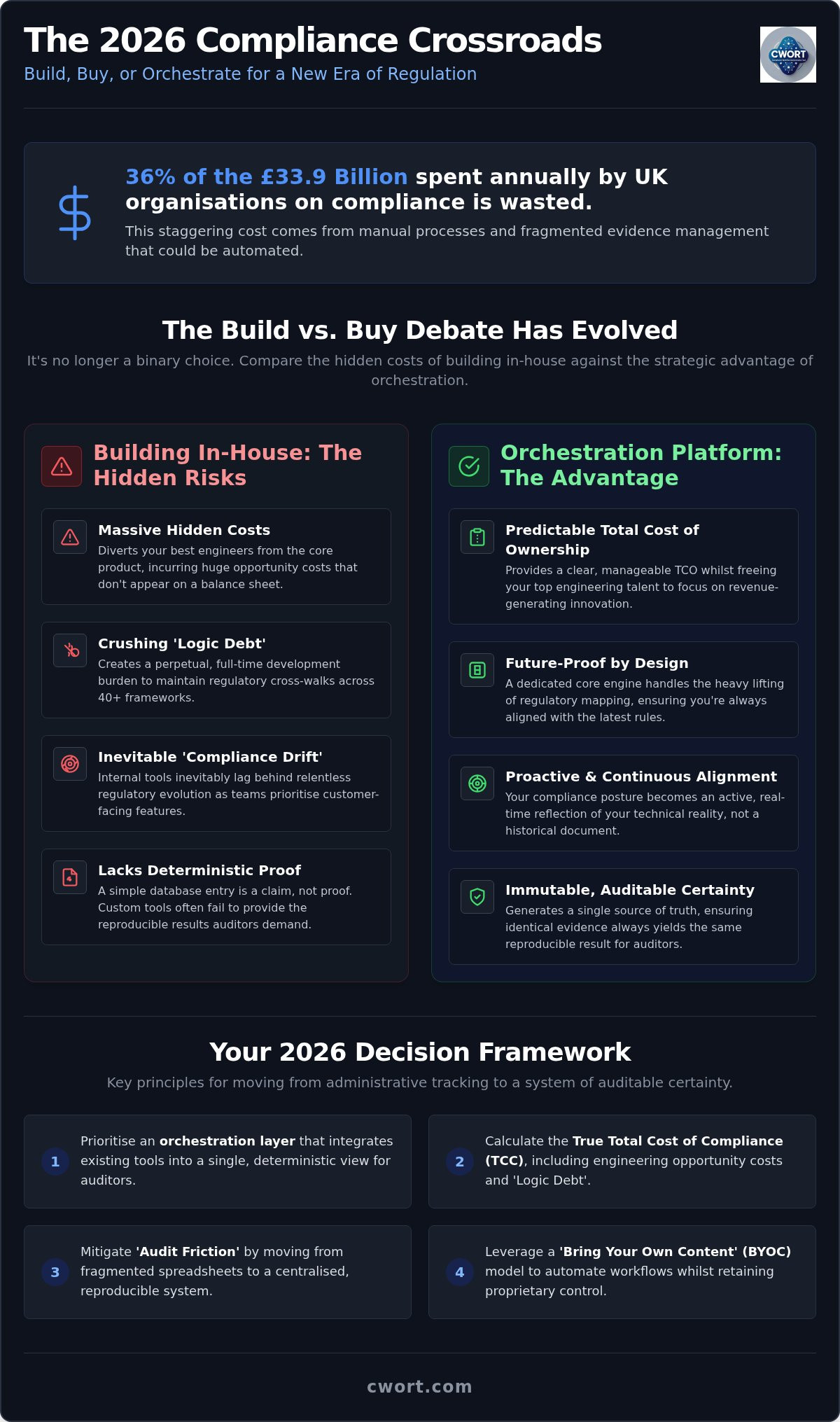
36% of the £33.9 billion spent annually on compliance by UK organisations is wasted on manual processes that could be automated. If you're still managing regulatory evidence across fragmented Jira tickets and Excel spreadsheets, you aren't just losing money; you're risking a catastrophic failure under DORA or the 2026 UK Cyber Security and Resilience Bill. The traditional build vs buy compliance software debate has shifted. It's no longer about whether you can code a dashboard. It's about whether you can afford to pull your best engineers away from your core product to maintain a custom-built system that lacks deterministic proof.
You'll likely agree that manual reconstruction of audit evidence is a recipe for error and executive anxiety. This guide will show you how to move beyond administrative tracking to a system of auditable certainty. We'll explore the 2026 strategy for UK enterprises, comparing the total cost of ownership for in-house builds against orchestration platforms. You'll learn how to establish a governance system that provides board-level visibility whilst ensuring every control is validated, reproducible, and ready for the most rigorous scrutiny.
Key Takeaways
- Evolve your approach to the build vs buy compliance software debate by prioritising an orchestration layer that integrates existing tools into a single, deterministic view for auditors.
- Calculate the True Total Cost of Compliance (TCC) by accounting for the "Logic Debt" and engineering opportunity costs associated with maintaining custom regulatory cross-walks.
- Identify which requirements offer a genuine competitive advantage versus those that are purely regulatory obligations to determine where custom development adds actual value.
- Mitigate "Audit Friction" by transitioning from fragmented evidence in spreadsheets to a centralised system that ensures identical data always yields the same reproducible result.
- Leverage the "Bring Your Own Content" (BYOC) model to retain proprietary control over your internal standards whilst benefiting from a governed, automated workflow.
Table of Contents
- The Build vs Buy Paradigm in 2026: Beyond the Binary Choice
- The Hidden Complexity of Building for DORA and NIS2
- Calculating the True Total Cost of Compliance (TCC)
- The 2026 Decision Framework: When to Build, Buy, or Orchestrate
- CWORT: Bridging the Gap Between Custom Control and Off-the-Shelf Efficiency
The Build vs Buy Paradigm in 2026: Beyond the Binary Choice
The 2026 UK regulatory climate has fundamentally altered the build vs buy compliance software decision. We've moved past the era where simple task-tracking sufficed. Organisations now face a landscape defined by the UK Cyber Security and Resilience Bill and the active enforcement of DORA. This pressure forces a transition from administrative record-keeping to the validation of control outcomes. Many leadership teams are tempted by AI-assisted development tools like Cursor or GitHub Copilot, believing they can build custom solutions cheaply. This is a false sense of security. Whilst AI can generate code, it cannot architect the deterministic logic required to satisfy a forensic audit.
Instead of a binary choice, a "Buy + Extend" model has emerged. This approach leverages a core orchestration engine to handle the heavy lifting of regulatory mapping whilst allowing internal teams to extend the system to fit unique operational workflows. When evaluating this path, firms must look beyond initial development and consider the long-term Total Cost of Ownership (TCO), including the burden of maintaining regulatory alignment as laws evolve. Proactive orchestration ensures that your compliance posture is an active reflection of your technical reality, not a historical document.
The Rise of Regulatory Orchestration
Traditional GRC tools are failing because they act as passive repositories. Modern requirements demand orchestration engines that proactively enforce discipline. You cannot rely on fragmented evidence buried in Jira tickets or Excel spreadsheets when an auditor demands proof of resilience. An orchestration layer sits above your technical stack, pulling data from SIEM or EDR tools to create a single, immutable source of truth. It translates complex obligations into validated execution activities. This ensures that every control is mapped, tracked, and evidenced without manual intervention.
Why 2026 is the Year of Audit-Defensibility
The stakes for software selection have never been higher. With active enforcement of NIS2 and DORA, regulators are rejecting "good enough" internal tools that lack rigorous traceability. They require deterministic results where identical evidence always yields the same outcome. Custom-built dashboards often lack the structural integrity to provide these immutable audit trails. To achieve professional maturity, your system must move beyond tracking what was done and start proving what was achieved. This shift requires a platform designed for defensibility, replacing manual reconstruction with automated, evidence-based certainty.
The Hidden Complexity of Building for DORA and NIS2
Whilst the build vs buy compliance software debate usually centres on upfront development costs, the real danger lies in logic debt. Logic debt is the silent killer of custom-built governance systems. When an organisation chooses to build its own tools, it inadvertently commits to a perpetual development cycle that has nothing to do with its core product. Maintaining regulatory cross-walks across 42 different frameworks isn't a one-off task; it's a full-time operational burden that drains high-value engineering resources.
Building for determinism is where most internal projects fail. An auditor doesn't just want to see a record; they want to see that identical evidence consistently yields the same result. A simple database entry is a claim, not a proof. Real audit-ready proof requires evidence binding, where technical data is mathematically linked to a specific control outcome. When evaluating the six key considerations for your strategy, you must weigh this technical rigour against your team's capacity to maintain it. The build vs buy compliance software decision often ignores the necessity of hard-coding Separation of Duties (SoD) into every layer of the application logic.
The Maintenance Trap: Regulatory Evolution
Regulatory velocity in 2026 is relentless. DORA technical standards and NIS2 guidelines undergo frequent revisions, requiring immediate code updates to maintain alignment. Internal engineering teams inevitably prioritise customer-facing features over back-office governance updates. This leads to "compliance drift", where your custom software reflects outdated versions of the law. This gap creates a significant liability during a formal assessment, as your evidence no longer maps to the current regulatory mandate.
Governance by Design: More Than Just Code
True governance requires sophisticated access controls that go beyond simple permissions. Implementing role-based and attribute-based access controls (RBAC/ABAC) within a custom tool is complex and prone to manual error. You also need to build "Assess Once, Report Many" logic from scratch to avoid duplicating effort across multiple frameworks. This level of structural integrity is difficult to achieve in-house without diverting massive resources from your core business objectives. To see how a professional orchestration engine handles these complexities, you can explore our deterministic platform.
Calculating the True Total Cost of Compliance (TCC)
36% of the £33.9 billion spent by UK firms on compliance is lost to manual processes that could be automated. This statistic highlights the fundamental flaw in the build vs buy compliance software debate: most firms ignore the "Audit Friction" tax. Senior staff spend hundreds of hours manually gathering evidence from fragmented systems, a cost that rarely appears on a standard balance sheet. A failed regulatory assessment under DORA or NIS2 introduces liabilities that extend far beyond initial development costs, impacting insurance premiums and board-level accountability. You aren't just paying for code; you're paying for the risk of non-deterministic proof.
Scalability is the final hidden cost. Mapping your first framework is manageable. However, as the UK regulatory landscape expands, adding the 43rd framework to a custom build requires a complete logic overhaul. An orchestration engine handles this transition seamlessly, providing a reproducible scoring system that internal tools lack. If your system cannot scale without a total re-engineering of its underlying taxonomy, it isn't a solution; it's a legacy burden in the making.
Engineering Opportunity Cost
Diverting senior developers to build compliance plumbing is a strategic failure. Every sprint spent on internal governance tools is a sprint lost on revenue-generating features. This technical debt in non-core systems creates a permanent drag on organisational velocity. Choosing a professional platform ensures a faster time-to-market, allowing your best talent to focus on competitive advantages rather than regulatory maintenance. Don't sacrifice your product roadmap to build a tool that already exists in a more robust form.
Total Cost of Compliance (TCC) Comparison Table
The break-even point for most UK enterprises occurs when the cost of manual evidence reconstruction and framework mapping exceeds the platform subscription fee. Use this comparison to evaluate your current trajectory.
The 2026 Decision Framework: When to Build, Buy, or Orchestrate
Selecting the right path in the build vs buy compliance software debate requires a disciplined assessment of your operational reality. Start by categorising the requirement. Is the software part of your unique customer value proposition, or is it a regulatory obligation? Most compliance functions are "hygiene factors" where standardisation is a strength, not a weakness. Next, assess the regulatory velocity of the target framework. If you're targeting DORA or the UK Cyber Security and Resilience Bill, the rules are shifting too fast for custom code to keep pace without constant reinvestment. You must also evaluate your internal capacity for long-term governance. It's easy to build version 1.0. It's nearly impossible for most firms to maintain version 5.0 whilst keeping the lights on for core products. Finally, determine the need for multi-framework cross-walks. If you must report against NIS2, ISO 27001, and NCSC CAF simultaneously, the complexity of manual mapping makes a "Build" strategy professionally irresponsible.
The Competitive Advantage Test
Ask yourself: "Does building this tool make our product better for our customers?" If the answer is no, you're building a liability. Compliance platforms provide the structural integrity you need without the overhead of non-core development. You should build the integration glue that connects your unique tech stack to a central engine, but buy the orchestration logic itself. This approach ensures your governance remains objective rather than subjective. Standardisation reduces friction and provides a common language for auditors and the board alike.
Assessing Maturity and Capacity
Your current maturity level dictates your investment strategy. Low-maturity organisations often try to build their way out of chaos, only to create more technical debt. High-maturity organisations recognise that their value lies in execution, not in building administrative infrastructure. Reviewing DORA Compliance Validation strategies can help you determine where your current gaps lie. Ensure your team has both the capability to build and the capacity to maintain over a multi-year horizon. If either is lacking, orchestration is the only defensible path forward. To see how our framework scales across 42 different frameworks, you can book a professional maturity assessment.
CWORT: Bridging the Gap Between Custom Control and Off-the-Shelf Efficiency
CWORT represents the logical conclusion to the build vs buy compliance software dilemma. It eliminates the need to choose between the bespoke control of a custom build and the operational speed of a commercial platform. By providing a rigorous orchestration engine, it allows UK enterprises to retain their unique internal standards whilst benefiting from a library of 1,355 pre-mapped controls. These controls ensure immediate readiness for DORA and UK NIS, removing the logic debt associated with manual framework mapping. This "Bring Your Own Content" (BYOC) advantage ensures you retain your proprietary intellectual property whilst using a governed, automated workflow.
The system functions as a deterministic validator. Unlike custom-built dashboards that often rely on subjective status updates, CWORT aggregates raw data from your existing security stack. It binds evidence from tools like SIEM or EDR directly to regulatory requirements. This creates a single, explainable view that satisfies auditors without requiring your engineering team to maintain complex database relationships or immutable audit logs. You achieve the precision of a bespoke tool without the maintenance trap of a legacy internal project. It replaces executive anxiety with the calm of auditable certainty.
Orchestration Above the Tooling
CWORT doesn't replace your security stack; it makes it auditable. It sits above your existing infrastructure to translate technical events into regulatory outcomes. This "Assess Once, Report Many" capability is essential for UK organisations navigating overlapping mandates. By integrating NCSC CAF Assessment Software capabilities into a broader orchestration workflow, you ensure that evidence collected for one framework automatically populates others. This efficiency eliminates the redundancy that plagues internal builds and traditional GRC tools alike. It ensures that 98.6% of your active controls have direct framework references, providing a level of traceability that manual spreadsheets cannot match.
Deterministic Logic for Board-Ready Assurance
Board-level visibility requires more than just a red-amber-green dashboard. It requires defensible truth. CWORT uses a reproducible scoring system to generate regulator-ready outputs. Whilst AI advisory functions suggest remediation paths, they never alter the deterministic results of an assessment. This ensures your compliance posture remains objective and forensic-ready. Implementing Regulatory Compliance Workflow Automation allows you to move from manual reconstruction to continuous, evidence-based assurance. The result is a governance system that enforces discipline by design. You replace the high-friction manual gathering of the past with a proactive system of auditable certainty.
Secure Your Regulatory Future with Deterministic Orchestration
The 2026 regulatory landscape in the UK demands a transition from administrative tracking to validated, evidence-based proof. Relying on fragmented internal tools creates a logic debt that compromises your audit-defensibility whilst draining high-value engineering resources. Navigating the build vs buy compliance software decision requires looking beyond initial development costs to the long-term integrity of your governance system. True professional maturity is found in orchestration layers that provide deterministic outcomes, allowing your team to focus on core product innovation instead of maintenance.
You can replace the anxiety of manual reconstruction with the calm of auditable certainty. CWORT offers a Red Dot level platform design, ensuring a sophisticated user experience alongside rigorous, audit-defensible evidence binding. Supported by UK-based professionals, our engine translates complex obligations into validated reality. Don't let your compliance posture become a legacy burden. Take the decisive step toward operational maturity and establish a system that stands up to the most forensic scrutiny.
Request a CWORT Pilot to Validate Your Compliance Operating Model and secure the definitive proof your board requires.
Frequently Asked Questions
Is it cheaper to build or buy compliance software in 2026?
Buying an orchestration platform is generally cheaper when factoring in the ongoing maintenance of regulatory logic. Whilst building has lower upfront software costs, the "logic debt" of mapping 42 frameworks and updating code for every DORA or NIS2 revision creates a massive recurring expense. Most UK firms find that the total cost of ownership for a custom build exceeds commercial subscriptions within 18 months due to engineering opportunity costs and manual reconstruction requirements.
Can we use Jira or Excel instead of buying compliance software?
You can use Jira and Excel for basic task tracking, but they lack the deterministic proof required for modern audits. These tools create fragmented evidence that must be manually reconstructed, a process that leads to significant "Audit Friction." Regulators now demand immutable audit trails and evidence binding that spreadsheet-based systems cannot provide. If you rely on manual tracking, you risk failing assessments under the UK Cyber Security and Resilience Bill due to human error.
How does AI-assisted development change the build vs buy decision?
AI-assisted development tools like GitHub Copilot make building version 1.0 faster, but they don't solve the long-term governance problem. Code generation cannot architect the deterministic logic or the mathematical evidence binding needed for high-stakes regulatory environments. AI often creates a false sense of security in the build vs buy compliance software debate. It produces code quickly but leaves your team responsible for the permanent burden of maintaining regulatory alignment as laws evolve.
What is the "Total Cost of Compliance" (TCC)?
Total Cost of Compliance (TCC) is a comprehensive metric that includes engineering salaries, opportunity costs, and the expense of manual evidence gathering. It goes beyond simple software licensing to account for the time senior staff spend on non-core activities. For many UK organisations, TCC is inflated by "Audit Friction," where 36% of compliance spending is wasted on inefficient manual processes. Calculating TCC helps leadership identify the true financial impact of maintaining a custom-built governance system.
How do regulators view custom-built compliance tools during a DORA audit?
Regulators view custom-built tools with high levels of scepticism unless they demonstrate rigorous, deterministic validation. During a DORA audit, assessors look for immutable audit trails and reproducible scoring systems that custom dashboards often lack. If your internal tool cannot prove that identical evidence always yields the same result, it will be rejected as non-defensible. Professional orchestration platforms provide the structural integrity and traceability that regulators expect from mature UK financial entities.
What is compliance orchestration, and how does it differ from a GRC tool?
Compliance orchestration is a proactive system that translates technical data from your security stack into validated regulatory outcomes. Unlike traditional GRC tools, which act as passive repositories for documents, an orchestration engine sits above your SIEM or EDR tools. It automates the collection and binding of evidence to specific controls. This shift from administrative tracking to active validation ensures your compliance posture is a real-time reflection of your technical reality, not a historical record.
Can I import my own internal controls into a bought compliance platform?
Yes, professional platforms like CWORT offer "Bring Your Own Content" (BYOC) capabilities that allow you to retain your proprietary standards. You can map your unique internal controls to established frameworks like ISO 27001 or NCSC CAF whilst using the platform's governed workflow. This hybrid approach provides the efficiency of automated orchestration without forcing you to abandon your existing intellectual property. It ensures your specific operational requirements are met within a standardised, audit-ready framework.
How long does it take to implement an enterprise compliance platform like CWORT?
Implementation typically takes between four and eight weeks, depending on the complexity of your existing technical stack. Unlike custom builds that can take months of development, orchestration platforms use pre-mapped taxonomies and API integrations to accelerate deployment. This rapid time-to-value is a critical factor in the build vs buy compliance software decision. You can establish a deterministic governance system and start validating controls across multiple frameworks far faster than building a bespoke solution from scratch.
Disclaimer
The content on this site is provided for general information and educational purposes only. It does not constitute legal, regulatory, financial, or professional advice. CWORT provides AI-assisted insights and workflow automation, but all compliance decisions remain the responsibility of your organisation and its management. Always seek qualified legal or regulatory guidance for decisions relating to the UK NIS Regulations, CAF, DORA, NIS2, ISO 27001, or other obligations.
Related posts
Auditable Compliance Proof Software: A Strategic Guide to Regulatory Validation in 2026
Stop documenting history and start managing risk. Our guide to defensible compliance evidence software prepares your organisation for tough 2026 regulatory a...
Jira for Compliance vs Orchestration: Why Task Tracking Fails Regulatory Audits
Discover why Jira fails DORA & NIS2 audits. In the debate of Jira for compliance vs orchestration, learn why task tracking isn't proof & how to automate assu...
The Shift to Compliance Orchestration Platforms: Beyond Enterprise GRC Automation
Struggling with DORA & NIS2? Move beyond failing GRC tools with a compliance orchestration platform for automated, auditor-ready evidence and real-time overs...
Article by
Michael Iyiola
Co-Founder, CWORT
Michael Iyiola is a co-founder of CWORT and a Cyber and AI Security Engineer with deep experience in vulnerability management, detection engineering and operational resilience across UK critical national infrastructure, including rail, energy and financial services. At CWORT, he designs scalable, evidence-driven workflows that help teams meet modern regulatory and security demands.
Build Your Foundation of Auditable Certainty
Take control of your regulatory obligations and secure your infrastructure with CWORT.