Auditable Compliance Proof Software: A Strategic Guide to Regulatory Validation in 2026

Michael Iyiola
Co-Founder, CWORT
Stop documenting history and start managing risk. Our guide to defensible compliance evidence software prepares your organisation for tough 2026 regulatory a...

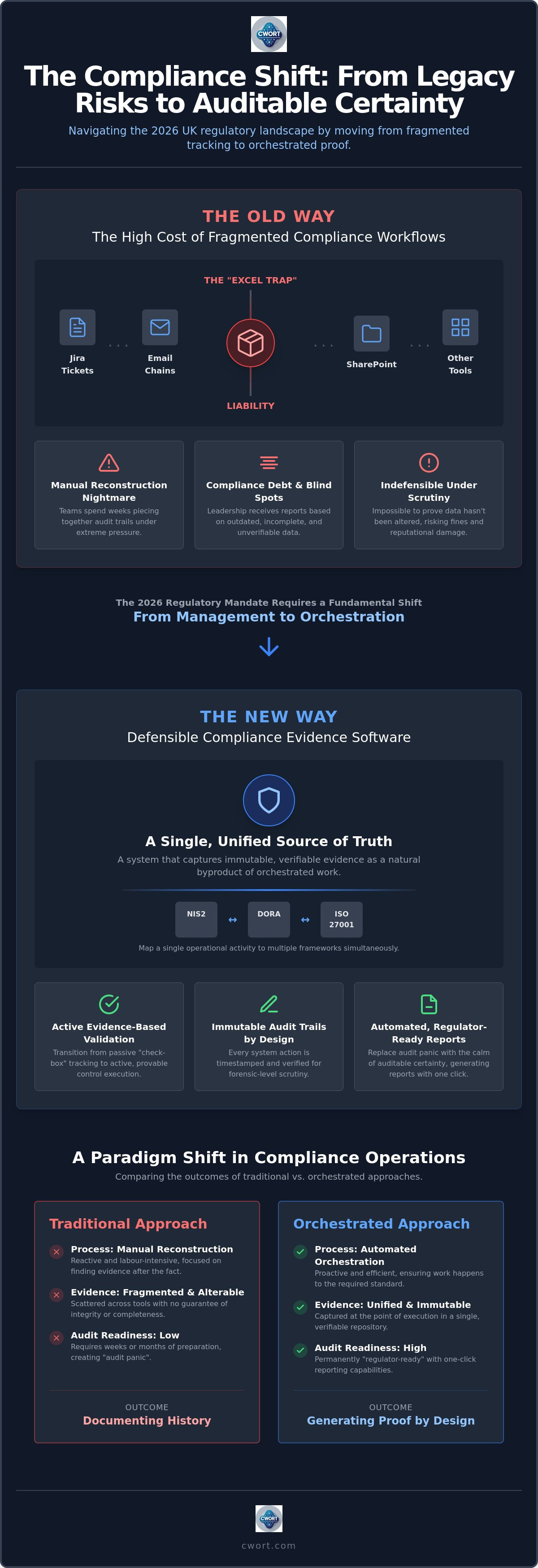
A static spreadsheet is not a strategy; it is a liability that will crumble under the weight of a 2026 regulatory audit. If your team still spends weeks manually reconstructing audit trails before a deadline, you aren't managing risk. You are merely documenting history. Most senior leaders agree that fragmented evidence scattered across disconnected tools creates a dangerous lack of visibility into real-time control effectiveness. The transition to defensible compliance evidence software is no longer optional for organisations facing the stringent requirements of the Data (Use and Access) Act 2025 or the latest Cyber Essentials Danzell set.
This guide promises to show you how to move beyond administrative tracking to a dynamic orchestration system that generates regulator-ready proof by design. You will learn how to establish a single source of truth for all regulatory obligations, ensuring that every control execution survives forensic scrutiny. We will preview the architecture required to automate separation of duties and produce comprehensive reports at the click of a button, replacing the anxiety of potential failure with the calm of auditable certainty.
Key Takeaways
- Transition from passive "check-box" tracking to active evidence-based validation to meet the rigorous UK regulatory standards of 2026.
- Eliminate the inherent risks of the "Excel Trap" by consolidating fragmented data from Jira, email, and SharePoint into a single, unified source of truth.
- Deploy defensible compliance evidence software to map individual operational activities to multiple frameworks simultaneously, including DORA, NIS2, and ISO 27001.
- Enforce separation of duties and immutable audit trails by design, ensuring every system action is timestamped and verified for forensic-level scrutiny.
- Shift from manual reconstruction to automated orchestration, allowing your team to generate regulator-ready reports at the click of a button.
Table of Contents
- What is Auditable Compliance Proof Software and Why Does it Matter in 2026?
- The Hidden Cost of Fragmented Compliance Workflows
- Orchestrating Compliance: How to Build a Defensible Audit Trail
- Key Features to Look for in Defensible Evidence Software
- CWORT: The UK Standard for Regulatory Compliance Orchestration
What is Auditable Compliance Proof Software and Why Does it Matter in 2026?
Auditable compliance proof is the immutable, cryptographically verifiable link between a specific regulatory obligation and a realised outcome. In the high-stakes environment of 2026, merely pointing to a signed policy is insufficient. Regulators now demand the granular trail of execution. This shift has redefined the traditional Governance, risk, and compliance (GRC) discipline. Old-guard GRC tools were designed for administrative tracking. They operate as repositories for documents rather than engines for proof. To survive a forensic audit today, organisations must transition to a system that captures evidence as a byproduct of the work itself.
Traditional tools fail because they rely on post-mortem reconstruction. When an auditor asks for proof of "separation of duties" during a critical system change, a spreadsheet cannot provide the timestamped, multi-user validation required. This is where defensible compliance evidence software becomes the strategic anchor for the enterprise. It translates abstract legal requirements into structured, executable activities. It doesn't just ask if a task was done. It enforces the specific workflow that proves it happened according to the standard.
The Evolution of Regulatory Scrutiny in the UK
The implementation of DORA and the NIS2 Directive has fundamentally altered the UK's regulatory landscape. The "burden of proof" has shifted. Organisations must now demonstrate resilience through continuous monitoring rather than static, annual snapshots. Regulators are no longer satisfied with a "yes" on a questionnaire. They require the "how" and the "who" behind every control. They want to see the forensic trail of who authorised the access, when the vulnerability was patched, and exactly how the validation was performed. This level of scrutiny makes manual evidence gathering a terminal risk to the business.
From Management to Orchestration: A New Paradigm
Management is about oversight; orchestration is about execution. A management tool tells you what you should do. An orchestration engine, such as the framework provided by cwort.com, ensures the work happens according to the required standard by design. By orchestrating validated workflows, defensible compliance evidence software captures evidence at the exact point of execution. This eliminates the "audit panic" associated with manual reconstruction. It creates a "regulator-ready" posture that isn't a goal to be reached, but a permanent state of being. This structural integrity replaces the anxiety of potential failure with the calm of auditable certainty.
The Hidden Cost of Fragmented Compliance Workflows
The "Excel Trap" is perhaps the most significant threat to audit integrity in 2026. Whilst spreadsheets are versatile, they are inherently fragile and lack the structural rigor required for modern regulatory validation. When evidence is scattered across Jira tickets, email chains, and SharePoint folders, the risk of data corruption or loss becomes a statistical certainty. This fragmentation forces teams into a "manual reconstruction nightmare" where audit trails must be pieced together from disconnected sources under extreme time pressure. This process is not only inefficient; it is indefensible. Relying on manual collation makes it impossible to prove that data hasn't been altered after the fact, leaving the organisation vulnerable to The Cost Of Non-Compliance, which often manifests as heavy fines and reputational damage.
This systemic fragmentation leads to "compliance debt." This is the accumulated burden of unmet evidence requirements that builds up when proof is not bound to controls in real-time. For Board-level reporting, this debt is a strategic blind spot. Leadership often receives reports based on outdated or incomplete data, making it impossible to assess the true resilience of the organisation. Without defensible compliance evidence software, the gap between perceived security and actual regulatory posture continues to widen until it is exposed during a forensic audit.
Beyond compliance, strategic visibility into the software estate is equally vital. AI-native platforms like LicenseIQ enable organisations to discover and recover wasted spend on Microsoft 365 licences, ensuring that operational efficiency and financial governance are maintained alongside regulatory standards.
Why Jira is Not an Auditable Compliance Tool
Standard project management software like Jira is designed for velocity, not for validation. It lacks the immutable audit trails necessary to survive forensic scrutiny. In these tools, comments can be deleted, timestamps can be misleading, and the enforcement of "separation of duties" is often porous. Without specialised controls, there is no way to guarantee that the person who executed a change wasn't also the one who approved it. This lack of structural discipline leads to errors and omissions that regulators, particularly under DORA and NIS2, will no longer tolerate.
The Human Element: SME Fatigue and Administrative Burden
The operational cost of manual compliance is staggering. Subject Matter Experts (SMEs) are frequently pulled away from high-value engineering or strategic roles to spend weeks gathering evidence for auditors. This "compliance tax" erodes productivity and fuels burnout. Automated orchestration replaces this chaos with a disciplined, year-round workflow. By capturing proof at the point of execution, organisations can automate their evidence collection, allowing SMEs to focus on their core responsibilities whilst maintaining a permanent state of audit-readiness. This transition replaces the annual anxiety of audit season with the calm of a verified, continuous process.
Orchestrating Compliance: How to Build a Defensible Audit Trail
Orchestration is the bridge between a regulatory mandate and a verified reality. Whilst most organisations struggle with reactive sampling, true resilience requires a proactive framework that builds the audit trail in real-time. Implementing defensible compliance evidence software allows leadership to move from a state of constant "audit panic" to one of disciplined execution. This process isn't merely about tracking tasks; it's about enforcing a system where every action is a building block for an irrefutable regulatory submission. Making defensible compliance decisions requires this shift from trust-based reporting to evidence-backed certainty.
- Step 1: Translate obligations into activities. Deconstruct complex requirements from DORA, NIS2, or ISO 27001 into specific, actionable tasks that teams can execute without ambiguity.
- Step 2: Enforce separation of duties. Hard-code the workflow so that the individual performing a change or control cannot be the one who validates the outcome.
- Step 3: Bind evidence directly to outcomes. Attach logs, screenshots, and system files to the specific control they prove at the exact moment of execution.
- Step 4: Automate board-level reporting. Generate comprehensive summaries that require no manual collation, providing real-time visibility into control effectiveness.
- Step 5: Maintain the validation loop. Use continuous monitoring to identify and remediate control failures before they escalate into audit findings or regulatory breaches.
Binding Evidence to Control Outcomes
Evidence integrity is the cornerstone of any successful regulatory submission. In a high-stakes audit, an unattached log or a loose screenshot is a liability rather than a proof point. Defensible compliance evidence software ensures that once evidence is captured, it's cryptographically bound to its control outcome and cannot be altered or detached. This technical rigor prevents the "evidence drift" that often occurs in fragmented systems. For a deeper technical analysis of these protocols, refer to our guide on Ensuring Compliance Evidence Integrity.
Enforcing Separation of Duties (SoD)
Separation of Duties (SoD) is a non-negotiable pillar of DORA and UK NIS compliance. Regulators need to see that your organisation has structural safeguards against internal error and fraud. Standard project management tools often fail here because they rely on policy rather than enforcement. An orchestrated system prevents the same user from both executing and approving a control by design. When the auditor arrives, you don't need to explain your policy; you simply present a transparent report that proves the system made a violation impossible.
Key Features to Look for in Defensible Evidence Software
Selecting defensible compliance evidence software requires a shift in focus from static content to active execution. The market is saturated with tools that provide policies; however, very few provide the structural integrity needed to survive a forensic audit. A strategic platform must serve as a rigorous orchestrator that enforces discipline by design. To move beyond administrative tracking, your chosen solution must possess specific technical capabilities that transform abstract obligations into concrete proof.
- Multi-framework mapping: Reduce administrative overhead by mapping a single operational activity to multiple obligations, such as DORA, NIS2, and ISO 27001. This ensures that a single piece of evidence satisfies several regulatory requirements simultaneously.
- Immutable audit trails: Every action within the system must be logged with a non-repudiable timestamp and a specific user ID. This creates a permanent record that remains resistant to tampering or unauthorised modification.
- Enforced Separation of Duties (SoD): The software must hard-code the requirement that the person executing a control cannot be the one who validates it. This is a non-negotiable auditable requirement for DORA and NIS2 that most generic tools ignore.
- Automated reporting: The system should generate regulator-ready PDFs or live dashboards instantly. This eliminates the need for manual data collation and ensures reports are always based on the current state of compliance.
- Dynamic control models: UK regulations are not static. Your software must allow for the rapid adjustment of controls and workflows as frameworks like the NCSC CAF or UK GDPR evolve.
Board-Level Dashboards and Strategic Reporting
Leadership requires clarity, not just technical logs. Effective dashboards must translate granular control data into "at-a-glance" compliance statuses. Utilising a Red-Amber-Green (RAG) reporting system allows the Board to identify critical ICT risks immediately. This visibility transforms compliance from a cost centre into a strategic asset. By understanding exactly where resilience gaps exist, senior executives can make informed, data-driven decisions regarding cyber security investment. This level of transparency replaces uncertainty with the calm of auditable certainty.
Integration and Scalability for UK Enterprises
Enterprise-grade software must integrate seamlessly with existing Identity and Access Management (IAM) systems. This ensures that the "who" in your audit trail is verified against your single source of truth for identity. Scalability is equally vital. A SaaS model should deploy across diverse business units whilst strictly adhering to UK-specific data sovereignty and security standards. Protecting sensitive regulatory data requires a platform that understands the local legal landscape. To see these features in action and secure your organisation’s regulatory future, request a professional demonstration of our orchestration platform.
For UK-based care providers, this local expertise is often supplemented by operational partners like Contesto, who ensure that out-of-hours management and support remain robust and aligned with national regulatory standards.
CWORT: The UK Standard for Regulatory Compliance Orchestration
CWORT functions as the definitive orchestrator for UK organisations navigating the complexities of the 2026 regulatory landscape. It eliminates the operational friction caused by disconnected GRC tools, providing a single, rigorous engine for DORA and NIS2 validation. By consolidating these requirements into one platform, CWORT ensures that compliance isn't a post-mortem exercise but a live, orchestrated reality. This structural integrity is essential for maintaining a defensible compliance evidence software posture that survives forensic scrutiny from regulators like the FCA or the ICO. It replaces the fragmented mess of spreadsheets with a disciplined system that enforces accountability by design.
The 'Execution to Evidence' workflow is the heart of this system. It ensures that no obligation remains an abstract requirement. Instead, every mandate is translated into a validated action. For enterprise SMEs and external consulting teams, this provides a clear, validated execution model that removes guesswork. It enforces discipline by ensuring that every control is performed, verified, and logged automatically. This transition from abstract obligation to concrete proof allows leadership to manage NCSC CAF and UK NIS requirements with total assurance, knowing that their evidence trail is non-repudiable and complete.
Meeting the DORA Challenge with Confidence
CWORT simplifies the DORA technical standards by providing specific modules for ICT risk management and reporting. It doesn't just list requirements; it enforces the specific activities needed to satisfy them. This allows financial institutions to manage complex supply chain risks and incident reporting with absolute certainty. By automating the link between a technical control and a regulatory obligation, organisations can significantly reduce their audit preparation time. For a deeper analysis of these requirements, see our guide on DORA Compliance Validation: A Guide for Financial Institutions.
Mastering Cyber Resilience with NCSC CAF
Streamlining the NCSC CAF assessment process is critical for operators of essential services and critical national infrastructure. CWORT maps CAF outcomes to broader regulatory frameworks, allowing organisations to satisfy multiple obligations through a single assessment cycle. This efficiency reduces the administrative burden on operational teams whilst providing a transparent view of cyber resilience. Utilising our NCSC CAF Assessment Software ensures that your UK NIS requirements are met with a disciplined, evidence-based approach. This orchestration model provides the calm of auditable certainty in an increasingly complex regulatory world.
Securing Your Regulatory Future Through Orchestrated Validation
The regulatory landscape of 2026 demands a shift from passive documentation to active, orchestrated proof. You've seen how fragmented workflows and the "Excel trap" create systemic vulnerabilities that no amount of manual reconstruction can fix. By binding evidence directly to control outcomes at the point of execution, your organisation maintains a permanent state of audit-readiness. Deploying defensible compliance evidence software transforms your regulatory posture from a reactive crisis into a strategic advantage, ensuring every obligation is met with irrefutable proof.
Securing this level of structural integrity requires a system designed for the rigours of DORA, NIS2, and ISO 27001. CWORT provides a UK-based orchestration engine that delivers regulator-ready outputs by design, not through post-mortem reconstruction. It's time to replace the anxiety of audit season with the calm of verified certainty. Book a CWORT demo to see how we automate your compliance proof and take full control of your regulatory validation today. Your path to total assurance starts with a single, disciplined workflow.
Frequently Asked Questions
What is the difference between GRC software and compliance proof software?
GRC software typically acts as a static repository for policies and risk registers, focusing on administrative oversight. In contrast, defensible compliance evidence software functions as an orchestration engine that captures proof at the point of execution. Whilst GRC tools manage the "what" of compliance, proof software validates the "how" by creating an immutable link between an obligation and a verified outcome.
Can auditable compliance software help with DORA separation of duties?
Yes, the platform enforces separation of duties (SoD) by design within the orchestrated workflow. It prevents a single user from both executing a control and validating the result, which is a core requirement for DORA and UK NIS. This hard-coded discipline ensures that your audit trail is non-repudiable and satisfies the most stringent regulatory scrutiny by making violation impossible.
How does automated evidence binding work during a regulatory audit?
Automated evidence binding cryptographically attaches logs, screenshots, or system files to a specific control outcome the moment a task is completed. During an audit, this eliminates the need for manual reconstruction or reactive sampling. You simply present the regulator with a timestamped, tamper-proof record that proves the control was executed according to the required standard without any manual intervention.
Is auditable compliance proof software suitable for ISO 27001 audits?
Absolutely. The system maps operational activities directly to ISO/IEC 27001:2022 controls, ensuring that every requirement has a corresponding evidence trail. This structured approach simplifies the transition from older versions and ensures that your Information Security Management System (ISMS) remains continuously validated. It replaces the anxiety of the annual audit with a permanent state of verified compliance.
How does this software replace manual spreadsheets for NIS2 compliance?
It replaces manual spreadsheets by centralising fragmented data into a single, automated source of truth. Spreadsheets lack the version control and immutable logging required for NIS2 compliance validation. This software orchestrates the collection of proof across diverse business units, removing the "Excel trap" and the associated risks of data corruption or human error that typically occur during audit preparation.
Can I use this platform to manage multiple regulatory frameworks simultaneously?
Yes, the platform supports multi-framework mapping, allowing one operational activity to satisfy several obligations. For instance, a single vulnerability patch can provide defensible compliance evidence software proof for DORA, NIS2, and ISO 27001 simultaneously. This efficiency reduces administrative duplication and ensures that your organisation maintains a consistent and robust regulatory posture across all applicable frameworks.
What kind of reports can I generate for a Board-level compliance meeting?
You can generate high-level, "at-a-glance" dashboards that utilise Red-Amber-Green (RAG) status reporting. These reports translate technical execution data into strategic insights for leadership. They provide immediate visibility into ICT risk management and control effectiveness, enabling boards to make informed investment decisions based on real-time resilience data rather than historical snapshots or manual summaries.
Does the software integrate with our existing Jira or ServiceNow workflows?
The system integrates with existing enterprise tools like Jira and ServiceNow to ingest operational data and trigger workflows. However, it adds a layer of regulatory validation that these general tools lack. Whilst your teams continue to work within their preferred environments, the software captures the necessary proof and enforces the structural discipline required to maintain a defensible audit trail.
Disclaimer
The content on this site is provided for general information and educational purposes only. It does not constitute legal, regulatory, financial, or professional advice. CWORT provides AI-assisted insights and workflow automation, but all compliance decisions remain the responsibility of your organisation and its management. Always seek qualified legal or regulatory guidance for decisions relating to the UK NIS Regulations, CAF, DORA, NIS2, ISO 27001, or other obligations.
Related posts
The Shift to Compliance Orchestration Platforms: Beyond Enterprise GRC Automation
Struggling with DORA & NIS2? Move beyond failing GRC tools with a compliance orchestration platform for automated, auditor-ready evidence and real-time overs...
The Evolution of the Enterprise GRC Validation Tool: From Tracking to Orchestration in 2026
Stop chasing compliance ghosts in spreadsheets. Create a single source of truth for compliance with GRC orchestration to master NIS2, DORA, and UK audit dema...
Streamlining Regulatory Compliance Processes: From Manual Tracking to Orchestrated Validation
Stop wasting money on manual compliance. Learn about streamlining regulatory compliance processes to reduce personal liability under DORA & NIS2 and gain aud...
Article by
Michael Iyiola
Co-Founder, CWORT
Michael Iyiola is a co-founder of CWORT and a Cyber and AI Security Engineer with deep experience in vulnerability management, detection engineering and operational resilience across UK critical national infrastructure, including rail, energy and financial services. At CWORT, he designs scalable, evidence-driven workflows that help teams meet modern regulatory and security demands.
Build Your Foundation of Auditable Certainty
Take control of your regulatory obligations and secure your infrastructure with CWORT.