Streamlining Regulatory Compliance Processes: From Manual Tracking to Orchestrated Validation

Michael Iyiola
Co-Founder, CWORT
Stop wasting money on manual compliance. Learn about streamlining regulatory compliance processes to reduce personal liability under DORA & NIS2 and gain aud...

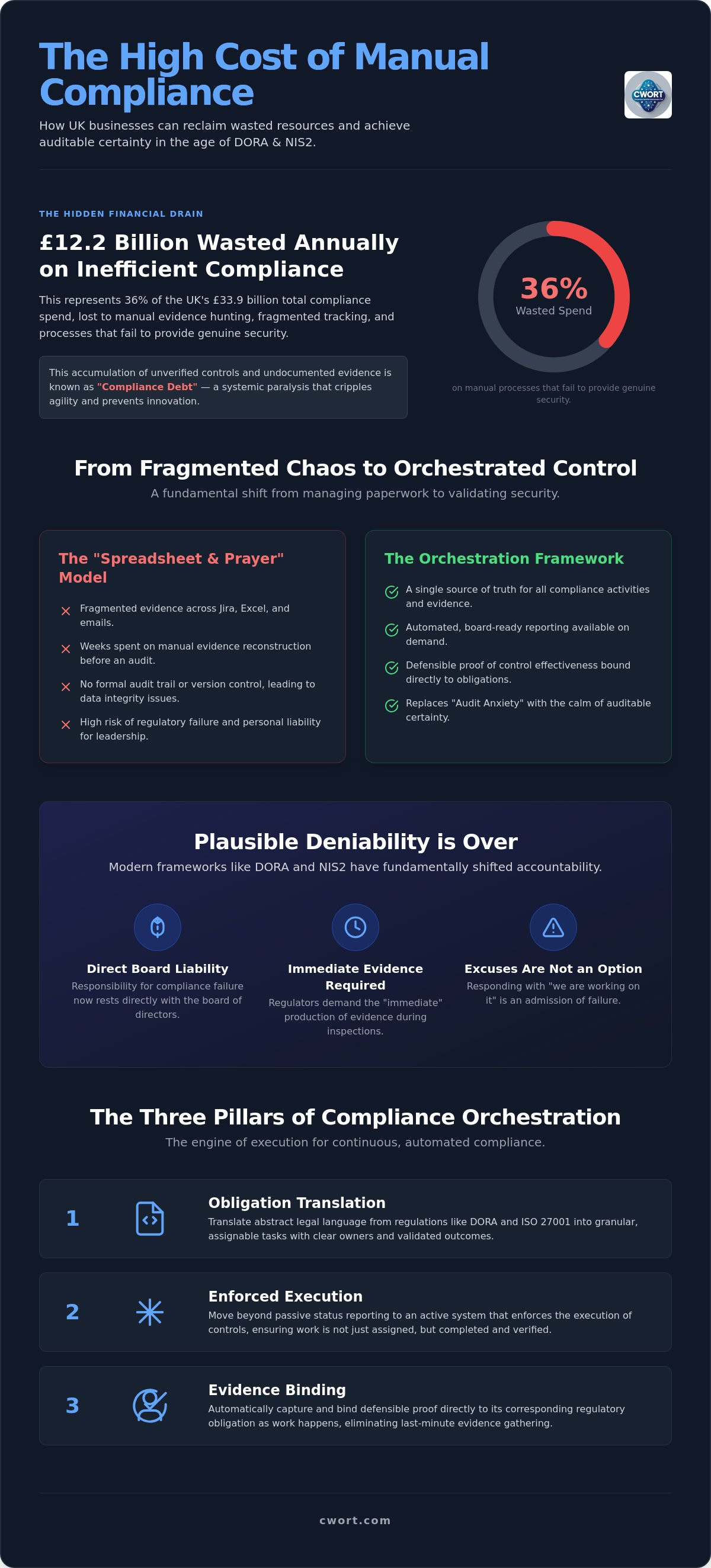
UK businesses are currently wasting 36% of their £33.9 billion annual compliance spend on manual processes that fail to provide genuine security. Streamlining regulatory compliance processes is no longer just an operational preference; it's a strategic necessity for leadership teams facing the stringent personal liability requirements of DORA and NIS2. If your team still spends weeks hunting through Jira tickets and Excel spreadsheets to reconstruct evidence before an audit, you aren't actually managing risk. You're merely managing paperwork whilst the threat of regulatory failure grows.
We recognise the exhaustion of manual reconstruction and the anxiety of compliance debt that accumulates between reporting cycles. This article outlines how to eliminate these inefficiencies by transitioning from fragmented tracking to a validated orchestration framework. You'll learn how to establish a single source of truth that produces automated, board-ready reporting and provides defensible proof of control effectiveness. It's time to replace the chaos of manual evidence gathering with the calm of auditable certainty and professional maturity.
Key Takeaways
- Identify the hidden costs of "compliance debt" and how manual evidence reconstruction creates unnecessary personal liability under DORA and NIS2.
- Execute a transition from fragmented tracking to orchestrated validation, effectively streamlining regulatory compliance processes across the entire enterprise.
- Recognise the limitations of project management tools like Jira and bridge the "evidence gap" by binding proof directly to regulatory obligations.
- Adopt a five-step framework to centralise your obligation library and map controls once to satisfy multiple standards, including ISO 27001 and the NCSC CAF.
- Establish a single source of truth that delivers automated, board-ready reporting and provides definitive, defensible proof of control effectiveness.
Table of Contents
- The Hidden Cost of Fragmented Compliance Processes in 2026
- Defining Compliance Orchestration: The Engine of Efficiency
- Why Traditional Tools Fail Regulatory Scrutiny
- A 5-Step Framework for Streamlining Regulatory Obligations
- CWORT: The Orchestration Engine for UK Enterprise Compliance
The Hidden Cost of Fragmented Compliance Processes in 2026
In 2026, the financial burden of non-compliance is only the visible peak of a much larger operational iceberg. Beneath the surface lies "Compliance Debt", a systemic paralysis caused by the accumulation of unverified controls and undocumented evidence. This debt accumulates every time a control is performed but not properly recorded in a central system. For UK enterprises, this creates a massive drag on agility. When teams are trapped in the past, they cannot innovate for the future. True regulatory compliance requires more than just meeting a standard; it requires the ability to prove it instantly without disrupting daily operations.
The manual reconstruction trap is the primary driver of this inefficiency. Verified data shows that UK businesses waste 36% of their annual compliance expenditure on manual processes that could be automated. A significant portion of this waste occurs when staff spend hours, or even days, hunting for evidence amongst disparate emails and folders. This fragmented approach triggers "Audit Anxiety" amongst senior leadership. It's the pervasive fear that a single missing timestamp or an unverified ticket could lead to a catastrophic regulatory failure. Transitioning toward streamlining regulatory compliance processes is the only way to replace this anxiety with the calm of auditable certainty.
The Failure of the "Spreadsheet and Prayer" Model
Excel remains a ubiquitous tool, yet it represents a critical vulnerability in your 2026 regulatory standing. Spreadsheets are flat files. They lack a formal audit trail and offer no robust version control. This makes it impossible to verify the integrity of your data over time. Furthermore, spreadsheets cannot enforce the "Separation of Duties" required by modern governance standards. Relying on a tool with no inherent validation logic means your security posture is based on hope rather than evidence-based discipline.
Regulatory Pressure: DORA, NIS2, and the End of Plausible Deniability
Modern frameworks like DORA and NIS2 have fundamentally shifted the landscape of accountability. Liability now rests directly with the board of directors. Plausible deniability is dead. Regulators now demand the "immediate" production of evidence during inspections. If your organisation's response to an auditor is "we are working on it," you've already failed. The requirement for continuous scrutiny means that evidence must be bound to obligations as work happens. Advanced systems like CWORT facilitate this by replacing fragmented trackers with a single, orchestrated framework that enforces accountability by design.
Defining Compliance Orchestration: The Engine of Efficiency
Compliance orchestration represents a fundamental shift from passive record-keeping to active, enforced governance. Whilst traditional GRC software often functions as a digital filing cabinet for past events, orchestration acts as the engine of execution. It moves the organisation away from mere "status reporting" toward the definitive "validation of control effectiveness." By integrating a robust framework for streamlining regulatory obligations into daily operations, enterprises ensure that every requirement is met with precision and documented without manual intervention.
The system relies on three core pillars: obligation translation, enforced execution, and evidence binding. This disciplined approach ensures that streamlining regulatory compliance processes is not a one-off project but a continuous, automated reality. It replaces the "check-box" mentality with a proactive system that enforces accountability by design. When a regulation changes, the orchestration engine updates the relevant workflows immediately, ensuring the organisation remains in a constant state of audit-readiness rather than scrambling during a reporting window.
Translating Regulations into Executable Activities
Regulations such as DORA or ISO 27001 are often written in abstract legal language that leaves room for interpretation and error. Orchestration translates these high-level obligations into granular, assignable tasks. Every obligation is assigned a clear owner and a validated outcome. This structural clarity eliminates the ambiguity that often leads to compliance debt. Effective streamlining regulatory compliance processes also utilises control mapping. This allows a single executed task to satisfy requirements across multiple frameworks simultaneously, significantly reducing redundant work for your technical and security teams.
Evidence Binding: The Secret to Zero-Manual Reporting
Traditional methods separate the work from the proof. A technician might close a ticket in one system, whilst a compliance officer later hunts for the associated proof in another. Orchestration eliminates this "evidence gap" by capturing proof at the exact moment of execution. Evidence Binding is the process of automatically attaching immutable proof to a regulatory task at the exact moment of its completion, ensuring a permanent and auditable link between action and obligation. This creates an unbreakable chain of custody that satisfies even the most rigorous auditor. If you are ready to move beyond the limitations of manual tracking, you can explore how orchestration validates your controls in real-time.
Why Traditional Tools Fail Regulatory Scrutiny
Many organisations believe they are streamlining regulatory compliance processes by shoehorning requirements into Jira or an existing ERP. This is a strategic error. Jira is an excellent project management tool, but it is a compliance officer’s nightmare. It lacks the rigid validation logic required to prove control effectiveness to a regulator. A ticket marked "closed" in a developer tool does not constitute auditable proof. It merely indicates that a task has been moved across a board, leaving the actual evidence disconnected and unverified.
This creates the "Evidence Gap," a dangerous void where the proof of a control's execution is missing or entirely separate from the task itself. Manual tools often facilitate "Compliance Theatre"—the appearance of activity without the substance of security. This superficial approach significantly increases the hidden cost of fragmented compliance. Teams spend more time documenting the fact of work rather than the integrity of the outcome. When a regulator demands proof, the scramble to find missing screenshots or log files begins, exposing the organisation and its leadership to unnecessary risk.
Leadership teams often ask if they can simply customise their existing ERP. The answer is almost always no. ERP systems are designed for transactional stability, not the rapid adaptation required by the shifting 2026 regulatory landscape. Attempting to build an orchestration layer on top of a legacy ERP results in a brittle, expensive system that still relies on manual data entry. It lacks the specific validation hooks needed for DORA or NIS2, ultimately failing to provide the auditable certainty required for modern governance.
The Critical Flaw: Lack of Separation of Duties
Regulators demand definitive proof that the person performing a task is not the same person verifying its success. Most developer tools or flat files cannot enforce this at a structural level. Orchestration engines solve this by hard-coding these checks into the workflow itself. You must ensure your system automatically prevents the "doer" from acting as the "checker" to maintain integrity. For a deeper dive into these requirements, review our guide on Enforcing Separation of Duties Under DORA.
The Audit Trail: Reconstruction vs. Extraction
Eliminate "Audit Prep Season" entirely. It is a symptom of a failed tracking system. Move your organisation to a "Push-Button" audit-ready state where evidence is extracted rather than reconstructed. Regulators favour systems with native, tamper-proof logs because they provide an immutable record of truth. When you orchestrate your validation, the audit trail is a natural byproduct of the work, not a frantic after-the-fact reconstruction project. This transition ensures that your proof is always defensible and immediately available.
A 5-Step Framework for Streamlining Regulatory Obligations
Transitioning from manual tracking to a validated orchestration framework requires a disciplined, step-by-step approach. Many organisations fail because they attempt to automate broken processes rather than re-engineering them for efficiency. For streamlining regulatory compliance processes to be effective, you must shift the focus from administrative record-keeping to enforced execution. This framework ensures that every regulatory requirement is translated into a concrete, auditable reality whilst eliminating the burden of manual reconstruction.
- Step 1: Centralise your regulatory "Obligation Library". Consolidate requirements from all relevant frameworks into a single, authoritative repository. Stop managing DORA, NIS2, and ISO 27001 in separate silos.
- Step 2: Map controls once to satisfy multiple frameworks. Identify commonalities amongst regulations to ensure that one validated action satisfies multiple obligations simultaneously.
- Step 3: Automate the workflow, not just the reminder. Move beyond "pester-ware" that merely sends emails. Implement a system that drives the task to completion and enforces the necessary separation of duties.
- Step 4: Bind evidence to outcomes in real-time. Ensure that proof of execution is captured and immutable at the moment the task is finalised.
- Step 5: Transition to board-level, automated dashboards. Replace manual report preparation with live data that reflects the current state of business resilience and regulatory standing.
Mapping Once, Complying Many Times
There is approximately an 80% overlap between major UK and EU regulations regarding ICT risk and operational resilience. Failing to recognise this leads to "Compliance Fatigue," where technical teams perform redundant tasks for different auditors. By using a sophisticated ISO 27001 Control Mapping Tool, you can identify these synergies early. This systematic mapping reduces the operational burden on your staff and ensures a consistent security posture across the entire organisation, regardless of which framework is being assessed.
Board-Level Reporting: From Technical Data to Strategic Assurance
Boards do not need to see granular technical logs; they require definitive proof of business resilience. They need to know that controls are effective and that the organisation’s liability is managed. Utilising Regulatory Compliance Workflow Automation allows you to translate technical data into strategic assurance. This shift in reporting style provides leadership with the auditable certainty they need to sign off on compliance statements with confidence. If you are ready to replace manual reporting with automated validation, you can request a demo of our orchestration engine to see these dashboards in action.
CWORT: The Orchestration Engine for UK Enterprise Compliance
CWORT serves as the definitive orchestration engine for organisations that have outgrown the limitations of fragmented trackers. Whilst traditional GRC platforms act as static repositories, CWORT functions as a proactive system that enforces discipline by design. It replaces the chaos of manual evidence gathering with a structured, automated environment focused on validated execution. By streamlining regulatory compliance processes through a single orchestrated framework, enterprise leaders can finally move from a state of constant audit anxiety to one of defensible certainty.
The platform is engineered to eliminate the "compliance debt" that typically paralyse UK enterprise agility. It achieves this by integrating evidence binding directly into the operational workflow. When a control is executed, the proof is captured and locked, creating an immutable record that satisfies even the most rigorous scrutiny. Most legacy implementations require months of configuration and consulting. CWORT is designed for rapid deployment, allowing organisations to transition from manual tracking to validated execution in weeks. This speed of adoption is critical for firms facing the immediate deadlines of DORA and the NIS2 Directive.
Built for High-Stakes Audits
Regulators in the UK financial and critical infrastructure sectors no longer accept promises of future improvement. They demand immediate, regulator-ready proof of current control effectiveness. CWORT generates these outputs without manual intervention, ensuring that your audit trail is always current and complete. The system provides a unified workflow where internal SMEs and external consulting teams collaborate within a single source of truth. This transparency ensures that data integrity is maintained throughout the compliance lifecycle, regardless of the complexity of the regulatory burden.
The Path to Auditable Certainty
Organisations that cannot afford to fail choose CWORT because it enforces accountability at the structural level. As your regulatory obligations grow, the platform scales with you, mapping new requirements to existing controls to prevent redundant effort. This systematic approach ensures that your governance remains robust whilst your operational agility is preserved. If you are ready to replace manual reconstruction with definitive proof, you should book a CWORT demonstration to see orchestration in action and secure your organisation's regulatory standing.
Achieving Auditable Certainty in a Fragmented Landscape
The transition from manual evidence reconstruction to a validated orchestration framework is no longer optional for the modern enterprise. Relying on fragmented tools like Excel or Jira creates a dangerous evidence gap that exposes leadership to significant personal liability under DORA and NIS2. True progress in streamlining regulatory compliance processes requires a shift toward enforced execution where proof is captured at the moment of action. This disciplined approach ensures that your organisation remains in a constant state of audit-readiness rather than suffering through the chaos of periodic reconstruction.
CWORT provides the definitive solution for this transition. Built on the deep expertise of Lapace Services UK Ltd, the platform directly maps DORA, NIS2, and ISO 27001 requirements into a single, cohesive workflow. It delivers board-level, audit-ready reporting out of the box, ensuring that your governance is as rigorous as it is transparent. It is time to move beyond the limitations of "compliance theatre" and establish a foundation of defensible truth. Replace your spreadsheets with CWORT’s compliance orchestration engine and secure your regulatory standing today. Take control of your compliance lifecycle and replace anxiety with the calm of auditable certainty.
Frequently Asked Questions
What is the difference between compliance management and compliance orchestration?
Compliance management is typically a passive exercise in record-keeping where teams document past events in static repositories. Orchestration, by contrast, is an active engine of execution that enforces controls and binds evidence in real-time. It moves the organisation away from mere administrative tracking toward a state of definitive, validated execution where requirements are met automatically as part of the daily workflow.
How can we streamline compliance for both DORA and NIS2 simultaneously?
You can achieve this by identifying the significant overlaps between these frameworks, which often exceed 80% in areas like ICT risk management and incident reporting. By mapping a single validated control to multiple obligations, you eliminate redundant work. This strategy is essential for streamlining regulatory compliance processes across the UK and EU, ensuring a unified security posture without duplicating effort.
Why is manual evidence collection considered a major risk by UK regulators?
Regulators view manual collection as a systemic vulnerability because it lacks an immutable, tamper-proof audit trail. Reconstructing evidence after the fact introduces the risk of human error or data manipulation. In high-stakes environments, regulators demand the immediate production of proof, and a failure to provide real-time evidence is often interpreted as a lack of control effectiveness.
Can CWORT integrate with our existing tools like Jira or ServiceNow?
CWORT is designed to function as an orchestration layer that sits above your existing technical stack. It doesn't replace tools like Jira or ServiceNow; instead, it orchestrates the regulatory tasks within them. It ensures that when a ticket is closed in a developer tool, the specific auditable evidence required for compliance is captured and bound to the obligation automatically.
How does streamlining compliance processes impact our overall cyber resilience?
Streamlining these processes shifts your organisation from a reactive "check-box" mentality to a state of continuous validation. This ensures that security controls are always functioning as intended rather than only being checked during an audit cycle. By automating the proof of these controls, your technical teams can focus on active threat mitigation rather than administrative reconstruction.
What are the most common mistakes when trying to automate regulatory workflows?
The most frequent error is attempting to automate a flawed manual process without first re-engineering it for validation. Organisations also often neglect to enforce a strict separation of duties within their automated workflows. For streamlining regulatory compliance processes to succeed, the system must structurally prevent the same individual from both performing a task and verifying its successful completion.
How long does it typically take to move from spreadsheets to an orchestrated platform?
Transitioning from fragmented spreadsheets to an orchestrated framework typically takes weeks rather than months. Whilst legacy GRC implementations are notoriously slow and complex, modern orchestration engines are built for rapid deployment. The exact duration depends on the volume of your obligation library, but the path to auditable certainty is significantly faster than traditional methods.
Is CWORT suitable for small consulting teams or only large enterprises?
CWORT is engineered for both large enterprises and specialised consulting teams that manage high-stakes regulatory environments. It provides the scalability required for complex corporate governance whilst offering the precision needed by SMEs in the critical infrastructure sector. The platform enforces the same rigorous standards of accountability and defensible proof regardless of the organisation's size.
Disclaimer
The content on this site is provided for general information and educational purposes only. It does not constitute legal, regulatory, financial, or professional advice. CWORT provides AI-assisted insights and workflow automation, but all compliance decisions remain the responsibility of your organisation and its management. Always seek qualified legal or regulatory guidance for decisions relating to the UK NIS Regulations, CAF, DORA, NIS2, ISO 27001, or other obligations.
Related posts
Separation of Duties Compliance Software: Orchestrating Defensible Governance in 2026
Move beyond manual tracking. See how separation of duties compliance software orchestrates defensible governance and ensures you're ready for DORA & NIS2.
Ensuring Compliance Evidence Integrity: A Strategic Guide for UK Enterprises in 2026
Master ensuring compliance evidence integrity for 2026. Our UK guide helps you move from risky spreadsheets to an audit-ready system for DORA & NIS2.
Automated IT Audit Preparation: Streamlining Compliance Workflows
Ditch spreadsheets for automated IT audit preparation. Learn how to streamline compliance for DORA & NIS2, and provide your board with total auditable assura...
Article by
Michael Iyiola
Co-Founder, CWORT
Michael Iyiola is a co-founder of CWORT and a Cyber and AI Security Engineer with deep experience in vulnerability management, detection engineering and operational resilience across UK critical national infrastructure, including rail, energy and financial services. At CWORT, he designs scalable, evidence-driven workflows that help teams meet modern regulatory and security demands.
Build Your Foundation of Auditable Certainty
Take control of your regulatory obligations and secure your infrastructure with CWORT.