Automated IT Audit Preparation: Streamlining Compliance Workflows

Michael Iyiola
Co-Founder, CWORT
Ditch spreadsheets for automated IT audit preparation. Learn how to streamline compliance for DORA & NIS2, and provide your board with total auditable assura...

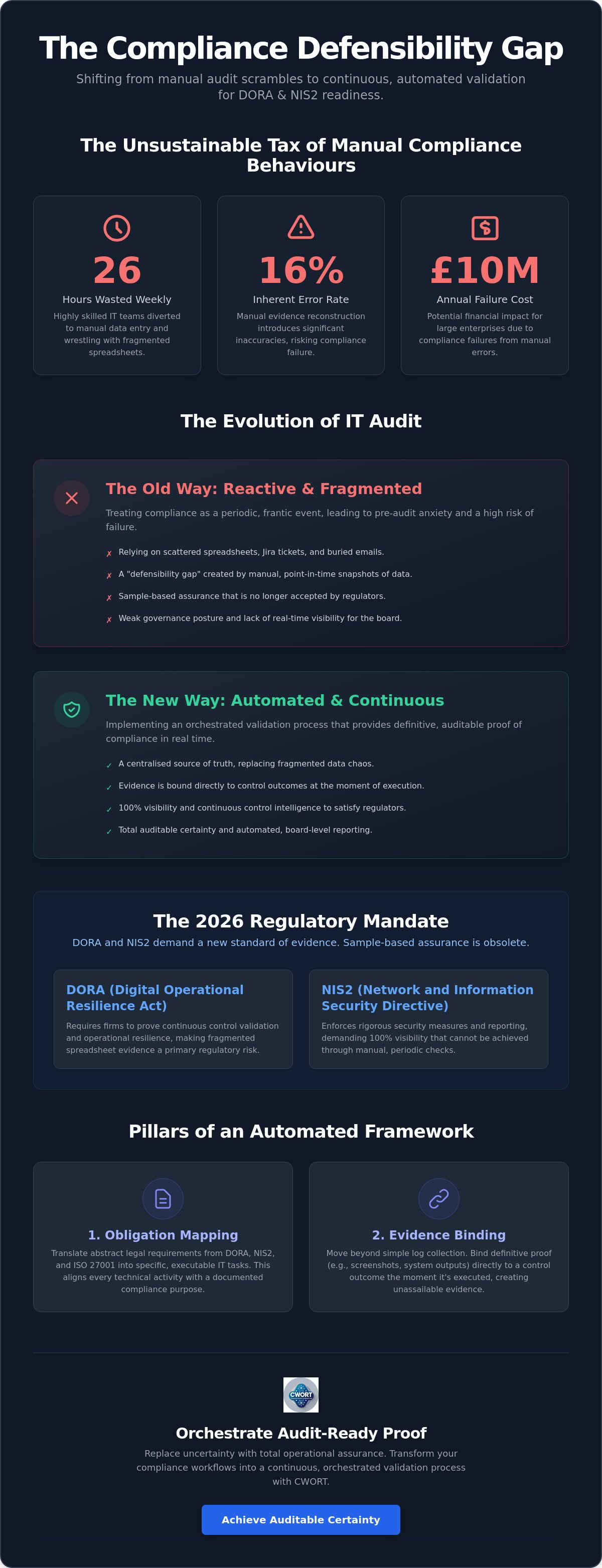
Why is your highly skilled IT team spending up to 26 hours every week wrestling with fragmented spreadsheets instead of securing your critical infrastructure? Transitioning to automated IT audit preparation is no longer optional for firms facing the rigorous enforcement cycles of DORA and NIS2 in 2026. Most organisations still treat compliance as a frantic, periodic event, relying on manual snapshots that risk immediate failure during a surprise inspection. This approach leaves evidence scattered across Jira tickets and buried emails, creating a dangerous lack of visibility for the board and a constant state of pre-audit anxiety.
You already understand that fragmented data leads to defensive, reactive governance. This article demonstrates how to transform these chaotic workflows into a continuous, orchestrated validation process that satisfies DORA, NIS2, and ISO 27001 requirements. We outline the shift from administrative tracking to definitive proof, providing a rigorous roadmap to automated, board-level reporting that replaces uncertainty with auditable certainty and total operational assurance.
Key Takeaways
- Shift your strategy from periodic snapshots to continuous validation by implementing automated IT audit preparation across your infrastructure.
- Identify the critical "defensibility gap" created by relying on spreadsheets or ticketing systems that fail to meet modern regulatory standards.
- Learn a structured roadmap for translating abstract legal obligations into executable IT tasks that generate real-time, auditable proof.
- Understand how to orchestrate a unified validation system that replaces fragmented emails and Excel sheets with a single, centralised source of truth.
- Gain the ability to produce automated, board-level compliance reports that demonstrate a state of total auditable certainty.
Table of Contents
- The Evolution of IT Audit Preparation: From Manual Scrambles to Continuous Validation
- Core Pillars of an Automated IT Audit Preparation Framework
- Why Traditional GRC Tools Fail Under DORA and NIS2 Scrutiny
- A Strategic Roadmap for Implementing Audit Automation in 2026
- Orchestrating Audit-Ready Proof with CWORT
The Evolution of IT Audit Preparation: From Manual Scrambles to Continuous Validation
The traditional Information technology audit has long been defined by a reactive cycle of panic and reconstruction. Historically, teams treated compliance as a point-in-time event, scrambling to gather evidence weeks before an auditor arrived. This model is now obsolete. As we move through 2026, the regulatory environment demands a definitive shift toward automated IT audit preparation. This process is not merely the automation of log collection. It's the systematic orchestration of evidence collection and control validation in real-time. It moves your organisation from a state of hoping you're compliant to knowing you're defensible.
Strategic urgency is no longer a boardroom buzzword; it's a survival requirement under the Digital Operational Resilience Act (DORA). Manual spreadsheet tracking is now a primary regulatory risk. Regulators increasingly view fragmented evidence across Excel and Jira as a sign of weak governance. True compliance validation requires a transition from simple log monitoring to a comprehensive system that proves every obligation is met by a specific, verifiable activity. This evolution replaces the anxiety of potential failure with the calm of auditable certainty.
The High Cost of Manual Compliance Behaviours
Manual compliance behaviours carry a hidden, unsustainable tax that drains technical resources. Industry reports indicate that IT professionals waste up to 26 hours every week on manual data entry and evidence gathering. This spreadsheet tax diverts your most expensive talent away from core security tasks. Beyond the time loss, the manual reconstruction of evidence carries an inherent 16% error rate. For large enterprises, these inaccuracies lead to compliance failures that can cost upwards of £10 million annually. Relying on human memory and scattered emails is no longer a viable strategy for high-stakes governance.
Why 2026 Regulators Reject Sample-Based Assurance
Regulators in 2026, particularly those enforcing DORA and NIS2, have moved beyond sample-based assurance. They no longer accept a small subset of data as proof of a robust security posture. These frameworks demand 100% visibility and continuous control intelligence. Automated IT audit preparation provides the auditable certainty required by UK financial authorities by binding proof directly to control outcomes at the moment of execution. This shift allows for real-time reporting that satisfies board-level requirements for transparency and risk management. Systems like CWORT enable this transition by translating abstract obligations into a disciplined, evidence-based reality.
Core Pillars of an Automated IT Audit Preparation Framework
Structural integrity in compliance requires more than just reactive monitoring. It demands a framework built on four non-negotiable pillars that transform abstract regulatory text into defensible evidence. Implementing automated IT audit preparation shifts the focus from administrative tracking to rigorous, outcome-based validation. This transition ensures that every control is not just active but demonstrably effective under the scrutiny of DORA or NIS2. Without these foundational elements, automation remains a superficial layer over a broken process.
Obligation Mapping: The Foundation of Orchestration
Effective automation begins with the regulation, not the software. You must first inventory your legal obligations across frameworks such as DORA, NIS2, and ISO 27001 before attempting to automate. This process involves translating high-level requirements into specific, executable IT tasks. By aligning your strategy with an established IT Audit Framework (ITAF), you ensure that every technical activity serves a documented compliance purpose. An orchestration engine then manages these cross-framework obligations, ensuring no requirement is overlooked in a fragmented environment. This alignment turns passive requirements into a disciplined, execution-driven workflow.
Evidence Binding vs. Log Collection
Distinguish between raw logs and validated compliance proof. Most organisations confuse log collection with evidence, yet a log without context is merely noise. Successful automated IT audit preparation relies on evidence binding, which attaches proof directly to a control outcome at the moment of execution. This contextual link proves that a specific security action fulfilled a specific regulatory obligation. It prevents the frantic data reconstruction typically seen in traditional audits. To ensure evidence integrity, your platform must prevent tampering and ensure that proof is immutable from the point of capture, creating a defensible chain of custody.
Beyond mapping and binding, your framework must enforce a strict separation of duties. This prevents compliance shortcuts by ensuring that the person executing a task is not the same person validating its success. Finally, replace static PDF reports with real-time dashboards. These live interfaces provide an immediate view of your audit-ready status, allowing leadership to move from periodic anxiety to a state of total assurance. By leveraging a dedicated platform like CWORT, you can replace fragmented tracking with a single orchestrated validation system. If you're ready to move beyond manual tracking, you can see how orchestration transforms your posture by requesting a tailored demonstration.
Why Traditional GRC Tools Fail Under DORA and NIS2 Scrutiny
Stop confusing productivity with proof. Relying on generic project management software for high-stakes regulatory oversight is a strategic error that leaves your organisation vulnerable. Many firms mistakenly believe that a populated Jira board or a meticulous Excel sheet constitutes an audit-ready system. It doesn't. These tools were designed for operational efficiency, not for the rigorous automated IT audit preparation required in 2026. Tracking a task is fundamentally different from validating a compliance outcome. Whilst a task manager records that work was assigned, it fails to provide the immutable link between the regulatory obligation and the evidence of its execution.
The "Jira Gap": Why Task Management Isn’t Compliance
Jira is a powerful engine for development, but it lacks the structural integrity needed for DORA compliance validation. The primary failure point is "compliance drift". This occurs when engineers mark tickets as complete without binding the specific, context-rich proof required by an auditor. Without a system that mandates evidence attachment before a task is closed, your audit trail becomes a collection of unsubstantiated claims. This is exactly Why Jira is Not a Compliance Orchestration Tool. It provides visibility into activity, but it offers zero assurance of regulatory adherence or technical validation.
A critical requirement of DORA and NIS2 is the enforced Separation of Duties (SoD). Traditional GRC tools and project boards often allow the same individual to perform a security control and then self-certify its success. Regulators now demand a system that prevents these shortcuts by design. Fragmented systems further complicate this by scattering evidence across disparate platforms. Reconstructing a coherent narrative from these silos during a surprise audit is nearly impossible. It leads to defensiveness and anxiety rather than the calm of auditable certainty.
The Fragility of Spreadsheet-Based Audit Trails
Spreadsheets are inherently fragile and lack the traceability required for NIS2 and UK NIS frameworks. Regulators view manual trackers as unreliable because they are prone to human error and lack an immutable audit log. An Excel sheet cannot prove the who, what, and when of control effectiveness with the level of rigour demanded in 2026. Transitioning to automated IT audit preparation eliminates this vulnerability by replacing manual entry with a disciplined, orchestrated system of record. This shift ensures that every piece of evidence is contextually bound to a specific control, making your compliance posture both transparent and unassailable.
A Strategic Roadmap for Implementing Audit Automation in 2026
Transitioning to automated IT audit preparation requires a disciplined, phased approach that replaces reactive scrambling with systematic orchestration. In 2026, the margin for error has vanished as DORA enforcement cycles begin and the October deadline for NIS2 security measures approaches. Implementation is not a software installation; it's a structural shift from administrative tracking to evidence-based proof. Follow this five-step roadmap to achieve total auditable certainty:
- Step 1: Inventory Regulatory Obligations. Categorise your requirements across DORA, NIS2, and ISO 27001 to identify overlapping controls and unique technical mandates.
- Step 2: Map Obligations to Technical Controls. Translate abstract legal text into specific technical and organisational settings within your infrastructure.
- Step 3: Define Validated Execution Workflows. Establish "execution activities" that mandate the attachment of evidence at the moment a task is performed.
- Step 4: Automate the Reporting Layer. Connect your validation engine to live dashboards that provide real-time visibility for the board and regulators.
- Step 5: Conduct Continuous Mock Audits. Use your platform to run internal validation cycles, ensuring your evidence remains immutable and defensible before an official inspection.
Mapping the UK Regulatory Landscape
Successful implementation requires aligning your automation strategy with specific British standards. This means integrating your workflows with NCSC CAF assessment software requirements to ensure you meet the Cyber Assessment Framework gold standard. You must bridge the gap between ISO 27001's broad controls and the granular technical standards demanded by DORA. By utilising dedicated UK NIS Audit Readiness Software, you can ensure that your automated IT audit preparation accounts for local regulatory nuances whilst maintaining global compliance integrity.
Designing for Auditor-Ready Outputs
A regulator-ready report in 2026 must be more than a collection of data; it must be a narrative of defensible truth. Board-level dashboards should provide strategic value by highlighting risk posture and control effectiveness, rather than overwhelming leadership with technical noise. The goal is "one-click" audit reporting. This capability reduces the pre-audit scramble from weeks of manual labour to a few minutes of automated generation. When your reporting layer is built on validated proof rather than manual claims, you provide the transparency that UK financial authorities now demand. If you're ready to secure your compliance future, you can request a tailored demonstration to see this roadmap in action.
Orchestrating Audit-Ready Proof with CWORT
Replace fragmented tracking with a single, disciplined source of truth. CWORT functions as a proactive orchestration platform that enforces accountability by design, moving beyond the passive monitoring typical of traditional GRC tools. It provides the structural integrity required to transform abstract regulatory requirements into a defensible reality. By centralising automated IT audit preparation, the platform ensures that every technical activity is directly tied to a specific legal obligation. This creates a state of auditable certainty that satisfies both internal stakeholders and external regulators.
For consulting teams and large enterprises, CWORT acts as a high-level strategic partner, providing a standardised framework for achieving "DORA-ready" status across complex ICT environments. It allows compliance specialists to deploy proven validation templates that eliminate the time spent on administrative overhead. This focus shifts the organisational energy from mere tracking to high-value risk mitigation. The system is not a passive utility but a rigorous orchestrator that ensures every stage of the compliance process is clearly accounted for and documented.
From Obligation to Evidence: The CWORT Workflow
The CWORT orchestration engine operates through a methodical and disciplined validation workflow. It translates complex mandates into specific execution activities, ensuring that no control is marked as complete without the attachment of immutable proof. This process is essential for Mastering the DORA ICT Risk Management Framework, where the depth of evidence is just as critical as the control itself. The platform's validation dashboards provide a real-time view of your compliance health, whilst the system enforces a strict separation of duties. This prevents the self-certification risks inherent in manual systems; every piece of evidence is verified by an independent party before it reaches the final audit trail.
Strategic Benefits for the Board and the Auditor
Achieving a continuous state of readiness eliminates the traditional pre-audit scramble and the operational anxiety that accompanies it. CWORT provides boards with a transparent, high-level view of the organisation's risk posture, replacing technical noise with strategic, evidence-based insight. This level of orchestration significantly reduces the complexity and overhead of ISO 27001 control mapping, allowing teams to maintain multiple certifications amongst a single unified environment. Auditors gain immediate access to a coherent, tamper-proof narrative of compliance, which accelerates the inspection process and reduces the likelihood of adverse findings. Secure your organisation's regulatory standing by moving from reactive tracking to orchestrated proof. Book a CWORT demonstration to see automated IT audit preparation in action.
Secure Your Regulatory Defensibility in 2026
Maintaining a state of constant audit readiness is no longer a luxury; it's a structural requirement for any firm operating under the oversight of DORA and NIS2. You must move beyond the fragmented workflows of Jira and Excel, which lack the context and rigour demanded by modern regulators. By implementing automated IT audit preparation, you replace the anxiety of manual reconstruction with a disciplined system that binds evidence directly to regulatory obligations at the moment of execution. This shift ensures that your compliance posture remains unassailable, providing the board with clear, evidence-based proof of operational resilience.
As a UK-based regulatory orchestration platform, CWORT is designed to bridge the gap between abstract mandates and technical reality, ensuring you're fully DORA and NIS2 ready. Stop wrestling with spreadsheets and start enforcing accountability by design. Request a CWORT demo to automate your IT audit preparation today and transform your compliance from a burden into a definitive strategic advantage. You can achieve total auditable certainty and regain control over your governance landscape.
Frequently Asked Questions
What is automated IT audit preparation?
Automated IT audit preparation is the systematic orchestration of evidence collection and control validation in real-time. It replaces manual spreadsheet tracking with a disciplined engine that binds immutable proof directly to regulatory obligations. This process ensures that your organisation maintains a state of auditable certainty rather than scrambling for snapshots during a surprise inspection.
Can I use Jira for automated compliance tracking?
Jira is designed for operational task management and lacks the structural integrity required for compliance validation. It cannot enforce the strict separation of duties or immutable evidence binding mandated by DORA and NIS2. Relying on Jira creates a defensibility gap because tasks are often marked as complete without the context-rich proof an auditor requires to verify a control's effectiveness.
How does automation help with DORA and NIS2 compliance?
Automation transitions your security posture from periodic sampling to 100% visibility across your infrastructure. It ensures that every technical activity serves a documented compliance purpose by mapping obligations directly to execution tasks. This level of orchestration is critical for meeting 2026 enforcement deadlines and providing the high-level reporting required by European and UK authorities.
What is evidence binding in a regulatory context?
Evidence binding is the process of attaching immutable proof directly to a control outcome at the exact moment of execution. Unlike simple log collection, binding provides the contextual link between a security action and a specific regulatory requirement. This ensures that your audit trail is transparent and tamper-proof, eliminating the need for manual data reconstruction during an audit cycle.
How long does it take to implement an automated audit prep system?
Implementation timelines vary based on organisational complexity, but a phased rollout typically begins with an obligation inventory. Most enterprises can establish core orchestration for a specific framework like DORA within a few weeks. Achieving a fully integrated system across multiple frameworks is a strategic transition that replaces legacy manual behaviours with a disciplined, automated workflow.
Does automation replace the need for an internal auditor?
Automation doesn't replace the internal auditor; it liberates them from the burden of administrative data entry. By adopting automated IT audit preparation, auditors shift their focus from gathering fragmented evidence to high-level risk analysis and strategic governance. The platform provides the validated proof, allowing the auditor to act as a meticulous guardian of standards rather than a data collector.
How do automated tools handle multiple frameworks like ISO 27001 and NIS2?
Advanced orchestration platforms use cross-framework mapping to identify overlapping controls between ISO 27001, NIS2, and DORA. This allows you to execute a single technical activity that satisfies multiple regulatory requirements simultaneously. It reduces duplication of effort and ensures that your compliance posture remains consistent across all jurisdictions and technical standards.
Is automated evidence collection acceptable to UK regulators?
UK regulators, including those overseeing the NCSC CAF and financial standards, increasingly prefer automated evidence because it reduces human error and provides an immutable audit trail. Manual spreadsheets are now viewed as a primary regulatory risk due to their inherent lack of traceability. Automated validation provides the definitive proof required to demonstrate structural integrity and operational resilience.
Disclaimer
The content on this site is provided for general information and educational purposes only. It does not constitute legal, regulatory, financial, or professional advice. CWORT provides AI-assisted insights and workflow automation, but all compliance decisions remain the responsibility of your organisation and its management. Always seek qualified legal or regulatory guidance for decisions relating to the UK NIS Regulations, CAF, DORA, NIS2, ISO 27001, or other obligations.
Related posts
Streamlining Regulatory Compliance Processes: From Manual Tracking to Orchestrated Validation
Stop wasting money on manual compliance. Learn about streamlining regulatory compliance processes to reduce personal liability under DORA & NIS2 and gain aud...
Reducing Audit Preparation Time and Costs: A Strategic Guide for UK Enterprises
Tired of costly audit seasons? Our guide for UK enterprises shows you how to stop the manual scramble, reducing audit preparation time and costs with automat...
GRC Platform vs Compliance Validation Tool: Choosing the Right Architecture for 2026
GRC platform vs compliance validation tool: Is your GRC ready for 2026? Learn how automated validation provides the defensible proof needed for DORA & NIS2.
Article by
Michael Iyiola
Co-Founder, CWORT
Michael Iyiola is a co-founder of CWORT and a Cyber and AI Security Engineer with deep experience in vulnerability management, detection engineering and operational resilience across UK critical national infrastructure, including rail, energy and financial services. At CWORT, he designs scalable, evidence-driven workflows that help teams meet modern regulatory and security demands.
Build Your Foundation of Auditable Certainty
Take control of your regulatory obligations and secure your infrastructure with CWORT.