GRC Platform vs Compliance Validation Tool: Choosing the Right Architecture for 2026

Michael Iyiola
Co-Founder, CWORT
GRC platform vs compliance validation tool: Is your GRC ready for 2026? Learn how automated validation provides the defensible proof needed for DORA & NIS2.

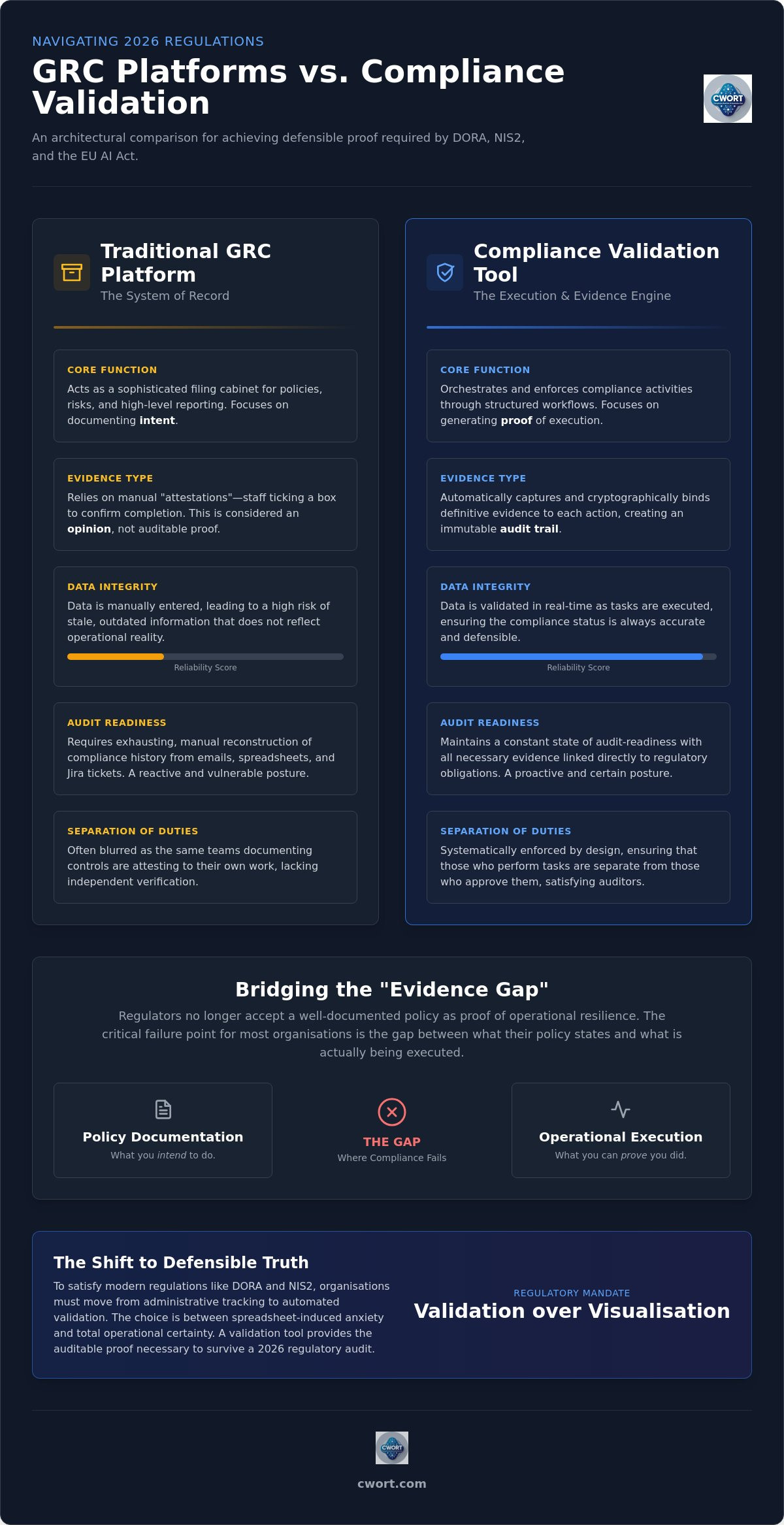
Your current GRC platform is likely a sophisticated filing cabinet that lacks the rigor required to survive a 2026 regulatory audit. While these systems excel at documenting what you intend to do, they consistently fail to produce the definitive, execution-linked evidence required by modern mandates like DORA and NIS2. When evaluating a GRC platform vs compliance validation tool, the choice isn't just about software; it's about the architecture of your defensible truth.
You've likely felt the exhaustion of manually reconstructing compliance statuses from Jira tickets and fragmented spreadsheets whilst the board demands real-time assurance. It's a high-stakes game of catch-up that leaves your organisation vulnerable to compliance drift and audit failure. This article will demonstrate how shifting from administrative tracking to automated validation provides the auditable proof necessary to satisfy the EU AI Act and the ISO 27001:2022 standards. We'll explore why moving to an orchestrated system ensures a strict separation of duties and replaces spreadsheet-induced anxiety with total operational certainty.
Key Takeaways
- Understand why the industry's shifting from static data repositories to active orchestration to meet the rigorous demands of 2026 regulations.
- Evaluate the architectural differences of a GRC platform vs compliance validation tool to determine which system provides the defensible proof required for DORA and NIS2 audits.
- Replace the inherent risks of stale, manual data entry with an execution engine that automatically binds evidence to every regulatory obligation.
- Enforce a non-negotiable separation of duties within your compliance workflow to satisfy central bank auditors and provide board-level certainty.
- Learn how to integrate validation tools with your existing GRC systems to maintain enterprise visibility whilst achieving operational rigour.
Table of Contents
- Defining the Divide: GRC Platforms vs Compliance Validation Tools
- The GRC Platform: Strengths and Structural Limitations
- Compliance Validation: The Execution and Evidence Engine
- Why Regulators Demand Validation Over Visualisation
- Choosing the Right Architecture for Your Organisation
Defining the Divide: GRC Platforms vs Compliance Validation Tools
By 2026, the gap between "managing" compliance and "validating" it has become the primary hurdle for senior leadership. Regulators no longer accept a well-documented policy as proof of operational resilience. They demand evidence of execution. The fundamental distinction in the GRC platform vs compliance validation tool debate lies in the transition from administrative tracking to active, technical orchestration. Whilst traditional systems focus on the "what" of regulatory requirements, validation tools focus on the "how" and the "proof."
Most organisations rely on foundational governance, risk, and compliance (GRC) frameworks to organise their internal standards. However, these frameworks often suffer from the "Evidence Gap." This occurs when a control is documented in a policy but remains invisible in practice. A validation tool bridges this gap by binding execution data directly to the regulatory obligation, ensuring that every claim made to an auditor is backed by defensible, real-time truth.
The Role of the GRC Platform in 2026
The GRC platform remains your organisation's essential system of record. It's the central hub for policy management, high-level risk heatmaps, and board-level reporting. Its primary function is to provide visibility across the enterprise, yet its structural limitations are becoming clearer under the weight of DORA and NIS2. These platforms typically rely on manual data entry and "attestations," where a staff member simply ticks a box to confirm a task was completed. In a high-stakes audit, an attestation is merely an opinion; it isn't evidence. Without an automated feed of validated data, your GRC risks becoming a repository of stale information that fails to reflect your actual security posture.
The Emergence of Compliance Validation
Compliance validation represents a shift toward disciplined orchestration. Instead of treating regulations as abstract concepts, systems like CWORT translate these obligations into structured, actionable activities. This is the execution engine of your compliance architecture. It moves beyond "check-the-box" mentalities by enforcing a rigid workflow where evidence is captured at the moment of execution. This approach provides auditable certainty that satisfies the most rigorous central bank inspections. By automating the collection of proof, you eliminate the manual reconstruction of compliance history and ensure that your organisation remains in a constant state of audit-readiness. It's about shifting from a reactive posture to one of proactive, systematic control.
The GRC Platform: Strengths and Structural Limitations
GRC platforms serve as the strategic command centre for an organisation's risk management efforts. They excel at aggregating data for board-level reporting and providing enterprise-wide visibility into potential threats. Yet, when evaluating a GRC platform vs compliance validation tool, the structural limitations of traditional GRC systems become apparent during high-stakes regulatory scrutiny. The primary issue is the reliance on manual data entry. This creates a permanent risk of "stale" compliance data, where the status reported to leadership no longer reflects the technical reality on the ground.
Manual reconstruction of compliance history during a DORA or NIS2 audit is not just inefficient; it's expensive. Teams spend hundreds of hours digging through emails and task logs to prove a control was active six months ago. This fragmented approach undermines the integrity of the GRC, turning it into a passive repository rather than an active guardian of standards. It leaves leadership in a state of perceived security that often collapses under the weight of a detailed inspection.
The Challenge of Fragmented Tracking
Many UK enterprises mistakenly treat Jira as a compliance orchestration tool. Whilst Jira is excellent for project management, it lacks the cryptographic binding and enforced workflows required for regulatory defensibility. This leads to "compliance silos" where different departments track obligations in isolation. The result is a reliance on spreadsheets. These documents often become the "hidden" GRC that regulators actually audit, despite their lack of version control or audit integrity. To move beyond these fragmented systems, you might consider how to automate your evidence collection to ensure total visibility.
The Attestation Trap
The most significant weakness in traditional GRC architecture is the attestation trap. This occurs when an employee simply confirms a control is "done" without providing objective proof. In 2026, regulators are moving away from trust-based attestations. Whether you are aiming for NIST compliance or meeting the strict requirements of DORA, an immutable audit trail is non-negotiable. An attestation is merely an assertion; it is not evidence. A GRC platform rarely provides the technical validation needed to prove that a control was executed correctly, by the right person, at the right time. This lack of rigour is precisely why a dedicated validation engine is becoming essential for modern governance.
Compliance Validation: The Execution and Evidence Engine
While GRC platforms document your intent, a compliance validation tool drives your execution. The market is shifting away from "systems of record" toward "systems of execution" that bridge the gap between policy and practice. When comparing a GRC platform vs compliance validation tool, the primary differentiator is the ability to orchestrate technical workflows. A validation engine does not wait for an annual audit to identify a gap; it enforces the control at the moment of activity, ensuring that every regulatory obligation is met with a corresponding, verified action.
Systems like CWORT translate abstract regulatory requirements into discrete, actionable tasks. This transformation is vital for maintaining a defensible posture under DORA or NIS2. Instead of a vague instruction to "monitor access logs," the system generates specific, time-bound execution activities. These activities are then tracked through a disciplined workflow that produces regulator-ready outputs without the need for manual data gathering or retrospective reconstruction. This is not merely tracking; it is the systematic enforcement of institutional rigour.
Orchestrating the Compliance Workflow
Effective orchestration eliminates the ambiguity that often leads to audit failure. By building a regulatory obligation execution workflow, you ensure that every task is accounted for and assigned to the correct stakeholder. Crucially, this architecture enforces a strict separation of duties. This is a non-negotiable requirement for DORA compliance, ensuring that the individual performing a task is never the one validating its success. Automated task enforcement replaces the need for manual follow-ups, reducing the risk of human error and ensuring that compliance drift is identified and rectified in real-time.
Evidence Binding and Integrity
The integrity of your data is the foundation of your regulatory defence. High-stakes environments require absolute compliance evidence integrity to survive a central bank inspection. A validation tool achieves this by binding metadata and cryptographic timestamps directly to the control outcome at the point of execution. This creates an immutable audit trail that proves exactly what happened, when it happened, and who was responsible. In the 2026 regulatory landscape, "audit-ready" must mean "instant." If your team requires weeks to prepare for an inspection, your architecture is already failing. Validation ensures that the proof is always ready, providing a state of constant, auditable certainty.
Why Regulators Demand Validation Over Visualisation
Regulators in 2026 have moved beyond the era of trust. In the UK financial sector, the Digital Operational Resilience Act (DORA) has fundamentally altered the expectations for board-level reporting, shifting the burden of proof from the auditor to the organisation. A colourful heatmap in a traditional GRC platform might indicate a low-risk status, but without underlying evidence, it's merely a visual representation of an assumption. When choosing between a GRC platform vs compliance validation tool, the decision hinges on your ability to survive a central bank audit. Regulators now demand granular, execution-linked proof that controls are functioning as intended, rather than static documentation that sits in a repository.
Validation tools act as the antidote to "compliance drift," a common phenomenon where security configurations slowly deviate from the required standard between audit cycles. By continuously verifying that controls are active, these systems ensure that the "validated" status reported to the board matches the technical reality. This level of rigour is now a baseline expectation for critical infrastructure and financial services, where the cost of a compliance gap can lead to significant punitive measures and reputational damage.
DORA and the Shift to Operational Resilience
DORA mandates that ICT risk management must be validated through rigorous testing and continuous monitoring. It's no longer sufficient to document a disaster recovery plan; you must provide evidence that the plan was executed and verified by a separate party. Proving this separation of duties is a core requirement that many UK organisations struggle to meet using fragmented, manual workflows. Achieving a DORA compliance validation standard requires a shift from periodic audits to a model of continuous validation. This proactive approach ensures that your organisation remains resilient against evolving threats whilst maintaining a constant state of audit-readiness.
NIS2 and UK NIS: Orchestrating Resilience
For those in critical infrastructure, the NIS2 directive and the UK NIS framework impose similar pressures. Using a NIS2 compliance platform allows organisations to orchestrate resilience across complex supply chains and internal departments. Boards need visibility into the actual state of their controls, not just a "reported" status that relies on human updates. This distinction is critical as we enter the "no-notice" audit reality of 2026. Regulators can demand proof of compliance at any moment, leaving no time for the manual reconstruction of evidence. To ensure your organisation is audit-ready at all times, book a validation strategy session today to see how orchestration can transform your defensive posture.
Choosing the Right Architecture for Your Organisation
Decisions regarding your compliance architecture must be driven by the complexity of your regulatory obligations. A GRC-led strategy is often suitable for high-level risk visibility; however, it lacks the execution rigour required for technical resilience. When comparing a GRC platform vs compliance validation tool, the decisive factor is your "Time to Evidence." This metric measures how quickly your organisation can retrieve defensible, unalterable proof of control execution. In a no-notice audit, this speed is the difference between a successful inspection and a costly failure.
Replacing manual trackers with regulatory compliance workflow automation provides a clear return on investment. You eliminate the hundreds of hours SMEs spend on manual data gathering and status reporting. By automating the evidence lifecycle, you ensure that your compliance posture is a reflection of real-time execution rather than a point-in-time snapshot. This transition removes the burden of administrative tracking and allows your technical teams to focus on operational security rather than paperwork.
The Hybrid Approach: GRC + Validation
Most mature organisations achieve the best results by integrating CWORT with their existing GRC systems. This hybrid architecture uses the GRC platform to define the "what"—the high-level policies and risk registers—whilst CWORT handles the "how" through active orchestration. This creates a seamless flow where every policy requirement triggers a validated execution activity. The resulting evidence is then fed back into the GRC for board-level reporting. This synergy ensures that your risk heatmaps are powered by validated data, providing leadership with a level of certainty that manual attestations can never match.
Strategic Next Steps for 2026
Begin by auditing your current evidence collection process to identify manual bottlenecks. Map your most critical DORA or ISO 27001 controls into a validation engine to ensure they are being executed according to standard. Move away from reactive audit preparation and adopt a proactive "always-ready" validation model. This disciplined approach ensures that your organisation is not just compliant on paper, but resilient in practice. Prioritise the automation of controls with the highest audit frequency to achieve the fastest impact on your operational efficiency and regulatory defensibility.
Secure Your Regulatory Future with Orchestrated Validation
The landscape of 2026 demands more than visual heatmaps and administrative attestations. You must shift from a passive repository to an active execution engine that binds evidence to every regulatory obligation. By replacing fragmented Jira and Excel tracking with a single orchestrated system, you eliminate the anxiety of audit failure and the high cost of manual reconstruction. This transition ensures that your compliance posture is built on a foundation of technical truth rather than human assertion.
Choosing between a GRC platform vs compliance validation tool is a strategic decision that defines your organisation's operational rigour. CWORT, developed by Lapace Services UK Ltd for high-stakes regulatory environments, is specifically designed for DORA, NIS2, and ISO 27001 validation. It provides the definitive, auditable proof required to satisfy the most uncompromising regulators whilst significantly reducing the administrative burden on your subject matter experts.
It's time to move beyond the limitations of traditional tracking and embrace a state of constant, auditable certainty. Book a CWORT demonstration to see compliance validation in action and transform your defensive posture today.
Frequently Asked Questions
What is the main difference between a GRC platform and a compliance validation tool?
The primary distinction in the GRC platform vs compliance validation tool debate lies in the transition from administrative documentation to technical execution. GRC platforms act as repositories for high-level policies and risk heatmaps. Validation tools function as orchestration engines that enforce controls and capture immutable evidence at the moment of activity, ensuring that your compliance posture is backed by technical reality rather than manual updates.
Can a compliance validation tool replace my existing GRC system?
Yes, although many enterprise organisations utilise them as complementary architectures. A validation tool replaces the manual evidence-gathering and task-tracking functions that typically fail within a standard GRC. Whilst you may retain your GRC for board-level risk visualisation, the validation engine becomes the authoritative source of truth for technical audits and operational resilience.
How does compliance validation help with DORA requirements?
Compliance validation satisfies the DORA mandate for active, continuous testing of ICT risk management frameworks. It moves beyond static policy statements by providing auditable proof that controls are functioning correctly. By automating the validation process, you ensure that your organisation meets the strict resilience standards demanded by UK and EU financial regulators without the need for manual intervention.
Why is separation of duties so difficult to enforce in a standard GRC?
Standard GRC platforms often lack the hard-coded workflow logic required to prevent the same individual from both performing and approving a task. They rely on trust-based attestations rather than enforced technical barriers. Validation tools solve this by orchestrating workflows that strictly separate duties by design. This ensures that proof of execution is verified by an independent party as a prerequisite for compliance.
Does a compliance validation tool automate the actual evidence collection?
Automated evidence collection is a core capability of a validation engine. Instead of teams manually uploading screenshots or logs, the tool captures relevant metadata and cryptographic timestamps at the point of control execution. This creates a defensible audit trail that's generated in real-time. It eliminates the need for retrospective data gathering and ensures your evidence is always current.
How do regulators view compliance validation outputs compared to GRC reports?
Regulators increasingly favour validated proof over the high-level visualisations found in a typical GRC. A validation output provides granular, execution-linked evidence that demonstrates exactly how a requirement was met. This level of rigour provides auditors with far greater assurance than a heatmap, which often relies on subjective, manual updates that don't reflect current operational reality.
Is compliance validation suitable for ISO 27001 audits?
Validation is highly effective for ISO 27001:2022 audits, particularly for Annex A controls that require technical verification. It ensures that your Information Security Management System (ISMS) is backed by continuous evidence rather than point-in-time snapshots. This approach simplifies the audit process by providing the external auditor with immediate access to a complete, verified history of control performance.
What is 'evidence binding' and why is it critical for UK enterprises?
Evidence binding is the technical process of linking a specific piece of proof directly to a regulatory obligation and its execution timestamp. For UK enterprises, this is critical for ensuring data integrity and non-repudiation. It prevents compliance drift and ensures that if a regulator asks for proof of a control from six months ago, you can produce unalterable evidence instantly.
Disclaimer
The content on this site is provided for general information and educational purposes only. It does not constitute legal, regulatory, financial, or professional advice. CWORT provides AI-assisted insights and workflow automation, but all compliance decisions remain the responsibility of your organisation and its management. Always seek qualified legal or regulatory guidance for decisions relating to the UK NIS Regulations, CAF, DORA, NIS2, ISO 27001, or other obligations.
Related posts
Regulatory Scrutiny Management Tool: Orchestrating Defensible Compliance in 2026
Facing DORA & NIS2? A regulatory scrutiny management tool orchestrates defensible compliance, ending manual evidence chaos for permanent audit-readiness in 2...
Regulatory Compliance Workflow Automation for UK Enterprise: A Strategic Guide
Ditch spreadsheets for DORA & NIS2. Our guide to regulatory compliance workflow automation delivers auditable certainty and board-level assurance for UK ente...
Streamlining Regulatory Compliance Processes: From Manual Tracking to Orchestrated Validation
Stop wasting money on manual compliance. Learn about streamlining regulatory compliance processes to reduce personal liability under DORA & NIS2 and gain aud...
Article by
Michael Iyiola
Co-Founder, CWORT
Michael Iyiola is a co-founder of CWORT and a Cyber and AI Security Engineer with deep experience in vulnerability management, detection engineering and operational resilience across UK critical national infrastructure, including rail, energy and financial services. At CWORT, he designs scalable, evidence-driven workflows that help teams meet modern regulatory and security demands.
Build Your Foundation of Auditable Certainty
Take control of your regulatory obligations and secure your infrastructure with CWORT.