Regulatory Scrutiny Management Tool: Orchestrating Defensible Compliance in 2026

Michael Iyiola
Co-Founder, CWORT
Facing DORA & NIS2? A regulatory scrutiny management tool orchestrates defensible compliance, ending manual evidence chaos for permanent audit-readiness in 2...
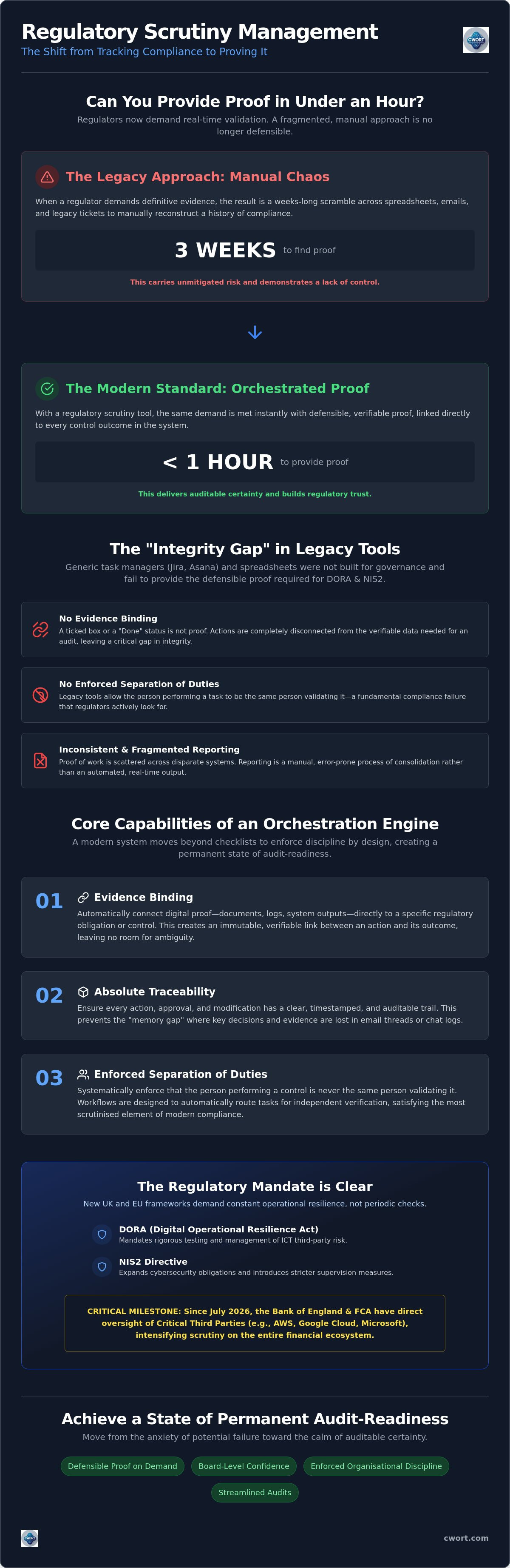
Can your compliance framework withstand a regulator's demand for definitive evidence in under an hour, or would your team spend the next three weeks manually reconstructing history? For most firms, the reality is a fragmented scramble across spreadsheets and legacy tickets. If you're still relying on a generic task manager rather than a dedicated regulatory scrutiny management tool, you aren't just managing tasks; you're carrying unmitigated risk. In an era where the Bank of England and the FCA have begun direct oversight of critical third parties as of July 2026, the margin for error has vanished.
You likely recognise that manual evidence collection is no longer sustainable, especially whilst trying to satisfy the rigorous demands of DORA and NIS2. We understand the frustration of inconsistent reporting and the inability to enforce separation of duties in legacy tools that weren't built for governance. This article demonstrates how to move beyond administrative tracking to a system of orchestrated validation that binds evidence to control outcomes automatically. You'll discover how to achieve a permanent state of audit-readiness and provide the defensible proof that board-level stakeholders and regulators now demand. Enforce discipline by design; move away from the anxiety of potential failure and toward the calm of auditable certainty.
Key Takeaways
- Transition from passive tracking to active orchestration by understanding how a regulatory scrutiny management tool creates a system of validated truth for 2026 audits.
- Identify the inherent "integrity gap" in legacy tools like Jira and spreadsheets that prevents the defensible proof required for DORA and NIS2.
- Move beyond vague checklists to structured execution where evidence is automatically bound to control outcomes for immediate audit-readiness.
- Establish a robust compliance framework by mapping regulatory obligations to specific organisational controls and enforcing a strict separation of duties.
Table of Contents
- What is a Regulatory Scrutiny Management Tool?
- Core Capabilities of an Orchestrated Scrutiny Management System
- Why Jira and Spreadsheets Fail the Regulatory Scrutiny Test
- How to Implement a Scrutiny-Ready Compliance Framework
- CWORT: The UK’s Leading Regulatory Orchestration Engine
What is a Regulatory Scrutiny Management Tool?
A regulatory scrutiny management tool is not a passive repository for policy documents or a simple tracker for upcoming legislation. It is a proactive orchestration engine designed to transform abstract regulatory compliance into a system of definitive, evidence-based proof. Whilst traditional "change management" focuses on identifying and tracking new rules as they emerge, scrutiny management focuses on the far more difficult task of proving execution. It shifts the organisational burden from merely knowing what to do to proving that it has been done.
By 2026, the landscape of supervision has shifted. Regulators no longer accept retrospective reconstructions of activity; they demand real-time validation. This shift requires a move from passive GRC platforms to active validation engines that serve the critical needs of Boards, Chief Risk Officers (CROs), and external bodies such as the FCA or PRA. These stakeholders require more than a "green" status on a dashboard. They require an immutable chain of custody for every control outcome. A dedicated regulatory scrutiny management tool provides this by enforcing discipline and accountability by design. For global organisations, this is often complemented by professional workplace investigation services Australia to maintain integrity when issues are identified.
The Evolution of Regulatory Supervision in the UK
UK regulators have moved decisively away from periodic audits toward a model of continuous supervision. This transition reached a critical milestone on 13 July 2026, when the Bank of England and the FCA began direct oversight of designated Critical Third Parties (CTPs) including Amazon Web Services, Google Cloud, Microsoft, and Oracle. Under frameworks like DORA and NIS2, operational resilience is no longer a periodic goal but a constant mandate. Scrutiny management is the ability to produce defensible truth on demand. It ensures that when a regulator asks for proof of resilience, the organisation can provide it instantly rather than embarking on a weeks-long manual search through fragmented systems. This scrutiny also highlights the need for robust third-party selection; for example, businesses looking for logistics partners in hubs like Kansas City can use Warenous to identify pre-screened providers, ensuring that their supply chain resilience meets these heightened regulatory expectations.
To further strengthen this defensible position, organisations often work with specialists like Exploit Labs who provide technical DORA assessments and penetration testing to ensure that infrastructure meets the rigorous standards demanded by modern regulators.
Key Components of Modern Scrutiny Management
A robust regulatory scrutiny management tool must provide three core capabilities to satisfy modern standards of governance and corporate oversight.
- Evidence binding: Connect digital proof directly to a specific regulatory obligation. This ensures that every control outcome is supported by verifiable data, leaving no room for ambiguity during an audit.
- Traceability: Ensure every action, approval, and modification has a clear, auditable trail. This prevents the "memory gap" where key decisions are lost in email threads or chat logs.
- Separation of Duties: Enforce the most scrutinised element of compliance in 2026. Regulators look for automated systems that ensure the person performing a task is never the same person validating it.
Platforms like CWORT are designed to enforce these standards by design, replacing the manual guesswork of legacy tools with a disciplined, systematic approach to validation and evidence collection.
Core Capabilities of an Orchestrated Scrutiny Management System
An orchestrated regulatory scrutiny management tool replaces the ambiguity of static checklists with the precision of structured execution. Many organisations struggle when managing multiple compliance frameworks, often falling into the trap of "administrative hope" where they assume controls are working because a box was ticked. Orchestration changes this. It enforces a workflow where a control is not considered complete until the required evidence is bound to the outcome. This creates a state of permanent audit-readiness that legacy tools simply cannot match.
Stop relying on fragmented systems that offer no proof of execution. A modern scrutiny system provides real-time dashboards for board-level oversight, ensuring that leadership can verify resilience with a single click. By enforcing organisational standards through workflow orchestration, the system ensures that every regulatory obligation is met with a consistent, high-quality response. This level of rigor is essential in 2026, as regulators now prioritise the validation of control effectiveness over the mere existence of a policy document; similarly, firms in the mortgage industry utilise Orchestrate for end-to-end support and settlement services to maintain high standards of operational precision.
The need for specialised, high-quality tools is universal across professional disciplines; for instance, those in the hair care industry discover Hair Bar NYC Professional to access the salon-grade equipment and products required to maintain their own standards of excellence.
Translating Obligations into Actionable Workflows
Break down complex mandates like DORA or NIS2 into discrete, actionable tasks assigned to specific Subject Matter Experts (SMEs). Don't let compliance become a separate administrative burden. Instead, bind evidence at the point of execution. When an engineer completes a system update or a risk officer reviews a third-party contract, the proof is captured and linked to the relevant control immediately. This approach replaces manual "chasing" with automated workflow triggers. It ensures that proof of compliance is a natural byproduct of daily operations, reducing the administrative load on your most valuable staff. Furthermore, for firms employing skilled workers from abroad, ensuring their expertise is formally recognised through Right Pathway can be a vital component of demonstrating professional competence to regulators.
This level of operational discipline is equally vital for environmental compliance; for instance, commercial kitchens can visit Cash 4 Waste Oil to ensure their used cooking oil collection is handled by specialists who provide the necessary documentation for regulatory audits.
Defensible Reporting: From Boardroom to Regulator
Generate reports that are ready for the FCA, PRA, or NCSC without the need for manual data reconstruction. Boards require auditable certainty to sign off on annual resilience statements; they don't need spreadsheets full of unverifiable claims. A regulatory scrutiny management tool provides a definitive record of who did what, when they did it, and what evidence supports the outcome. You can customise these outputs for different regulatory bodies, ensuring that each stakeholder receives exactly the data they require in the format they expect. This level of transparency is also vital for financial reporting, where firms like CTC Tax & Accounting provide the bookkeeping and tax compliance support needed to maintain global standards of audit-readiness. This transition from "tracking" to "orchestrating" provides the calm of auditable certainty in a high-stakes environment.
To see how your organisation can transition from manual tracking to a system of validated truth, you may wish to explore how orchestration engines automate evidence collection and simplify the reporting process.
Why Jira and Spreadsheets Fail the Regulatory Scrutiny Test
Many leadership teams mistakenly believe that existing project management infrastructure is sufficient for high-stakes audits. This assumption creates a dangerous integrity gap. Whilst these tools are excellent for tracking general tasks, they lack the structural integrity required to serve as a regulatory scrutiny management tool. The fundamental difference lies in the concept of "defensible truth". General-purpose tools record that a task was moved to a "done" column; they do not prove that the underlying regulatory obligation was actually satisfied or validated by a second, independent party.
In 2026, regulators from the FCA and PRA have moved beyond accepting simple task logs. They demand evidence that is immutable, time-stamped, and directly bound to the control outcome. Relying on fragmented systems leads to a state of permanent administrative anxiety. When an audit begins, teams are forced into a reactive scramble to find proof that should have been captured at the point of execution. This disconnect between activity and evidence is where most compliance programmes fail; furthermore, firms must stay abreast of broader changes such as those outlined by CiDATax SRL regarding EU product compliance.
The Problem with "Compliance via Jira"
Jira is an exceptional platform for software delivery, but it's not a regulatory validation engine. It lacks the rigorous evidence-locking mechanisms necessary to satisfy DORA requirements. In a standard Jira environment, tickets can be edited, deleted, or moved without the strict oversight required for financial governance. Most importantly, Jira fails to enforce the separation of duties by design. It's often too easy for the same individual to both perform a technical change and "approve" the ticket, a loophole that regulators will immediately identify as a control failure. For a deeper analysis, read our guide on Why Jira is Not a Compliance Orchestration Tool.
Spreadsheet Sprawl: The Silent Audit Killer
Excel-based regulatory change registers are static artifacts in a dynamic risk environment. They suffer from inherent version control issues that lead directly to stale data and, ultimately, regulatory fines. The administrative burden of manual evidence reconstruction before an audit is immense, often pulling Subject Matter Experts (SMEs) away from their primary roles for weeks at a time. Manual trackers create a "single point of failure" in compliance teams, where the entire history of an organisation's resilience depends on a few individuals maintaining a fragile spreadsheet. This lack of scalability and transparency makes spreadsheets the most significant liability in modern governance. Transitioning to a dedicated regulatory scrutiny management tool is the only way to replace this administrative hope with auditable certainty.
How to Implement a Scrutiny-Ready Compliance Framework
Transitioning from a state of administrative hope to auditable certainty requires a structured implementation strategy. It's no longer enough to claim compliance; you must orchestrate it. For those in specialised sectors like accounting, you can discover Apex Tech 4 Tax Pros for WISP and cybersecurity solutions that support these rigorous goals. A regulatory scrutiny management tool provides the structural backbone for this transition, ensuring that every obligation is matched by a corresponding, verified action. By following a linear, results-driven process, organisations can build a framework that is inherently defensible and resilient against the most rigorous inspections.
- Step 1: Map every regulatory obligation from DORA or NIS2 to specific organisational controls.
- Step 2: Define and enforce the separation of duties for each control activity to ensure independent validation.
- Step 3: Establish a "golden source" for evidence binding where proof is captured at the moment of execution.
- Step 4: Automate the reporting cycle to maintain continuous audit readiness without manual intervention.
- Step 5: Validate the entire framework against established standards like ISO 27001 to ensure global alignment.
Mapping Obligations to Execution
Move beyond simply reading the regulation. Execution requires translating abstract mandates into granular tasks that Subject Matter Experts (SMEs) can perform as part of their daily workflow. The role of the SME is critical; they provide the primary data that the system then validates. Ensure that every control outcome is measurable and auditable. If a control can't be proven with objective evidence, it doesn't exist in the eyes of a 2026 regulator. This transition ensures that compliance is a byproduct of work, not a separate, burdensome project. This same logic applies to operational safety standards; by partnering with You Can Do It Training Ltd, organisations can ensure that their staff training is both accredited and documented with the same level of rigour required for financial audits.
In the same vein, maintaining physical safety standards is essential for holistic resilience; you can visit UK Fire Risk Assessments to learn how professional assessments can help your business meet its legal obligations and protect its premises.
Building on these assessments, the installation of physical safety measures must also be meticulously documented; National Fire Ltd provides the specialist fire door services necessary to ensure that passive fire protection meets stringent UK regulatory standards.
The requirement for such technical precision and documented evidence is equally critical in the wider building sector; for instance, NOORICO brings a similar level of rigour to residential design and construction, ensuring that every phase of a project is executed to the highest professional standards.
Establishing Continuous Monitoring
Once-a-year compliance checks are a relic of the past. In 2026, the shift toward evidence-based compliance management has become the non-negotiable standard for regulated firms. Use automated triggers within your regulatory scrutiny management tool to identify control failures in real time. This allows your team to remediate issues before they escalate or are discovered by a regulator. Continuous monitoring provides the Board with the security of knowing that resilience is being maintained every day, not just during an audit window. To see this framework in action, you can request a demo of our orchestration engine and begin your transition to definitive proof.
CWORT: The UK’s Leading Regulatory Orchestration Engine
CWORT represents the next evolution of governance, positioning itself as the premier regulatory scrutiny management tool for organisations that require more than just administrative tracking. It's a lean orchestration engine purpose-built to address the specific mandates of DORA, NIS2, and the UK NIS framework. By replacing fragmented, general-purpose tools with a unified system of validated truth, CWORT eliminates the integrity gap that leaves many firms vulnerable during a PRA or FCA inspection. It doesn't just record what you intend to do; it orchestrates what you actually achieve.
Lapace Services UK Ltd provides the localised support and technical expertise necessary to navigate the UK's complex regulatory landscape. This partnership ensures that your compliance framework isn't just a static document but a living, breathing operation. Just as businesses in niche sectors might explore Digital Marketing for Marine Contractors to ensure their growth, financial firms must use specialised orchestration to ensure their resilience. A unique differentiator of the platform is its uncompromising enforcement of Separation of Duties. This isn't a suggestion; it's a structural requirement. The system ensures that every control outcome is independently verified, providing the definitive proof of accountability that regulators now demand as a baseline standard. Secure your environment with a tool that enforces discipline by design.
DORA Compliance Validation with CWORT
Satisfying the Digital Operational Resilience Act requires a shift in focus toward ICT risk management and the continuous validation of resilience. CWORT provides specific features designed to map ICT assets to regulatory obligations, ensuring that every control is active and evidenced. It generates audit-ready proof for DORA Pillar 2 requirements, allowing your organisation to demonstrate operational resilience in real time. Don't wait for a request for information (RFI) to begin your evidence search. Use our DORA Compliance Validation Guide to understand how orchestration simplifies the transition from policy to proof.
NIS2 and UK NIS: Orchestrating National Resilience
Managing the complexities of NIS2 and UK NIS for critical infrastructure requires a level of coordination that spreadsheets cannot provide. CWORT simplifies this by integrating NCSC CAF assessments directly into daily workflows. This ensures that your technical teams are performing activities that directly contribute to your resilience score. Every action taken within the system is bound to a regulatory outcome, providing a clear path from national obligation to granular execution. Replace administrative hope with auditable certainty today. Book a CWORT demonstration to see orchestration in action and secure your organisation's regulatory future.
Securing Your Regulatory Future Through Orchestration
The transition from manual evidence reconstruction to a state of auditable certainty is no longer optional. Regulators in 2026 demand a level of granularity and validation that legacy spreadsheets and general task managers simply cannot provide. By implementing a dedicated regulatory scrutiny management tool, your organisation replaces administrative hope with a system of definitive, evidence-based proof. Orchestration bridges the integrity gap, ensuring that every control outcome is bound to its regulatory obligation whilst enforcing a strict separation of duties by design.
CWORT stands as the definitive solution for DORA and NIS2 validation, backed by Lapace Services UK Ltd's deep UK-based regulatory expertise. It's time to move beyond the anxiety of potential audit failure and embrace a disciplined, systematic approach to governance. Take the first step toward total assurance and Request a CWORT Orchestration Demo today. Ensure your framework is not just a policy document but a defensible reality that satisfies the most rigorous oversight. You have the power to transform compliance from a burden into a strategic advantage.
Frequently Asked Questions
What is the difference between GRC software and a regulatory scrutiny management tool?
Traditional GRC software typically acts as a passive repository for policy documents and risk registers. In contrast, a regulatory scrutiny management tool is an active orchestration engine that focuses on the validation of execution. It ensures that evidence is bound to controls in real-time, shifting the focus from merely tracking rules to providing definitive, defensible proof for auditors and boards.
Can a scrutiny management tool help with DORA compliance validation?
Yes, it automates the validation process by mapping complex ICT risk requirements to specific, actionable tasks for Subject Matter Experts. The system ensures that operational resilience proof is captured at the point of execution, directly satisfying DORA Pillar 2 requirements. This replaces the frantic, manual evidence gathering common in legacy environments with a system of continuous, orchestrated validation.
Why is evidence binding important for regulatory audits in 2026?
Evidence binding ensures that proof is immutably linked to a specific control outcome at the exact moment of execution. In 2026, regulators such as the FCA and PRA no longer accept retrospective reconstructions of activity. Binding provides a clear, auditable trail that proves a control was effective when it was required, significantly reducing the risk of enforcement actions.
How does a scrutiny management tool enforce separation of duties?
The tool uses hard-coded workflow orchestration to ensure the individual performing a technical task cannot be the same person who validates the outcome. This automated check is a non-negotiable requirement for DORA and NIS2 audits. It prevents the "self-policing" loopholes that are often found in general-purpose task management systems, ensuring independent and objective oversight of every control.
Can I replace my compliance spreadsheets with a single orchestration platform?
Transitioning to a single orchestration platform eliminates version control issues and the inherent "integrity gap" found in manual trackers. A dedicated regulatory scrutiny management tool centralises evidence and reporting into a single source of truth. This provides the Board with auditable certainty whilst drastically reducing the administrative burden on your technical and compliance teams.
Does CWORT support the NCSC CAF framework for UK NIS compliance?
CWORT fully supports the NCSC CAF framework by integrating its assessment indicators directly into daily organisational workflows. It translates the Cyber Assessment Framework into structured activities that are easier for teams to execute and validate. This ensures that UK NIS compliance is maintained through continuous orchestration rather than through periodic and often inaccurate manual reviews.
How long does it take to implement a regulatory scrutiny management tool?
Implementation follows a phased approach, beginning with the mapping of core obligations which typically takes a matter of weeks. The full transition to an orchestrated state depends on your organisational complexity and the number of frameworks being managed. However, the system is designed for rapid onboarding to ensure firms meet the critical enforcement deadlines set for late 2026.
What are the risks of using Jira for regulatory compliance tracking?
Jira lacks the rigorous evidence-locking and strict separation of duties enforcement required for high-stakes financial governance. It is a tool designed for software delivery, not for providing a defensible audit trail. Using it for compliance risks creating stale data and makes it nearly impossible to prove control effectiveness to a regulator during a high-pressure inspection.
Disclaimer
The content on this site is provided for general information and educational purposes only. It does not constitute legal, regulatory, financial, or professional advice. CWORT provides AI-assisted insights and workflow automation, but all compliance decisions remain the responsibility of your organisation and its management. Always seek qualified legal or regulatory guidance for decisions relating to the UK NIS Regulations, CAF, DORA, NIS2, ISO 27001, or other obligations.
Related posts
GRC Platform vs Compliance Validation Tool: Choosing the Right Architecture for 2026
GRC platform vs compliance validation tool: Is your GRC ready for 2026? Learn how automated validation provides the defensible proof needed for DORA & NIS2.
Compliance Evidence Management Software: Proving Regulatory Readiness in 2026
Prepare for DORA & NIS2. See how compliance evidence management software replaces chaotic audit trails with a single, defensible source of truth.
Regulatory Compliance Workflow Automation for UK Enterprise: A Strategic Guide
Ditch spreadsheets for DORA & NIS2. Our guide to regulatory compliance workflow automation delivers auditable certainty and board-level assurance for UK ente...
Article by
Michael Iyiola
Co-Founder, CWORT
Michael Iyiola is a co-founder of CWORT and a Cyber and AI Security Engineer with deep experience in vulnerability management, detection engineering and operational resilience across UK critical national infrastructure, including rail, energy and financial services. At CWORT, he designs scalable, evidence-driven workflows that help teams meet modern regulatory and security demands.
Build Your Foundation of Auditable Certainty
Take control of your regulatory obligations and secure your infrastructure with CWORT.