Compliance Evidence Management Software: Proving Regulatory Readiness in 2026

Michael Iyiola
Co-Founder, CWORT
Prepare for DORA & NIS2. See how compliance evidence management software replaces chaotic audit trails with a single, defensible source of truth.

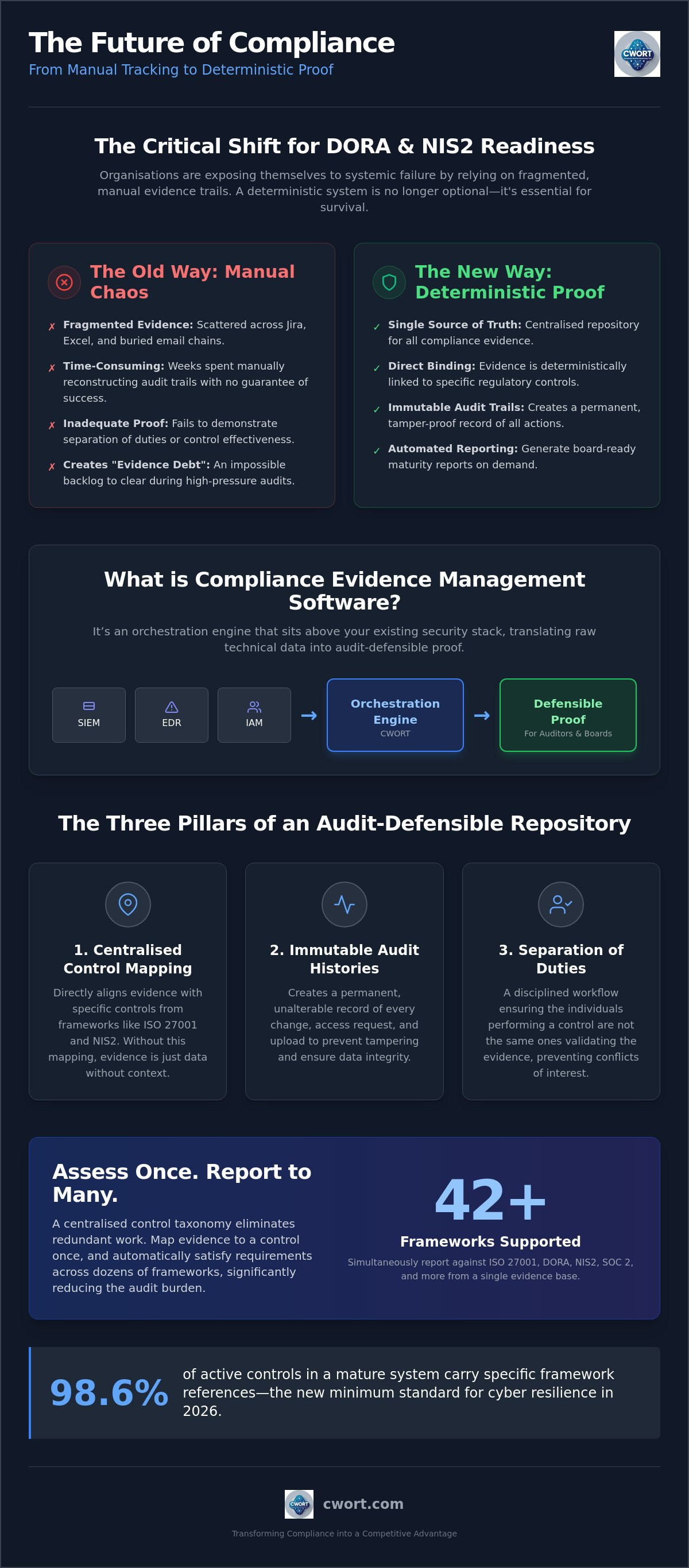
An audit isn't a test of your professional intent; it's a cold interrogation of your data. If your organisation still relies on fragmented evidence scattered amongst Jira tickets, Excel spreadsheets, and buried email chains, you're doing more than wasting time. You're exposing the business to systemic failure. Implementing a dedicated compliance evidence management software is no longer optional; it's the only way to transform abstract requirements into a defensible reality before DORA and NIS2 deadlines arrive.
You likely recognise the exhaustion of manual audit trails that take weeks to reconstruct and still fail to prove separation of duties. We'll show you how to transition from this chaotic manual tracking to a deterministic system that binds evidence directly to regulatory outcomes. This article explores how to establish a single source of truth and generate board-ready maturity reports automatically. You'll learn to replace the anxiety of potential failure with the absolute certainty of a system that enforces accountability by design.
Key Takeaways
- Learn why moving from passive tracking to active validation is essential for maintaining control in high-stakes regulatory environments.
- Understand the architecture of deterministic proof and why simple document storage fails to satisfy the rigorous requirements of modern auditors.
- Discover how purpose-built compliance evidence management software eliminates the "Jira Trap" by creating immutable audit trails that generic task managers cannot provide.
- Master the process of aligning your unique maturity model with looming DORA and UK NIS requirements to ensure total audit readiness for 2026.
- Explore how a centralised control taxonomy allows your organisation to assess once and report across 42 different frameworks simultaneously.
Table of Contents
- What is Compliance Evidence Management Software for Enterprise?
- The Architecture of Audit-Defensible Proof: Binding Evidence to Controls
- Compliance Orchestration vs. Manual Tracking: Why Jira and Excel Fail Audits
- Implementing a Robust Evidence Management Framework: A Step-by-Step Approach
- CWORT: The Deterministic Orchestration Engine for Modern Governance
What is Compliance Evidence Management Software for Enterprise?
Compliance evidence management software is the definitive system of record designed to collect, organise, and bind proof to specific regulatory control outcomes. It marks a fundamental shift in organisational posture. Most firms currently operate on a tracking basis, which is often little more than hoping processes occur as intended. By contrast, a validation-based approach focuses on what you can definitively prove. As we move through 2026, the grace periods for regulations like DORA and NIS2 have expired. Manual evidence gathering is no longer a viable strategy for enterprises facing these stringent requirements.
This technology functions as an orchestration engine. It doesn't replace your existing security stack; it sits above your SIEM, EDR, and IAM tools. It aggregates raw data from these disparate sources and translates it into a language that auditors and boards understand. It provides the connective tissue within a broader Governance, Risk, and Compliance (GRC) framework, ensuring that technical telemetry becomes defensible proof. The complexity of modern mandates has rendered traditional methods obsolete. By mid-2026, the global compliance management software market is projected to reach $68.4 billion, reflecting a massive transition toward automated validation.
The Critical Difference Between Forensics and Regulatory Proof
Many organisations confuse enterprise evidence management with digital forensics. Law enforcement tools focus on legal admissibility in criminal proceedings, often requiring chain-of-custody protocols for specific devices. Compliance evidence management software operates on a different plane. Its primary goal is audit-defensibility. It must support maturity assessments and operating models by demonstrating that controls are functioning effectively over time. Whilst forensics looks for a "smoking gun", compliance validation looks for a "consistent shield". It proves that your behaviour aligns with your stated policies.
Key Components of an Enterprise Evidence Repository
A robust repository requires three foundational elements to be effective:
- Centralised Control Mapping: Direct alignment with frameworks like ISO 27001 and UK NIS. Without this mapping, evidence is just data without context.
- Immutable Audit Histories: A permanent record of every change, access request, or upload to prevent tampering and ensure integrity.
- Separation of Duties: A disciplined workflow where the individuals performing the control are not the ones validating the evidence.
Relying on spreadsheets or Jira tickets creates "evidence debt" that becomes impossible to clear during a high-pressure audit. For those requiring secure document delivery, byNow - Bezpieczna platforma wymiany dokumentów i wysyłki dokumentów offers a modern digital alternative to registered mail, whilst a dedicated platform like CWORT ensures that 98.6% of active controls carry specific framework references. This level of precision is the new minimum standard for cyber resilience in 2026.
The Architecture of Audit-Defensible Proof: Binding Evidence to Controls
The era of the "document dump" has ended. For years, organisations have mistaken a folder full of static PDFs for a compliance strategy. In the high-stakes regulatory environment of 2026, this approach is a liability. True compliance evidence management software requires a deterministic link between raw telemetry and specific regulatory obligations. It's not enough to possess data; you must bind that data to a control outcome to prove its effectiveness. Following NIST guidelines on evidence management, integrity and chain of custody are now fundamental requirements for digital proof. You must demonstrate that your evidence is untampered, relevant, and directly mapped to the risks you aim to mitigate.
Managing this at scale is a significant challenge. Most enterprises must navigate a complex landscape of 1,355+ controls across 42 different frameworks amongst their various business units. Without a centralised orchestration engine, this leads to fragmented "evidence silos" that crumble under auditor scrutiny. A robust architecture ensures that 98.6% of active controls carry precise framework references. This level of granularity allows leadership to move beyond administrative tracking and into a state of definitive validation. It's about building a structural foundation where every action is recorded and every requirement is satisfied by design.
This 'compliance by design' philosophy is increasingly vital for firms exploring blockchain-based finance; for example, you can learn more about STO Foundation to see how they apply these principles to asset tokenisation.
Deterministic Scoring vs. Subjective Assessment
Regulators are increasingly rejecting manual "red-amber-green" (RAG) status reports because they lack empirical backing. These reports are often clouded by human bias or optimistic projections that don't reflect technical reality. Deterministic scoring replaces this guesswork with reproducible logic. Deterministic scoring is the foundation of reproducible audit results. By ensuring that identical evidence always yields the same result, you remove the "person-dependent" risk from your reporting. This creates a transparent, auditable process that stands up to the most rigorous external inspections.
The 'Assess Once, Report Many' Methodology
Operational teams are often burdened by a "compliance tax", providing the same evidence repeatedly for different audits. An orchestration-led approach allows you to break this cycle. You can map a single piece of evidence to satisfy DORA, NIS2, and ISO 27001 requirements simultaneously. This is particularly vital when using NCSC CAF assessment software to streamline resilience reporting across the UK critical infrastructure. It reduces manual effort whilst significantly increasing the accuracy of your maturity assessments.
Transitioning to a structured evidence model is the only way to maintain pace with evolving mandates. If your current evidence collection feels like an uphill struggle, you can explore a deterministic approach to validation to see how orchestration simplifies the audit process.
Compliance Orchestration vs. Manual Tracking: Why Jira and Excel Fail Audits
Many organisations fall into the "Jira Trap". They mistakenly assume that because a security ticket is marked as "Done", they've satisfied a compliance requirement. This is a dangerous conflation of duties. Task management focuses on execution, whilst compliance evidence management software focuses on validation. A closed ticket doesn't prove that a control remained effective over a six-month period. It only proves a specific action occurred at a single point in time. This gap between activity and proof is exactly where regulators find fault during an inspection.
Excel is even more problematic for enterprise governance. It lacks the immutable audit trails required to meet modern federal audit and compliance requirements. In a spreadsheet, anyone with access can modify data, change dates, or delete evidence without leaving a permanent, tamper-proof trace. This absence of version control integrity creates "evidence silos" that fail under the slightest regulatory scrutiny. Reconstructing these trails manually for a board-level review often takes hundreds of hours. It diverts senior staff from strategic resilience tasks to administrative archeology. The cost of this inefficiency isn't just measured in labour; it's measured in the increased risk of a failed audit.
The Risks of Manual Evidence Handling
Manual handling introduces significant data integrity risks. Moving evidence between disconnected systems leads to "context contamination" where the original metadata of the proof is lost. Common project management tools don't enforce a strict separation of duties. Regulators like Ofgem and the NCSC now demand evidence that is both persistent and independently verified. A spreadsheet cannot prove that the person who configured a firewall isn't the same person who signed off on the security report. Without enforced workflows, your "proof" remains a subjective claim rather than a deterministic fact.
Orchestration: The Strategic Alternative
Orchestration offers the only strategic alternative for modern governance. It replaces fragmented, high-risk workflows with a single, governed digital environment. By implementing regulatory compliance workflow automation, you ensure that every execution activity directly matches a regulatory obligation. This proactive approach ensures every control is "auditor-ready" at any moment without manual intervention. It moves the organisation from a state of reactive panic to one of professional maturity. You stop chasing documents and start managing outcomes.
Implementing a Robust Evidence Management Framework: A Step-by-Step Approach
Implementation is not a passive event; it is a rigorous orchestration of people, processes, and technology. To move beyond the spreadsheet chaos discussed earlier, you must first define your standard. Modern compliance evidence management software allows you to import your organisation's unique maturity model through a "Bring Your Own Content" (BYOC) approach. This ensures your existing internal standards aren't lost whilst you align with external mandates like UK NIS and DORA. Once your blueprints are configured, you must assign clear scope and ownership. This enforces accountability across the three lines of defence, ensuring that risk owners, compliance officers, and internal auditors all operate within a single, unified workflow.
Capturing responses is only the beginning. You must bind evidence in a reproducible digital workflow that leaves no room for ambiguity. Every piece of proof must be linked to a specific control requirement, creating a transparent trail that any auditor can follow. This disciplined approach removes the "person-dependency" that plagues manual systems. If a key staff member leaves, the evidence and the logic behind its validation remain intact within the system. You are building a permanent repository of institutional knowledge that secures your regulatory standing.
Calculating Maturity and Confidence Levels
Binary "pass/fail" results are insufficient for the complexity of 2026. You need nuanced maturity heat-maps that reflect the actual state of your controls across the enterprise. By calculating confidence levels based on the quality and age of the evidence provided, you can prioritise remediation effort where it delivers the highest business value. This proactive analysis identifies gaps in your operating model before they can be exploited by a threat or flagged by a regulator. It shifts the focus from simple completion to genuine risk reduction.
Continuous Monitoring and Reassessment
Static audits are snapshots of the past. You require continuous operating-model intelligence to maintain compliance evidence integrity throughout the control lifecycle. This shift from "point-in-time" to "always-on" validation allows for the generation of board-ready reports that demonstrate tangible progress over time. It transforms compliance from a seasonal burden into a strategic asset that informs leadership decisions. When your evidence is continuously refreshed, you are always in a state of audit-readiness.
Establishing this framework is the definitive path to proving your regulatory readiness. To see these steps in action within your own environment, you can request a tailored demo of our orchestration platform.
CWORT: The Deterministic Orchestration Engine for Modern Governance
CWORT serves as the definitive orchestration engine for organisations that have outlived the limitations of manual tracking. It sits strategically above your existing security stack, aggregating telemetry from SIEM, EDR, and IAM tools to transform raw data into validated proof. This compliance evidence management software doesn't just store documents; it enforces discipline and accountability by design through governed digital workflows. By automating the binding of evidence to controls, it eliminates the human bias that often compromises regulatory submissions. It shifts the organisational focus from simple administrative activity to the production of definitive, evidence-based truth.
The platform's strength lies in its comprehensive control taxonomy. With 1,355 controls mapped across 42 frameworks and standards, CWORT provides an unparalleled depth of coverage. As of June 2026, 98.6% of active controls within the system carry specific framework references. This allows UK enterprises to navigate the overlapping requirements of DORA, NIS2, and ISO 27001 without duplicating effort. You can manage 217 distinct domains within a single environment, ensuring that your cyber resilience posture is always visible and verifiable. This "assess once, report many" capability is the only sustainable way to handle the increasing volume of regulatory requests whilst maintaining operational focus.
Built for Boards and Regulators
Audit preparation should not be a period of organisational crisis. CWORT produces audit-ready outputs that satisfy the most demanding regulatory bodies, including Ofgem and the NCSC. It specifically supports the NCSC CAF and UK NIS frameworks, providing the structured evidence required for critical infrastructure protection. By translating technical telemetry into a common language of maturity, the platform enables productive dialogue amongst executives and operational teams. Leadership gains the auditable certainty they require to sign off on compliance statements with absolute confidence. It replaces the anxiety of potential failure with a clear, evidence-based record of effectiveness.
Start Your Compliance Validation Journey
Long-term resilience requires a governed, reusable model service rather than a series of disconnected assessments. CWORT allows you to build a persistent repository of proof that gains value over time. Transitioning to this deterministic model doesn't require a total overhaul of your current operations. Many organisations choose to pilot the platform on a specific sub-function, such as identity management or incident response, to prove end-to-end value before a full-scale rollout. This phased approach demonstrates how compliance evidence management software can reduce manual effort whilst improving the integrity of your governance. It's the most direct path from fragmented tracking to total assurance.
Book a demo of the CWORT orchestration engine to see evidence-based validation in action and secure your regulatory standing for 2026.
Securing Your Regulatory Standing in an Era of Validation
The transition from manual tracking to automated orchestration is no longer a matter of operational preference; it's a strategic necessity. By adopting a robust compliance evidence management software, your organisation replaces fragmented spreadsheets with a deterministic system of record. You've seen how binding immutable evidence to specific controls eliminates the risks of subjective reporting and manual reconstruction. This shift ensures your business is prepared for the rigorous scrutiny of DORA, NIS2, and UK NIS audits well before the regulators arrive at your door.
CWORT provides the precision required for UK Enterprise and Critical National Infrastructure. It maps 1,355 controls across 42 global frameworks to deliver reproducible scoring that auditors trust by default. You can move from the anxiety of potential failure to the calm of auditable certainty. Stop managing compliance as a seasonal crisis and start treating it as a continuous, board-ready asset that protects your reputation and your operations.
Transition to audit-defensible compliance with CWORT and establish a definitive foundation for your organisation's cyber resilience today.
Frequently Asked Questions
What is the primary difference between GRC software and compliance evidence management software?
GRC software typically focuses on high-level risk registers, policy management, and administrative tracking of obligations. Compliance evidence management software is a more granular technical system of record that validates the actual effectiveness of controls through immutable proof. Whilst GRC tells you what should happen, evidence management proves what is happening in your environment at any given moment.
How does evidence management software help with DORA compliance specifically?
This software provides the deterministic proof required for DORA ICT risk management and operational resilience pillars. It automates the collection of telemetry from your security stack to satisfy requirements for continuous monitoring and third-party risk validation. This ensures financial entities can demonstrate a state of audit-readiness rather than relying on frantic, point-in-time reconstructions of activity.
Can we use Jira or Excel as an evidence repository for NIS2 audits?
Jira and Excel are unsuitable for NIS2 audits because they lack immutable audit trails and enforced separation of duties. Regulators require defensible proof that cannot be backdated or modified without a permanent, tamper-proof record. Using generic task managers creates "evidence debt" that usually leads to audit failure during the rigorous inspections mandated by the NIS2 directive.
What does 'binding evidence to controls' actually mean in practice?
Binding evidence to controls involves creating a direct, immutable link between a specific piece of proof and a regulatory requirement. In practice, this ensures a technical output, such as an access log or encryption report, is explicitly mapped to a control outcome within a framework like UK NIS. This removes ambiguity and allows auditors to verify the effectiveness of a control instantly.
Is compliance evidence management software suitable for ISO 27001 audits?
Yes, it's highly suitable for ISO 27001 audits, particularly for Annex A control validation and Statement of Applicability (SoA) support. The software maps evidence to specific 2022 update requirements, ensuring every active control has associated proof of operation. It simplifies the internal audit process and significantly reduces the time needed for external certification by providing an organised, framework-aligned repository.
How does CWORT ensure the integrity of the evidence it collects?
CWORT ensures integrity through deterministic scoring and immutable audit histories that record every interaction with the data. Identical evidence always yields the same result, which removes human bias from the assessment process. Additionally, 98.6% of active controls carry specific framework references, ensuring the proof is always contextually relevant and remains untampered throughout its lifecycle.
Does this software replace our existing security tools like SIEM or EDR?
No, compliance evidence management software doesn't replace your security stack; it acts as an orchestration engine that sits above it. It aggregates telemetry from your existing SIEM, EDR, and IAM tools to validate that they're meeting specific regulatory obligations. It translates raw technical security data into a defensible language of compliance for auditors and boards.
How long does it take to implement a compliance evidence management system?
Initial implementation usually takes a few weeks to configure assessment blueprints and import your organisation's unique maturity models. The system provides immediate value by identifying gaps in your current evidence collection workflows during the setup phase. Full enterprise-wide orchestration depends on the complexity of your control environment and the number of frameworks you intend to map simultaneously.
Disclaimer
The content on this site is provided for general information and educational purposes only. It does not constitute legal, regulatory, financial, or professional advice. CWORT provides AI-assisted insights and workflow automation, but all compliance decisions remain the responsibility of your organisation and its management. Always seek qualified legal or regulatory guidance for decisions relating to the UK NIS Regulations, CAF, DORA, NIS2, ISO 27001, or other obligations.
Related posts
Regulatory Scrutiny Management Tool: Orchestrating Defensible Compliance in 2026
Facing DORA & NIS2? A regulatory scrutiny management tool orchestrates defensible compliance, ending manual evidence chaos for permanent audit-readiness in 2...
GRC Platform vs Compliance Validation Tool: Choosing the Right Architecture for 2026
GRC platform vs compliance validation tool: Is your GRC ready for 2026? Learn how automated validation provides the defensible proof needed for DORA & NIS2.
Regulatory Compliance Workflow Automation for UK Enterprise: A Strategic Guide
Ditch spreadsheets for DORA & NIS2. Our guide to regulatory compliance workflow automation delivers auditable certainty and board-level assurance for UK ente...
Article by
Michael Iyiola
Co-Founder, CWORT
Michael Iyiola is a co-founder of CWORT and a Cyber and AI Security Engineer with deep experience in vulnerability management, detection engineering and operational resilience across UK critical national infrastructure, including rail, energy and financial services. At CWORT, he designs scalable, evidence-driven workflows that help teams meet modern regulatory and security demands.
Build Your Foundation of Auditable Certainty
Take control of your regulatory obligations and secure your infrastructure with CWORT.