Reducing Audit Preparation Time and Costs: A Strategic Guide for UK Enterprises

Michael Iyiola
Co-Founder, CWORT
Tired of costly audit seasons? Our guide for UK enterprises shows you how to stop the manual scramble, reducing audit preparation time and costs with automat...

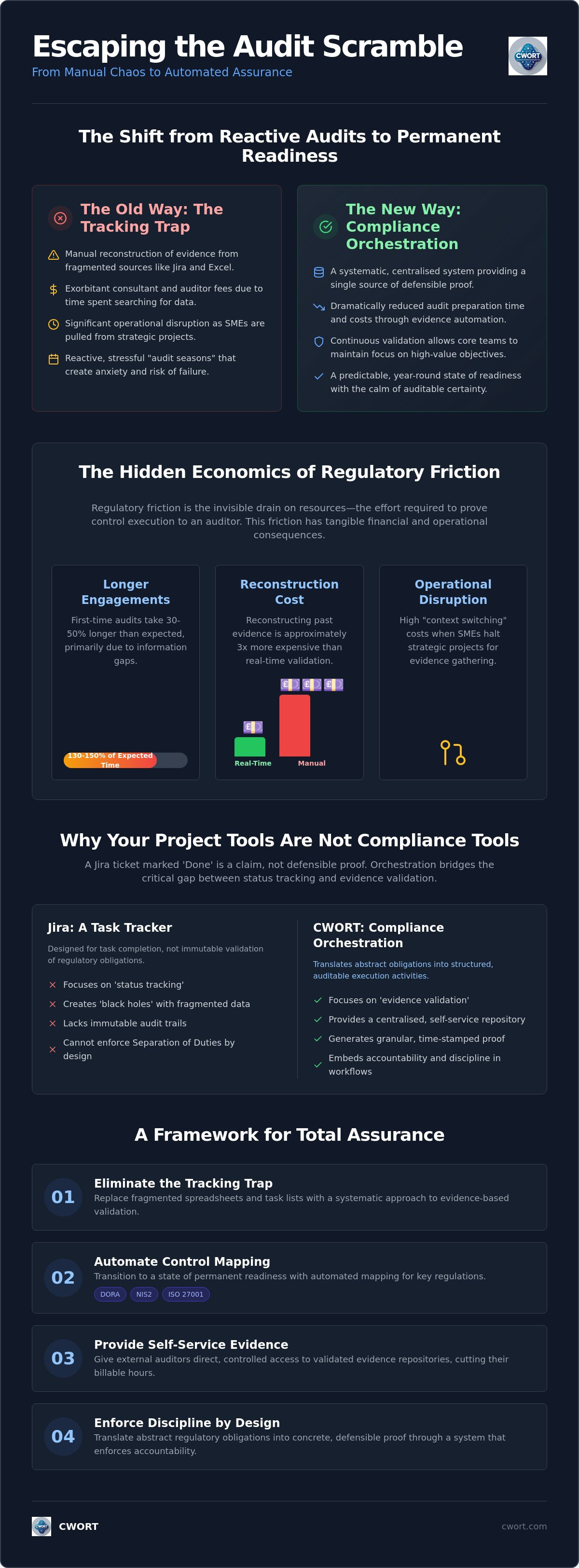
Why is your senior leadership team still manually reconstructing evidence from Jira and Excel when regulators demand real-time, defensible proof? Most UK enterprises treat the audit season as a period of inevitable operational disruption, often paying exorbitant consultant fees to bridge the gap between daily workflows and compliance requirements. You likely recognise the frustration of high billable hours for external auditors who spend more time searching for data than validating it. This guide demonstrates how compliance orchestration eliminates the manual scramble, effectively reducing audit preparation time and costs while shifting your organisation to a state of permanent readiness.
We'll examine the transition from fragmented tracking to a systematic close, ensuring you provide auditors with a disciplined and auditable reality. You'll learn how to replace the anxiety of potential failure with the calm of auditable certainty. By implementing a framework of continuous validation, you'll secure a path to total assurance and professional maturity.
Key Takeaways
- Eliminate the "tracking trap" by replacing fragmented spreadsheets with a systematic approach to evidence-based validation and compliance orchestration.
- Identify the hidden economics of regulatory friction and how manual evidence reconstruction diverts critical resources from high-value operational objectives.
- Implement a strategic framework for reducing audit preparation time and costs by providing external auditors with direct access to validated, self-service evidence repositories.
- Transition from reactive "audit seasons" to a predictable, year-round state of readiness using automated control mapping for DORA, NIS2, and ISO 27001.
- Translate abstract regulatory obligations into concrete, defensible proof through a centralised system that enforces discipline and accountability by design.
Table of Contents
- The Hidden Economics of Audit Preparation and Regulatory Friction
- Moving from Manual Tracking to Compliance Orchestration
- Implementing Evidence-Based Validation to Eliminate Audit Surprises
- Practical Strategies for Reducing External Audit Fees
- CWORT: Transforming Compliance from a Cost Centre to a Strategic Asset
The Hidden Economics of Audit Preparation and Regulatory Friction
Regulatory friction represents the invisible drain on enterprise resources. It's the delta between actual control execution and the effort required to prove it to an auditor. For many UK firms, this friction manifests as a frantic, manual scramble for evidence that disrupts core operations. Whilst the financial audit process is a standard requirement, the labour-intensive nature of gathering evidence for ICT risk and governance has become a significant financial burden. Companies don't just pay for the audit itself; they pay for the internal chaos required to survive it.
The 2026 regulatory environment has intensified this pressure. With the implementation of DORA and NIS2, the evidence burden for UK enterprises has reached an inflection point. Regulators no longer accept vague assurances. They demand granular, time-stamped proof of control effectiveness. When this data is fragmented across Jira tickets, Excel sheets, and email threads, the cost of extraction skyrockets. This fragmentation directly correlates with increased external auditor billable hours. Professionals must sift through unstructured data to find a defensible truth, and you're the one paying for every hour they spend searching.
The High Price of Manual Evidence Reconstruction
Manual audit preparation is a resource-intensive process that often requires multiple Full-Time Equivalent (FTE) staff members to pivot away from their primary roles. Research indicates that first-time audit engagements in the mid-market consistently take 30-50% longer than expected, primarily due to information gaps. Reconstructing the past is approximately three times more expensive than real-time validation. This inefficiency stems from the need to trace historical actions without a continuous audit trail. Relying on manual records doesn't just inflate costs; it introduces the risk of audit failures. If a manual record is missing or unverifiable, the entire control environment is called into question, leading to remediation costs and potential regulatory penalties.
Quantifying the Cost of Operational Disruption
Audit preparation frequently halts strategic innovation projects. When Subject Matter Experts (SMEs) are pulled into weeks of evidence gathering, the "context switching" cost is profound. Technical teams lose momentum on product roadmaps whilst they hunt for configuration logs or change request approvals. This disruption affects employee retention, as high-performing staff grow weary of the annual scramble. Organisations that fail to address this friction find themselves in a cycle of reactive compliance, where the cost of proving work exceeds the cost of the work itself. Prioritising a strategy for reducing audit preparation time and costs is no longer optional. It's a strategic necessity for maintaining operational focus and protecting the bottom line.
Moving from Manual Tracking to Compliance Orchestration
Enterprises often fall into the 'tracking trap' by assuming that project management software is a substitute for a rigorous compliance framework. Jira and Excel are designed for task completion, not for the immutable validation of regulatory obligations. Whilst these tools excel at managing workflows, they lack the structural integrity required to prove that a control was executed correctly, by the right person, at the specific time required. This distinction is critical for reducing audit preparation time and costs, as it shifts the burden from manual verification to automated certainty.
Regulatory orchestration is the process of translating abstract obligations into structured execution activities. It enforces discipline by design. Instead of relying on post-hoc reviews, orchestration ensures that accountability is embedded within the workflow itself. A robust system will enforce a strict 'separation of duties'. This ensures that the individual performing a task is never the same person validating its success. This architectural choice reduces internal fraud risks and eliminates the common audit findings that result from conflicting permissions or lack of oversight.
Why Jira is Not a Compliance Orchestration Tool
The fundamental danger lies in the gap between 'status tracking' and 'evidence validation'. A Jira ticket marked 'Done' is merely a claim; it is not defensible proof. For an auditor, fragmented tools create 'black holes' where the link between a requirement and its supporting data is lost. You can explore a deeper analysis of why Jira is not a compliance orchestration tool to understand how these gaps lead to increased billable hours during the audit season. Relying on project management tools for compliance forces your team into a cycle of manual evidence reconstruction that orchestration is designed to prevent.
The Strategic Shift to Evidence-Based Management
Moving from a 'trust me' culture to a 'show me' reality is the hallmark of professional maturity. The ongoing discussion regarding UK audit reform highlights the increasing need for transparency and reliability in corporate reporting. Orchestration reduces the 'audit gap' by binding evidence directly to control outcomes. This replaces administrative overhead with systematic certainty, ensuring that every regulatory requirement is backed by a concrete, auditable reality. If your organisation still relies on manual document hunting, it's time to see how orchestration transforms your compliance posture and secures a state of permanent readiness.
Implementing Evidence-Based Validation to Eliminate Audit Surprises
Eliminating audit surprises requires a fundamental shift from administrative tracking to rigorous, evidence-based validation. Most organisations fail their audits not because they haven't done the work, but because they can't prove it. Evidence binding ensures that every control outcome is inextricably linked to its supporting proof at the moment of creation. This level of discipline is the only reliable way of reducing audit preparation time and costs while maintaining a defensible posture for UK regulators.
Integrity is the cornerstone of any regulatory submission. For UK enterprises, maintaining a clear "Chain of Custody" for compliance data is essential to satisfy the scrutiny of bodies like the NCSC or the FCA. When evidence is captured, stored, and linked automatically, the risk of tampering or loss is removed. This systematic approach ensures that the data presented to auditors is both accurate and immutable, providing a level of certainty that manual document hunting can never achieve.
Step-by-Step: Binding Evidence to Outcomes
Architecting an audit-ready environment follows a linear, logical progression. By enforcing evidence requirements at the point of execution, you eliminate the need for retrospective data gathering. Follow this framework to secure your compliance landscape:
- Map Obligations: Translate abstract regulatory requirements into specific, executable activities within your workflow.
- Enforce at Execution: Require the submission of proof as a mandatory step for completing any control-related task.
- Establish a Source of Truth: Centralise all control proofs in a single, auditable repository to prevent data fragmentation.
- Verify Integrity: Use automated validation to ensure the integrity of compliance evidence throughout its lifecycle.
- Automate Reporting: Generate regulator-ready outputs for boards and auditors instantly, removing the need for manual report writing.
Achieving "Audit-Ready" Status Every Single Day
The transition from a frantic "Audit Season" to a state of "Continuous Validation" represents the peak of operational maturity. Real-time dashboards provide immediate visibility into control effectiveness, allowing leadership to identify and remediate gaps before they become audit findings. This proactive stance significantly reduces the need for internal "pre-audit" assessments, which are often just as costly as the external audit itself. By embedding validation into daily operations, you'll find that reducing audit preparation time and costs becomes a natural byproduct of a disciplined system. You no longer need to prepare for an audit when you're always ready for one.
Practical Strategies for Reducing External Audit Fees
External audit fees are not static. They reflect the level of risk and administrative effort an auditor expects to encounter within your environment. When your evidence is fragmented, auditors must bill for hours spent on 'discovery'—the tedious process of identifying which records exist and where they are stored. By providing auditors with 'Self-Service' access to a validated evidence repository, you eliminate this inefficiency. This shift allows the audit team to focus on validation rather than data collection, which is a primary lever for reducing audit preparation time and costs. For enterprises requiring independent verification, a global certification body like ia-uk.com can provide the necessary assurance that your processes align with international standards.
Continuous monitoring of control effectiveness prevents 'Materiality Surprises'. These occur when a significant control failure is discovered late in the audit process, necessitating extensive supplementary work and follow-up queries. Maintaining a clean audit trail ensures that the scope of the audit remains predictable. You can use this 'Orchestration Data' as a strategic asset during contract negotiations. Demonstrating a disciplined, automated environment provides the justification needed to secure lower fixed-fee audit contracts, as the auditor's exposure to discovery-related overruns is effectively neutralised.
Empowering Auditors with Validated Evidence
Traditional audits rely on sampling because manual verification of every record is cost-prohibitive. Automation changes this dynamic by enabling 'full population validation'. This approach provides total assurance and reduces the time auditors spend on administrative discovery. For organisations in the financial sector, implementing DORA Compliance Validation: A Guide for Financial Institutions ensures that ICT risk evidence is captured at the point of execution, leaving no gaps for auditors to query.
Strategic Planning for 2026 Regulatory Submissions
Aligning your audit scope with the latest technical standards is essential for the 2026 submission cycle. Regulators increasingly look for adherence to the NCSC CAF and DORA frameworks. Setting materiality thresholds based on real-time risk data ensures that your audit focus remains on high-impact areas. Utilising specialised NCSC CAF Assessment Software allows you to present a structured, defensible reality that mirrors regulatory expectations. To see how these strategies can be applied to your specific environment, request a demo of our orchestration system today.
CWORT: Transforming Compliance from a Cost Centre to a Strategic Asset
Enterprises often view compliance as an unavoidable financial drain, yet this perception stems from an reliance on fragmented, manual processes. CWORT fundamentally alters this dynamic by replacing disconnected trackers with a single, orchestrated validation system. By centralising control management, organisations shift from a state of reactive panic to one of strategic oversight. This transition is the most effective method for reducing audit preparation time and costs, as it converts administrative labour into a streamlined, automated workflow that serves the interests of both the board and the regulator.
The "Validation Engine" at the heart of the platform translates complex frameworks such as DORA, NIS2, and ISO 27001 into structured, auditable proof. Instead of interpreting abstract requirements during the audit season, your teams follow a pre-defined path of execution that captures evidence at the source. This proactive discipline closes the gap between regulatory obligation and board-level assurance. Real-world applications of this model have demonstrated the ability to reduce preparation time by up to 70% whilst ensuring 100% evidence integrity through immutable record-keeping.
The CWORT Advantage: Orchestration over Administration
Orchestration eliminates the need for manual reconstruction by enforcing accountability at the point of action. CWORT automatically binds evidence to outcomes, ensuring that every control is backed by a defensible reality. The system enforces a strict separation of duties, preventing the common oversight errors that lead to costly audit findings. As a strategic partner for UK enterprises navigating high-stakes audits, the platform provides the technical framework necessary to produce regulator-ready reports instantly. You no longer need to hunt for documents; the system generates them as a byproduct of disciplined execution.
Next Steps: From Reactive Scramble to Auditable Certainty
Starting the transition to an orchestrated compliance model requires a shift in perspective. You must move away from the "tracking trap" and embrace a "Single Source of Truth" that provides real-time visibility into your risk posture. This level of transparency is essential for board-level reporting, where definitive proof is required to satisfy governance standards. Stop wasting critical resources on the annual scramble and secure a state of permanent readiness. Book a CWORT demonstration to see how we reduce audit costs and transform your compliance environment into a rigorous, defensible asset.
Securing a State of Permanent Audit Readiness
The annual scramble for compliance evidence is a symptom of systemic fragmentation. You've seen how manual reconstruction diverts critical resources and inflates external fees. By adopting an orchestrated model, you replace administrative chaos with a disciplined, evidence-based reality. This shift ensures that every control outcome is verified at the moment of creation, effectively reducing audit preparation time and costs whilst providing total assurance to your board. You no longer need to fear the audit season when your organisation maintains a constant state of auditable certainty.
CWORT provides the UK-based regulatory expertise required to navigate high-stakes environments with confidence. Our platform replaces unreliable spreadsheets and Jira trackers with a single source of auditable truth, offering native support for DORA, NIS2, and ISO 27001. Stop managing compliance through administrative discovery and start enforcing it by design. Request a CWORT demo to see how we reduce audit prep time and secure your path to a professional, defensible future. It's time to reclaim your operational focus and transform compliance into a strategic advantage.
Frequently Asked Questions
How much can automation really reduce audit preparation costs?
Automation reduces audit preparation costs by eliminating manual labour and significantly lowering external auditor billable hours. By automating evidence collection and control mapping, enterprises often see a reduction in preparation time of up to 70%. This efficiency prevents the need for expensive readiness consultants and allows internal teams to maintain focus on strategic innovation rather than administrative tracking.
Is it possible to use Jira for regulatory compliance instead of a dedicated platform?
Jira is a task-tracking tool and lacks the structural integrity required for definitive compliance validation. Whilst it's effective for project management, it doesn't enforce the separation of duties or immutable evidence binding necessary for high-stakes audits. Relying on Jira creates data silos that auditors must manually investigate, which increases the time and expense of the validation process.
How does "evidence binding" differ from traditional document management?
Evidence binding inextricably links a control outcome to its supporting proof at the exact moment of execution. Traditional document management relies on retrospective filing and manual tagging, which is prone to human error and data loss. Binding ensures that the "Chain of Custody" is maintained automatically, providing regulators with a defensible and immutable reality that manual systems cannot replicate.
What are the main causes of increased audit fees in the UK for 2026?
Increased regulatory scrutiny from the Financial Reporting Council (FRC) and the implementation of complex frameworks like DORA and NIS2 are driving audit fees higher. Tighter regulations require auditors to perform more extensive testing and validation. If your evidence is fragmented, auditors must bill for additional hours spent on discovery and supplementary work to ensure compliance with these updated standards.
Can an orchestrated compliance system help with DORA and NIS2 simultaneously?
Yes, an orchestrated system maps overlapping controls across multiple frameworks to provide a unified compliance posture. Instead of managing each regulation in a silo, orchestration allows you to execute a single control that satisfies requirements for DORA, NIS2, and ISO 27001. This is a primary strategy for reducing audit preparation time and costs across complex regulatory landscapes.
What is the "reconstruction cost" in a manual audit process?
Reconstruction cost refers to the expensive labour required to manually gather and verify historical evidence during the audit season. Research indicates that reconstructing the past is approximately three times more expensive than real-time validation. This cost includes the Full-Time Equivalent (FTE) waste of subject matter experts who must pause strategic projects to hunt for missing or unverifiable records.
How do auditors react to self-service compliance validation platforms?
Auditors typically respond positively to self-service platforms as they reduce administrative friction and allow for full-population validation. Providing direct access to validated evidence repositories reduces the time auditors spend on discovery and sampling. This transparency builds professional trust and often leads to significantly fewer follow-up queries and supplementary billable hours during the fieldwork phase.
What is the difference between GRC software and a compliance orchestration engine?
GRC software focuses on administrative tracking and high-level risk reporting, whilst an orchestration engine enforces control execution and evidence capture. Traditional GRC tools are often passive repositories that require manual data entry and updates. An orchestration engine is a proactive system that drives discipline by design, ensuring that every regulatory obligation is translated into a concrete, auditable reality.
Disclaimer
The content on this site is provided for general information and educational purposes only. It does not constitute legal, regulatory, financial, or professional advice. CWORT provides AI-assisted insights and workflow automation, but all compliance decisions remain the responsibility of your organisation and its management. Always seek qualified legal or regulatory guidance for decisions relating to the UK NIS Regulations, CAF, DORA, NIS2, ISO 27001, or other obligations.
Related posts
Streamlining Regulatory Compliance Processes: From Manual Tracking to Orchestrated Validation
Stop wasting money on manual compliance. Learn about streamlining regulatory compliance processes to reduce personal liability under DORA & NIS2 and gain aud...
Automated IT Audit Preparation: Streamlining Compliance Workflows
Ditch spreadsheets for automated IT audit preparation. Learn how to streamline compliance for DORA & NIS2, and provide your board with total auditable assura...
GRC Platform vs Compliance Validation Tool: Choosing the Right Architecture for 2026
GRC platform vs compliance validation tool: Is your GRC ready for 2026? Learn how automated validation provides the defensible proof needed for DORA & NIS2.
Article by
Michael Iyiola
Co-Founder, CWORT
Michael Iyiola is a co-founder of CWORT and a Cyber and AI Security Engineer with deep experience in vulnerability management, detection engineering and operational resilience across UK critical national infrastructure, including rail, energy and financial services. At CWORT, he designs scalable, evidence-driven workflows that help teams meet modern regulatory and security demands.
Build Your Foundation of Auditable Certainty
Take control of your regulatory obligations and secure your infrastructure with CWORT.