Separation of Duties Compliance Software: Orchestrating Defensible Governance in 2026

Michael Iyiola
Co-Founder, CWORT
Move beyond manual tracking. See how separation of duties compliance software orchestrates defensible governance and ensures you're ready for DORA & NIS2.

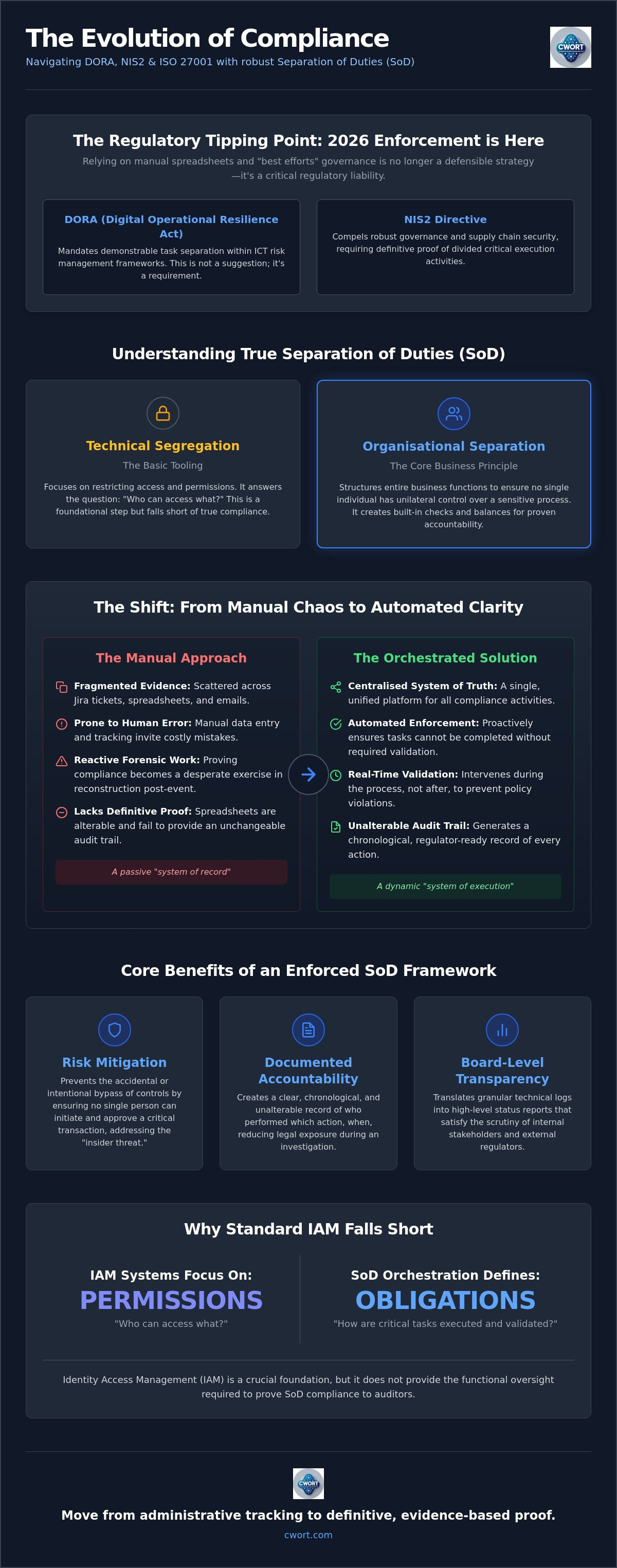
Relying on manual spreadsheets to prove internal controls is no longer a defensible strategy; it's a regulatory liability. As the EU AI Act and DORA enforcement hit full stride in 2026, the era of "best efforts" governance has ended. Implementing robust separation of duties compliance software is now the only way to move from administrative tracking to definitive, evidence-based proof. You likely feel the constant pressure of fragmented evidence scattered across Jira tickets and Excel logs, whilst the anxiety of a potential insider threat or human error looms over every audit cycle.
We recognise that proving control effectiveness to sceptical regulators often feels like a desperate exercise in forensic reconstruction. This article provides a clear path forward. You'll discover how to transition from reactive monitoring to a system of orchestrated validation that satisfies the uncompromising requirements of DORA, NIS2, and ISO 27001. We'll examine how automated enforcement replaces manual checklists, creating regulator-ready audit trails and providing your board with the absolute visibility they require to sign off on compliance status with confidence.
Key Takeaways
- Distinguish between technical segregation and the broader organisational principle of separation required to eliminate fraud and operational risk.
- Transition from passive administrative tracking to dynamic, orchestrated validation using advanced separation of duties compliance software.
- Recognise why standard Identity Access Management (IAM) falls short of full compliance by focusing on permissions rather than functional obligations.
- Execute a defensible framework by mapping critical business functions directly to the rigorous requirements of DORA, NIS2, and ISO 27001.
- Shift to a system of truth that translates abstract regulatory mandates into concrete, structured activities for definitive audit readiness.
Table of Contents
- What is Separation of Duties (SoD) in Regulatory Compliance?
- The Critical Role of Compliance Software in Enforcing SoD
- Why Identity Access Management (IAM) is Not a Complete SoD Solution
- Steps to Implementing a Defensible SoD Framework in 2026
- CWORT: Orchestrating Separation of Duties for Audit-Ready Validation
What is Separation of Duties (SoD) in Regulatory Compliance?
Separation of Duties (SoD) is the strategic division of critical responsibilities designed to prevent fraud, eliminate human error, and ensure no single individual holds unilateral control over a sensitive process. At its core, the objective is absolute. By requiring at least two individuals to complete a high-stakes task, organisations create a built-in system of checks and balances. Whilst many firms conflate technical "segregation" with "separation," the distinction is vital for defensible governance. Segregation often refers to the basic tooling settings that restrict access; Separation of duties (SoD) is an organisational principle that dictates how business functions are structured to ensure accountability. Modern separation of duties compliance software transforms these abstract principles into rigid, executable rules that auditors can verify with certainty.
The Evolution of SoD under DORA and NIS2
The regulatory environment in 2026 demands more than just a policy document. Under the Digital Operational Resilience Act (DORA), which became applicable on 17 January 2025, financial entities must demonstrate task separation within their ICT risk management frameworks. This is not a suggestion. It is a mandatory requirement for operational resilience. Similarly, the NIS2 directive compels organisations to implement robust governance and supply chain security. For UK entities, "best efforts" are no longer a valid defence. Regulators now require definitive proof that critical execution activities are divided amongst distinct roles. Deploying DORA Compliance Validation tools allows leadership to move beyond static spreadsheets and into a state of continuous, orchestrated oversight.
Core Benefits of a Formal SoD Policy
Implementing a rigorous SoD framework delivers immediate structural integrity to an enterprise. With European data protection authorities reporting a 22% year-over-year increase in breach notifications, the risk of the "insider threat" is a boardroom priority. A formalised policy, enforced by separation of duties compliance software, achieves three critical outcomes:
- Risk Mitigation: Prevents the accidental or intentional bypass of controls by ensuring no single person can initiate and approve a transaction.
- Documented Accountability: Creates a clear, chronological record of who performed which action, reducing legal exposure during an investigation.
- Board-Level Transparency: Translates granular technical logs into high-level status reports that satisfy the scrutiny of both internal stakeholders and external regulators.
Establishing these controls is the first step toward a mature compliance posture. It replaces the anxiety of potential failure with the calm of auditable certainty. By mapping these obligations to specific roles, organisations ensure that every critical process is transparent, traceable, and, above all, defensible.
The Critical Role of Compliance Software in Enforcing SoD
Static policy documents don't stop fraud. They certainly don't satisfy DORA auditors looking for operational resilience. To achieve true defensibility, organisations must transition from GRC as a passive "system of record" to a dynamic "system of execution." This shift is powered by separation of duties compliance software, which moves beyond simple logging to enforce task separation in real-time. By binding every action to a specific control outcome, you replace administrative guesswork with definitive, auditable truth. It's about moving from knowing what should happen to proving what did happen.
Traditional GRC tools often act as digital filing cabinets. They store policies and record incidents after they occur. In contrast, orchestration software intervenes during the process. It ensures that a task cannot be finalised until the required validation steps are completed by an authorised second party. This proactive stance is essential in high-stakes environments where a single oversight can lead to catastrophic financial or regulatory penalties.
Orchestration vs. Manual Tracking
Spreadsheets are the enemy of structural integrity. They're prone to human error and lack the unalterable history required for high-stakes audits. When evidence is fragmented across Jira tickets or Excel cells, proving compliance becomes a manual, forensic nightmare. Implementing regulatory compliance workflow automation ensures that every critical task is systematically validated by a secondary party. This orchestration prevents any single user from bypassing protocols, effectively closing the gap between intent and execution. It transforms compliance from a periodic burden into a continuous, automated process.
Automated Evidence Binding
Defensible governance requires more than just an access log. It demands a direct link between user actions and regulatory requirements. Modern separation of duties compliance software achieves this through automated evidence binding. By creating unalterable audit trails, you preserve compliance evidence integrity without the need for manual reconstruction. This process is fundamental to an effective internal control framework, as it ensures that every task is performed, checked, and recorded as it happens. This real-time validation allows boards to see exactly where they stand at any given moment.
The result is a set of regulator-ready outputs that require zero manual intervention. Auditors no longer have to sift through disjointed emails or disparate systems to verify a control. Instead, they are presented with a unified, defensible record of truth. If you're ready to move beyond manual tracking, you can explore how automated orchestration secures your processes today.
Why Identity Access Management (IAM) is Not a Complete SoD Solution
Many leadership teams operate under the dangerous misconception that robust Identity Access Management (IAM) is synonymous with a complete SoD strategy. It isn't. IAM is designed to manage the perimeter; it controls who has the keys to the building. Separation of duties compliance software manages the activity; it dictates what happens once the door is open. Knowing a user possesses the permission to execute a high-value transaction is entirely different from proving that the transaction was validated by an independent authority in accordance with regulatory mandates. IAM tells you who has the potential to act, but it fails to prove that the execution remained compliant.
This "Execution Gap" is where most organisations fail their audits. An IAM system might record that two different users have access to a sensitive environment, but it rarely provides the unalterable evidence that those two users actually performed their distinct roles during a specific workflow. Regulators in 2026, particularly those enforcing DORA and NIS2, are no longer satisfied with technical access logs. They demand proof of functional separation. They want to see that your internal controls proactively prevented a single individual from controlling a process from start to finish.
Permissions vs. Obligations
Permissions define what is possible; obligations define what is required. Whilst IAM tools are excellent at managing the "potential" to act, they lack the context of business obligations. The NIST definition of SoD emphasises a condition where no individual should be able to execute every step of a critical process. Auditors look for the "who, what, when, and how" of the execution phase. They require evidence that the duty separation actually occurred during the live process. Standard access logs are often too granular and disconnected from the business logic to provide this level of clarity, leaving compliance teams to manually reconstruct timelines during an audit.
Beyond Access: Validating the Workflow
A common pitfall is the reliance on project management tools like Jira to track task separation. These platforms are built for collaboration, not for the structural integrity required for defensible governance. They lack the unalterable audit trails and rigid enforcement mechanisms found in dedicated separation of duties compliance software. In contrast, an orchestration engine enforces the "four-eyes principle" in real-time. It prevents a process from advancing until the secondary validation obligation is met and recorded. This is where DORA compliance validation becomes indispensable. It bridges the gap between technical permissions and auditable execution. Your board doesn't need more technical logs; they need the defensible truth that your system enforces discipline by design.
Steps to Implementing a Defensible SoD Framework in 2026
Transitioning from a legacy GRC approach to a defensible framework requires a disciplined, step-by-step methodology. You must move beyond high-level policy statements and dive into the granular reality of your daily operations. Start by identifying your critical business functions and the specific regulatory obligations that govern them, such as DORA, NIS2, and ISO 27001. Once these mandates are clear, map them to specific execution activities. This ensures that your separation of duties compliance software is configured to protect the exact processes that carry the highest risk.
Defining an SoD matrix is the next crucial phase. You must decide which roles must never overlap for any given activity. For instance, the individual who initiates a high-value payment must never be the one who authorises it. By implementing an orchestration engine, you enforce these boundaries automatically. This system doesn't just block unauthorised actions; it collects the unalterable evidence required to prove compliance during an audit. This structured approach replaces the chaos of fragmented logs with a streamlined, defensible record of truth. The efficiency gained through such automation is equally valuable for managing other complex enterprise workflows; to see how this works for channel management, visit Computer Market Research.
Mapping Obligations to the NCSC CAF
UK enterprises face a unique set of requirements under the Cyber Assessment Framework. It's essential to use NCSC CAF assessment software to identify and close resilience gaps within your infrastructure. By aligning your SoD controls with the UK’s specific framework, you ensure cross-framework consistency. This unified strategy allows you to satisfy ISO 27001 and NIS2 requirements simultaneously, reducing the administrative burden on your security teams whilst strengthening your overall defensive posture. It moves your organisation from a state of mere compliance to one of genuine operational resilience.
Continuous Monitoring and Board Reporting
Audit cycles are no longer annual events; they are continuous processes. You must shift from reactive reporting to proactive, evidence-based compliance management. This transition allows you to maintain a permanent state of "audit-ready" status. By creating automated, board-level dashboards, you provide leadership with real-time visibility into the health of your SoD controls. This transparency eliminates the anxiety of the unknown and replaces it with the confidence of auditable certainty. Leadership can now sign off on compliance status based on hard data rather than optimistic projections. If you're ready to automate your governance, you can request a demo of our orchestration system to see these steps in action.
CWORT: Orchestrating Separation of Duties for Audit-Ready Validation
CWORT serves as the definitive orchestrated compliance validation system, designed to eliminate the ambiguity of traditional governance. It addresses the fundamental flaw in most risk management strategies: the disconnect between policy and practice. By acting as a proactive separation of duties compliance software, CWORT translates abstract regulatory obligations into structured, executable activities. It doesn't just record that a rule exists. It ensures that the rule is physically impossible to bypass during the execution of a critical business process.
This "Enforcement by Design" approach is central to the platform’s identity. It replaces the hope of compliance with the certainty of validation. When a sensitive task is initiated, the system automatically triggers the required secondary approval, binding the identity and action of both parties into a permanent, unalterable record. The result is a stream of regulator-ready outputs generated in real-time. This eliminates the need for manual intervention from your compliance team during an audit cycle.
Replacing Fragmented Manual Workflows
Manual tracking is a relic of a less regulated era. Relying on Jira, Excel, and disparate email chains creates a fragmented evidence trail that inevitably falls apart under rigorous scrutiny. CWORT centralises these activities, offering a unified source of truth for all ISO 27001 control mapping. This consolidation significantly reduces the administrative burden on Subject Matter Experts (SMEs) and external consulting teams. Instead of chasing evidence across multiple departments, your team can focus on strategic risk management whilst the software handles the orchestration of defensible proof.
Securing Your Regulatory Future
In the high-stakes environment of 2026, the strategic advantage lies with organisations that can provide instantaneous, auditable proof of control effectiveness. The transition from administrative tracking to orchestrated validation is the only way to replace the persistent anxiety of audit failure with the calm of auditable certainty. With European data protection fines having surpassed €7.1 billion by mid-2026, the cost of inadequate task separation is simply too high to ignore.
Defensible governance is no longer an aspirational goal; it is a baseline requirement for corporate survival. CWORT provides the structural integrity needed to protect your organisation against both insider threats and regulatory penalties. You can request a CWORT demonstration to see SoD orchestration in action and secure your path to total assurance today.
Secure Your Regulatory Standing Through Automated Orchestration
The 2026 regulatory landscape leaves no room for the structural vulnerabilities of manual oversight. Transitioning to dedicated separation of duties compliance software is the only definitive way to move beyond the limitations of fragmented access logs and unreliable spreadsheets. By enforcing task separation at the point of execution, you eliminate the threat of unilateral control. This ensures every critical process is transparent, traceable, and fully aligned with your governance objectives.
CWORT provides the rigorous framework required to achieve total assurance. Our system delivers DORA and NIS2 regulator-ready outputs whilst eliminating the risks inherent in manual spreadsheet tracking. As UK-based compliance orchestration experts, we help you transform abstract obligations into concrete, defensible evidence that satisfies both auditors and the board. Replace the anxiety of potential failure with the auditable certainty of a system designed for resilience.
Orchestrate your SoD compliance with CWORT today and establish a permanent state of audit-readiness. You have the power to secure your organisation's future through disciplined, evidence-based governance.
Frequently Asked Questions
What is the difference between Segregation of Duties and Separation of Duties?
Segregation of duties refers to the technical implementation of access controls whilst separation of duties is a broader organisational principle. Whilst segregation uses technical tools to restrict user permissions, separation dictates the structural division of business functions to prevent any single individual from holding end-to-end control. Effective governance requires both technical barriers and a disciplined policy framework to ensure total accountability.
How does DORA specifically require Separation of Duties for financial entities?
DORA mandates that financial entities must establish clear task separation within their ICT risk management frameworks to ensure operational resilience. This requirement prevents the concentration of critical functions in a single role, reducing the risk of systemic failure or malicious activity. Regulators now demand definitive proof that these controls are active and validated rather than just documented in a static policy.
Can we use Jira to manage Separation of Duties compliance?
Jira is unsuitable for managing SoD compliance because it lacks the unalterable audit trails and rigid enforcement mechanisms required for defensible truth. Whilst it is an excellent collaboration tool, it allows for manual overrides and lacks the structural integrity needed to satisfy a DORA or NIS2 auditor. Relying on project management software for regulatory evidence creates a significant risk of fragmented or manipulated data.
What is an SoD conflict and how do I identify one?
An SoD conflict occurs when a single individual possesses the authority to perform two or more conflicting steps in a critical business process. You identify these conflicts by mapping your organisational roles against a risk matrix that highlights incompatible activities, such as initiating and approving a financial transaction. Regular automated scanning of user permissions is essential to detect and remediate these overlaps before they result in a breach.
How does SoD compliance software differ from standard GRC tools?
Standard GRC tools function as passive systems of record that store policies, whereas separation of duties compliance software acts as a proactive system of execution. This software orchestrates workflows in real-time, ensuring that a task cannot proceed until the required secondary validation is completed. It moves the organisation from reactive monitoring to a state of continuous, automated enforcement and evidence collection.
Is Separation of Duties required for ISO 27001 certification?
Yes, ISO 27001 requires the separation of conflicting duties and areas of responsibility to reduce opportunities for unauthorised modification or misuse of assets. Annex A controls specifically mandate that organisations must define and implement these boundaries within their information security management systems. Failing to demonstrate task separation during an audit can result in non-conformities that jeopardise your certification status.
How do we implement SoD in a small IT team with limited staff?
Small teams can implement SoD by utilising compensating controls and automated validation through separation of duties compliance software. When staff numbers are low, you must focus on peer-review orchestration and the rotation of critical tasks to ensure oversight. Automation reduces the administrative burden of peer validation, allowing small teams to maintain a defensible security posture without needing a large headcount.
What evidence do UK regulators expect for SoD enforcement?
UK regulators expect to see unalterable, chronological audit trails that prove a second authorised party validated every critical execution activity. They require evidence that controls were enforced at the time of the event, rather than reconstructed through manual logs after the fact. Providing real-time dashboards and structured validation reports demonstrates a level of professional maturity that satisfies the scrutiny of NCSC and FCA auditors.
Disclaimer
The content on this site is provided for general information and educational purposes only. It does not constitute legal, regulatory, financial, or professional advice. CWORT provides AI-assisted insights and workflow automation, but all compliance decisions remain the responsibility of your organisation and its management. Always seek qualified legal or regulatory guidance for decisions relating to the UK NIS Regulations, CAF, DORA, NIS2, ISO 27001, or other obligations.
Related posts
Streamlining Regulatory Compliance Processes: From Manual Tracking to Orchestrated Validation
Stop wasting money on manual compliance. Learn about streamlining regulatory compliance processes to reduce personal liability under DORA & NIS2 and gain aud...
Mastering the Regulatory Obligation Execution Workflow: A Guide to Auditable Certainty
Struggling with UK compliance audits? Learn to build a regulatory obligation execution workflow for auditable certainty and replace risky spreadsheets with t...
Binding Evidence to Control Outcomes for Regulatory Audits
Stop failing audits. Shift to evidence based compliance management to bind proof to controls and achieve real-time, defensible validation for DORA & NIS2.
Article by
Michael Iyiola
Co-Founder, CWORT
Michael Iyiola is a co-founder of CWORT and a Cyber and AI Security Engineer with deep experience in vulnerability management, detection engineering and operational resilience across UK critical national infrastructure, including rail, energy and financial services. At CWORT, he designs scalable, evidence-driven workflows that help teams meet modern regulatory and security demands.
Build Your Foundation of Auditable Certainty
Take control of your regulatory obligations and secure your infrastructure with CWORT.