Binding Evidence to Control Outcomes for Regulatory Audits

Michael Iyiola
Co-Founder, CWORT
Stop failing audits. Shift to evidence based compliance management to bind proof to controls and achieve real-time, defensible validation for DORA & NIS2.

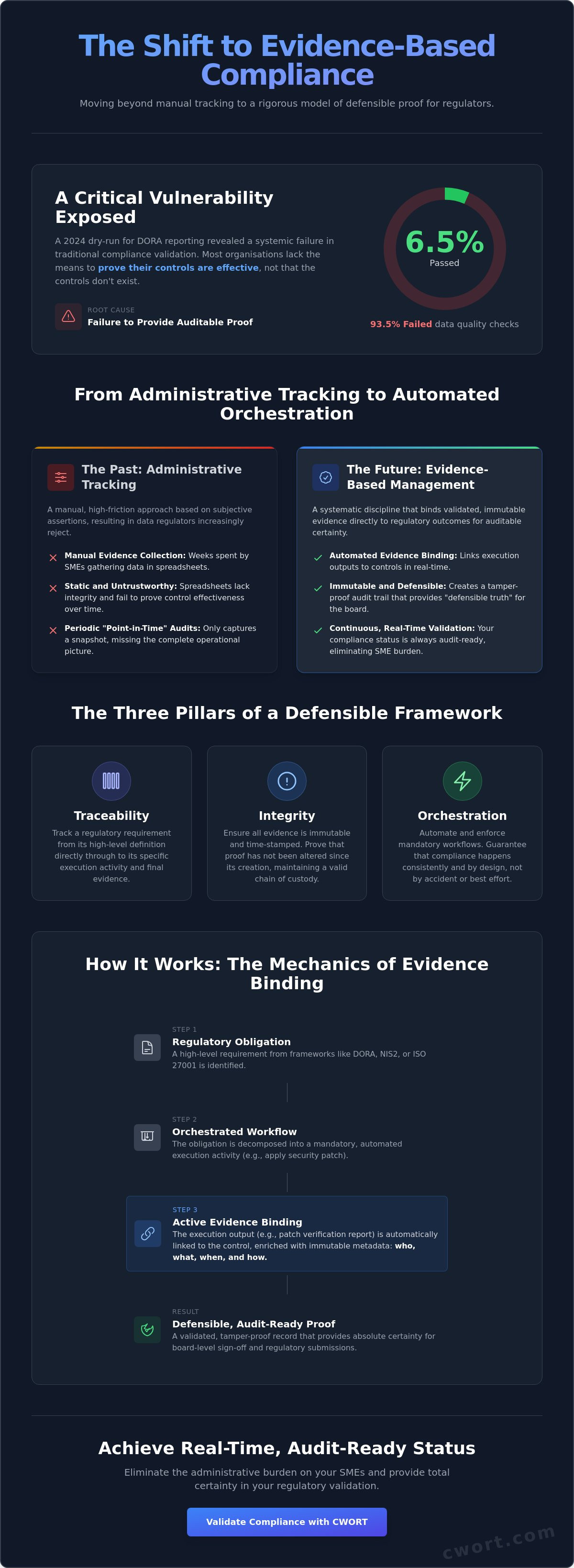
In a 2024 dry-run for DORA reporting, only 6.5% of nearly 1,000 firms successfully passed all data quality checks. This statistic exposes a critical vulnerability: most organisations aren't failing because they lack controls, but because they can't prove those controls work. You likely spend weeks manually collecting evidence, only to present spreadsheets that regulators increasingly reject for lacking integrity. It's time to move beyond the friction of administrative tracking and adopt a rigorous model of evidence based compliance management that prioritises defensible truth over manual guesswork.
You understand that the board demands certainty, yet proving separation of duties or control effectiveness remains a fragmented struggle. This article provides a blueprint for shifting to a systematic, auditable framework that binds validated evidence directly to regulatory outcomes. We'll examine how to orchestrate mandatory workflows that ensure your status is audit-ready in real-time, reducing the burden on your SMEs whilst providing total certainty in your regulatory validation.
Executive Summary
- Shift from manual tracking to evidence based compliance management to transform abstract obligations into a defensible, auditable reality.
- Learn the mechanics of "evidence binding" to automatically link execution outputs to regulatory requirements, ensuring every control is backed by immutable proof.
- Understand why static spreadsheets don't work and how a dynamic orchestration engine maintains the structural integrity required for DORA and NIS2 validation.
- Construct a unified control model that maps DORA, NIS2, and ISO 27001 requirements into a single, mandatory workflow for consistent execution.
- Discover how to achieve real-time, audit-ready status whilst eliminating the administrative burden on SMEs through a centralised system of record.
Table of Contents
- What is Evidence Based Compliance Management in 2026?
- The Mechanics of Binding Evidence to Control Outcomes
- Orchestration vs. Administrative Tracking: Replacing Spreadsheets
- Building a Defensible Compliance Workflow for UK Regulators
- CWORT: Validating Regulatory Compliance with Auditable Certainty
What is Evidence Based Compliance Management in 2026?
By 2026, the definition of regulatory adherence has shifted from a policy-centric exercise to a technical discipline. We define evidence based compliance management as the systematic transition from abstract regulatory obligations to a validated, auditable reality. This methodology mirrors the rigor of Evidence-based practice in scientific fields, where decisions must be supported by objective, verifiable data rather than subjective assertions or "best efforts."
Traditional "check-box" mentalities are now a significant operational liability. Under frameworks like the Digital Operational Resilience Act (DORA) and NIS2, regulators no longer accept the mere existence of a policy as proof of compliance. They demand evidence of execution. This shift necessitates a move towards continuous validation, where controls are monitored in real-time rather than during periodic, manual audits that only capture a static moment in time.
The 2026 standard for compliance is built upon three non-negotiable pillars:
- Traceability: The ability to track a regulatory requirement through to its specific execution activity.
- Integrity: Ensuring that evidence is immutable and has not been altered since its creation.
- Orchestration: The automated enforcement of workflows to ensure compliance happens by design, not by accident.
The Evolution of Regulatory Scrutiny in the UK
UK regulators have dramatically increased their expectations for granular proof. It is no longer enough to state that a control exists; you must demonstrate its effectiveness under pressure. The NCSC Cyber Assessment Framework (CAF) now serves as the definitive benchmark for resilience amongst critical national infrastructure and financial entities. Failing to provide regulator-ready evidence during a thematic review can lead to severe enforcement actions. Consider the 2024 DORA dry-run, where only 6.5% of nearly 1,000 firms passed all data quality checks. This highlights a systemic failure in traditional tracking that evidence based compliance management is designed to solve.
Core Components of a Validated Evidence Framework
A validated framework transforms raw data into "Audit-Ready Evidence." This requires data that is time-stamped, tamper-proof, and explicitly linked to a specific control outcome. A primary focus for leadership must be ensuring compliance evidence integrity throughout its entire lifecycle. When evidence is bound to the outcome, it creates a "defensible truth" for board-level reporting. This provides directors with the absolute certainty they need to sign off on regulatory submissions, replacing the anxiety of potential failure with the security of auditable proof.
The Mechanics of Binding Evidence to Control Outcomes
Execution is the only currency in modern auditing. Whilst most organisations focus on the passive collection of logs, true evidence based compliance management relies on the active binding of those logs to specific regulatory outcomes. This process ensures that every piece of data serves a defined purpose, eliminating the common pitfall of "evidence drift"—where vast quantities of data are stored but fail to prove that a specific control was effective at a specific time.
Binding requires an automated link between a task output and a regulatory requirement. For example, when implementing NIST security and privacy controls, a system shouldn't just record that a patch was applied. It must bind the patch verification report directly to the vulnerability management requirement, enriched with critical metadata. This metadata provides the essential context—who executed the task, what specific assets were affected, when the validation occurred, and how the success was verified—to create a defensible audit trail that survives rigorous scrutiny.
Translating Obligations into Execution Activities
Complex frameworks like ISO 27001 or the NCSC CAF are often too abstract for operational teams to implement consistently. You must decompose these high-level requirements into granular, actionable workflows. Implementing a robust system for enterprise compliance evidence management allows you to maintain structural integrity amongst thousands of individual controls. Every activity must have a clearly defined owner and a mandatory evidence output. If a task is completed without the associated evidence being bound to the control, the system should treat the control as failed, forcing immediate corrective action rather than waiting for an audit discovery.
Enforcing Separation of Duties (SoD) via Orchestration
Separation of Duties is no longer a suggestion; it's a core requirement for DORA and NIS2 compliance. Orchestration engines enforce this discipline by design, preventing the same individual from executing a control and subsequently validating its outcome. This structural safeguard ensures that no single person has end-to-end control over a sensitive process, which significantly reduces the risk of internal collusion or unintentional oversight. Automated SoD enforcement replaces the fallibility of manual supervision with a proactive, system-enforced barrier that guarantees accountability. To see how this orchestration works in practice, you can explore our compliance validation platform.
Orchestration vs. Administrative Tracking: Replacing Spreadsheets
Legacy compliance relies on the static, fragile nature of spreadsheets. This approach is no longer viable in a landscape defined by DORA and NIS2. Spreadsheets offer no structural integrity; they are easily manipulated and lack the immutable audit trails required for evidence based compliance management. In contrast, a dynamic orchestration engine enforces regulatory execution in real-time. It moves the organisation from a state of reactive "tracking" to proactive "validation," where compliance is a byproduct of the workflow itself rather than a separate, administrative burden.
Relying on Excel or fragmented tools creates a significant administrative tax. Teams often spend weeks before an audit manually reconstructing evidence from disparate systems. This fragmented data landscape introduces severe security risks, as sensitive compliance information sits in unlinked, unprotected files. Orchestration consolidates this into a single system of record, ensuring that every data point is protected, linked, and regulator-ready at all times. It replaces the anxiety of "finding the proof" with the calm of knowing the proof is already bound to the outcome.
Why Jira is Not a Compliance Tool
Jira excels at project management, but it's fundamentally insufficient for regulatory validation. It tracks the completion of a task, not the effectiveness of a control. This creates a dangerous "compliance gap" where a ticket marked "Done" is mistaken for a validated regulatory outcome. Jira lacks the built-in logic to enforce duty separation or to bind immutable evidence to specific clauses. Transitioning to regulatory compliance workflow automation is the only way to ensure that execution and validation are inextricably linked, providing the defensible proof that auditors now demand.
The ROI of Automated Compliance Validation
The financial argument for automation is compelling. Moving from manual collection to automated compliance proof generation typically saves hundreds of hours for subject matter experts (SMEs) during every audit cycle. This drastic reduction in "audit fatigue" allows your most valuable personnel to focus on strategic resilience rather than administrative paperwork. More importantly, real-time dashboards provide leadership with total visibility. You can identify and remediate control failures before they escalate into multi-million pound regulatory fines or public reputational damage. Automation doesn't just save time; it secures your licence to operate.
Building a Defensible Compliance Workflow for UK Regulators
Establishing a defensible position requires more than just intent; it requires a structured architecture. With the FCA expanding its Code of Conduct to non-banks in September 2026, the margin for error is disappearing. You must move away from isolated silos and adopt a unified approach to evidence based compliance management. This begins by mapping disparate regulatory obligations, such as DORA, NIS2, and ISO 27001, into a single, centralised control model. By doing so, you eliminate redundant tasks and ensure that every action taken serves multiple regulatory requirements simultaneously.
Once your obligations are mapped, you must define the specific execution activities that satisfy each requirement. It's not enough to say you "monitor access"; you must define the exact workflow that constitutes monitoring. Automation plays a critical role here. By requesting evidence at the exact point of execution, you ensure that no task is considered complete until the proof is captured. This prevents the frantic, retrospective "evidence hunting" that typically precedes an audit. Finally, an orchestration layer must be implemented to enforce validation and separation of duties, ensuring that your status is always backed by immutable, regulator-ready data.
Achieving Board-Level Transparency
Directors don't need technical logs; they need assurance. You must translate granular technical data into automated compliance reporting that provides a clear, high-level view of the organisation's risk posture. Dynamic "red-to-green" dashboards, backed by immutable evidence, allow the board to see exactly where vulnerabilities lie. This transparency transforms compliance from a cost centre into a strategic driver for ICT risk management investment, replacing vague updates with definitive, auditable status reports.
Preparing for Central Bank and NCSC Audits
When the FCA or NCSC conducts a thematic review, the "discovery phase" should be non-existent. Providing auditors with direct access to a "single source of truth" demonstrates a level of professional maturity that spreadsheets can never match. By integrating NCSC CAF assessment software into your wider evidence framework, you ensure that every response is pre-validated and supported by a tamper-proof repository. This proactive stance reduces audit friction and reinforces your reputation as a resilient, well-governed entity. To see how these workflows are built and enforced in real-time, you should request a demonstration of our orchestration platform.
CWORT: Validating Regulatory Compliance with Auditable Certainty
CWORT functions as the definitive enterprise orchestration engine designed specifically for the complexities of the UK regulatory landscape. It eliminates the systemic fragmentation caused by disconnected legacy tools and manual spreadsheets. By providing a single system of record, CWORT ensures that your compliance validation is not a retrospective scramble but a continuous, automated reality. This platform empowers organisations to generate regulator-ready outputs instantly. It removes the need for manual data reconstruction and eliminates the administrative burden that typically exhausts subject matter experts before an audit.
Position your organisation at the highest standard of corporate governance. CWORT acts as a strategic partner, shifting the focus from mere administrative tracking to definitive, auditable proof. It provides the structural integrity required to satisfy the most demanding auditors, from the FCA to the NCSC. Every data point within the system is part of an immutable audit trail, ensuring that your compliance status is always defensible and transparent. This level of professional maturity transforms compliance from a reactive obligation into a source of competitive advantage and operational stability.
From Obligation to Evidence: The CWORT Workflow
The CWORT workflow begins by translating high-level DORA and NIS2 requirements into structured, actionable execution activities. It utilises proprietary "evidence binding" technology to ensure that every control outcome is inextricably linked to its supporting data. This ensures that your evidence based compliance management strategy is defensible by design. The platform also enforces separation of duties through mandatory, system-led workflows. This prevents the risk of internal oversight. It ensures that every validation step is performed by the correct authorised personnel, providing a level of discipline that manual processes simply cannot match. Every task output is automatically mapped to its corresponding regulatory clause, creating a seamless path from obligation to evidence.
Securing Your Regulatory Future
Achieving auditable certainty provides more than just a successful audit result. It delivers profound peace of mind to leadership and the board. You no longer have to guess if your controls are effective. You have the proof. By adopting a proactive resilience orchestration model, you move from a defensive posture to a state of total operational command. This transition secures your organisation's reputation and its long-term viability in an increasingly strict regulatory environment. It replaces the anxiety of potential failure with the calm of auditable truth. Discover how CWORT orchestrates evidence-based compliance for UK enterprises to transform your governance framework today.
Master Your Regulatory Outcomes with Auditable Certainty
The transition from administrative tracking to active orchestration is no longer a strategic choice; it's a regulatory necessity. The evidence is clear: binding validated data to specific control outcomes eliminates the structural fragility of spreadsheets and manual guesswork. By adopting a rigorous framework for evidence based compliance management, you replace the anxiety of audit preparation with the security of real-time validation. This disciplined approach ensures your organisation remains resilient against the evolving demands of DORA, NIS2, and the NCSC CAF.
CWORT provides the sophisticated architecture required to enforce this rigor by design. You'll achieve total transparency through board-level automated reporting whilst ensuring every action is protected by enforced separation of duties. This system doesn't just record activity; it generates regulator-ready outputs that stand up to the most intense scrutiny. It's time to move beyond the friction of fragmented tools and secure your regulatory future with a single system of record. Request a CWORT demo to see evidence-based orchestration in action and transform your compliance into a definitive strategic advantage. You have the power to replace uncertainty with auditable truth.
Frequently Asked Questions
What is the difference between compliance management and compliance validation?
Compliance management focuses on the administrative oversight of policies and obligations. Compliance validation is the technical process of proving those controls are functioning as intended through immutable evidence. Whilst management tracks intent, validation confirms reality. Transitioning to a validated model ensures that your regulatory status is backed by execution data rather than just policy documentation.
How does evidence-based compliance support DORA requirements?
DORA mandates that firms demonstrate operational resilience through granular, high-quality data. Evidence based compliance management provides the structural framework to link technical resilience activities directly to DORA's regulatory requirements. This ensures that every resilience test and vulnerability scan is automatically bound to the relevant compliance outcome, satisfying the regulator's demand for defensible, real-time proof of resilience.
Can we use our existing Jira workflows for evidence-based management?
You can integrate Jira, but it cannot serve as your primary system for regulatory validation. Jira is designed to track task completion, yet it lacks the native ability to enforce duty separation or bind immutable metadata to specific controls. Effective compliance management requires an orchestration layer that sits above your task management tools to ensure that "Done" actually means "Validated" and "Defensible."
Why do regulators prefer automated evidence over manual screenshots?
Regulators prefer automated evidence because it is time-stamped, tamper-proof, and provides a continuous audit trail. Manual screenshots are static, easily manipulated, and only capture a single moment in time without context. Automation ensures the integrity of the data by capturing evidence at the point of execution, providing auditors with a transparent view of control effectiveness over the entire reporting period.
How does CWORT ensure the integrity of compliance evidence?
CWORT ensures integrity through its unique evidence binding technology and centralised system of record. Every piece of evidence is automatically linked to a regulatory requirement and enriched with metadata that proves who, what, when, and how a control was executed. This creates an immutable audit trail that prevents tampering and ensures that the evidence remains regulator-ready throughout its entire lifecycle.
What are the risks of continuing to use spreadsheets for regulatory compliance in 2026?
Continuing to use spreadsheets in 2026 introduces severe operational and regulatory risks. Spreadsheets lack the structural integrity to support complex frameworks like NIS2 and are frequently rejected by regulators for failing to provide immutable audit trails. Relying on manual tracking often leads to data quality failures and significant administrative overhead, increasing the likelihood of multi-million pound fines and reputational damage.
How long does it take to implement an evidence-based compliance system?
Implementation timelines vary based on your organisation's current maturity and the complexity of your control environment. Most enterprises can map core frameworks into an orchestration engine within a matter of weeks. The process begins with mapping obligations and defining execution activities, leading to a phased rollout that quickly replaces manual tracking with automated validation workflows.
Does evidence-based management help with ISO 27001 certification?
Yes, evidence-based management is highly effective for maintaining ISO 27001 certification. It allows you to map every Annex A control to a specific execution activity and its associated evidence output. This ensures that your Information Security Management System (ISMS) is not just a collection of documents but a living, validated framework that provides auditors with absolute certainty regarding your security posture.
Disclaimer
The content on this site is provided for general information and educational purposes only. It does not constitute legal, regulatory, financial, or professional advice. CWORT provides AI-assisted insights and workflow automation, but all compliance decisions remain the responsibility of your organisation and its management. Always seek qualified legal or regulatory guidance for decisions relating to the UK NIS Regulations, CAF, DORA, NIS2, ISO 27001, or other obligations.
Related posts
Streamlining Regulatory Compliance Processes: From Manual Tracking to Orchestrated Validation
Stop wasting money on manual compliance. Learn about streamlining regulatory compliance processes to reduce personal liability under DORA & NIS2 and gain aud...
Separation of Duties Compliance Software: Orchestrating Defensible Governance in 2026
Move beyond manual tracking. See how separation of duties compliance software orchestrates defensible governance and ensures you're ready for DORA & NIS2.
DORA Obligation Mapping Tool: Orchestrating Defensible Compliance in 2026
Stop manual DORA tracking. A DORA obligation mapping tool orchestrates compliance, automates reporting, and creates a defensible audit trail for central banks.
Article by
Michael Iyiola
Co-Founder, CWORT
Michael Iyiola is a co-founder of CWORT and a Cyber and AI Security Engineer with deep experience in vulnerability management, detection engineering and operational resilience across UK critical national infrastructure, including rail, energy and financial services. At CWORT, he designs scalable, evidence-driven workflows that help teams meet modern regulatory and security demands.
Build Your Foundation of Auditable Certainty
Take control of your regulatory obligations and secure your infrastructure with CWORT.