DORA Obligation Mapping Tool: Orchestrating Defensible Compliance in 2026

Michael Iyiola
Co-Founder, CWORT
Stop manual DORA tracking. A DORA obligation mapping tool orchestrates compliance, automates reporting, and creates a defensible audit trail for central banks.

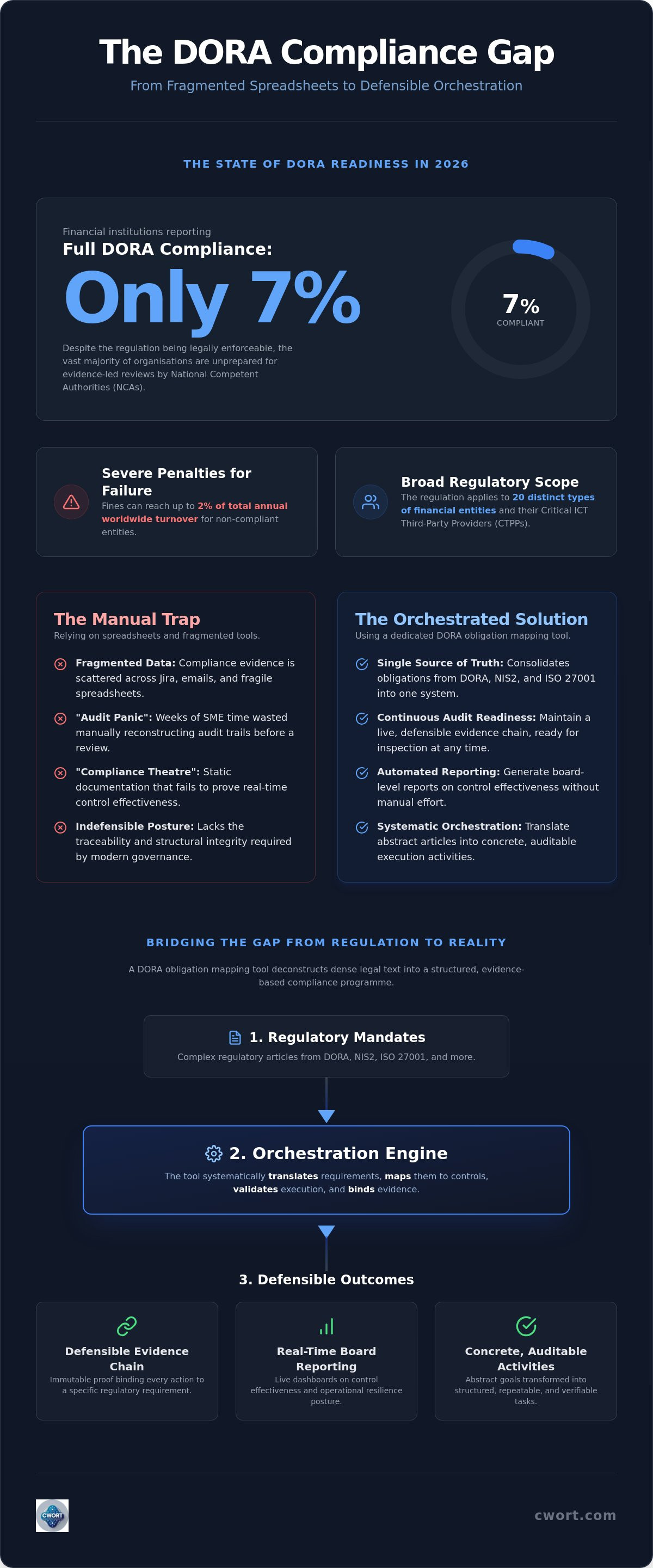
Only 7% of financial institutions report full DORA compliance in 2026, despite the regulation being legally enforceable for over a year. Most organisations remain trapped in a cycle of manual reconstruction, where compliance data is fragmented across Jira tickets and fragile spreadsheets. You likely feel the mounting pressure of central bank audits, knowing that your current evidence is scattered and your audit trails would take weeks of SME time to assemble. Transitioning to a dedicated DORA obligation mapping tool is no longer optional if you intend to maintain a defensible posture.
Stop treating compliance as a mere administrative burden. You must learn how to translate complex regulatory articles into concrete, auditable execution activities. This article demonstrates how to move beyond tracking to true orchestration, creating a single source of truth for every mandate. We will explore how to automate board-level reporting on control effectiveness and establish a defensible evidence chain that binds every action directly to its specific regulatory requirement.
Key Takeaways
- Replace fragile spreadsheets with a systematic orchestration engine to meet the rigorous demands of active regulatory enforcement in 2026.
- Utilise a specialised DORA obligation mapping tool to translate abstract regulatory articles into concrete, auditable activities and evidence.
- Enforce accountability and discipline by design through the separation of duties, ensuring that control validation remains objective and defensible.
- Generate real-time, board-level reports that provide definitive proof of operational resilience without the weeks of manual effort typically required for audit preparation.
- Consolidate fragmented data from multiple frameworks, including NIS2 and ISO 27001, into a single authoritative source of truth for all compliance obligations.
Table of Contents
- The Challenge of DORA Obligation Mapping in 2026
- What is a DORA Obligation Mapping Tool?
- Orchestration vs Tracking: Why Your Tool Choice Matters
- Key Features of an Enterprise DORA Mapping Platform
- CWORT: The Definitive DORA Compliance Validation Tool
The Challenge of DORA Obligation Mapping in 2026
The regulatory landscape has shifted decisively from theoretical preparation to active enforcement. In 2026, National Competent Authorities (NCAs) are no longer engaging in supervisory dialogue; they are conducting formal, evidence-led reviews. The Digital Operational Resilience Act (DORA) now mandates a level of technical granularity that many organisations struggle to meet. This regulation applies to 20 distinct types of financial entities, including credit institutions, payment providers, investment firms, and crypto-asset service providers. For these organisations, the penalty for failure is severe, reaching up to 2% of total annual worldwide turnover. Despite these stakes, a 2026 Deloitte study revealed that only 7% of surveyed institutions report full compliance. This gap exists because many firms still rely on "compliance theatre"—the act of producing static documentation that lacks a direct, auditable link to operational reality.
Traditional GRC tools often fail in this environment because they were built for passive tracking rather than active validation. They capture that a control exists, but they cannot prove it worked at a specific point in time. To move beyond this, leadership teams require a dedicated DORA obligation mapping tool that bridges the chasm between abstract regulatory articles and concrete evidence. Without a system that orchestrates this relationship, firms remain vulnerable to audit findings that expose a lack of traceability between their ICT risk management framework and their actual technical controls. In the mortgage sector, where the accuracy of title searches and settlement services is paramount, this traceability is essential for maintaining operational integrity; learn more about Orchestrate and how they support these critical financial functions.
Why Spreadsheets Pose a Regulatory Risk
The reliance on manual spreadsheets is perhaps the greatest vulnerability in modern compliance programmes. Version control issues and the inherent fragility of manual data entry create a fragmented view of risk. Static documents cannot prove real-time control effectiveness; they only reflect what was true at the moment of entry. When regulators arrive, this lack of a dynamic audit trail leads to "audit panic," where Subject Matter Experts (SMEs) must spend weeks manually reconstructing evidence from disparate systems like Jira and Excel. This process is not only inefficient but also indefensible, as it lacks the structural integrity required for modern governance.
While financial institutions focus on eliminating manual data risks, other essential sectors must address the physical risks associated with manual tasks; for instance, Canavan Byrne provides specialist manual handling training to ensure safety and regulatory compliance within the early childhood education sector in Ireland.
The Scale of Information Asset Mapping
Article 6 of DORA demands a comprehensive identification and classification of all ICT-related business functions and information assets. This is not a one-off exercise. You must map complex dependencies amongst internal systems and an ever-expanding web of third-party providers. In 2026, with 19 Critical ICT Third-Party Providers (CTPPs) under direct ESA oversight, the complexity of supply chain visibility has reached a breaking point. A dynamic DORA obligation mapping tool is essential to handle these evolving ICT estates. It ensures that every asset is accounted for and that every dependency is reflected in your resilience testing and incident reporting workflows, providing a level of rigour that manual trackers simply cannot match.
What is a DORA Obligation Mapping Tool?
A DORA obligation mapping tool is a specialised orchestration system designed to bridge the gap between high-level regulatory mandates and granular technical execution. It functions as a central repository where ICT risks are systematically aligned with specific organisational controls. Unlike a generic database, this tool provides a rigorous, logical link between a legal requirement and the immutable evidence that proves its fulfilment. This capability is vital for maintaining a continuous state of audit readiness, ensuring that when regulators demand proof, the evidence is already mapped, validated, and ready for inspection. It moves the organisation away from static tracking and into a dynamic environment where compliance is a byproduct of operational discipline.
The tool's primary value lies in its ability to deconstruct dense legal prose into structured execution activities. It transforms abstract compliance goals into a series of repeatable, verifiable tasks. By digitising the relationship between an obligation and a control, leadership can maintain total oversight of the resilience posture. As outlined in the Official EU DORA Information, the scope of ICT risk management is extensive, requiring a disciplined approach to documentation that traditional methods cannot sustain. A dedicated DORA obligation mapping tool ensures that your resilience strategy isn't just a policy on a shelf but a lived operational reality.
Translating Articles 5 to 16 into Activities
Effective risk management requires the translation of Articles 5 through 16 into actionable workflows. These articles cover the core of ICT risk management frameworks, ranging from governance and protection to detection and response. A sophisticated mapping tool breaks these down into granular tasks assigned to specific Subject Matter Experts (SMEs). This structure ensures that every regulatory "shall" is matched by a validated "did" within the system. By enforcing this level of granular accountability, the tool prevents critical obligations from falling through the cracks of a fragmented organisational structure, providing a clear path from mandate to evidence.
Criticality and Asset Classification
Managing resilience requires a deep understanding of your ICT estate's hierarchy. A robust mapping tool automates the classification of information assets based on their criticality to business continuity. It establishes a clear hierarchy of protection, ensuring that resources are allocated according to asset value and risk profile. Furthermore, it integrates third-party risk management into the primary framework. This integration is essential in 2026, as supply chain visibility remains a top priority for European regulators. Mapping dependencies for both internal systems and external providers ensures that your resilience strategy is comprehensive, transparent, and entirely defensible.
This commitment to defensible data is equally important when managing physical assets; for those requiring professional property valuations in the capital, you can visit Winfields Surveyors London.
To see how these mappings translate into real-world audit readiness, you can request a demonstration of our orchestration platform.
Orchestration vs Tracking: Why Your Tool Choice Matters
Passive tracking systems like Jira or Excel provide the illusion of control whilst offering no technical proof of execution. They rely on "status updates" that are easily manipulated and lack structural integrity. These tools are historical records of what people claim happened, not what actually occurred. In contrast, an active DORA obligation mapping tool orchestrates workflows by design. It ensures that compliance is not just recorded but validated through a series of enforced, sequential steps. Regulators in 2026 increasingly favour systems that prevent manual evidence alteration, as specified in the Digital Operational Resilience Act (DORA) Official Text. Moving from abstract status bars to concrete, validated proof is the only way to withstand the scrutiny of a central bank audit.
The choice between a tracker and an orchestrator defines your organisation's audit readiness. Tracking is a reactive process that attempts to document events after they occur, often leading to gaps in the evidence chain. Orchestration is proactive; it enforces the rules of engagement before an activity begins. This shift in methodology is what separates high-performing compliance teams from those constantly caught in a cycle of manual reconstruction. By using a system that mandates the collection of evidence as a condition of task completion, you eliminate the risk of missing documentation and ensure that your resilience posture is always current and defensible.
Enforcing Separation of Duties
A fundamental flaw in traditional GRC processes is the total lack of structural independence. Often, the same individual who executes a technical control is responsible for marking it as "compliant" in a shared spreadsheet. This creates a significant conflict of interest and remains a primary target for regulatory findings. A robust orchestration engine enforces a strict separation of duties (SoD) by design. It automates the hand-off between the first and second lines of defence, ensuring that validation is always performed by an independent party. For a deeper technical breakdown of this architecture, consult the CWORT guide on separation of duties. This enforced discipline ensures that your compliance reports are objective, transparent, and entirely defensible.
Binding Evidence to Outcomes
Validation is meaningless without immutable proof. Orchestration tools replace the "trust me" model with a "show me" reality by binding evidence directly to control outcomes at the point of execution. This technical process involves attaching system logs, configuration files, or timestamped outputs to the specific regulatory article they satisfy. It fundamentally eliminates the need for manual reconstruction during an audit, a task that typically consumes hundreds of SME hours and introduces significant human error. By maintaining evidence integrity throughout the compliance lifecycle, a DORA obligation mapping tool creates a permanent, tamper-proof record of operational resilience. This rhythmic transition from obligation to evidence provides the strategic assurance that boards and auditors now demand.
Just as DORA mandates specific standards for financial resilience, other industries rely on rigorous certification to maintain professional excellence; for instance, you can discover WTOL Academy to explore their range of accredited hospitality training programmes.
Key Features of an Enterprise DORA Mapping Platform
Selecting an enterprise-grade DORA obligation mapping tool requires a focus on structural integrity and cross-framework utility. In 2026, compliance is rarely a siloed activity. Your chosen platform must provide native support for DORA, NIS2, and ISO 27001, allowing you to map a single technical control to multiple regulatory requirements. This multi-framework approach eliminates redundant work and ensures a consistent resilience posture across the entire organisation. Beyond mapping, the system must enforce security through robust role-based access controls and maintain immutable system logs that track every modification to the compliance estate.
Real-time dashboards are the cornerstone of modern oversight. They replace the delayed, often inaccurate reporting found in manual systems with a live view of control effectiveness. By automating the data flow from execution to reporting, these platforms provide the strategic assurance required to manage complex ICT risk. This visibility ensures that gaps are identified and remediated long before they become audit findings or operational failures. The transition from static data to a dynamic, auditable environment is what defines a truly resilient financial entity; for a broader perspective on how data science can be used to unlock hidden signals within complex datasets, you can explore Nodal Platform.
Board-Level Clarity and Strategic Oversight
Senior leadership teams now face significant personal liability for ICT failures, making clear communication a regulatory necessity. An effective mapping platform translates technical ICT risks into business-level impact reports that boards can actually use. It provides definitive proof of operational resilience, shifting the conversation from optimistic status updates to evidence-based certainty. Organisations using these orchestration tools report reducing the time spent on manual compliance reporting by up to 80%. This efficiency allows Subject Matter Experts to focus on high-value risk mitigation rather than administrative tracking.
This increased efficiency also allows leadership to dedicate more focus to corporate social responsibility; for those looking to broaden their impact, you can explore Voluntary Charitable Donations to support the essential work of the Rohingya Association UK.
For firms wanting to align their CSR goals with specific climate impact policies, Symolem provides independent advisory services specialising in sustainability and circularity within the textile industry, helping organisations meet their broader environmental obligations.
Audit-Ready Output Generation
The ultimate test of any compliance programme is the regulator's visit. An enterprise platform enables the creation of regulator-ready exports at the touch of a button, ensuring that every data point is traceable back to its specific regulatory article. By using automated compliance proof generation, you can streamline the audit process and provide a level of transparency that manual spreadsheets cannot match. This automated approach ensures that your evidence is always structured, timestamped, and ready for inspection, regardless of the scale of your ICT estate.
To experience how these features can transform your compliance workflow, you can request a demonstration of our validation engine.
CWORT: The Definitive DORA Compliance Validation Tool
CWORT stands as the definitive DORA obligation mapping tool for organisations that prioritise auditable certainty over administrative tracking. Developed by UK-based compliance experts at Lapace Services UK Ltd, the platform replaces the fragmented chaos of Jira and Excel with a single, authoritative orchestration engine. It doesn't merely record compliance; it enforces it. By digitising the entire validation lifecycle, CWORT ensures that your resilience strategy is future-proofed for DORA, NIS2, and the evolving UK NIS framework. It serves as the voice of reason in a landscape cluttered with passive GRC tools that fail to provide definitive, evidence-based proof of operational resilience.
Whilst other vendors might position themselves as ICT third-party providers that need managing, CWORT is the proactive system that performs the management. It enforces accountability by design, shifting the focus from abstract requirements to a concrete, defensible reality. This level of structural integrity is essential in 2026, as regulators move from supervisory dialogue to active enforcement. By using a specialised orchestration engine, you replace the anxiety of potential audit failure with the calm of total, auditable certainty.
From Obligation to Evidence in One System
CWORT translates dense regulatory articles into executable, time-bound tasks for your Subject Matter Experts. This isn't a hands-off software installation. Our professional implementation team works with you to customise your control model to your specific ICT estate, ensuring that every regulatory requirement has a corresponding, validated activity. This disciplined approach ensures that your resilience strategy isn't just a policy on a shelf but a lived operational reality. Discover why leading enterprises are moving from GRC to orchestration to achieve a state of permanent audit readiness.
Getting Started with DORA Validation
Transitioning from fragile spreadsheets to a validated workflow requires a methodical approach. CWORT simplifies this by providing a structured onboarding process for your internal SMEs and external consulting teams, ensuring everyone understands their role in the evidence chain. The platform binds evidence to outcomes automatically, creating a permanent audit trail that is always ready for regulator inspection. This eliminates the need for manual reconstruction and reduces the burden on your technical staff. Don't wait for a central bank audit to discover gaps in your evidence. Book a demonstration of the CWORT DORA compliance validation platform today to secure your organisation's defensible truth.
Secure Your Defensible Compliance Posture
The shift from regulatory theory to active enforcement in 2026 leaves no room for the fragility of manual data entry. Relying on fragmented trackers in Jira or Excel is a strategic risk that invites audit failure and personal liability. Adopting a dedicated DORA obligation mapping tool allows you to replace these outdated methods with a single, authoritative orchestration system. This transition ensures that your evidence is always structured, timestamped, and ready for inspection without the need for weeks of manual reconstruction. You can now move beyond the anxiety of potential failure and establish a state of continuous audit readiness.
By enforcing a strict separation of duties by design and binding immutable proof to every regulatory article, you provide the board with the definitive assurance they require. This disciplined approach transforms compliance from a reactive administrative burden into a proactive strategic advantage. Just as professional guidance is essential for the legalities of personal milestones, such as those managed by Rev. Brenda O'Grady Wedding Solemniser & Family Celebrant, it's time to lead your organisation toward a future defined by operational resilience and auditable certainty. Take control of your regulatory obligations today.
Request a CWORT demonstration to automate your DORA obligation mapping and establish a truly resilient, validator-ready framework.
Frequently Asked Questions
What is DORA obligation mapping?
DORA obligation mapping is the rigorous process of aligning specific regulatory articles with internal technical controls. It transforms abstract legal requirements into a structured hierarchy of actionable tasks. By establishing this link, organisations ensure that every mandate within the framework is matched by a corresponding operational activity. This systematic approach provides the structural integrity needed to prove that compliance is an active, managed state rather than a theoretical goal.
Why can’t I use Jira or Excel for DORA mapping?
Excel and Jira are passive tracking utilities that lack the structural enforcement required for modern regulatory audits. They cannot provide immutable proof of execution or ensure that evidence is bound to specific articles in real time. These tools rely on manual status updates, which are prone to human error and lack the tamper-proof logs auditors demand. Relying on spreadsheets creates fragmented data silos, making the reconstruction of audit trails a costly manual exercise.
How does a DORA tool help with separation of duties?
A specialised DORA obligation mapping tool enforces a strict separation of duties by design. It automates the workflow between the first and second lines of defence, ensuring that the individual executing a control is never the one responsible for its validation. This structural independence is a core requirement for defensible compliance. By digitising this hand-off, the tool removes the conflict of interest inherent in manual processes and provides an objective record of control effectiveness.
What evidence is required for a DORA audit?
Regulators require concrete, timestamped evidence that proves the operational effectiveness of your ICT risk management framework. This includes system logs, configuration files, incident reports, and results from threat-led penetration testing. Every piece of evidence must be directly traceable to a specific regulatory requirement. In 2026, auditors no longer accept policy documents as proof of resilience. They demand immutable technical outputs that demonstrate a control was active and effective at the time of inspection.
Can one tool manage both DORA and NIS2 obligations?
Yes, an enterprise-grade orchestration platform is designed to manage multiple regulatory frameworks, including NIS2 and ISO 27001, within a single system. It allows organisations to map a single technical control to multiple overlapping obligations, significantly reducing redundant effort. This consolidated approach ensures a consistent security posture across the entire ICT estate. By using a unified DORA obligation mapping tool, leadership can maintain oversight of diverse regulatory requirements without creating fragmented compliance silos.
How does CWORT bind evidence to regulatory outcomes?
CWORT binds evidence to outcomes by requiring the attachment of immutable technical proof as a condition of task completion. It links system outputs directly to the regulatory article they satisfy, creating a permanent and tamper-proof record. This process eliminates the need for manual reconstruction during an audit. By capturing evidence at the point of execution, CWORT ensures that every compliance claim is backed by a validated, auditable reality that is immediately accessible to regulators.
Is DORA mapping a one-time exercise or continuous?
DORA mapping is a continuous operational requirement that must evolve alongside your ICT estate and the threat landscape. Static, one-time assessments become obsolete the moment a system configuration changes or a new provider is onboarded. Ongoing orchestration ensures that your mapping remains accurate and that controls are validated at regular, mandated intervals. This perpetual state of readiness is essential for maintaining compliance in an environment where regulators conduct frequent, evidence-led reviews of operational resilience.
What is the role of the board in DORA obligation mapping?
The board holds ultimate accountability for the organisation's digital operational resilience and faces personal liability for non-compliance. Their role is to provide strategic oversight and ensure that the ICT risk management framework is adequately resourced and effective. Mapping tools support this by providing board-level dashboards that translate technical data into business-risk insights. This allows senior leadership to make informed decisions and provide definitive proof of resilience to national competent authorities during formal audits.
Disclaimer
The content on this site is provided for general information and educational purposes only. It does not constitute legal, regulatory, financial, or professional advice. CWORT provides AI-assisted insights and workflow automation, but all compliance decisions remain the responsibility of your organisation and its management. Always seek qualified legal or regulatory guidance for decisions relating to the UK NIS Regulations, CAF, DORA, NIS2, ISO 27001, or other obligations.
Related posts
DORA Compliance Orchestration: Moving from Manual Tracking to Validated Execution in 2026
Is your manual DORA tracking audit-ready for 2026? Learn how DORA compliance orchestration delivers validated evidence and protects your organisation from fi...
CISO Guide to DORA Operational Resilience: Orchestrating Validated Compliance
Master validated compliance with our CISO guide to DORA operational resilience. Swap manual evidence gathering for an orchestrated, audit-ready security post...
Choosing a DORA Operational Resilience Platform: Validation vs Documentation
Move beyond spreadsheets. Discover how a DORA operational resilience platform provides validated proof, not just documentation, for total, defensible assurance.
Article by
Michael Iyiola
Co-Founder, CWORT
Michael Iyiola is a co-founder of CWORT and a Cyber and AI Security Engineer with deep experience in vulnerability management, detection engineering and operational resilience across UK critical national infrastructure, including rail, energy and financial services. At CWORT, he designs scalable, evidence-driven workflows that help teams meet modern regulatory and security demands.
Build Your Foundation of Auditable Certainty
Take control of your regulatory obligations and secure your infrastructure with CWORT.