DORA Compliance Orchestration: Moving from Manual Tracking to Validated Execution in 2026

Michael Iyiola
Co-Founder, CWORT
Is your manual DORA tracking audit-ready for 2026? Learn how DORA compliance orchestration delivers validated evidence and protects your organisation from fi...
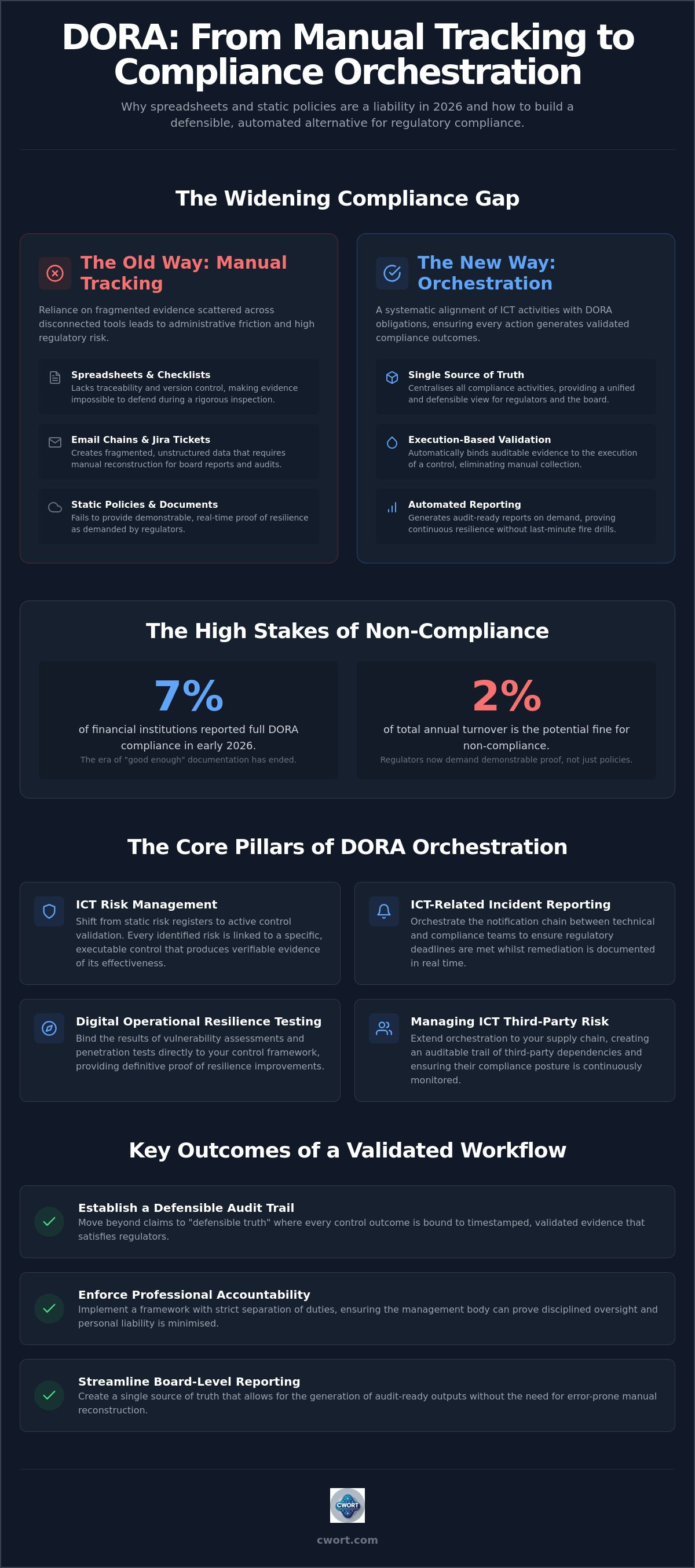
With only 7% of financial institutions reporting full DORA compliance in early 2026, the era of "good enough" documentation has ended. Regulators have shifted their focus from reviewing static policies to demanding demonstrable, real-time proof of resilience. If your organisation still relies on fragmented evidence scattered across Jira tickets, emails, and Excel spreadsheets, you're not just facing administrative friction; you're courting a fine of up to 2% of total annual turnover. Transitioning to a model of DORA compliance orchestration is no longer a strategic choice but a regulatory necessity to ensure every control outcome is bound to validated evidence.
You likely feel the mounting anxiety of preparing board-level reports whilst manually reconstructing audit trails that should've been automated months ago. We recognise the pressure to prove separation of duties and maintain a single source of truth across all five DORA pillars. This article explores how to move beyond manual tracking into a state of validated execution. You'll discover how to transform abstract regulatory obligations into a disciplined, evidence-based workflow that satisfies both the European Supervisory Authorities and your own management body. We'll examine the shift from mere documentation to active orchestration, ensuring your reports are audit-ready without the need for manual reconstruction.
This need for active orchestration is a trend across various industries; for instance, enterprise-scale retailers looking to improve their operational efficiency can learn more about Ommni to discover how dedicated platforms manage complex workflows.
Key Takeaways
- Understand why manual tracking in spreadsheets fails 2026 regulatory standards and how DORA compliance orchestration establishes a defensible, automated alternative.
- Learn to map every DORA obligation to a structured execution activity, ensuring that technical tasks result in verifiable compliance outcomes rather than just completed tickets.
- Discover how to bridge the "Evidence Gap" by binding real-time data directly to control outcomes, replacing fragmented evidence scattered across Jira, emails, and Excel.
- Implement a framework that enforces strict separation of duties and professional accountability, providing the auditable certainty required by both regulators and the board.
- Streamline the preparation of board-level reports by creating a single source of truth that allows for the generation of audit-ready outputs without manual reconstruction.
Table of Contents
- The Shift from DORA Tracking to Compliance Orchestration
- The Five Pillars of Digital Operational Resilience Orchestration
- Why Standard GRC Tools Fail at DORA Validation
- Building a Regulator-Ready Evidence Repository
- CWORT: The Enterprise Engine for DORA Orchestration
The Shift from DORA Tracking to Compliance Orchestration
Compliance is no longer a paperwork exercise to be completed in the weeks preceding an audit. As of early 2026, the European Supervisory Authorities (ESAs) have made it clear that they require demonstrable proof of operational resilience, not just a collection of signed policies. This shift has necessitated the rise of DORA compliance orchestration. This approach represents the systematic alignment of ICT activities with regulatory obligations, ensuring that every technical action taken within the organisation contributes directly to a validated compliance outcome.
Traditional "static" compliance relies on periodic checklists and retrospective evidence gathering. This method is fundamentally flawed in a high-stakes environment where the Digital Operational Resilience Act (DORA) demands continuous oversight. Orchestration replaces these disjointed efforts with automated workflows. Instead of chasing engineers for screenshots, an orchestrated system binds evidence to the execution of the task itself. This creates a state of "execution-based validation", where the completion of a control activity automatically generates the necessary auditable proof.
Why Spreadsheets Fail the DORA Audit Test
Manual trackers and spreadsheets lack the structural integrity required for modern governance. They offer no inherent traceability or "defensible truth". In a spreadsheet, data can be modified without leaving a forensic trail, making it impossible to prove the integrity of your evidence during a rigorous inspection. Version control errors often lead to conflicting reports, creating a significant risk of providing inaccurate data to regulators. Regulators now favour systems like CWORT that enforce discipline by design. These platforms ensure that every entry is timestamped, verified, and linked to a specific regulatory requirement, removing the ambiguity that plagues manual systems.
The Role of Strategic Urgency in 2026
The grace period for compliance has expired. In 2026, the strategic urgency stems from the move towards continuous validation expectations. Periodic audits are being replaced by real-time resilience proof. Financial entities must be prepared to demonstrate their posture at any given moment, especially regarding third-party risks and incident response capabilities. This pressure requires a centralised orchestration engine that can synchronise activities across multiple departments. Moving from manual tracking to a system of validated execution isn't just about efficiency; it's about establishing the auditable certainty needed to protect the management body from personal liability and the organisation from catastrophic fines. To discover how similar automation principles can be applied to streamline complex sales and channel operations, visit Computer Market Research.
The Five Pillars of Digital Operational Resilience Orchestration
The European Union's DORA regulation establishes a rigorous framework that demands more than simple administrative oversight. It requires an active, operational response across five distinct functional areas. Effective DORA compliance orchestration necessitates moving beyond these silos to create a unified execution environment. By synchronising ICT risk management, incident reporting, resilience testing, third-party risk, and information sharing, organisations can replace reactive firefighting with a disciplined, auditable workflow.
- ICT Risk Management: Shift from static risk registers to active control validation. Every identified risk must be linked to a specific, executable control that produces verifiable evidence of its effectiveness.
- ICT-Related Incident Reporting: Orchestrate the notification chain between technical response teams and compliance leads. This ensures that regulatory deadlines are met whilst technical remediation is documented in real time.
- Digital Operational Resilience Testing: Bind the results of vulnerability assessments and threat-led penetration testing directly to your control framework. This provides definitive proof that testing programmes are driving actual resilience improvements.
- Managing ICT Third-Party Risk: Extend orchestration to your supply chain. Move beyond contractual clauses to require structured execution and evidence submission from critical vendors.
- Information and Intelligence Sharing: Create a secure, auditable environment for sharing threat intelligence. This ensures that defensive actions taken in response to shared data are recorded as part of your resilience narrative.
Orchestrating ICT Risk Management
Translating high-level ICT standards into specific execution tasks is the foundation of a defensible strategy. You must map every internal control to a specific DORA article to ensure no regulatory gap remains unaddressed. This mapping process transforms abstract policy into a series of mandatory activities. Assign clear ownership for each task and enforce a strict validation process. When a control is executed, the system must automatically capture the output. This discipline ensures that every risk has a corresponding, validated mitigation activity that is ready for regulatory inspection at any moment. To achieve this level of rigour, organisations can examine how orchestration platforms enforce these standards by design.
Third-Party Oversight Beyond the Contract
The Register of Information (ROI) requirements in 2026 demand deep visibility into your ICT supply chain. You can no longer rely on annual questionnaires or static contract clauses to satisfy regulators. Orchestration allows you to demand validated performance from your providers. Set up automated workflows that prompt vendors for specific evidence of their own resilience controls. This proactive approach ensures that third-party risks are managed with the same level of granularity as internal ICT risks. Refer to the DORA compliance validation pillar for deeper context on how to integrate vendor performance into your broader resilience framework. This transition from "trust" to "verified execution" is critical for maintaining compliance across complex, multi-tiered supply chains.
Why Standard GRC Tools Fail at DORA Validation
Traditional Governance, Risk, and Compliance (GRC) tools were designed for a different era of oversight. They act as passive repositories for data rather than active enforcers of standards. This creates a significant "Evidence Gap" where an organisation might have a record of a task being completed but lacks the granular proof of the compliance outcome. Under the Digital Operational Resilience Act (DORA), regulators aren't interested in your intent; they demand validated proof of your execution. Relying on passive tracking systems leaves leadership vulnerable during an audit, as these tools fail to bind real-time evidence to specific control outcomes.
True DORA compliance orchestration eliminates this friction by capturing evidence at the point of execution, ensuring that every control is auditable from the moment it's triggered. It's about moving from a reactive posture to a state of constant readiness, which often involves evaluating your current software suite; for those seeking software alternatives, Alternative Radar provides a discovery platform for comparing digital tools that meet these rigorous standards.
Jira vs. Compliance Orchestration
It's common for technical teams to assume that managing tasks in Jira satisfies regulatory requirements. This is a misconception. Task management is about workflow efficiency, whilst regulatory validation is about accountability and proof. Developers shouldn't be expected to self-certify their own compliance without independent, system-enforced verification. This lack of rigour is exactly Why Jira is Not a Compliance Orchestration Tool. Without a system that mandates evidence submission before a task can be closed, your compliance posture remains an unverified claim rather than a defensible reality.
Enforcing Separation of Duties
Auditors look for independent validation of technical controls to ensure that no single individual can override security protocols. Standard GRC tools rarely enforce this at the execution level. They might track that a change occurred, but they don't prevent unauthorised overrides in real-time. Orchestration platforms solve this by design. They mandate that the person executing a control and the person validating the outcome are distinct entities, with the system acting as the final arbiter. This no-nonsense approach to accountability ensures that your organisation's resilience isn't just a policy on paper, but a structural integrity enforced by your compliance engine.
Building a Regulator-Ready Evidence Repository
Achieving a state of audit-readiness requires the same level of meticulous preparation as any high-stakes outdoor activity. Just as seasoned explorers discover Wood To Water Outdoors to source the high-quality hiking and bushcraft equipment needed for their expeditions, financial firms must ensure they have the correct tools to manage their regulatory evidence.
Establish a regulator-ready repository by moving beyond passive storage. A folder of static PDFs is no longer sufficient for 2026 standards. You must build a system where evidence is an inevitable byproduct of execution. This structured approach ensures your repository withstands the scrutiny of a rigorous audit. Follow these five steps to transform your compliance posture:
- Step 1: Map every DORA obligation to a structured execution activity. Do not leave regulatory articles as abstract concepts; translate them into mandatory tasks.
- Step 2: Assign ownership and enforce strict separation of duties. Auditors demand proof that technical changes were independently verified by a separate authorised party.
- Step 3: Capture and bind evidence directly to the activity at the point of execution. Eliminate the "evidence gap" by ensuring proof is generated and attached in real-time.
- Step 4: Generate automated reports that mirror regulator expectations. Remove the need for manual data manipulation or retrospective reconstruction.
- Step 5: Review and iterate based on continuous monitoring data. Use performance metrics to refine your resilience posture and address emerging ICT risks.
Integrating DORA compliance orchestration into your daily operations ensures that your organisation moves beyond mere documentation. It creates a defensible reality where every claim of resilience is backed by validated, tamper-proof data. To see this workflow in action, you can request a demonstration of our validation engine.
Automating the Audit Trail
Manual evidence gathering is a significant drain on senior resources. This "audit tax" often diverts your most expensive talent from strategic tasks to administrative hunting. Immutable evidence logging solves this by creating a permanent, unalterable record of every compliance activity. By Ensuring Compliance Evidence Integrity, you provide auditors with a forensic trail that is impossible to dispute. It shifts the focus from finding proof to demonstrating excellence whilst maintaining total transparency.
Board-Level Reporting with Strategic Urgency
The board doesn't need to see technical logs. They need assurance. Effective reporting translates complex ICT data into high-level dashboards that highlight residual risk and resilience posture. You must demonstrate control effectiveness without the friction of manual slide-deck preparation. This automated approach provides leadership with the auditable certainty they need to sign off on regulatory submissions with confidence. It replaces the anxiety of potential failure with a clear, data-driven narrative of control and professional maturity.
This demand for real-time visibility is also transforming the education sector; schools looking to unify their student data and performance analytics can check out Rise to see how modern dashboards simplify complex oversight.
Just as the board values the efficiency of automated reporting, individuals value the same level of digital coordination in their personal administrative tasks. For example, to learn more about how automated systems can streamline road test booking, one can explore specialised service platforms that eliminate the need for manual scheduling.
CWORT: The Enterprise Engine for DORA Orchestration
CWORT stands as the definitive platform for financial entities moving beyond administrative tracking. It functions as the engine for DORA compliance orchestration, ensuring that every regulatory requirement is met with validated execution. The platform doesn't merely record intent; it enforces a transition from abstract "obligation" to "auditable evidence". This shift is critical for satisfying the rigorous expectations of regulators in 2026. By building discipline directly into the workflow, CWORT replaces the anxiety of potential failure with the calm of auditable certainty.
The system provides a sophisticated environment designed for serious governance. It allows leadership to manage DORA, NIS2, and ISO 27001 within a single orchestrated system. This unified approach eliminates the waste and inconsistency of maintaining separate compliance silos. It offers a "no-nonsense" solution for organisations that prioritise professional maturity and defensible truth over superficial checklists. Just as Narrow Minded Railworks provides the specific, detailed guidance required for mastering narrow gauge railway modelling, CWORT provides the granular structure needed for regulatory excellence. The platform ensures that every action taken by technical teams is automatically linked to a specific regulatory article, creating a repository that is always audit-ready.
From Implementation to Continuous Validation
Moving from implementation to continuous validation requires a system that enforces accountability by design. CWORT configures custom control models tailored to your specific organisational structure. This ensures that technical SMEs and consulting teams are onboarded to a validated workflow where their actions are automatically bound to compliance outcomes. For organisations already maintaining existing standards, our ISO 27001 Control Mapping Tool allows you to integrate legacy controls into a modern orchestration framework without losing traceability or integrity.
Scaling Beyond DORA
Regulatory requirements are not static; they represent a moving target for global financial entities. Leveraging orchestration for NIS2 and UK NIS requirements allows your organisation to scale its resilience efforts across multiple frameworks effortlessly. This approach future-proofs your compliance posture against evolving cyber resilience standards. It ensures that your evidence repository remains a living asset rather than a static archive. Secure your organisation's position as a meticulous guardian of standards and eliminate the risk of manual error. Book a demo of the CWORT orchestration engine to begin your transition from manual tracking to validated execution.
Establishing Defensible Resilience for 2026 and Beyond
Transitioning from administrative tracking to DORA compliance orchestration represents a fundamental shift in how financial entities manage risk. By replacing fragmented spreadsheets with an automated validation engine, you ensure that every control outcome is backed by immutable proof. This level of digital rigour is increasingly necessary across all technical fields; for instance, SOCWeld provides a platform to automate and manage welding documentation, ensuring that critical industrial records are as defensible as financial ones. This approach eliminates the "audit tax" and provides the auditable certainty required by both regulators and the board. You can now move beyond the anxiety of potential failure into a state of total, defensible control.
CWORT provides the structural integrity needed to survive 2026 regulatory scrutiny. Our platform delivers regulator-ready outputs through automated evidence binding, all backed by UK-based expert support. Don't leave your resilience posture to chance or manual reconstruction. Secure your organisation's future by choosing a system designed for rigorous governance and professional accountability. Take the decisive step towards a validated compliance workflow that protects your management body and your business.
Secure your DORA compliance with CWORT orchestration and begin your journey toward validated execution today.
Frequently Asked Questions
What is the difference between DORA compliance tracking and orchestration?
Tracking is a passive process that records history through checklists and spreadsheets, whilst orchestration is an active system that directs and validates activity in real-time. DORA compliance orchestration ensures that every ICT task is aligned with a specific regulatory obligation and produces evidence automatically as a byproduct of execution. This eliminates the "evidence gap" inherent in manual systems by enforcing discipline at the point of task completion.
Does DORA apply to UK-based financial institutions in 2026?
DORA applies to any UK-based institution that provides financial services within the European Union or handles EU-based client data. Whilst the UK maintains its own regulatory landscape, including the UK NIS Framework, firms with an EU footprint must comply with DORA to avoid penalties of up to 2% of annual worldwide turnover. UK institutions often use orchestration to align their domestic resilience efforts with these stringent EU requirements, and many also integrate specialised tools like Conzent to ensure their cookie consent practices remain fully GDPR-compliant.
How does an orchestration platform enforce separation of duties?
The platform enforces independent verification by preventing a single individual from both executing a technical control and approving the compliance outcome. It utilises hard-coded workflows that mandate a separate authorised party validates every action before it's logged as a completed obligation. This system-level enforcement removes the risk of unauthorised overrides and provides auditors with a definitive record of professional accountability.
Can we use CWORT to manage NIS2 and DORA simultaneously?
CWORT is designed as a multi-framework engine that allows you to manage DORA, NIS2, and ISO 27001 within a single environment. By mapping shared controls across different regulatory pillars, the system reduces redundant activities and ensures a unified resilience posture. This integrated approach allows leadership to maintain a single source of truth for all governance and risk management obligations across the enterprise.
What kind of evidence is required to prove DORA ICT risk management compliance?
Auditors require immutable logs, validated control outcomes, and a comprehensive Register of Information (ROI) regarding third-party ICT providers. You must demonstrate that every identified risk in your register is linked to a specific, executed mitigation activity that has been independently verified. Static policy documents are insufficient; regulators now demand real-time proof of control effectiveness and operational resilience testing results.
How long does it take to implement a DORA orchestration workflow?
A structured DORA compliance orchestration workflow can typically be established within several weeks, depending on the complexity of your existing ICT environment. The process involves mapping your current controls to specific DORA articles and onboarding technical SMEs to the automated evidence capture system. This fast-paced implementation shifts your focus from administrative preparation to continuous, validated execution almost immediately.
Why is manual evidence collection considered a high-risk activity by auditors?
Manual collection lacks forensic integrity and is highly susceptible to version control errors and human oversight. Auditors view spreadsheets as "soft" evidence because they lack immutable timestamps and can be modified without leaving an auditable trail. This lack of "defensible truth" creates significant regulatory risk, as it's impossible to prove the data hasn't been altered retrospectively to satisfy an audit request.
Does DORA orchestration replace our existing GRC system?
Orchestration acts as the "execution layer" that most standard GRC systems lack, meaning it can either augment or replace your current tools. Whilst traditional GRCs function as passive repositories, an orchestration engine proactive enforces the discipline required for DORA. Many organisations choose to replace legacy systems with CWORT to achieve the granular, real-time evidence capture necessary for 2026 regulatory standards.
Disclaimer
The content on this site is provided for general information and educational purposes only. It does not constitute legal, regulatory, financial, or professional advice. CWORT provides AI-assisted insights and workflow automation, but all compliance decisions remain the responsibility of your organisation and its management. Always seek qualified legal or regulatory guidance for decisions relating to the UK NIS Regulations, CAF, DORA, NIS2, ISO 27001, or other obligations.
Related posts
DORA Obligation Mapping Tool: Orchestrating Defensible Compliance in 2026
Stop manual DORA tracking. A DORA obligation mapping tool orchestrates compliance, automates reporting, and creates a defensible audit trail for central banks.
DORA Compliance Validation Software: Orchestrating Defensible Proof in 2026
Is your DORA strategy audit-ready for 2026? Learn how DORA compliance validation software provides defensible proof and protects board members from liability.
Challenges of DORA Compliance for Financial Institutions in 2026: A Strategic Guide
Facing the challenges of DORA compliance for financial institutions? Our 2026 guide helps you move from manual tracking to automated validation for total ass...
Article by
Michael Iyiola
Co-Founder, CWORT
Michael Iyiola is a co-founder of CWORT and a Cyber and AI Security Engineer with deep experience in vulnerability management, detection engineering and operational resilience across UK critical national infrastructure, including rail, energy and financial services. At CWORT, he designs scalable, evidence-driven workflows that help teams meet modern regulatory and security demands.
Build Your Foundation of Auditable Certainty
Take control of your regulatory obligations and secure your infrastructure with CWORT.