Challenges of DORA Compliance for Financial Institutions in 2026: A Strategic Guide

Michael Iyiola
Co-Founder, CWORT
Facing the challenges of DORA compliance for financial institutions? Our 2026 guide helps you move from manual tracking to automated validation for total ass...

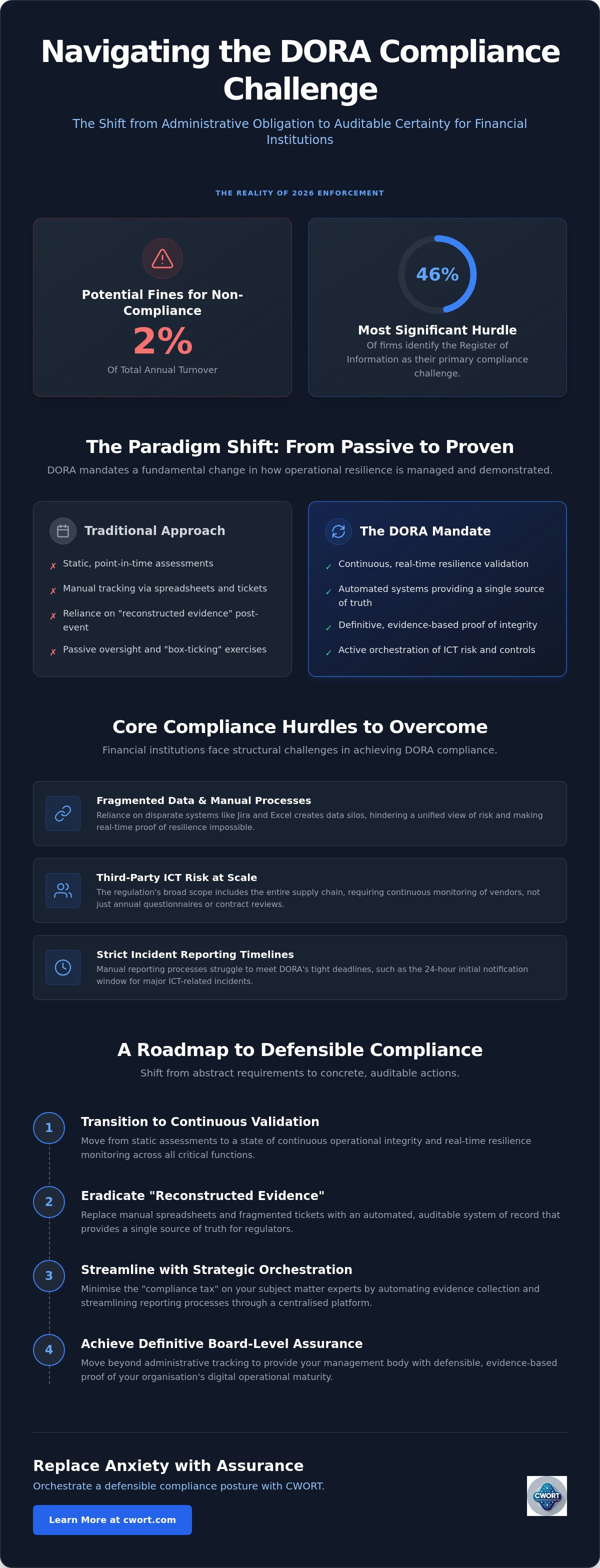
With 2026 ushering in a period of active regulatory enforcement, the reality for the sector is stark: 46% of firms identify the Register of Information as their most significant hurdle. You likely recognise the daily friction of managing fragmented data across Jira and Excel, where the primary challenges of DORA compliance for financial institutions stem from an inability to prove resilience in real time. It's no longer enough to simply track tasks. You must now provide definitive, evidence-based proof of operational integrity to avoid fines that can reach 2% of total annual turnover.
This guide bridges the gap between administrative obligation and auditable certainty. You'll discover how to move beyond manual tracking toward a system of automated validation that satisfies both National Competent Authorities and your management body. We'll examine the structural hurdles of third-party ICT risk at scale and provide a clear roadmap for orchestrating a defensible compliance posture that offers total board-level assurance. By shifting from abstract requirements to concrete reality, you can replace the anxiety of potential failure with the calm of professional maturity.
Key Takeaways
- Transition from static, point-in-time assessments to a mandated state of continuous operational integrity and real-time resilience.
- Navigate the structural challenges of DORA compliance for financial institutions by integrating regulatory requirements directly into existing technical and organisational frameworks.
- Eradicate the risk of "reconstructed evidence" by replacing manual spreadsheets with automated, auditable validation systems.
- Minimise the "compliance tax" on subject matter experts through strategic orchestration that streamlines reporting and evidence collection.
- Achieve definitive board-level assurance by moving beyond administrative tracking to provide defensible proof of digital operational maturity.
Table of Contents
- The Paradigm Shift: Why DORA Compliance Challenges Are Structural
- Navigating the Five Pillars: Technical and Organisational Hurdles
- The Evidence Integrity Crisis: Why Spreadsheets Fail DORA Audits
- Overcoming Resource Constraints through Compliance Orchestration
- Future-Proofing DORA: From Implementation to Validation
The Paradigm Shift: Why DORA Compliance Challenges Are Structural
The transition into 2026 marks the end of the grace period for financial entities. Compliance is no longer a theoretical exercise or a "best efforts" endeavour; it is a mandated state of operational readiness. The Digital Operational Resilience Act (DORA) has fundamentally altered the regulatory landscape by shifting the focus from static, point-in-time audits to continuous, evidence-based integrity. Traditional risk management often relied on annual reviews that provided a snapshot of security. DORA demands a live, orchestrated view of every critical function. This shift creates significant challenges of DORA compliance for financial institutions, as legacy structures aren't designed for the level of transparency regulators now require.
Risk managers must now bridge the gap between technical execution and board-level oversight. The "Digital" aspect of the regulation extends far beyond the server room. It encompasses the entire ICT ecosystem, including third-party providers who were previously outside the direct line of regulatory fire. This creates a core tension: firms must maintain high operational speed to remain competitive whilst adhering to a level of scrutiny that can feel restrictive. Success depends on moving from manual tracking to a system of truth that provides auditable validation at a moment's notice.
From Box-Ticking to Operational Resilience
Adhering to a framework is not the same as proving resilience under stress. Regulators have moved away from "passive oversight," where the existence of a policy was sufficient. They now favour evidence of "effective control." This means your organisation must demonstrate that its resilience measures actually work during a disruption. It requires a move toward active orchestration of ICT risks. You don't just need a plan; you need a validated system that enforces accountability by design. The focus has shifted from what you say you do to what you can prove you've done.
The Scope Inflation Challenge
One of the primary challenges of DORA compliance for financial institutions is the sheer breadth of the regulation. DORA pulls in a vast array of previously unregulated ICT service providers, forcing firms to re-evaluate their entire supply chain. Categorising "critical or important functions" across a global enterprise is a complex task. It often leads to fragmented data amongst disparate business units. Without a unified platform like CWORT to map these dependencies and manage DORA Compliance Validation, maintaining a coherent view of risk becomes nearly impossible. You cannot defend what you cannot see, and 2026 leaves no room for visibility gaps.
Navigating the Five Pillars: Technical and Organisational Hurdles
Execution within the five pillars requires more than policy updates; it demands a technical and cultural overhaul. Integrating DORA into existing frameworks like ISO 27001 or NIST is a significant hurdle because these standards often treat operational resilience as a secondary objective. DORA elevates it to a primary mandate. For those managing DORA compliance in the cloud, the complexity multiplies as shared responsibility models often clash with strict regulatory accountability. You cannot delegate your compliance obligations to a cloud provider, regardless of their scale.
Third-party risk management remains one of the most visible challenges of DORA compliance for financial institutions. Moving beyond static, annual questionnaires to a state of continuous monitoring is an operational necessity. It's no longer sufficient to have a "compliant" contract sitting in a drawer. You must ensure your critical vendors are operationally resilient through active DORA Compliance Validation. This shift requires a level of transparency that many traditional vendor management offices are currently unequipped to provide.
The Incident Reporting Logjam
Standardising incident classification across multiple EU jurisdictions is a logistical nightmare. Manual reporting processes inevitably fail the strict DORA timelines for major ICT-related incidents, particularly the 24-hour initial notification window. Under the latest Regulatory Technical Standards, a major incident is defined by thresholds concerning the number of users affected, the criticality of the services disrupted, and the geographic spread of the impact. Failing to automate this classification leads to reporting delays that trigger immediate regulatory scrutiny.
Third-Party Risk: The Contractual vs Operational Gap
A compliant contract does not guarantee a resilient supply chain. Enforcing "right to audit" clauses remains a significant challenge in practice, especially when dealing with dominant global ICT providers. You must also account for "nth-party" risk, which involves the resilience of your provider’s own critical suppliers. This chain of dependency creates a visibility gap that manual tracking cannot bridge. To see how orchestration can simplify these complex pillar-specific requirements, you might explore a tailored validation demo. Achieving true resilience requires moving from contractual promises to evidence-based operational certainty.
Testing and Intelligence Sharing
Digital Operational Resilience Testing, particularly Threat-Led Penetration Testing (TLPT), introduces high costs and administrative complexity. Significant entities must conduct these tests every three years, requiring coordination between internal teams, external testers, and regulators. Simultaneously, overcoming the cultural and legal barriers to information sharing is essential. Whilst DORA encourages sharing threat intelligence, many firms remain hesitant due to perceived liability risks. Breaking down these silos is the only way to build a collective defence against evolving cyber threats.
The Evidence Integrity Crisis: Why Spreadsheets Fail DORA Audits
Manual tracking methods create a dangerous "Evidence Gap" that regulators in 2026 are no longer willing to overlook. One of the primary challenges of DORA compliance for financial institutions is the reliance on fragmented data residing in static spreadsheets. These documents lack the inherent traceability required for a rigorous audit. When a control is updated in your environment but the evidence remains static in an Excel file, you encounter "Evidence Drift." This misalignment leaves your organisation vulnerable to findings of non-compliance. The board cannot verify the current state of resilience from outdated rows and columns whilst the threat landscape evolves daily.
Spreadsheets also fail to enforce a necessary "Separation of Duties." In a manual environment, the person responsible for executing a control is often the same person documenting its success. This lack of independent validation undermines the integrity of your compliance posture. Regulators demand a clear, system-enforced distinction between operational activity and regulatory oversight. Without this, your evidence is merely a claim rather than a defensible truth. You must move from administrative tracking to definitive, evidence-based proof.
The Danger of Reconstructed Evidence
Reconstructed evidence refers to documentation generated after the fact, specifically to satisfy an auditor's request. It's a common industry pitfall that carries severe risks under DORA. Regulators now specifically look for "contemporaneous validation." They require proof that a control was active and effective at the exact moment it was required. Ensuring compliance evidence integrity is vital for DORA because it replaces retroactive storytelling with a real-time, immutable audit trail. If you cannot prove a control's status historically without manual intervention, you don't have a resilient system. You have a documentation problem.
Why Jira and Excel Are Not Compliance Tools
General-purpose tools like Jira are excellent for project management but lack the "Regulatory Logic" essential for DORA governance. They track the completion of a task, not the ongoing validity of a control outcome. This distinction is critical. A Jira ticket might show that a patch was applied, but it doesn't provide the continuous evidence that the system remains patched and compliant. Relying on a single "owner" of a compliance spreadsheet also creates a single point of failure. If that individual leaves or the file is corrupted, your entire history of resilience disappears. Adopt a system designed for DORA Compliance Validation to ensure your evidence is as robust as your operations.
Static reports provide a false sense of security that fails the "Board-Level Visibility" test. DORA mandates that the management body takes personal liability for ICT risk. A quarterly PDF summary cannot provide the real-time assurance required for such high stakes. Leadership needs a live dashboard that reflects the actual state of the organisation's resilience, not a curated view that is weeks out of date. Shifting to an automated orchestration engine ensures that the board receives evidence-based certainty. This allows them to make informed strategic decisions with total confidence.
Overcoming Resource Constraints through Compliance Orchestration
Resource constraints are the silent killers of long-term resilience programmes. Many organisations treat DORA as a one-time project, but the reality is a continuous requirement that places a heavy "compliance tax" on operational teams. Subject Matter Experts (SMEs) often face extreme compliance fatigue when tasked with manual, repetitive reporting. This drain on high-value talent is one of the most overlooked challenges of DORA compliance for financial institutions. Addressing the structural challenges of DORA compliance for financial institutions requires a shift from managing people to orchestrating workflows, allowing your team to focus on security rather than documentation.
Orchestration replaces the manual chase for data with automated validation. It forces discipline by design, ensuring that every action taken in the environment is automatically mapped to a regulatory obligation. This transition reduces manual audit preparation time by providing a constant state of readiness. You aren't just tracking work; you are validating outcomes. It's about moving from a reactive posture to a proactive, system-enforced standard of truth.
Automating the Control Validation Loop
Execution must be structured to be defensible. You need to translate abstract regulatory obligations into granular, executable activities. By binding evidence directly to control outcomes as they occur, you eliminate the risk of the "Evidence Gap" mentioned earlier. To achieve this, explore how regulatory compliance workflow automation can streamline DORA by enforcing accountability at the point of execution. This ensures that validation is a byproduct of work, not an additional task that SMEs have to complete after the fact.
Board-Level Reporting without the Manual Labour
Senior leadership requires "Regulator-Ready" insights without the delay of manual PowerPoint assembly. A live dashboard provides the board with real-time visibility, fulfilling their governance and organisation obligations under DORA. This transparency removes the anxiety of high-stakes audits. When the board can see definitive proof of resilience at any moment, it fosters a culture of professional maturity and strategic control. To see this orchestration in action, you can request a tailored validation demo today and replace manual labour with auditable certainty.
Future-Proofing DORA: From Implementation to Validation
Viewing the challenges of DORA compliance for financial institutions as a mere administrative burden is a strategic error. In reality, these requirements offer a unique opportunity to achieve a level of operational maturity that was previously unattainable. The shift from implementation to validation is the final step in this evolution. It marks the transition from "trying to be compliant" to "being resilient." By adopting an orchestration engine, you replace the chaos of fragmented spreadsheets with a single, disciplined system of record. This is the foundation of a "Defensible Truth"—a state where your evidence is so robust that it requires no explanation or manual defence.
Defensible Truth is not a static report; it is a dynamic state of being. It means that every time a regulator asks for proof, the system provides it instantly, without the need for a team of consultants to spend weeks digging through Jira tickets. It replaces the anxiety of potential failure with the calm of auditable certainty. This is the ultimate goal of DORA: to ensure that the financial system is not just compliant on paper, but resilient in practice. Organisations that embrace this shift will find that their compliance efforts actually reduce operational risk, rather than just adding to the workload. Effectively navigating the challenges of DORA compliance for financial institutions means moving beyond the spreadsheet and embracing a future of validated execution.
The CWORT Approach to DORA Validation
CWORT is designed to enforce this truth by design. Unlike general-purpose project management tools, it understands the specific logic of regulatory obligations. The platform enforces a strict separation of duties, ensuring that the person executing a task is not the one validating its success. This system-enforced accountability produces auditable proof that is contemporaneous and immutable. It eliminates the "reconstructed evidence" trap that leads to audit failures. To see how this works in practice, read the DORA Compliance Validation Guide for a deeper dive into modern resilience standards and how they apply to your specific infrastructure.
Next Steps for Financial Leadership
Leadership must now move from strategy to execution. Start with a rigorous Tooling Gap Analysis to identify where manual dependencies are masking operational risk. You must find every instance where a critical control relies on a spreadsheet or an individual's memory. Once these vulnerabilities are mapped, initiate a pilot programme in a specific high-risk area, such as managing critical ICT third-party providers or incident reporting workflows. This allows your team to experience the efficiency of orchestration first-hand and builds the internal momentum needed for enterprise-wide adoption. Don't wait for the next audit to discover your weaknesses. Request a CWORT demonstration to witness compliance orchestration in action and move your organisation toward a state of total, auditable assurance.
Securing Your Operational Future: From Fragmented Data to Defensible Truth
The period of awareness has ended. 2026 demands a rigorous shift from administrative tracking to definitive, evidence-based proof. You've seen how manual dependencies across Jira and Excel create a dangerous "Evidence Gap" that regulators will no longer tolerate. Success requires a transition from "reconstructed evidence" to contemporaneous validation. Whilst the structural challenges of DORA compliance for financial institutions are significant, they aren't insurmountable for those who prioritise orchestration over administration.
It's time to replace the anxiety of high-stakes audits with the calm of auditable certainty. Orchestrate your DORA compliance with CWORT to eliminate fragmented tracking and enforce a strict separation of duties. Our platform binds evidence directly to execution, generating regulator-ready, board-level outputs that prove your resilience in real time. Move beyond the limitations of spreadsheets and secure your organisation's operational integrity. You have the roadmap; now take the decisive step toward professional maturity and strategic control.
Frequently Asked Questions
What are the main pillars of DORA for financial institutions?
DORA is built on five core pillars: ICT Risk Management, ICT-Related Incident Reporting, Digital Operational Resilience Testing, ICT Third-Party Risk Management, and Information Sharing. These pillars create a comprehensive framework designed to ensure that financial entities can withstand, respond to, and recover from all types of ICT-related disruptions. Each pillar requires definitive proof of execution rather than mere policy documentation.
How does DORA differ from existing financial regulations like NIS2?
DORA acts as "lex specialis," meaning its sector-specific requirements for the financial industry take precedence over the more general NIS2 Directive. Whilst NIS2 covers a broad range of essential sectors, DORA provides a far more granular and harmonised framework for financial resilience across the EU. It introduces stricter mandates for third-party risk management and requires specific entities to conduct advanced resilience testing that NIS2 does not explicitly detail.
What are the penalties for non-compliance with DORA in 2026?
Non-compliance in 2026 carries severe financial and personal consequences. Financial entities face administrative fines of up to 2% of their total annual worldwide turnover, whilst periodic penalty payments can reach 1% of average daily worldwide turnover. Crucially, senior management and board members face personal liability. Fines for individuals can reach €1 million, or up to €5 million in specific member states like Germany, reflecting the regulation's focus on personal accountability.
Can we use our existing GRC tool for DORA compliance validation?
Most general GRC tools are insufficient for true DORA validation. Whilst they are capable of tracking tasks and storing policies, they often fail to bind contemporaneous evidence to specific control outcomes. This lack of automated validation is one of the primary challenges of DORA compliance for financial institutions. Effective compliance requires a system that enforces separation of duties and provides an immutable audit trail, moving beyond simple administrative tracking.
How does DORA impact third-party ICT service providers?
DORA brings critical ICT third-party providers (CTPPs) under direct regulatory oversight for the first time. The European Supervisory Authorities (ESAs) have the power to audit these providers and issue fines of up to 1% of their average daily worldwide turnover. Financial entities must also maintain a detailed Register of Information on all ICT third-party arrangements. This ensures that the entire supply chain meets the same rigorous standards as the financial institutions themselves.
What is Threat-Led Penetration Testing (TLPT) under DORA?
Threat-Led Penetration Testing (TLPT) is a high-level security assessment required for significant financial entities at least every three years. Unlike standard vulnerability scans, TLPT involves controlled, intelligence-led "red teaming" that mimics the tactics of real-world attackers. These tests must cover the entity's critical functions and involve their most important ICT third-party providers. The goal is to provide definitive proof of a firm's ability to withstand sophisticated cyber attacks.
How can we automate DORA reporting for the board?
You can automate reporting by shifting from static, manual documents to live, regulator-ready dashboards. These systems pull data directly from orchestrated workflows, ensuring the board sees real-time evidence of resilience rather than curated, out-of-date snapshots. Automated reporting fulfils the "Governance and Organisation" pillar by providing management with the objective data they need to meet their personal liability obligations. It replaces manual labour with auditable certainty.
What is the "Evidence Gap" in DORA compliance?
The "Evidence Gap" describes the disparity between a firm's documented policies and its ability to provide real-time, auditable proof of control effectiveness. Regulators now reject "reconstructed evidence" created after an incident or during an audit. Closing this gap is amongst the critical challenges of DORA compliance for financial institutions. It requires moving from manual spreadsheets to orchestrated workflows where validation is a continuous, system-enforced byproduct of daily operations.
Disclaimer
The content on this site is provided for general information and educational purposes only. It does not constitute legal, regulatory, financial, or professional advice. CWORT provides AI-assisted insights and workflow automation, but all compliance decisions remain the responsibility of your organisation and its management. Always seek qualified legal or regulatory guidance for decisions relating to the UK NIS Regulations, CAF, DORA, NIS2, ISO 27001, or other obligations.
Related posts
DORA Compliance Validation: A Guide for Financial Institutions
Master DORA compliance validation. Our guide shows you how to replace risky manual tracking with an automated, auditable system for definitive regulatory proof.
The Cost of Non-Compliance with DORA Regulation: A Strategic Risk Analysis for 2026
Understand the true cost of non-compliance with DORA regulation. Our 2026 analysis details the 2% turnover fines & personal liability to protect your organis...
Choosing a DORA Operational Resilience Platform: Validation vs Documentation
Move beyond spreadsheets. Discover how a DORA operational resilience platform provides validated proof, not just documentation, for total, defensible assurance.
Article by
Michael Iyiola
Co-Founder, CWORT
Michael Iyiola is a co-founder of CWORT and a Cyber and AI Security Engineer with deep experience in vulnerability management, detection engineering and operational resilience across UK critical national infrastructure, including rail, energy and financial services. At CWORT, he designs scalable, evidence-driven workflows that help teams meet modern regulatory and security demands.
Build Your Foundation of Auditable Certainty
Take control of your regulatory obligations and secure your infrastructure with CWORT.