The Cost of Non-Compliance with DORA Regulation: A Strategic Risk Analysis for 2026

Michael Iyiola
Co-Founder, CWORT
Understand the true cost of non-compliance with DORA regulation. Our 2026 analysis details the 2% turnover fines & personal liability to protect your organis...

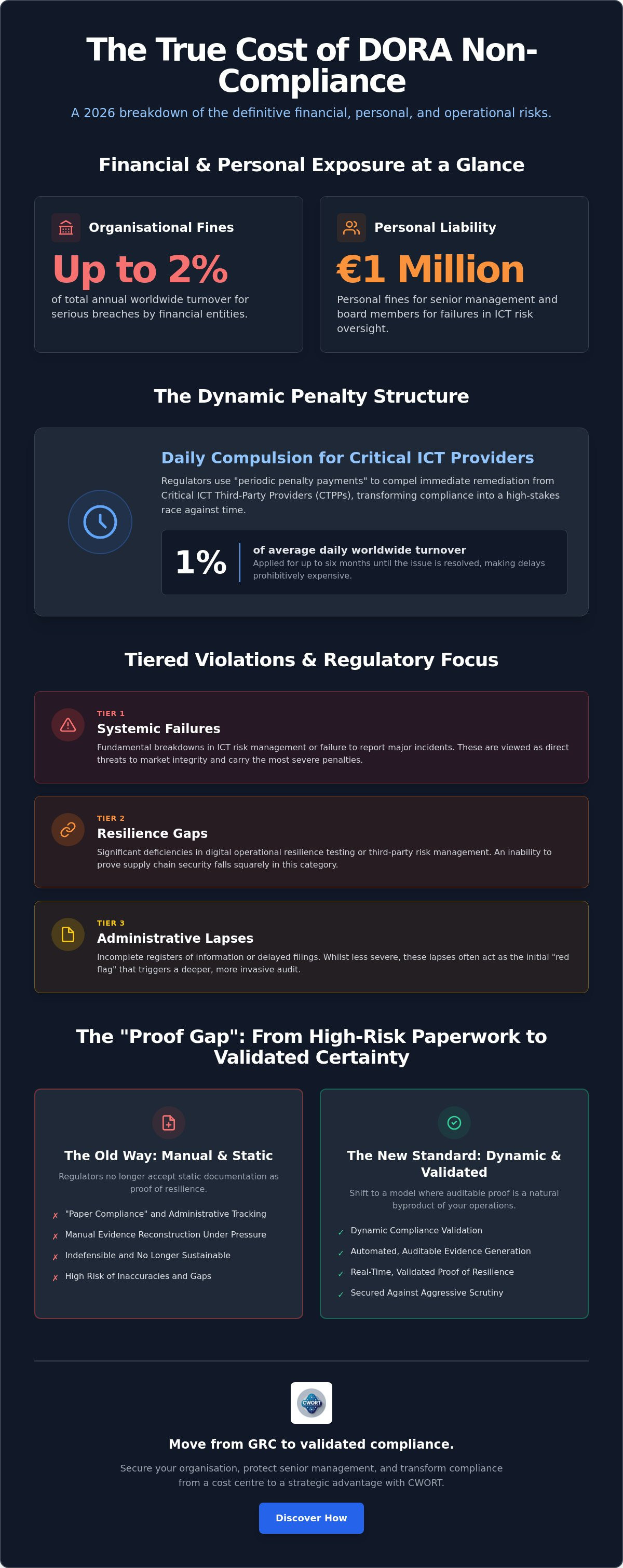
In 2026, the era of "paper compliance" has officially ended; regulators no longer accept static documentation as a proxy for operational resilience. With the European Commission's recent review intensifying oversight, the cost of non-compliance with DORA regulation has evolved from a theoretical risk into a definitive threat to your organisation's balance sheet and operating licence. You likely recognise that manual evidence reconstruction is no longer sustainable, yet the uncertainty of how authorities measure "resilience" remains a significant source of strategic anxiety.
This analysis provides a clear breakdown of your total financial and legal exposure, including the 2% annual turnover fines and the €1 million personal liability facing senior management. You'll discover how to close the "proof gap" by shifting from administrative tracking to validated, auditable certainty. We will examine the multi-layered penalties of DORA failures and outline a strategy to secure your organisation against aggressive regulatory scrutiny through rigorous orchestration and automated evidence.
Key Takeaways
- Quantify the immediate financial exposure by analysing the 2026 penalty framework, including turnover-based fines and the daily levies used to enforce remediation.
- Understand the shift toward individual accountability, where senior management and boards face personal sanctions for failures in ICT risk oversight.
- Evaluate the broader cost of non-compliance with DORA regulation, focusing on the risk to your operating licence and the long-term impact on investor confidence.
- Identify why manual evidence reconstruction is no longer defensible and how to move from administrative tracking to validated, real-time proof of resilience.
- Discover how to transition from static GRC processes to a dynamic compliance validation model that secures your organisation against regulatory scrutiny.
Table of Contents
- The Direct Financial Impact: Understanding DORA Fines and Levies
- Personal Liability: The Cost to Senior Management and Boards
- Operational and Strategic Costs: Beyond the Balance Sheet
- The "Proof Gap": Why Manual Compliance Tracking Increases Your Risk
- Mitigating the Cost: Moving from GRC to Compliance Validation
The Direct Financial Impact: Understanding DORA Fines and Levies
The Digital Operational Resilience Act (DORA) establishes a punitive environment where financial penalties are designed to be prohibitive rather than just a cost of doing business. In 2026, we've moved beyond the initial implementation phase into a period of aggressive enforcement by National Competent Authorities (NCAs). The cost of non-compliance with DORA regulation isn't a fixed fee; it's a dynamic financial burden that scales with the severity of the failure and the duration of the deficiency. Whilst the European Supervisory Authorities (ESAs) ensure a unified standard, individual Member State regulators maintain significant discretion in how they apply these sanctions based on the local impact of a firm's operational failure.
Financial entities and Critical ICT Third-Party Providers (CTPPs) face different penalty structures. For CTPPs, regulators employ "periodic penalty payments" to compel compliance. These daily levies can reach up to 1% of the average daily worldwide turnover for the preceding business year, applied for up to six months until the organisation demonstrates remediation. This mechanism ensures that delay is never a viable financial strategy. It transforms compliance from a static checklist into a high-stakes race for validated proof.
Tiered Violations: From Administrative to Systemic Failures
Regulators categorise failures based on their potential to destabilise the broader financial ecosystem. Understanding these tiers is essential for prioritising remediation efforts and managing balance sheet risk.
- Tier 1: Systemic Failures. These involve fundamental breakdowns in ICT risk management or a failure to report major incidents. These are viewed as threats to market integrity and carry the highest penalties.
- Tier 2: Resilience Gaps. Significant deficiencies in digital operational resilience testing or third-party risk oversight fall here. If you can't prove your supply chain is secure, you're in this bracket.
- Tier 3: Administrative Lapses. These include incomplete registers of information or delayed filings. Whilst less severe, they often act as the initial "red flag" that triggers a deeper, more invasive audit.
The Daily Compulsion: Why Delayed Compliance is the Most Expensive Option
Periodic penalty payments act as a coercive tool to force immediate corrective action. These daily levies accumulate until specific remedial activities are validated by the regulator. Remediation under fire is a chaotic, high-cost exercise that drains resources and focus; conversely, proactive orchestration ensures that evidence is generated as a byproduct of execution. You don't want to be in a position where you're reconstructing evidence whilst a daily fine erodes your capital reserves. Financial entities found in serious breach face administrative fines of up to 2% of their total annual worldwide turnover.
Personal Liability: The Cost to Senior Management and Boards
The regulatory landscape in 2026 has shifted the burden of proof from the organisation to the individual. Under the official text of the DORA regulation, senior management and board members are no longer shielded by corporate structures. Personal liability is now a concrete reality, with individual fines for "key function holders" reaching up to €1 million. This personal financial exposure is compounded by the risk of temporary bans from management positions, effectively ending careers for those found to be in serious breach of their oversight duties.
Protecting leadership requires more than just high-level policy statements; it demands a granular approach to governance. Auditors now scrutinise whether boards have actively managed the "proof gap" between policy and execution. One critical area of focus is enforcing separation of duties to ensure that no single individual has unchecked control over ICT systems or incident reporting. Failing to implement such structural controls is increasingly viewed as a failure of executive oversight, leaving leaders vulnerable to claims of professional negligence. The true cost of non-compliance with DORA regulation for an executive is the loss of both personal capital and professional standing.
The Duty of Oversight: Why Ignorance is No Defence
Board members can't claim technical illiteracy as a defence against regulatory action. DORA mandates that the management body approves and periodically reviews the ICT risk management framework. This isn't a "rubber-stamping" exercise. Regulators expect boards to understand the risk posture and resource allocation for digital resilience. If an investigation reveals that a board failed to challenge inadequate resilience testing, the cost of legal defence for those individuals can be astronomical, often falling outside the scope of standard D&O insurance policies if "gross negligence" is established.
Criminal Penalties and Professional Reputation
Member States retain the right to pursue criminal proceedings for the most egregious failures in operational resilience. Whilst administrative fines are the primary tool, the threat of criminal prosecution serves as a powerful deterrent for systemic neglect. Even in the absence of criminal charges, the "reputation tax" is severe. Being named in a public DORA enforcement notice creates a permanent record of failure that follows an executive through the remainder of their career. Transitioning from "best efforts" to a state of validated proof is the only way to safeguard your professional legacy. To see how orchestration can provide this defensible evidence, you may wish to explore our compliance validation approach.
Operational and Strategic Costs: Beyond the Balance Sheet
Financial penalties are merely the visible tip of the iceberg. The deeper cost of non-compliance with DORA regulation lies in the systemic erosion of your organisation's strategic autonomy and market position. Whilst fines impact the current quarter, the loss of an operating licence terminates the future of the firm entirely. Regulators now possess the mandate to intervene directly in your ICT strategy, effectively stripping leadership of its ability to dictate the company's technological roadmap. This shift from autonomous governance to regulatory conservatorship represents an existential threat that no balance sheet can absorb.
The "reputation tax" following a public sanction is equally devastating. In a landscape where trust is the primary currency, a public declaration of resilience failure triggers immediate customer churn and a sharp decline in investor confidence. This damage extends into the M&A arena. During due diligence, any ambiguity in your resilience posture becomes a significant valuation discount. Potential acquirers or partners view unvalidated ICT risks as "deal-breakers," leading to collapsed transactions or aggressive price renegotiations. Compliance is no longer a back-office function; it is a core component of your firm's market valuation.
Withdrawal of Authorisation and Business Restrictions
Regulators have reached for the "nuclear option" with increasing frequency. Revoking or suspending a firm's authorisation to provide financial services is the ultimate sanction for systemic resilience failures. Even short of a total ban, authorities can impose interim restrictions that paralyse growth. This includes blocking the launch of new products or preventing entry into new geographic markets until remediation is complete. For service providers, losing "Critical ICT" status due to non-compliance can result in an immediate exodus of Tier 1 financial clients who are legally barred from using non-compliant vendors.
Forced Remediation and the "Consultancy Trap"
When an audit reveals systemic gaps, the ensuing "remediation under fire" is ruinously expensive. Organisations often fall into the consultancy trap, hiring emergency teams of specialists to manually reconstruct evidence and patch legacy processes. This reactive approach is an operational drag that diverts your best talent away from innovation and toward administrative survival. Managing regulators on-site for extended periods further compounds this cost, as every hour spent in defensive meetings is an hour lost to productive execution. Adopting regulatory compliance workflow automation is significantly more cost-effective than attempting to solve structural deficiencies through post-audit manual fixes. It replaces the chaos of emergency remediation with the discipline of continuous validation.
The "Proof Gap": Why Manual Compliance Tracking Increases Your Risk
The most significant risk factor in a 2026 audit is not the absence of security controls, but the inability to prove they were executed correctly at the time of an incident. This structural failure is what often triggers the maximum cost of non-compliance with DORA regulation. Many organisations operate under an "illusion of compliance," where Jira tickets and Excel spreadsheets create a narrative of activity that lacks technical validation. When a regulator demands proof of resilience, these manual records are frequently rejected as unreliable and unverifiable. This "proof gap" is where administrative tracking fails and regulatory scrutiny intensifies.
Building a defensible position requires a shift from tracking tasks to orchestrating evidence. Fragmented systems create "compliance debt," a backlog of unverified activities that become impossible to reconstruct during a high-stakes investigation. By ensuring compliance evidence integrity through an automated orchestration engine, you eliminate the risk of human error and data manipulation. This transition is essential for protecting the organisation’s operating licence and reducing the likelihood of Tier 1 violations.
Excel vs. Orchestration: The Auditor’s Perspective
Regulators now view spreadsheets as inherently flawed because they lack an immutable audit trail. A manual tracker is a static representation of a past event; it does not provide a "single version of the truth." Auditors prioritise systems that bind evidence to execution in real-time. Consider the following distinctions:
- Data Manipulation Risk: Manual trackers can be edited after the fact, making them inadmissible as definitive proof. Orchestration platforms provide immutable logs that are timestamped and cryptographically secured.
- Audit Preparation Time: Traditional methods require weeks of manual data gathering and evidence reconstruction. CWORT reduces this to minutes by generating auditable evidence as a byproduct of daily operations.
- Continuous Validation: Spreadsheets are point-in-time snapshots. Orchestration offers continuous oversight, alerting leadership to resilience gaps before they result in a breach.
Fragmented Tools and the Failure of Separation of Duties
Using general-purpose project management tools like Jira for regulatory compliance often leads to "task fatigue." Critical obligations are treated as just another ticket, increasing the probability of missed deadlines or incomplete documentation. More dangerously, these fragmented systems often fail to enforce a strict separation of duties. When the same individual who performs a control is also responsible for validating its success, the integrity of the entire resilience framework is compromised. Moving to an orchestration model ensures that validation is independent, automated, and outcome-focused. To see how you can bridge the proof gap in your organisation, request a demo of our compliance validation platform.
Mitigating the Cost: Moving from GRC to Compliance Validation
Traditional Governance, Risk, and Compliance (GRC) platforms have become a strategic liability in 2026. These systems act as passive repositories that track intentions rather than outcomes, leaving a critical gap between policy and reality. To effectively eliminate the cost of non-compliance with DORA regulation, organisations must transition to a model of active compliance validation. CWORT serves as the orchestration engine that closes this gap by translating abstract regulatory obligations into concrete execution activities. This shift ensures that every control is not just documented, but technically validated in real-time.
Translating high-level standards into structured workflows significantly reduces the risk of Tier 1 systemic violations. When evidence is generated as a direct byproduct of execution, the "proof gap" discussed previously simply ceases to exist. This creates "regulator-ready" outputs that fundamentally alter the dynamic of an audit. Instead of weeks of manual data gathering, your team provides immutable, timestamped proof of resilience. This efficiency shortens audit cycles and demonstrates a level of professional maturity that naturally reduces the severity of any potential sanctions. You move from a state of defensive reconstruction to a culture of defensible truth.
Orchestrating the ICT Risk Management Framework
Successful resilience requires turning the abstract ICT risk management framework into a disciplined operational rhythm. CWORT automates the binding of evidence to control outcomes, ensuring that no obligation is left to "best efforts" or manual tracking. This orchestration provides board-level visibility through real-time compliance dashboards, allowing leaders to see the organisation's true resilience posture at any moment. It replaces the anxiety of the unknown with the calm of auditable certainty. By enforcing discipline by design, you protect both the balance sheet and the individual liability of your senior executives.
Securing the Future of Financial Resilience
Adopting evidence-based compliance management is the only viable path to satisfy 2026 regulatory standards. Regulators now demand proof of execution, not just proof of planning. Organisations that can demonstrate a validated, auditable resilience posture gain a significant competitive advantage; they enjoy lower insurance premiums, higher investor confidence, and a more secure operating licence. The transition from manual tracking to CWORT orchestration is a strategic imperative. Start by mapping your existing obligations to execution activities and let the system enforce the accountability required for modern financial resilience.
Securing Your Strategic Autonomy in 2026
The regulatory landscape has reached a point of total transparency; the ability to prove resilience is now as critical as the resilience itself. We've established that the cost of non-compliance with DORA regulation extends far beyond immediate financial levies. It encompasses personal executive liability and the potential revocation of your organisation's operating licence. Relying on fragmented manual trackers creates a dangerous "proof gap" that auditors will no longer overlook. To safeguard your firm, you must shift from passive administrative tracking to active, evidence-based validation.
Integrating automated evidence binding and generating regulator-ready outputs transforms compliance from a reactive burden into a strategic shield. Our UK-based enterprise compliance experts provide the orchestration necessary to ensure your ICT risk management framework is both defensible and disciplined. You have the opportunity to replace uncertainty with auditable certainty. Take control of your compliance posture now and protect your professional legacy.
Replace your manual trackers with a validated DORA orchestration engine today and secure the future of your financial resilience.
Frequently Asked Questions
What is the maximum fine for DORA non-compliance in 2026?
Financial entities face administrative fines of up to 2% of their total annual worldwide turnover for serious breaches. Individual National Competent Authorities determine the specific penalty based on the severity, duration, and systemic impact of the violation. This framework ensures that the cost of non-compliance with DORA regulation is proportional to the firm's global scale, making digital resilience a critical board-level priority.
Can individual executives be held personally liable for DORA failures?
Yes, DORA removes the shield of corporate anonymity for senior management and board members. Individual executives can be held personally liable for oversight failures, with potential fines reaching up to €1 million. Beyond these financial penalties, individuals face temporary bans from management functions, effectively terminating their professional standing and career progression within the financial services sector.
How does DORA enforcement differ for critical ICT third-party providers?
Critical ICT Third-Party Providers (CTPPs) are subject to periodic penalty payments designed to compel immediate remedial action. Regulators can impose daily levies of up to 1% of the provider's average daily worldwide turnover for the preceding business year. These payments can accumulate for up to six months until the provider demonstrates and validates that the non-compliant behaviour has been fully rectified.
Will a firm lose its banking licence for a single DORA violation?
Licence revocation is the ultimate sanction reserved for systemic, unaddressed failures that threaten market stability. Whilst a single administrative lapse is unlikely to result in a lost licence, regulators possess the authority to suspend or revoke authorisations for fundamental resilience breakdowns. More commonly, authorities impose interim restrictions on launching new products or entering new markets until compliance is validated.
What are the aggravating factors that increase DORA penalties?
Penalty severity scales based on the duration of the breach, the degree of executive negligence, and the potential for systemic contagion. Regulators also scrutinise previous non-compliance history and any attempts to conceal deficiencies during an audit. Conversely, maintaining an orchestrated resilience posture that provides immediate, auditable evidence serves as a significant mitigating factor during the sanctioning process.
How does DORA compliance overlap with NIS2 and GDPR fines?
DORA acts as lex specialis for the financial sector, meaning its specific requirements take precedence over broader frameworks like NIS2. However, a single operational failure involving personal data can still trigger concurrent GDPR investigations and fines. The total cost of non-compliance with DORA regulation may be compounded by these overlapping jurisdictions if the breach reveals systemic weaknesses across multiple regulatory domains.
Why do regulators prefer orchestrated compliance platforms over spreadsheets?
Orchestrated platforms provide an immutable, timestamped audit trail that manual spreadsheets cannot replicate. Regulators prioritise validated proof over static documentation because it eliminates the risk of human error and retrospective data manipulation. Transitioning to orchestration ensures that evidence is a byproduct of execution, providing auditors with the "defensible truth" required to satisfy 2026 resilience standards.
Can proactive self-reporting of ICT incidents reduce DORA fines?
Proactive self-reporting and transparent cooperation with National Competent Authorities are viewed as significant mitigating factors that can reduce fine severity. Identifying and communicating an incident before it's discovered through a regulatory audit demonstrates that your ICT risk management framework is functioning with integrity. This transparency often prevents the more aggressive enforcement actions associated with a forced discovery of systemic failures.
Disclaimer
The content on this site is provided for general information and educational purposes only. It does not constitute legal, regulatory, financial, or professional advice. CWORT provides AI-assisted insights and workflow automation, but all compliance decisions remain the responsibility of your organisation and its management. Always seek qualified legal or regulatory guidance for decisions relating to the UK NIS Regulations, CAF, DORA, NIS2, ISO 27001, or other obligations.
Related posts
Challenges of DORA Compliance for Financial Institutions in 2026: A Strategic Guide
Facing the challenges of DORA compliance for financial institutions? Our 2026 guide helps you move from manual tracking to automated validation for total ass...
CISO Guide to DORA Operational Resilience: Orchestrating Validated Compliance
Master validated compliance with our CISO guide to DORA operational resilience. Swap manual evidence gathering for an orchestrated, audit-ready security post...
DORA Compliance Validation: A Guide for Financial Institutions
Master DORA compliance validation. Our guide shows you how to replace risky manual tracking with an automated, auditable system for definitive regulatory proof.
Article by
Michael Iyiola
Co-Founder, CWORT
Michael Iyiola is a co-founder of CWORT and a Cyber and AI Security Engineer with deep experience in vulnerability management, detection engineering and operational resilience across UK critical national infrastructure, including rail, energy and financial services. At CWORT, he designs scalable, evidence-driven workflows that help teams meet modern regulatory and security demands.
Build Your Foundation of Auditable Certainty
Take control of your regulatory obligations and secure your infrastructure with CWORT.