CISO Guide to DORA Operational Resilience: Orchestrating Validated Compliance

Michael Iyiola
Co-Founder, CWORT
Master validated compliance with our CISO guide to DORA operational resilience. Swap manual evidence gathering for an orchestrated, audit-ready security post...

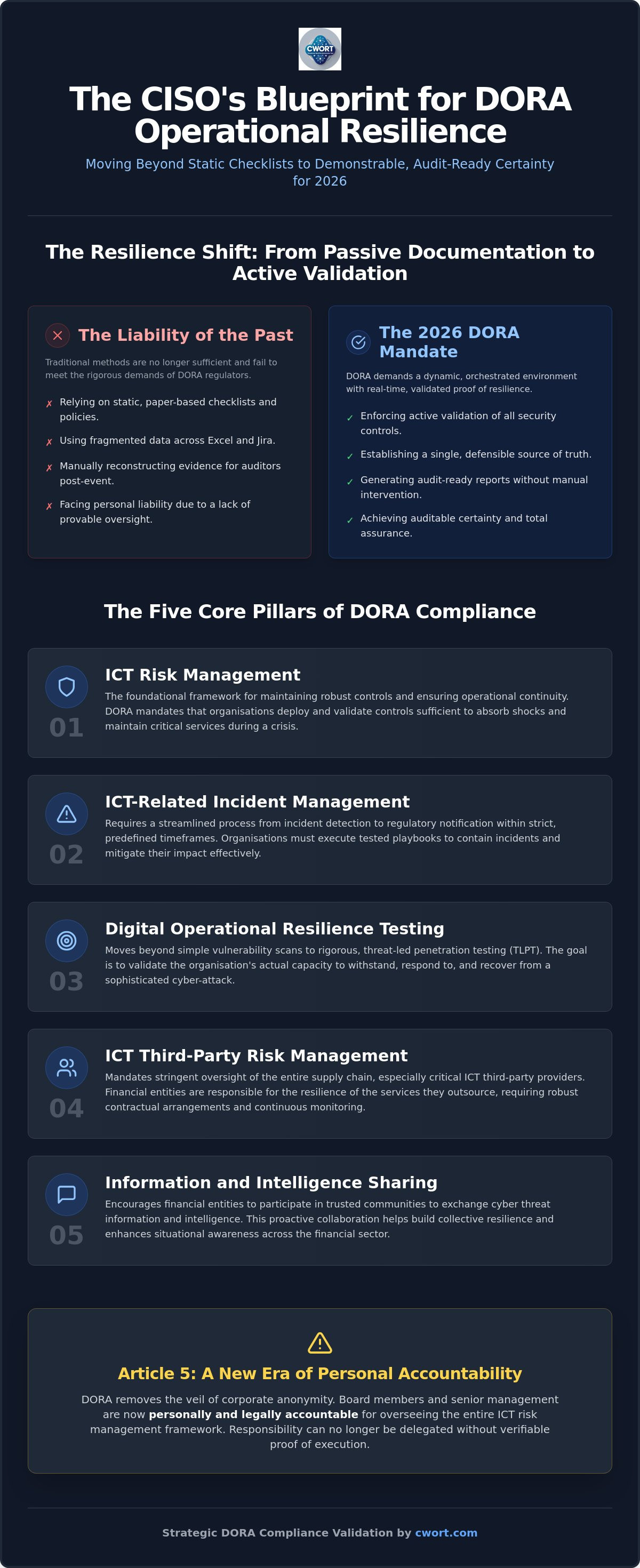
In 2026, a static DORA checklist isn't just insufficient; it's a liability. Regulators have moved beyond "paper compliance" to demand real-time, validated proof of operational resilience. You're likely grappling with fragmented data across Jira and Excel, struggling to prove separation of duties whilst facing the mounting anxiety of personal liability under DORA governance rules. This CISO guide to DORA operational resilience addresses these pressures head-on. It's time to stop the manual labour of reconstructing evidence for auditors and start enforcing a disciplined, systematic approach to compliance.
We provide a strategic blueprint to transition your organisation from reactive tracking to a dynamic, orchestrated environment. You'll learn how to establish a single source of truth for DORA validation that generates audit-ready reports without manual intervention. By shifting the focus to definitive, evidence-based proof, you can replace the uncertainty of potential failure with the calm of auditable certainty. This guide outlines the path toward enforced accountability and total assurance in a landscape where the European Commission now demands nothing less than absolute transparency.
Key Takeaways
- Transition from passive documentation to active validation to meet the rigorous 2026 standards for demonstrable operational resilience.
- Recognise the inherent risks of manual tracking and why fragmented data in Excel or Jira fails to satisfy modern audit requirements.
- Utilise this CISO guide to DORA operational resilience to transition your security posture from static checklists to a dynamic, orchestrated environment.
- Enforce strict accountability and separation of duties by binding digital evidence directly to control outcomes as they occur.
- Leverage a central orchestration engine to transform complex regulatory requirements into a single, defensible source of truth.
Table of Contents
- Beyond the Checklist: Why DORA Redefines Operational Resilience for CISOs
- The Five Pillars of DORA: Mapping Technical Standards to Executive Oversight
- The Spreadsheet Trap: Why Manual Compliance Tracking Fails DORA Audits
- Operationalising Validation: Enforcing Separation of Duties and Evidence Binding
- Strategic Audit Readiness: Orchestrating DORA Compliance Validation with CWORT
Beyond the Checklist: Why DORA Redefines Operational Resilience for CISOs
Operational resilience under the Digital Operational Resilience Act (DORA) is a fundamental departure from legacy security frameworks. It demands that financial entities maintain the capacity to withstand, respond to, and recover from ICT disruptions without compromising critical services. Traditional ICT risk management focused heavily on preventing breaches. DORA assumes failure is inevitable and mandates proof of survival. This CISO guide to DORA operational resilience clarifies that documentation alone no longer constitutes compliance; you must prove execution through validated evidence.
The transition from 2025 into 2026 marks the end of "good faith" efforts. Regulators have shifted from reviewing static policies to demanding real-time proof of resilience. This evolution requires a proactive stance where every control is not just present, but demonstrably effective. You can't rely on the assumption that your systems will hold. You must validate that they will, using data that is both current and defensible. DORA defines resilience through three specific lenses:
- Withstand: Deploying robust controls to absorb shocks and maintain service continuity during a crisis.
- Respond: Executing predefined, tested playbooks to contain incidents and mitigate impact.
- Recover: Restoring critical functions within defined timeframes to ensure market stability.
Article 5 of the regulation removes the veil of corporate anonymity by placing personal accountability for ICT risk management directly on the board and senior management. Leaders can't delegate their way out of this responsibility. They're now legally required to oversee every stage of the resilience lifecycle. This shift transforms the CISO from a technical gatekeeper into a strategic architect of defensible truth, responsible for providing the board with the assurance they need to satisfy regulatory scrutiny.
The Shift from Risk Avoidance to Resilience Validation
Regulators now demand proof of effectiveness rather than the mere existence of a policy. A "Resilience Gap" often exists in traditional GRC frameworks where controls are documented but rarely tested against real-world scenarios. You must bridge this gap by translating technical metrics into board-level assurance. Validation requires more than a point-in-time audit; it necessitates a system that continuously verifies that controls are functioning as intended. This move from passive tracking to active validation ensures that resilience is an operational reality, not just a boardroom theory.
Regulatory Expectations for 2026 Audit Readiness
As of 2026, active enforcement is the norm across the EU. UK-based firms with European footprints must prioritise the creation of a Register of Information that is both accurate and dynamic. Regulators expect more than a collection of stagnant PDFs. They require a system of orchestrated evidence collection that proves compliance at any given moment. Transitioning to DORA Compliance Validation ensures that your organisation moves away from the high manual cost of evidence reconstruction and towards a state of permanent, auditable certainty.
The Five Pillars of DORA: Mapping Technical Standards to Executive Oversight
DORA is structured around five core pillars that transform technical requirements into executive mandates. For the CISO, these pillars aren't just silos of activity; they are interconnected workstreams that require a unified orchestration strategy. This CISO guide to DORA operational resilience focuses on moving beyond the individual requirements to a holistic view of the organisation's defensive posture. Incident reporting, for instance, is no longer just about internal logs; it's a streamlined path from detection to regulatory notification within strict timeframes. Similarly, digital operational resilience testing must move from simple vulnerability scans to rigorous, threat-led exercises that validate your actual capacity to survive an attack.
The five pillars establish a comprehensive lifecycle for digital stability:
- ICT Risk Management: The foundational framework for maintaining operational continuity.
- Incident Reporting: A standardised process for detecting, managing, and notifying authorities of major incidents.
- Digital Operational Resilience Testing: Periodic validation of defences through advanced testing methodologies.
- Third-Party Risk Management: Proactive oversight of the ICT supply chain and critical providers.
- Information Sharing: Strategic participation in collective defence amongst financial peers.
Operationalising ICT Risk Management (Article 6)
Article 6 requires that ICT risk management is not a periodic exercise but a continuous operational reality. You must map specific regulatory obligations to daily execution activities. It's about ensuring that high-level risk policies are reflected in technical operations. Linking control outcomes directly to your risk management framework provides the defensible evidence regulators demand. Research from Deloitte indicates that 46% of financial institutions find the Register of Information to be the most challenging aspect of DORA. This difficulty stems from fragmented data. You should follow official DORA guidance to ensure your framework aligns with the latest technical standards whilst maintaining a single source of truth for all risk data.
Managing Critical Third-Party Providers (CTPPs)
One of the most significant challenges involves managing concentration risk amongst major cloud service providers. In November 2025, the ESAs designated the first 19 Critical ICT Third-Party Providers, including the major global cloud giants. Whilst these entities are now under direct EU oversight, the legal responsibility for your firm's resilience remains yours. DORA Article 30 mandates standardised contractual requirements to ensure third-party integrity. You can't simply accept a provider's standard report as proof of compliance. You must validate that third-party controls are effective through automated evidence binding. This ensures that your supply chain doesn't become a single point of failure for your operational continuity.
If you're struggling to harmonise these pillars across a complex infrastructure, you can request a demo of our orchestration platform to see how validation is automated and enforced.
The Spreadsheet Trap: Why Manual Compliance Tracking Fails DORA Audits
Relying on spreadsheets for regulatory compliance is a legacy habit that creates significant operational risk. In the context of the Digital Operational Resilience Act, Excel and Jira are no longer sufficient tools for validation. They lack the immutable audit trails required to prove that controls were executed correctly at the precise moment of need. This CISO guide to DORA operational resilience highlights a critical flaw: manual trackers only record what someone claims happened, not what actually occurred. This distinction is the difference between passing an audit and facing a fine of up to 2% of global annual turnover.
Fragmented data across various disconnected platforms creates a false sense of security. You might see "Green" on a dashboard, but without evidence binding, that status is merely an opinion. Manual evidence reconstruction is a reactive, high-cost process that pulls senior engineers away from core tasks to hunt for historical logs. It's a symptom of "Compliance Debt," where the gap between execution and validation grows until it becomes unmanageable. When evidence is not bound to the control outcome in real-time, the risk of data integrity loss becomes an inevitable reality.
Regulator Scrutiny of Manual Evidence
European regulators have shifted their focus from reviewing documentation to demanding system-generated proof. They prioritise logs that are automatically captured and timestamped over manually curated reports. Proving "Separation of Duties" is nearly impossible in a spreadsheet environment where a single user can edit any cell without an audit trail. Auditors look for a clear, unalterable record of who did what, when, and with what authority. Without this, your compliance posture is indefensible. Some firms have already struggled whilst facing intense scrutiny for failing to provide granular traceability during deep-dive inspections.
The High Cost of Compliance Debt
Compliance debt accumulates every time a validation step is skipped or deferred. Manual updates consume hundreds of SME hours annually, creating organisational friction and increasing the likelihood of human error. Moving towards a "Zero-Touch" evidence model is the only way to scale with DORA’s requirements. By using DORA Compliance Validation, you automate the collection of defensible truth. This reduces the labour-intensive burden on your teams and ensures that your organisation is always audit-ready. You transition from a state of constant preparation to a state of permanent, auditable assurance.
Operationalising Validation: Enforcing Separation of Duties and Evidence Binding
Validated Execution represents the definitive standard for modern operational resilience. It's no longer enough to claim a control exists; you must prove it was executed correctly at the precise moment of need. This CISO guide to DORA operational resilience focuses on the transition from passive monitoring to active enforcement. Orchestration plays a vital role in this shift. It ensures that complex regulatory obligations are never missed or ignored amongst the daily noise of IT operations. By moving to a model where execution and validation are inextricably linked, you eliminate the ambiguity that often leads to audit failures.
Enforcing Separation of Duties (SoD)
DORA demands clear boundaries between those who perform a task and those who validate its outcome. Self-attestation is a primary cause of control failure. It creates a conflict of interest that regulators specifically target during inspections. Implementing automated workflows is the most effective way to prevent this. These systems ensure that the person executing a technical change cannot be the same person who signs off on its compliance. For a deeper look at this requirement, see our article on Enforcing Separation of Duties Under DORA Requirements. This structural discipline enforces accountability across diverse security teams by design.
Binding Evidence to Control Outcomes
The technical process of evidence binding involves attaching immutable proof directly to a regulatory activity at the point of execution. You cannot rely on periodic data collection or retrospective reporting. Evidence must be captured, timestamped, and secured automatically. This ensures that the integrity of your data remains beyond reproach. When evidence is bound to the outcome, you create a defensible reality that auditors can trust without question. You can learn more about maintaining this standard in our guide on Ensuring Compliance Evidence Integrity. This approach shifts the focus from administrative tracking to definitive, evidence-based proof.
Accountability is often lost in fragmented IT environments. Orchestration solves this by acting as a proactive system that enforces discipline across the organisation. It translates abstract DORA articles into granular, actionable tasks that are tracked to completion. If a task isn't validated, the process stops. This no-nonsense approach ensures that your resilience posture isn't just a policy on paper but a functional reality within your technical infrastructure. To see how this level of rigour can be applied to your environment, request a demo of our compliance validation platform.
Strategic Audit Readiness: Orchestrating DORA Compliance Validation with CWORT
Orchestration is the only viable path to sustainable compliance in a post-2025 regulatory environment. Fragmented tools like Jira and Excel fail because they cannot enforce the discipline required by the Digital Operational Resilience Act. CWORT functions as a proactive orchestration engine, replacing disparate systems with a single, authoritative platform for validated execution. This CISO guide to DORA operational resilience has detailed the risks of manual tracking; CWORT eliminates those risks by translating complex regulatory articles into granular, actionable tasks. It ensures that every obligation is met with a validated outcome, providing the defensible truth needed to satisfy the most rigorous audits.
Generating regulator-ready reports no longer requires weeks of manual evidence reconstruction. With CWORT, these reports are available at the click of a button, reflecting the real-time state of your organisation's resilience. This shift reduces the administrative workload on the CISO, allowing leadership to focus on strategic risk management rather than data collection. By automating the validation process, you move from a state of constant audit preparation to a state of permanent audit readiness. This creates a disciplined environment where accountability is enforced by design, not by chance.
From Obligation to Evidence: The CWORT Workflow
The transition from a regulatory requirement to an auditable fact follows a precise, three-step linear progression within CWORT. First, the platform maps DORA mandates directly to your specific organisational structure, ensuring every article has a clear owner. Second, it orchestrates activities across diverse teams with enforced accountability, preventing any task from being bypassed or ignored. Finally, the system automatically captures and binds immutable evidence to every outcome. This workflow ensures that validation is a continuous byproduct of daily operations, rather than an afterthought. It bridges the gap between policy and proof, ensuring that your resilience posture is always backed by data.
Delivering Board-Level Assurance
Board members and senior management now face personal liability for ICT risk oversight under Article 5. CWORT dashboards provide these leaders with a real-time, objective view of the organisation's defensive posture. You can communicate a definitive "Resilience Score" to the board with total confidence, backed by validated data rather than subjective attestation. This transparency replaces the anxiety of potential failure with the calm of auditable certainty. When you can prove that every control is functioning as intended, you provide the high-level assurance required to maintain market trust and regulatory standing. It's time to organise your DORA journey with CWORT and secure your organisation's operational future.
Securing Your Defensible Truth Under DORA
DORA has fundamentally altered the regulatory landscape. CISOs can no longer rely on static checklists or fragmented spreadsheets that fail during deep-dive audits. Proving operational resilience requires a definitive move toward validated execution where every control is backed by immutable proof. This CISO guide to DORA operational resilience has outlined the necessity of bridging the gap between mere policy existence and demonstrable effectiveness whilst enforcing strict accountability across your technical teams.
Transitioning to a system of orchestrated validation ensures that your organisation remains audit-ready at all times. CWORT enforces separation of duties by design and binds evidence directly to control outcomes; this provides regulator-ready outputs without the high cost of manual reconstruction. This disciplined approach replaces the anxiety of personal liability with the calm of auditable certainty. It's time to move beyond administrative tracking and lead your organisation into a state of permanent, defensible resilience.
Master DORA Compliance Validation with CWORT
Frequently Asked Questions
What is the primary role of a CISO under DORA operational resilience rules?
The CISO acts as the strategic architect of defensible truth, responsible for translating technical resilience into board-level assurance. This CISO guide to DORA operational resilience clarifies that leadership must maintain active oversight of ICT risk, requiring continuous validation of control effectiveness. The role shifts from mere security management to ensuring that the organisation can withstand, respond to, and recover from disruptions as a functional, auditable reality.
Can we use our existing ISO 27001 evidence for DORA compliance?
You can map existing ISO 27001 controls to DORA requirements, but the evidence itself often lacks the "proof of resilience" regulators now demand. ISO 27001 is a management system standard that focuses on policies and processes. DORA requires validated execution and system-generated logs that prove controls were active during an incident. Stagnant audit reports from previous years won't satisfy a 2026 DORA inspection or prove operational continuity.
How does DORA differ from the UK NIS regulations for financial services?
DORA provides a more granular and harmonised framework specifically for the financial sector, whereas UK NIS regulations cover a broader range of essential services. Whilst both emphasise resilience, DORA introduces stricter mandates for third-party risk management and threat-led penetration testing. Financial entities must align with DORA's five specific pillars to ensure cross-border compliance within the EU and maintain access to European markets.
What happens if we cannot prove separation of duties during a DORA audit?
Failing to prove separation of duties results in a critical finding that suggests a fundamental lack of internal control. Regulators view self-attestation as a high-risk vulnerability that could lead to undetected errors or fraud. Without an automated audit trail to prove these boundaries, your organisation faces increased supervisory scrutiny and potential administrative fines. It's a failure that directly undermines the concept of validated, defensible compliance.
How much time does it take to reconstruct evidence for a DORA regulator?
Manual evidence reconstruction typically takes weeks of intensive labour from senior SMEs and security analysts. This process involves hunting through disparate logs, Jira tickets, and emails to build a retrospective narrative for auditors. This compliance debt creates significant organisational friction. By following this CISO guide to DORA operational resilience, you can move toward automated collection to eliminate this manual burden and ensure you're always audit-ready.
Is Jira a suitable tool for DORA compliance orchestration?
Jira is a task management tool, not a compliance orchestration engine. It lacks the ability to bind immutable evidence to control outcomes or enforce strict separation of duties by design. Whilst Jira can track that a task was marked as finished, it cannot provide the system-validated proof that the task was executed correctly. Relying on Jira for DORA creates a "spreadsheet trap" where data integrity remains unverified.
What are the penalties for non-compliance with DORA operational resilience standards?
Non-compliance carries severe financial consequences, with entities facing fines of up to 2% of their global annual turnover or €10 million, whichever is higher. For critical third-party providers, regulators can impose daily penalty payments of up to 1% of average daily global turnover for up to six months. Beyond financial loss, non-compliance leads to public reputational damage and increased personal liability for the board under Article 5.
How does CWORT integrate with our existing security tech stack?
CWORT integrates via secure APIs to pull data directly from your existing security tools, cloud environments, and internal databases. It acts as an orchestration layer that sits above your tech stack to validate execution and bind evidence to specific DORA obligations. This ensures that your existing investments are utilised to provide a single, defensible source of truth for all regulatory reporting without requiring manual intervention.
Disclaimer
The content on this site is provided for general information and educational purposes only. It does not constitute legal, regulatory, financial, or professional advice. CWORT provides AI-assisted insights and workflow automation, but all compliance decisions remain the responsibility of your organisation and its management. Always seek qualified legal or regulatory guidance for decisions relating to the UK NIS Regulations, CAF, DORA, NIS2, ISO 27001, or other obligations.
Related posts
Mastering the DORA ICT Risk Management Framework: A Reference Guide for 2026
Master the DORA ICT risk management framework for 2026. Our guide helps you build an auditable, evidence-based system and move beyond spreadsheets.
DORA Separation of Duties Enforcement: Moving from Policy to Validated Proof
Achieve effective DORA separation of duties enforcement. This guide shows how to replace manual tracking with an automated system for validated, audit-ready ...
DORA Obligation Mapping Tool: Orchestrating Defensible Compliance in 2026
Stop manual DORA tracking. A DORA obligation mapping tool orchestrates compliance, automates reporting, and creates a defensible audit trail for central banks.
Article by
Michael Iyiola
Co-Founder, CWORT
Michael Iyiola is a co-founder of CWORT and a Cyber and AI Security Engineer with deep experience in vulnerability management, detection engineering and operational resilience across UK critical national infrastructure, including rail, energy and financial services. At CWORT, he designs scalable, evidence-driven workflows that help teams meet modern regulatory and security demands.
Build Your Foundation of Auditable Certainty
Take control of your regulatory obligations and secure your infrastructure with CWORT.