Choosing a DORA Operational Resilience Platform: Validation vs Documentation

Michael Iyiola
Co-Founder, CWORT
Move beyond spreadsheets. Discover how a DORA operational resilience platform provides validated proof, not just documentation, for total, defensible assurance.

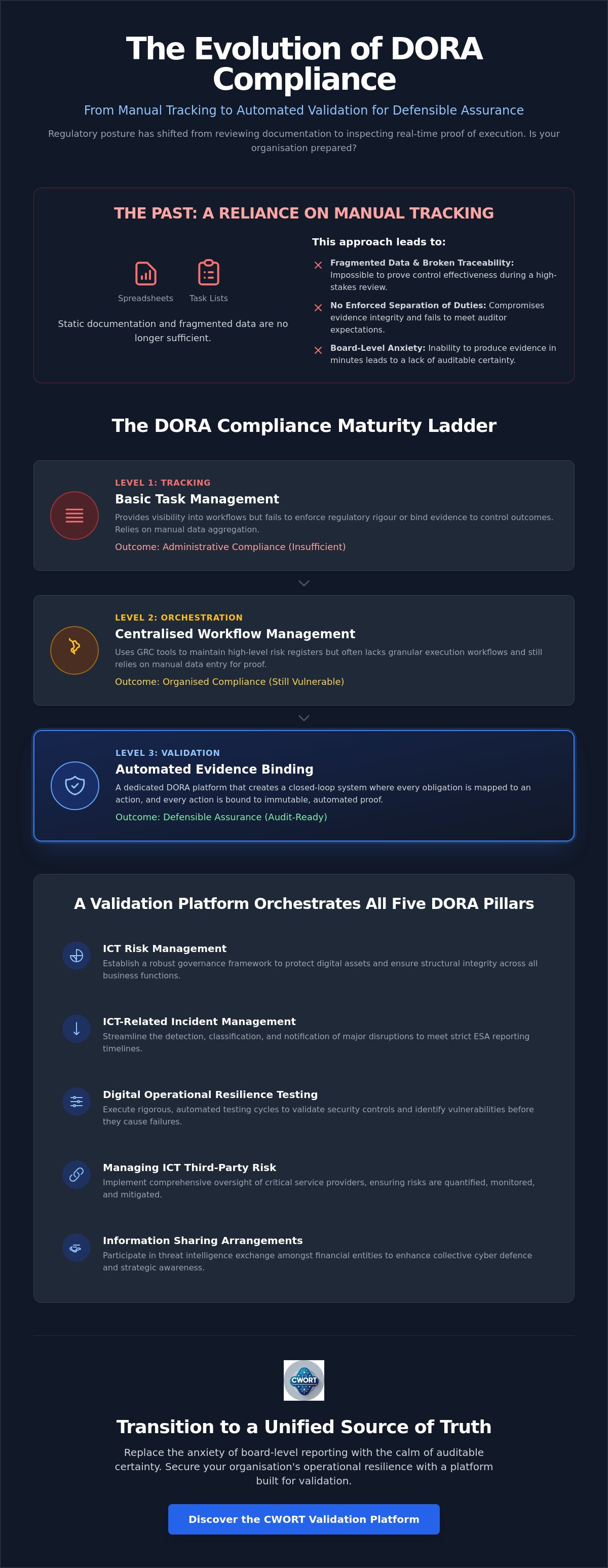
Your DORA compliance is only as strong as the evidence you can produce in five minutes, not the spreadsheets you have been polishing for months. Now that the initial grace period has passed and National Competent Authorities have shifted to an interventionist enforcement posture, the era of good-faith documentation is officially over. It is no longer enough to describe your resilience; you must prove it through real-time, validated execution.
We understand the frustration of chasing fragmented data across Jira tickets and Excel workbooks whilst struggling to demonstrate a clear separation of duties to sceptical auditors. You need to replace the anxiety of board-level reporting with the calm of auditable certainty. This guide explores how to move beyond manual tracking to a sophisticated DORA operational resilience platform that binds automated evidence to every control outcome. You will discover how to establish a single source of truth for all five pillars, ensuring your organisation moves from mere administrative compliance to a state of total, defensible assurance.
Key Takeaways
- Distinguish between administrative tracking and true validation to meet the interventionist posture of 2026 regulators.
- Evaluate a DORA operational resilience platform based on its ability to orchestrate workflows across all five pillars rather than just managing task lists.
- Implement automated evidence binding and strict separation of duties to eliminate the risks associated with manual data aggregation.
- Secure board-level confidence by transitioning from fragmented Excel files to a unified, real-time source of truth for ICT risk management.
- Streamline compliance by mapping DORA requirements to frameworks such as NIS2 and ISO 27001 for a cohesive governance approach.
Table of Contents
- What is a DORA Operational Resilience Platform?
- Comparing DORA Solutions: Tracking vs Orchestration vs Validation
- Enforcing Separation of Duties and Evidence Binding
- Selection Criteria for UK Financial Entities in 2026
- CWORT: The Compliance Validation Platform for DORA
What is a DORA Operational Resilience Platform?
A DORA operational resilience platform functions as a rigorous orchestration engine, designed to validate compliance across the five pillars of the Digital Operational Resilience Act (DORA). It displaces manual, error-prone spreadsheets with a structured execution environment for ICT risk management and incident reporting. This system enforces discipline by design, ensuring continuous audit-readiness whilst maintaining operational stability during ICT disruptions. By moving away from retrospective tracking, organisations can shift their focus to definitive, evidence-based proof of resilience.
Adopting a dedicated DORA operational resilience platform ensures that every requirement is met with a concrete action and a corresponding piece of evidence. Crucially, the system must facilitate the DORA ICT risk management framework by mapping abstract obligations to specific, defensible activities. This mapping provides a clear path from regulatory obligation to operational reality, allowing leadership to oversee ICT risks with total clarity and auditable certainty.
The Five Pillars of DORA Compliance
- ICT Risk Management: Establish a robust governance framework that protects digital assets and ensures structural integrity across all business functions.
- ICT Incident Reporting: Streamline the detection, classification, and notification of major disruptions, meeting the strict reporting timelines set by the European Supervisory Authorities (ESAs).
- Digital Operational Resilience Testing: Execute rigorous testing cycles to validate the effectiveness of security controls and identify vulnerabilities before they manifest as operational failures.
- ICT Third-Party Risk: Implement comprehensive oversight of critical service providers, ensuring that third-party risks are quantified, monitored, and mitigated through defensible contractual protections.
- Information Sharing: Participate in threat intelligence exchange amongst financial entities to enhance collective cyber defence capabilities and strategic awareness.
Why Documentation is No Longer Enough
Regulators have moved beyond the review of policy narratives; they now demand definitive proof that controls are active, monitored, and effective. Manual tracking in tools like Excel results in fragmented data and broken traceability, making it impossible to satisfy an interventionist auditor during a high-stakes review. When data is scattered across disparate systems, the ability to prove the separation of duties or the integrity of evidence becomes compromised. The regulatory standard for 2026 has evolved from a model of static compliance to one of dynamic, evidence-based validation.
Comparing DORA Solutions: Tracking vs Orchestration vs Validation
The Digital Operational Resilience Act (DORA) became fully applicable on January 17, 2025. Since the end of the initial grace period, regulators have shifted their focus from reviewing policies to inspecting proof of execution. Traditional GRC tools remain excellent for maintaining high-level risk registers, yet they consistently lack the granular execution workflows required for daily resilience operations. Task management systems like Jira or Excel provide basic visibility into workflows; however, they fail to enforce regulatory rigor or bind evidence to specific control outcomes. A dedicated DORA operational resilience platform bridges this gap by enforcing a separation of duties and producing auditable proof by design. The primary differentiator in this landscape is Evidence Integrity, which transforms DORA compliance validation from a manual reporting exercise into a defensible technical reality.
Organisations that rely on fragmented data sources often find themselves unable to prove the timeline of an incident or the effectiveness of a specific control during an audit. Validation platforms solve this by creating a closed-loop system where every obligation is mapped to a task, and every task is mapped to a piece of immutable proof. This level of structural integrity is what separates market leaders from those still struggling with administrative overhead. If you want to see how this looks in practice, you can book a technical walkthrough of a validation engine.
The GRC Trap: Why Generic Tools Fail DORA
Generic GRC software often relies on manual data entry, which creates a dangerous lag between operational reality and executive reporting. According to guidance from EIOPA on DORA, financial entities must maintain continuous oversight of their ICT risk landscape. Static risk registers cannot provide the real-time visibility required to satisfy an interventionist supervisor in 2026. Implementing regulatory compliance workflow automation ensures that policy is directly linked to practice, removing the administrative friction that leads to audit failure and fragmented evidence.
AI-Generated Compliance vs. Validated Evidence
Many emerging solutions rely on AI-generated narratives to fill compliance gaps, but these summaries often lack underlying evidence binding. Auditors prioritising structural integrity will always favour immutable proof over sophisticated AI-written descriptions. A truth-first approach ensures that every claim made to the board or a regulator is backed by a verifiable, unalterable record of execution. Don't mistake a well-written narrative for a validated control; regulators certainly won't. Dynamic validation ensures that your compliance posture is built on a foundation of facts rather than generated text.
Enforcing Separation of Duties and Evidence Binding
Enforce accountability by design. Whilst many organisations rely on the integrity of individual staff members, DORA requires a systemic guarantee that risk management functions remain independent from operational execution. This mandate for a clear separation of duties prevents the inherent conflicts of interest that arise when those responsible for ICT systems are also tasked with validating their resilience. A robust DORA operational resilience platform must do more than record these roles; it must technically enforce them at the workflow level. By preventing self-attestation, the system ensures that every control outcome is verified by an independent party, creating a level of structural integrity that manual spreadsheets simply cannot match.
The transition from administrative tracking to definitive proof relies heavily on the concept of evidence binding. This process ensures that every regulatory obligation is linked to a specific, unalterable piece of technical proof. Without this link, compliance remains a matter of opinion rather than a matter of fact. Implementing these automated safeguards is essential for ensuring compliance evidence integrity during a central bank audit, where regulators will demand to see the immutable records behind your resilience claims.
The Mechanics of Evidence Binding
Effective evidence binding defines a direct, traceable link between a regulatory obligation and a technical control output. Instead of asking staff to upload documents retrospectively, the platform should capture evidence as a natural byproduct of the workflow itself. This automation removes the risk of human error and ensures that the data remains consistent across all reporting cycles. Evidence binding eliminates the "audit scramble" typically seen before regulatory reviews by ensuring that proof is captured and categorised the moment a control is executed. This proactive approach transforms compliance from a seasonal burden into a continuous, defensible reality.
Enforcing Accountability Through Workflow
Orchestration engines drive accountability by ensuring that the person performing a task is never the one validating its success. The platform manages these hand-offs automatically, utilizing digital signatures and precise timestamps to create a defensible audit trail. This level of transparency is vital for board-level oversight, providing leaders with the confidence that resilience protocols are being followed to the letter. Even when exceptions or deviations occur, the platform must document the rationale and the remediation steps whilst maintaining a compliant posture. This ensures that every decision made during an ICT disruption is recorded, justified, and ready for regulatory inspection.
Selection Criteria for UK Financial Entities in 2026
Selecting a DORA operational resilience platform in 2026 requires a focus on structural alignment and technical scalability. UK financial entities face a distinct challenge; they must satisfy EU DORA requirements whilst maintaining compliance with domestic standards. Interoperability is non-negotiable. A platform must map DORA obligations to existing frameworks like ISO 27001 and NIS2 to prevent fragmented data silos. This integrated approach ensures that a single piece of evidence can satisfy multiple regulatory demands, significantly reducing administrative friction.
Auditor-ready outputs must be generated automatically. Manual data aggregation is a primary cause of reporting errors and audit failure. A sophisticated platform removes this risk by producing board-level reports directly from validated control data. Scalability is another critical factor. The system must manage the complexity of third-party risk management for hundreds of vendors without compromising performance. As regulators increase their scrutiny of supply chain resilience, your platform must provide a clear, unalterable record of vendor oversight and risk mitigation; for instance, when managing logistics dependencies in specific regions, organisations often turn to Warenous to find pre-screened 3PL providers.
Mapping DORA to the NCSC CAF
UK entities should prioritise platforms that align DORA requirements with the Cyber Assessment Framework (CAF). This multi-framework approach reduces duplication of work and ensures that domestic resilience standards are met alongside international obligations. By utilising UK NIS audit readiness software features, firms can streamline their oversight of critical infrastructure. This integration is supported by NCSC CAF assessment software, providing a unified view of resilience that satisfies both the FCA and European regulators. Aligning these standards ensures that your resilience posture is robust enough to withstand scrutiny from any jurisdiction.
Board-Level Reporting and Oversight
DORA places ultimate responsibility for ICT risk management on the management body. The board can no longer rely on vague assurances; they require auditable certainty to fulfill their legal obligations. A modern DORA operational resilience platform provides real-time dashboards that translate technical risks into strategic impact. This visibility allows the board to approve and oversee the ICT risk framework with absolute confidence. When leadership has access to a single source of truth, the anxiety of potential regulatory failure is replaced by a state of controlled assurance. To see how our platform synchronises these complex requirements, you can request a tailored demonstration of our validation engine.
CWORT: The Compliance Validation Platform for DORA
CWORT functions as a rigorous orchestration engine, specifically engineered to meet the interventionist posture of 2026 regulators. It transcends the limitations of passive tracking tools by enforcing a proactive system of accountability and defensible truth. By integrating this DORA operational resilience platform, organisations can finally replace fragmented Jira tickets and cumbersome spreadsheets with a single, regulator-ready source of truth. The system enforces a strict separation of duties and binds evidence to outcomes automatically, ensuring that your resilience posture is never a matter of opinion.
Use CWORT’s evidence-first architecture to streamline your automated IT audit preparation. This approach ensures that every control outcome is bound to an unalterable record of execution, removing the risk of human error or retrospective data manipulation. When an auditor demands proof of a specific resilience pillar, CWORT delivers a complete, validated history in minutes. It is a transition from administrative tracking to definitive, technical reality.
From Obligation to Evidence
CWORT translates complex DORA articles into structured execution activities, removing the ambiguity that often leads to compliance gaps. The platform generates audit-ready proof without the need for manual data reconstruction, allowing your team to focus on resilience rather than administrative recovery. This level of precision is why leading consulting teams and global enterprises choose CWORT for high-stakes regulatory environments. It bridges the gap between policy and practice, delivering a state of total assurance. Every activity is mapped, every outcome is recorded, and every claim is verified.
Strategic Resilience in 2026
Operating in a post-grace period environment requires more than good-faith efforts; it requires a meticulous guardian of standards. CWORT replaces the anxiety of potential failure with the calm of auditable certainty by enforcing discipline by design. It ensures that your management body has the visibility required to fulfil their legal obligations whilst maintaining operational continuity amongst shifting threat landscapes. Don't leave your regulatory standing to chance or fragmented data silos. Secure your organisation's future by moving to a validated, evidence-based framework. Request a demonstration of the CWORT DORA validation platform today and establish the structural integrity your stakeholders and regulators demand.
Establish Auditable Certainty for 2026
The transition from manual documentation to automated validation is no longer optional. As regulators shift from observation to intervention, your ability to prove control execution becomes your primary defence. By enforcing a strict separation of duties and automating the link between obligations and technical proof, you eliminate the administrative friction that leads to audit failure and fragmented reporting.
Selecting the right DORA operational resilience platform ensures that your management body has the strategic visibility required to lead with confidence. CWORT is built on the enterprise expertise of Lapace Services UK Ltd, offering a robust orchestration engine that enforces evidence binding by design. It seamlessly supports mapping across DORA, NIS2, and ISO 27001, providing a single source of truth for complex regulatory landscapes. Take control of your resilience posture and replace the anxiety of compliance with the calm of auditable truth.
Orchestrate your DORA compliance with CWORT. Your organisation is ready to move beyond tracking to definitive, evidence-based validation.
Frequently Asked Questions
What is the primary difference between a GRC tool and a DORA operational resilience platform?
GRC tools focus on high-level risk registers and policy documentation. In contrast, a DORA operational resilience platform prioritises the granular execution of resilience activities and the automated binding of evidence. Whilst GRC tools provide a static view of risk, a validation platform ensures that every control is active and verifiable in real-time.
Does DORA require a specific software platform for compliance?
DORA does not mandate the use of a specific software platform. However, regulators now require demonstrable proof of operational resilience that manual spreadsheets cannot provide. Relying on fragmented data sources often leads to audit failure because firms cannot prove the timeline of an incident or the integrity of their evidence during a high-stakes review.
How does a DORA platform help with third-party risk management?
A dedicated platform streamlines third-party risk management by mapping vendor obligations directly to DORA requirements. It automates the collection of risk assessments and contractual proof across hundreds of providers. This systematic approach ensures that critical ICT third-party providers are monitored with the same rigour as internal systems, satisfying the European Supervisory Authorities' oversight requirements.
Can we use Jira to manage DORA operational resilience requirements?
Jira is designed for workflow visibility and task management but lacks the regulatory rigour required for DORA. It cannot technically enforce the separation of duties or bind immutable evidence to control outcomes. Without these features, firms risk self-attestation and fragmented data silos that fail to satisfy the interventionist posture of modern auditors.
What kind of evidence do regulators expect to see during a DORA audit?
Regulators expect to see definitive, unalterable proof of control execution. This includes precise timestamps, digital signatures, and clear evidence of the separation of duties for every resilience activity. They prioritise truth-first data over retrospective narratives, demanding a transparent audit trail that proves compliance was maintained throughout the entire reporting period.
How does CWORT handle the separation of duties required by DORA?
CWORT enforces the separation of duties technically at the workflow level. It prevents the individual responsible for an ICT task from also validating its success, thereby eliminating conflicts of interest. By managing these hand-offs automatically, the platform creates a defensible audit trail that satisfies both internal governance and external regulatory requirements.
Is it possible to map DORA controls to ISO 27001 using a single platform?
It is entirely possible to map DORA controls to ISO 27001 and other frameworks like NIS2 within a single validation platform. CWORT utilises a multi-framework architecture to ensure that one piece of evidence can satisfy multiple regulatory demands. This integration reduces duplication of work and provides a unified view of your organisation's global resilience posture.
How long does it typically take to implement a DORA validation platform?
Implementation timelines vary based on organisational complexity and existing data maturity. However, a structured DORA operational resilience platform significantly accelerates the process by providing pre-mapped DORA articles and automated evidence-binding workflows. Most entities find that moving from fragmented spreadsheets to a unified orchestration engine takes months rather than years, immediately replacing compliance anxiety with auditable certainty.
Disclaimer
The content on this site is provided for general information and educational purposes only. It does not constitute legal, regulatory, financial, or professional advice. CWORT provides AI-assisted insights and workflow automation, but all compliance decisions remain the responsibility of your organisation and its management. Always seek qualified legal or regulatory guidance for decisions relating to the UK NIS Regulations, CAF, DORA, NIS2, ISO 27001, or other obligations.
Related posts
Challenges of DORA Compliance for Financial Institutions in 2026: A Strategic Guide
Facing the challenges of DORA compliance for financial institutions? Our 2026 guide helps you move from manual tracking to automated validation for total ass...
DORA Separation of Duties Enforcement: Moving from Policy to Validated Proof
Achieve effective DORA separation of duties enforcement. This guide shows how to replace manual tracking with an automated system for validated, audit-ready ...
Central Bank Audit Compliance Software: A Strategic Implementation Guide for 2026
Facing a 2026 central bank audit? Ditch spreadsheets. Our guide to central bank audit compliance software helps you master DORA & NIS2 for total audit readin...
Article by
Michael Iyiola
Co-Founder, CWORT
Michael Iyiola is a co-founder of CWORT and a Cyber and AI Security Engineer with deep experience in vulnerability management, detection engineering and operational resilience across UK critical national infrastructure, including rail, energy and financial services. At CWORT, he designs scalable, evidence-driven workflows that help teams meet modern regulatory and security demands.
Build Your Foundation of Auditable Certainty
Take control of your regulatory obligations and secure your infrastructure with CWORT.