DORA Compliance Validation Software: Orchestrating Defensible Proof in 2026

Michael Iyiola
Co-Founder, CWORT
Is your DORA strategy audit-ready for 2026? Learn how DORA compliance validation software provides defensible proof and protects board members from liability.
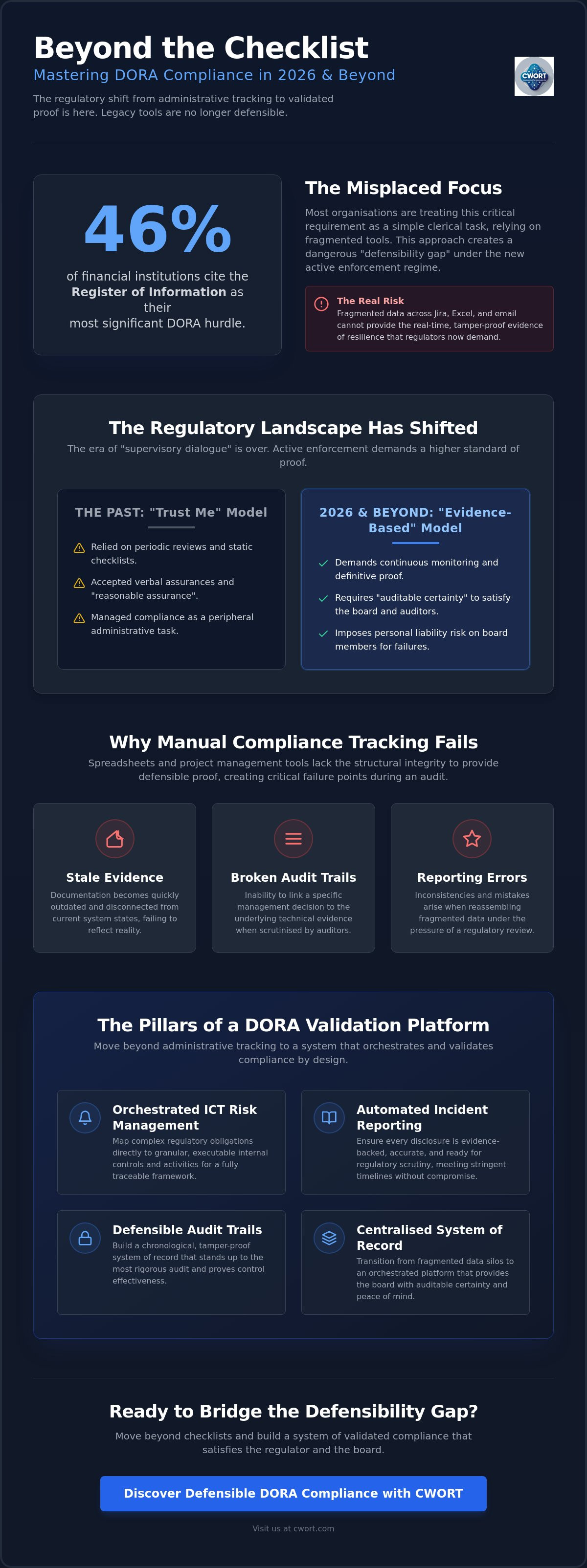
Forty-six per cent of financial institutions cite the Register of Information as their most significant DORA hurdle, yet most are still treating it as a clerical task rather than a validation exercise. If you're still relying on fragmented data across Jira, Excel, and email to manage your ICT risk, you aren't just behind the curve. You're exposed. As we move through 2026, the era of "supervisory dialogue" has ended. Regulators now demand more than just documentation; they require definitive, real-time proof of resilience. Transitioning to a dedicated DORA compliance validation software isn't about ticking boxes. It's about building a system of record that stands up to the most rigorous audit.
We understand the anxiety that comes with personal liability for board members and the struggle to prove separation of duties to sceptical auditors. This guide shows you how to move beyond administrative tracking to a system of validated compliance that satisfies both the regulator and the board. You'll discover how to orchestrate regulator-ready audit trails, automate board-level reporting, and provide defensible proof of control effectiveness across every pillar of the regulation.
Key Takeaways
- Understand why traditional administrative checklists fail under the active enforcement regimes of 2026 and how to bridge the "defensibility gap".
- Evaluate the essential features of DORA compliance validation software to ensure your system enforces a strict separation of duties and structural integrity.
- Learn to map complex regulatory obligations to granular internal execution activities for an audit-ready ICT risk management framework.
- Discover how to automate the incident reporting lifecycle, ensuring every disclosure is evidence-backed and ready for regulatory scrutiny.
- Transition from fragmented data silos to an orchestrated system of record that provides the board with auditable certainty and professional peace of mind.
Table of Contents
- Beyond Administrative Checklists: Why DORA Compliance Validation Software is Essential
- The Core Pillars of a DORA Compliance Validation Platform
- Validation vs Tracking: Evaluation Framework for DORA Software
- Building an Audit-Ready ICT Risk Management Framework
- CWORT: Orchestrating Defensible DORA Compliance Proof
Beyond Administrative Checklists: Why DORA Compliance Validation Software is Essential
The Digital Operational Resilience Act (DORA) has fundamentally altered the burden of proof for financial institutions. In the past, compliance was often treated as a peripheral administrative function, managed through periodic reviews and static checklists. Those days are over. In 2026, the regulatory gaze has shifted from mere management to rigorous validation. It's no longer enough to claim that controls exist; you must prove they're effective, enforced, and continuously monitored. This shift creates a "defensibility gap" for organisations relying on legacy tools. Traditional project management software and spreadsheets lack the structural integrity to bind evidence to obligations. Bridging this gap requires a dedicated DORA compliance validation software that moves beyond tracking tasks to orchestrating defensible proof.
Moving from a "trust me" model to an "evidence-based" model is now a survival requirement. Auditors no longer accept verbal assurances or screenshots of Jira tickets as sufficient evidence of operational resilience. They demand a chronological, tamper-proof record of how every ICT risk was identified, mitigated, and validated. Fragmented manual workflows cannot provide this level of traceability. When data is scattered across different departments, the risk of "stale evidence" increases, leaving the organisation vulnerable during a formal review. A centralised validation engine replaces this chaos with a disciplined, automated workflow that ensures every control is backed by a verifiable audit trail.
The Limitations of Manual Compliance Tracking
Excel remains the single greatest risk factor in modern regulatory audits. It offers no version control, lacks a tamper-proof audit trail, and relies entirely on manual updates that are prone to human error. When an auditor asks for proof of a specific ICT control from six months ago, manual reconstruction often results in data that's disconnected from reality. Consider these common failure points in manual tracking:
- Stale Evidence: Documentation that was accurate at the time of entry but hasn't been updated to reflect current system states.
- Broken Audit Trails: The inability to link a specific management decision to the underlying technical evidence.
- Reporting Errors: Inconsistencies that occur when reassembling fragmented data from email threads and spreadsheets under pressure.
Regulatory Expectations for ICT Risk Management in 2026
Regulators in 2026 have moved past the initial "supervisory dialogue" phase. They now expect real-time visibility into your ICT risk management framework. This requires a transition from abstract policy statements to executable activities. Every DORA obligation must map directly to a validated internal action. For the board, the standard has also risen. They don't accept "reasonable assurance" based on a manager's word. Given the personal liability risks under DORA, directors demand "auditable certainty." They need to see a centralised system where control effectiveness is validated by design. Implementing DORA compliance validation software ensures that this certainty is built into the workflow, providing a proactive shield against regulatory scrutiny.
The Core Pillars of a DORA Compliance Validation Platform
Effective DORA compliance requires more than a list of capabilities; it demands a unified orchestration of five distinct pillars. A robust DORA compliance validation software serves as the central nervous system for this effort, ensuring that risk management, incident response, and resilience testing aren't siloed activities but integrated workflows. By automating the transition from detection to disclosure, organisations can meet the stringent timelines mandated by regulators without compromising on accuracy or depth. This orchestration extends beyond internal boundaries, pulling third-party ICT providers into a shared environment of accountability and verified resilience.
Orchestrating ICT Risk Management Frameworks
Enforce discipline in your risk identification process by moving away from subjective assessments. A validation platform translates abstract regulatory standards into specific, executable organisational controls. It doesn't just record that a risk exists; it mandates the mitigation steps and automatically tests the effectiveness of the response. This systematic approach ensures that every technical standard is mapped to an internal activity, leaving no room for interpretation or oversight. To understand how these pillars operate in a live environment, you may request a technical demonstration of our orchestration engine.
Operational Resilience and Testing Validation
Move past "check-the-box" testing by implementing validated resilience scenarios that reflect real-world threats. According to ESMA's DORA Requirements, the scope of testing must be comprehensive, covering all critical ICT functions and recovery protocols. A dedicated platform captures live evidence during stress tests and business continuity exercises, providing an objective record of performance. Instead of manual data entry, the system generates automated reports on recovery time objectives (RTOs). This transition from manual reporting to automated validation ensures that your recovery capabilities are proven, not just promised.
Binding Evidence to Control Outcomes
The most significant gap in traditional compliance management is the failure to link results to reality. Evidence-based compliance management solves this by ensuring every control outcome is backed by immutable, timestamped proof. If a control is marked as "effective," the system must point to the specific digital artifact that proves it. Evidence-binding is the process of linking digital artifacts directly to specific regulatory obligations. This creates an unbreakable chain of custody that satisfies the most demanding auditors. By maintaining this level of structural integrity, you replace the anxiety of a potential audit with the confidence of a defensible reality.
- Automated Lifecycle Management: Track incidents from initial detection through to final regulator-ready disclosure.
- Supply Chain Validation: Extend your resilience standards to third-party providers with automated evidence collection.
- Immutable Audit Trails: Ensure all validation activities are recorded in a tamper-proof ledger for total transparency.
Validation vs Tracking: Evaluation Framework for DORA Software
Compliance is often mistaken for a management task. This misconception leads organisations to rely on generic project management tools to oversee their regulatory obligations. However, a task manager merely tracks effort; it doesn't validate outcomes. In the context of 2026 regulatory oversight, the distinction is critical. Implementing a dedicated DORA compliance validation software is the only way to move from a passive checklist to an active system of record. Whilst Jira or Excel can tell you that a task is "Done," they cannot prove that the resulting control is effective or that it meets the specific technical standards required by the regulator. A validation engine enforces discipline by design, ensuring that every completed activity is accompanied by the necessary digital artifacts to make it defensible.
The "Jira for Compliance" myth is a dangerous shortcut. Generic tools lack the structural integrity required to maintain a tamper-proof audit trail. They allow for retrospective changes, lack hard-coded validation workflows, and fail to provide the granular traceability that auditors now demand. For a compliance posture to be truly defensible, the software must act as a proactive orchestrator. It must define the standard, enforce the execution, and capture the evidence in a single, unalterable workflow. This transition from tracking to validation replaces the ambiguity of manual oversight with the certainty of an automated system of truth.
Enforcing Separation of Duties (SoD)
DORA demands strict separation between those who execute a control and those who validate its effectiveness. Self-certification is a significant red flag during a regulatory review. It creates an inherent conflict of interest and increases the risk of internal fraud or operational oversight. Robust DORA compliance validation software prevents this by hard-coding SoD into the workflow. The system ensures that a control owner cannot act as their own validator. By enforcing this discipline, organisations reduce their operational risk and provide auditors with clear proof of independent oversight. This level of structural accountability is impossible to maintain within a spreadsheet or a standard ticketing system.
Audit-Ready Output vs Manual Reconstruction
Eliminate the "Audit Panic" phase that typically precedes a regulatory visit. When compliance is managed through fragmented manual processes, evidence collection often requires weeks of forensic reconstruction. This is inefficient and prone to error. An orchestrated platform provides a board-level dashboard that offers real-time visibility into your compliance posture. It allows leadership to see exactly where gaps exist and which controls have been validated. More importantly, it enables the generation of regulator-ready reports at the click of a button. Instead of reassembling data from disparate sources, you present a unified, evidence-backed record that demonstrates total control over your ICT risk environment.
- Real-Time Dashboards: Move from periodic reporting to continuous visibility for the board and senior management.
- Automated Report Generation: Produce comprehensive audit trails instantly, reducing the administrative burden on compliance teams.
- Tamper-Proof Evidence: Ensure that all validation data is immutable, providing a definitive record for national competent authorities.
Building an Audit-Ready ICT Risk Management Framework
Constructing a framework that withstands rigorous regulatory scrutiny requires a disciplined, four-phase approach. It begins with the granular mapping of regulatory obligations to internal execution activities. Without this foundation, organisations risk leaving "orphan obligations", which are requirements that exist on paper but have no corresponding action in the real world. A robust DORA compliance validation software ensures that every Level 2 and Level 3 technical standard is translated into a specific, executable task. This process is significantly streamlined by leveraging ISO 27001 control mapping, allowing you to bridge the gap between international security standards and DORA’s unique technical requirements whilst maintaining total traceability.
Once obligations are mapped, the focus shifts to accountability and enforcement. Defining clear control owners is only half the battle; the system must also enforce validation workflows that prevent self-certification. This phase ensures that every action taken is verified by an independent party, creating the structural integrity discussed in previous sections. By hard-coding these workflows into your operational fabric, you replace subjective management with objective validation. This transition is essential for building a framework that regulators will actually trust during a formal inspection. It creates a defensible reality where every control is backed by a verified chain of custody.
Mapping Obligations to Execution
Translate abstract regulatory language into executable reality by linking every requirement within the DORA framework to a verifiable internal activity. This eliminates ambiguity and ensures that your technical teams understand exactly what evidence they must produce to satisfy an auditor. By integrating your DORA compliance validation software with existing security tools, you can automate the collection of this evidence in real-time. This proactive approach ensures that your audit trail is always current, rather than being a retrospective reconstruction that is prone to human error and data gaps.
Continuous monitoring serves as the vital third phase, where the system moves from static planning to active validation. Evidence collection must be an ongoing process rather than a seasonal event triggered by an audit notification. By utilising an orchestrated platform, you capture timestamped artifacts as they occur, ensuring that your records are immutable and tamper-proof. This replaces the frantic scramble for documentation with a methodical, professional flow that demonstrates total control over the ICT environment at any given moment.
Automated Compliance Reporting for the Board
Boards of directors in 2026 no longer settle for vague assurances or "reasonable hope". They require a clear distinction between perceived risk and actual resilience. Strategic decision-making now relies on automated compliance proof generation to identify exactly where further investment is required to meet regulatory standards. This shifts the organisational mindset from quarterly reporting cycles to a state of continuous compliance. Instead of reacting to audit requests, leadership can monitor the organisation's resilience posture in real-time. To see how your board can gain this level of auditable certainty, you should schedule a technical consultation with our compliance architects.
CWORT: Orchestrating Defensible DORA Compliance Proof
CWORT is not a passive repository for documents; it's a proactive enterprise platform designed to enforce regulatory discipline by design. As we move through 2026, the requirement for auditable certainty has superseded the traditional management of ICT risks. Our orchestration engine replaces the uncertainty of manual oversight with a rigorous, automated system of record that binds every regulatory obligation to a validated outcome. By implementing DORA compliance validation software that prioritises evidence integrity, organisations can transition from a state of constant audit anxiety to a position of professional control. CWORT ensures that every control activity is timestamped, verified, and linked to its corresponding digital artifact, creating a single source of defensible truth that satisfies both the board and national competent authorities.
The "defensibility gap" identified in earlier sections is often the result of using tools that were never intended for high-stakes governance. CWORT closes this gap by automating the transition from abstract policy to concrete evidence. It doesn't just track that a resilience test occurred; it validates that the test met the required standards and captured the necessary proof of recovery. This level of orchestration ensures that your compliance posture is always regulator-ready, eliminating the need for the forensic reconstruction of audit trails that plagues organisations relying on fragmented systems. Stop managing tasks. Start validating outcomes.
From Fragmented Tracking to Orchestrated Validation
Replace the chaos of Jira tickets and Excel spreadsheets with a dedicated workflow built for the rigours of 2026 regulatory oversight. CWORT hard-codes the separation of duties and evidence binding into your daily operations, ensuring that self-certification is impossible. This structural integrity is essential for maintaining a tamper-proof audit trail across all five pillars of DORA. Beyond DORA, the platform provides a unified environment for managing multiple frameworks, including NIS2 and the UK NIS regulations. This consolidation reduces administrative overhead whilst ensuring that your resilience standards remain consistent across every jurisdiction in which you operate.
- Evidence Binding: Automatically link digital artifacts to specific ICT risk controls for immediate validation.
- Hard-Coded SoD: Enforce a strict separation between control owners and validators to prevent internal fraud and oversight.
- Framework Consolidation: Manage DORA, NIS2, and UK NIS requirements within a single, orchestrated environment.
Strategic Resilience for UK Financial Entities
Positioning DORA compliance validation as a strategic asset allows UK financial entities to turn regulatory obligation into a competitive advantage. Operational resilience is no longer just a cost centre; it's a marker of institutional maturity and reliability. By utilising DORA compliance validation software to automate the most labour-intensive aspects of evidence collection and reporting, you significantly reduce the long-term cost of compliance. This efficiency allows your risk and security teams to focus on active threat mitigation rather than administrative box-ticking.
The transition to orchestrated validation provides the board with the auditable certainty they require to manage their personal liability effectively. It replaces vague progress reports with real-time dashboards that reflect the organisation's true resilience posture. To see how CWORT can transform your compliance workflow and generate regulator-ready proof at the click of a button, request a technical demonstration with our orchestration specialists today. Secure your framework, validate your evidence, and lead with confidence in a landscape of active enforcement.
Secure Your Regulatory Future with Orchestrated Validation
The regulatory landscape of 2026 has no room for the ambiguity of manual checklists. As we have explored, the shift from administrative tracking to evidence-based validation is now a prerequisite for institutional survival. Relying on fragmented data across generic tools creates a defensibility gap that leaves your organisation, and your board, exposed to significant liability. True operational resilience requires a disciplined approach where every control is backed by immutable proof and every workflow enforces a strict separation of duties by design.
Implementing a dedicated DORA compliance validation software replaces the frantic scramble of manual audit reconstruction with the efficiency of an automated system of record. CWORT provides the structural integrity and traceability required to satisfy the most rigorous national competent authorities. By moving to an orchestrated framework, you gain regulator-ready, board-level reporting that demonstrates total control over your ICT risk environment. Lead your organisation with the confidence of auditable certainty rather than the hope of reasonable assurance.
Book a CWORT Demo to Orchestrate Your DORA Validation and secure your path to definitive compliance today.
Frequently Asked Questions
What is the difference between GRC software and DORA compliance validation software?
GRC software typically functions as a broad management layer for general corporate governance and policy tracking. In contrast, DORA compliance validation software acts as a technical orchestration engine. It moves beyond high-level administrative tracking to bind specific digital artifacts directly to regulatory obligations, ensuring every control is backed by immutable evidence rather than just a manager's word.
Does DORA require a specific software tool for compliance validation?
The regulation is technology-neutral and does not mandate a specific tool. However, it does require the management body to be ultimately accountable for an ICT risk management framework that provides auditable certainty. Achieving the necessary level of traceability, enforced discipline, and separation of duties without dedicated automation is an immense operational challenge for complex financial entities.
How does DORA compliance validation software handle third-party ICT risk?
Validation software extends your internal resilience standards to the entire ICT supply chain. It automates the collection of evidence from third-party providers and monitors their performance against agreed service levels in real-time. This ensures that critical providers are integrated into your defensible proof system, providing a unified view of resilience across your entire technical estate.
Can we use Jira or Excel for DORA compliance validation in 2026?
Relying on Jira or Excel for DORA compliance validation software functions in 2026 is a significant regulatory risk. These tools lack the tamper-proof audit trails and hard-coded validation workflows required for active enforcement. Regulators now demand a level of structural integrity and evidence binding that generic project management tools or spreadsheets simply cannot deliver.
What are the reporting requirements for major ICT incidents under DORA?
DORA requires a structured reporting process consisting of an initial notification, an intermediate report, and a final analysis. Dedicated software automates this lifecycle from detection to disclosure. It ensures that every report is evidence-backed and submitted within the strict timelines defined by the Regulatory Technical Standards (RTS), reducing the risk of reporting errors.
How does software help with DORA separation of duties enforcement?
Software enforces separation of duties by hard-coding independent validation into the compliance workflow. It ensures that the individual responsible for executing a control cannot act as the validator for that same activity. This eliminates the risk of self-certification, which is a major red flag for auditors, and provides a clear record of independent oversight.
What should a board-level DORA compliance dashboard include?
A board-level dashboard must focus on resilience outcomes rather than administrative progress. It should include real-time data on recovery time objectives (RTOs), the current status of critical ICT third-party providers, and the overall effectiveness of validated controls. This provides directors with the auditable certainty required to manage their personal liability under the regulation.
How long does it take to implement a DORA compliance validation platform?
Implementation timelines depend on the scale of your ICT environment and organisational complexity. Most organisations can move from initial obligation mapping to active validation within three to six months. This structured approach is significantly more efficient than manual framework construction, which often results in fragmented data silos and disconnected evidence.
Disclaimer
The content on this site is provided for general information and educational purposes only. It does not constitute legal, regulatory, financial, or professional advice. CWORT provides AI-assisted insights and workflow automation, but all compliance decisions remain the responsibility of your organisation and its management. Always seek qualified legal or regulatory guidance for decisions relating to the UK NIS Regulations, CAF, DORA, NIS2, ISO 27001, or other obligations.
Related posts
DORA Compliance Validation: A Guide for Financial Institutions
Master DORA compliance validation. Our guide shows you how to replace risky manual tracking with an automated, auditable system for definitive regulatory proof.
DORA Technical Standards Compliance: Moving from Regulatory Theory to Validated Execution
Struggling with DORA technical standards compliance? Move beyond spreadsheets to a validated framework that provides real-time, auditable evidence for regula...
DORA Compliance Orchestration: Moving from Manual Tracking to Validated Execution in 2026
Is your manual DORA tracking audit-ready for 2026? Learn how DORA compliance orchestration delivers validated evidence and protects your organisation from fi...
Article by
Michael Iyiola
Co-Founder, CWORT
Michael Iyiola is a co-founder of CWORT and a Cyber and AI Security Engineer with deep experience in vulnerability management, detection engineering and operational resilience across UK critical national infrastructure, including rail, energy and financial services. At CWORT, he designs scalable, evidence-driven workflows that help teams meet modern regulatory and security demands.
Build Your Foundation of Auditable Certainty
Take control of your regulatory obligations and secure your infrastructure with CWORT.