DORA Technical Standards Compliance: Moving from Regulatory Theory to Validated Execution

Michael Iyiola
Co-Founder, CWORT
Struggling with DORA technical standards compliance? Move beyond spreadsheets to a validated framework that provides real-time, auditable evidence for regula...

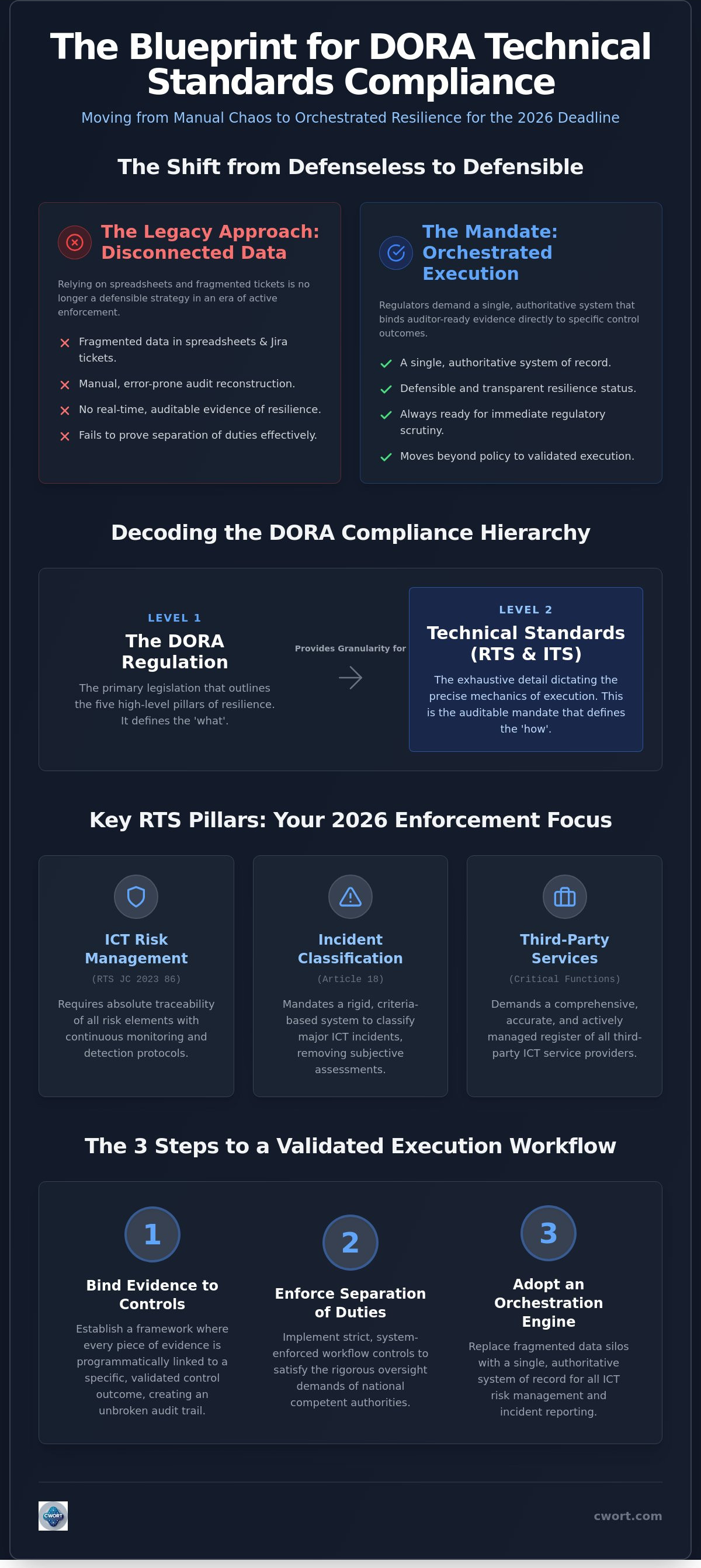
Spreadsheets and fragmented Jira tickets are no longer a defensible strategy for DORA technical standards compliance in an era of active enforcement. With the January 2025 application date behind us and regulators now demanding real-time evidence of operational resilience, the margin for administrative error has vanished. You likely recognise the exhaustion of manual audit reconstruction and the mounting pressure of the Q4 2026 annual ICT risk management review. It is a common struggle to prove separation of duties or verify control integrity whilst your compliance data remains scattered across disconnected silos.
This article provides the blueprint to translate complex Regulatory Technical Standards into a disciplined, evidence-based validation framework that satisfies both the board and the regulator. You'll discover how to move beyond theoretical compliance to a state of orchestrated execution. We will examine the shift from static documentation to a single, orchestrated system that binds auditor-ready evidence directly to specific control outcomes; this ensures your resilience status is always defensible, transparent, and ready for immediate regulatory scrutiny.
Key Takeaways
- Identify how Regulatory Technical Standards (RTS) provide the necessary granularity to translate high-level DORA mandates into precise operational requirements.
- Recognise the strategic danger of relying on manual tools like Excel or Jira, which fail to provide the auditable evidence required for 2026 enforcement deadlines.
- Establish a disciplined framework for DORA technical standards compliance by binding every piece of evidence to a specific, validated control outcome.
- Learn to enforce a strict separation of duties within your compliance workflow to satisfy the rigorous oversight demands of national competent authorities.
- Adopt an orchestration engine that replaces fragmented data with a single, authoritative system of record for all ICT risk management and incident reporting.
Table of Contents
- Decoding the DORA Technical Standards (RTS and ITS) Framework
- Critical Requirements for ICT Risk Management and Incident Reporting
- The Strategic Failure of Manual Compliance Trackers
- Implementing a Validated Execution Workflow for DORA
- Orchestrating DORA Technical Compliance with CWORT
Decoding the DORA Technical Standards (RTS and ITS) Framework
The Digital Operational Resilience Act (DORA) establishes the primary legislative mandate, but the true operational burden lies within the secondary layer of technical standards. These Regulatory Technical Standards (RTS) and Implementing Technical Standards (ITS) are drafted by the European Supervisory Authorities (ESAs), including the EBA, EIOPA, and ESMA. Whilst the high-level regulation sets the objective, these standards dictate the precise mechanics of execution. For leadership teams, achieving DORA technical standards compliance isn't a matter of policy interpretation; it's a requirement for granular, technical validation.
For UK-based financial entities, the legal weight of these standards is absolute if they maintain EU operations or serve EU-based clients. National Competent Authorities (NCAs) across the 27 Member States now use these standards as the definitive yardstick for enforcement. Relying on "best efforts" or legacy frameworks will lead to structural failure under audit. You must move from understanding the theory of the Act to enforcing the specific technical requirements these standards demand.
The Hierarchy of DORA Compliance
A disciplined approach requires recognising the two-tier structure of the regulation. Level 1 consists of the primary legislation, which outlines the five pillars of resilience. Level 2 comprises the RTS and ITS, which provide the exhaustive detail missing from the initial text. This hierarchy is why DORA compliance validation must be treated as an orchestration challenge rather than a legal one. Without the Level 2 standards, the Act remains an abstract set of goals; with them, it becomes a rigorous, auditable mandate for specific ICT behaviours and controls.
Key RTS Pillars for 2026
As we move through the 2026 reporting cycles, three specific pillars demand immediate attention:
- ICT Risk Management Frameworks (RTS JC 2023 86): These define the technical specifications for Article 15 and 16. They require entities to document every element of their risk landscape with absolute traceability and establish protocols for continuous monitoring and detection.
- Incident Classification (Article 18): This standard forces a move away from subjective severity levels. It mandates a rigid, criteria-based approach to identifying and classifying major ICT-related incidents within strict timeframes.
- Policy on ICT services supporting critical or important functions: This requires a comprehensive register of information for all ICT service providers. It leaves no room for manual data entry errors or incomplete third-party records.
Critical Requirements for ICT Risk Management and Incident Reporting
The transition from policy to practice begins with RTS JC 2023 86. This standard demands a robust ICT Risk Management Framework that goes beyond high-level security objectives. It requires specific protection, prevention, and detection mechanisms. You cannot simply claim to have a firewall; you must prove its efficacy through documented, repeatable execution. These mandates extend to ICT business continuity and disaster recovery, ensuring your organisation can withstand and recover from severe operational disruptions with minimal data loss.
Integrating these requirements into existing workflows is a logical first step for mature firms. Many organisations find that leveraging an ISO 27001 control mapping tool provides a foundational structure. However, DORA adds a layer of prescriptive detail that legacy frameworks often lack. For smaller financial entities, the ESAs have established a "simplified" framework. This allows for a proportional application of the rules based on size and risk profile, though the core requirement for DORA technical standards compliance remains non-negotiable and strictly enforced.
Standardising the ICT Risk Management Framework
Protection and prevention mechanisms must now be backed by continuous monitoring. The technical standards require documented policies that define how you identify vulnerabilities and respond to threats in real-time. This isn't a periodic exercise; it's a permanent state of readiness. Every control must be mapped to a specific outcome, creating a clear line of sight from regulatory obligation to technical evidence.
Incident Classification and Reporting Timelines
Incident reporting is the most time-sensitive aspect of the new regime. The ITS introduces harmonised reporting templates to ensure consistency across the EU. According to EIOPA on DORA, the criteria for "Major" ICT-related incidents are now strictly defined. You must classify incidents based on the number of users affected, the duration of the outage, and the geographical spread of the impact.
The reporting timelines are unforgiving. You must submit an initial notification within 4 hours of classification, followed by an intermediate report within 72 hours, and a final report within one month. Achieving DORA technical standards compliance whilst manually reconstructing audit trails is nearly impossible. Central to this effort is the "Register of Information" for third-party providers. Research indicates that 46% of financial institutions find this register to be their greatest challenge. You must move away from static trackers and adopt a system that automates the collection and validation of this critical data.
To see how this level of rigour can be automated within your organisation, you might consider how to orchestrate your compliance validation workflow.
The Strategic Failure of Manual Compliance Trackers
Relying on administrative tools to manage DORA technical standards compliance is a strategic error that invites regulatory scrutiny. Jira and Excel are designed for task management and data entry; they are not built for the rigorous validation of complex technical controls. They offer a dangerous illusion of progress whilst obscuring the actual state of operational resilience. Regulators have moved beyond reviewing static policies. They now demand demonstrable, real-time proof that controls are functioning as intended. A spreadsheet cannot provide the immutable, time-stamped audit trail required to survive a 2026 inspection.
The fundamental flaw lies in the creation of a "fragmented truth." When evidence is stored in one decentralised folder, a task status in another, and the original regulatory obligation in a third, the logical connection between them is severed. This disconnection makes it impossible to verify that a specific technical standard has been effectively met. Manual reconstruction of these links during an audit is not only time-consuming; it is increasingly rejected by European Supervisory Authorities who view such ad-hoc reporting as a sign of poor governance.
The Evidence Gap in Legacy GRC
A "task complete" tick in a legacy GRC tool or Jira ticket is not auditable proof. It represents an administrative claim rather than a validated technical outcome. Without a system that binds evidence directly to the control at the precise moment of execution, ensuring compliance evidence integrity becomes an impossible task. Decentralised storage systems are inherently prone to accidental loss or intentional tampering. This leaves your organisation unable to defend its resilience posture during a major ICT incident or a routine regulatory review.
Separation of Duties and Accountability
DORA mandates clear internal governance and accountability structures. You must prove exactly who performed a control activity, who validated the output, and who provided the final approval. Proving this strict separation of duties in a manual spreadsheet environment is a technical impossibility. Spreadsheets lack the granular permissions and tamper-proof logs necessary to demonstrate that these distinct roles were maintained. Without an orchestrated system that enforces these boundaries by design, accountability remains a theoretical concept. You need a system that ensures no single individual can both perform and validate their own work, providing a defensible truth for auditors.
Implementing a Validated Execution Workflow for DORA
Moving from a theoretical understanding of the Digital Operational Resilience Act to a state of validated execution requires a fundamental shift in operational philosophy. You must replace passive monitoring with an active, orchestrated workflow. This process ensures that DORA technical standards compliance is not a periodic check but an inherent byproduct of daily operations. Success depends on a four-step framework that prioritises accountability and evidentiary integrity over administrative convenience. It transforms the way your organisation handles risk by moving from "tracking" to "validating".
Translating Obligations into Activities
The first step involves decomposing complex RTS articles into a series of orchestrated tasks. An obligation like Article 15 of the ICT Risk Management Framework cannot be managed as a single line item. It must be broken down into granular, repeatable activities. Each task requires a precise "definition of done" that aligns perfectly with the technical standard. By utilising regulatory compliance workflow automation, you maintain momentum and ensure no requirement is overlooked. You then assign these tasks to specific subject matter experts (SMEs). The system must enforce a strict separation of duties, ensuring that the individual performing the activity is never the one validating the final outcome.
Binding Evidence to Control Outcomes
The core of a defensible resilience posture is the concept of immutable evidence. You must capture proof that cannot be altered or retroactively created. This involves binding digital evidence, such as system logs, configuration screenshots, or signed policy documents, directly to the outcome of each control activity at the exact moment of execution. This binding creates a definitive, tamper-proof audit trail that satisfies the most rigorous central bank inspections. Unlike manual trackers where evidence is often reconstructed months after the event, this approach ensures that your data is always regulator-ready. It eliminates the anxiety of "the missing file" during an audit and provides a secure, auditable record of every technical control.
Once evidence is bound to validated outcomes, the final step is the automation of board-level and regulator-ready reporting. You should be able to generate a comprehensive status report at the touch of a button, requiring zero manual reconstruction. This level of transparency provides the board with a real-time view of the organisation’s resilience status whilst offering regulators the granular proof they expect. To transition your organisation from administrative tracking to validated execution, request a demonstration of our DORA orchestration engine.
Orchestrating DORA Technical Compliance with CWORT
CWORT serves as the definitive orchestration engine for organisations transitioning from regulatory theory to validated execution. It replaces the fragmented, manual trackers discussed earlier with a single, auditable system of record. This shifts your operational focus from administrative tracking to definitive, evidence-based proof. By enforcing discipline by design, CWORT ensures that DORA technical standards compliance is a continuous state rather than a reactive project. It provides the structural integrity required to survive the 2026 reporting cycles and the first annual ICT risk management reviews.
The core of the platform is the CWORT "Evidence Binding" model. This model radically reduces audit preparation time by capturing immutable proof at the point of activity. It eliminates the forensic reconstruction of history that plagues traditional GRC approaches. Every control outcome is bound to specific, tamper-proof evidence, providing a clear line of sight for national competent authorities. This systematic approach replaces the anxiety of potential failure with the calm of auditable certainty, allowing leadership to focus on strategic resilience rather than administrative survival.
Regulator-Ready Outputs on Demand
Audits often trigger a "mad scramble" for documentation that disrupts normal business operations. CWORT eliminates this inefficiency by generating regulator-ready reports that map directly to the DORA RTS and ITS templates. These outputs are not merely summaries; they are validated records of execution. Board-level dashboards reflect real-time resilience status, providing senior leadership with objective data rather than subjective assurances. You gain the ability to demonstrate total control over your ICT risk landscape at any moment, fulfilling the mandate for ultimate accountability within the management body.
A Unified Framework for UK Enterprises
For UK-based financial entities with cross-border operations, the regulatory landscape is uniquely complex. You must manage DORA technical standards compliance whilst simultaneously adhering to the NIS2 compliance platform UK requirements and the UK NIS framework. CWORT provides a unified framework that orchestrates multiple regulatory obligations within a single environment. This reduces operational overhead by mapping shared controls across different standards, ensuring that a single validated activity can satisfy multiple regulatory demands.
Choosing CWORT is a strategic decision for organisations that prioritise professional maturity over manual guesswork. It offers a no-nonsense path toward total assurance in a fragmented landscape. By adopting an orchestration engine built for the gravity of today's regulatory environment, you secure your organisation’s future and protect its reputation. Move beyond the limitations of spreadsheets and establish a defensible truth with a platform designed for the highest levels of governance and oversight. If you appreciate this same commitment to quality in British-designed apparel, you can check out DRIPrDRY.
Securing Your Regulatory Future through Orchestrated Validation
The transition from regulatory theory to validated execution is no longer optional. With the 2025 application date behind us, the focus has shifted entirely to demonstrable proof. Relying on manual trackers for DORA technical standards compliance creates a dangerous gap between policy and reality; it leaves your organisation vulnerable to significant penalties and structural failure. Success requires a move toward orchestrated workflows that replace administrative hope with auditable certainty.
CWORT provides the disciplined framework necessary to survive the 2026 reporting cycles. By utilising auditor-ready evidence binding and enforced separation of duties, the platform ensures your resilience status is always defensible. You can generate regulator-ready reporting templates at the touch of a button, eliminating the forensic reconstruction of audit trails. It's time to replace fragmented data with a single, authoritative system of record that satisfies both the board and the regulator. Take the first step toward total assurance and book a demo of the CWORT DORA validation platform today. You have the power to turn regulatory pressure into a strategic advantage.
Frequently Asked Questions
What is the difference between DORA RTS and ITS?
Regulatory Technical Standards (RTS) define the technical content and specific requirements of the regulation, such as the components of an ICT risk management framework. Implementing Technical Standards (ITS) establish the standardised formats and templates for reporting to ensure harmonisation across the EU. You must adhere to both to achieve full compliance, as RTS dictate the "what" whilst ITS specify the "how" for data submission.
When do the DORA technical standards become legally binding for UK firms?
DORA and its associated technical standards became fully applicable on 17 January 2025. UK-based financial entities with EU operations, subsidiaries, or clients must comply with these mandates immediately. National Competent Authorities have moved past the initial implementation phase and are now actively enforcing these standards through rigorous audits and demands for demonstrable, real-time proof of resilience.
How do the technical standards affect ICT third-party risk management?
The standards mandate the creation of a comprehensive Register of Information for all ICT service providers, which was due for initial submission in early 2026. You must map every third-party arrangement supporting critical or important functions with absolute precision. The technical standards also dictate specific contractual requirements and assessment criteria that must be enforced across your entire supply chain to manage concentration risk effectively.
Can we use our existing ISO 27001 framework to satisfy DORA RTS requirements?
An ISO 27001 framework provides a strong foundation, but it lacks the prescriptive granularity required for DORA technical standards compliance. DORA introduces much stricter incident reporting timelines and specific mandates for third-party registers that go beyond ISO's general guidelines. You must bridge this gap by mapping existing controls to the specific, granular technical requirements found in the RTS JC 2023 86.
What are the specific incident reporting timelines mandated by the DORA technical standards?
You must submit an initial notification within 4 hours of classifying an ICT-related incident as major. This is followed by an intermediate report within 72 hours and a final report within one month of classification. These timelines are unforgiving and require a system capable of rapid, automated data collection to ensure you don't miss critical regulatory deadlines during an active operational crisis.
Why is 'separation of duties' so critical for DORA technical compliance?
Separation of duties ensures that the individual performing a technical control is never the same person responsible for its validation. This is a core requirement for defensible governance under DORA, as it prevents internal tampering and ensures evidence integrity. Proving this separation within your workflow is essential for satisfying auditors that your resilience posture is based on objective, independently verified data.
How does CWORT automate the validation of DORA technical standards?
CWORT automates the validation process by translating abstract regulatory obligations into structured, repeatable execution activities. It binds immutable evidence directly to control outcomes at the moment of execution, ensuring that DORA technical standards compliance is a continuous state. The platform enforces roles and responsibilities by design, eliminating the need for manual audit reconstruction and providing a single, authoritative system of record.
What happens if a financial entity fails to meet the technical standards by the deadline?
Non-compliance can result in administrative penalties exceeding €10 million or 1% of average daily global turnover. Beyond financial costs, regulators may issue public cease-and-desist orders or require a complete overhaul of your ICT risk management framework. Failure to meet these standards signals a lack of operational control, which often leads to more frequent, intrusive, and costly regulatory inspections.
Disclaimer
The content on this site is provided for general information and educational purposes only. It does not constitute legal, regulatory, financial, or professional advice. CWORT provides AI-assisted insights and workflow automation, but all compliance decisions remain the responsibility of your organisation and its management. Always seek qualified legal or regulatory guidance for decisions relating to the UK NIS Regulations, CAF, DORA, NIS2, ISO 27001, or other obligations.
Related posts
DORA Compliance Validation: A Guide for Financial Institutions
Master DORA compliance validation. Our guide shows you how to replace risky manual tracking with an automated, auditable system for definitive regulatory proof.
DORA Compliance Validation Software: Orchestrating Defensible Proof in 2026
Is your DORA strategy audit-ready for 2026? Learn how DORA compliance validation software provides defensible proof and protects board members from liability.
Challenges of DORA Compliance for Financial Institutions in 2026: A Strategic Guide
Facing the challenges of DORA compliance for financial institutions? Our 2026 guide helps you move from manual tracking to automated validation for total ass...
Article by
Michael Iyiola
Co-Founder, CWORT
Michael Iyiola is a co-founder of CWORT and a Cyber and AI Security Engineer with deep experience in vulnerability management, detection engineering and operational resilience across UK critical national infrastructure, including rail, energy and financial services. At CWORT, he designs scalable, evidence-driven workflows that help teams meet modern regulatory and security demands.
Build Your Foundation of Auditable Certainty
Take control of your regulatory obligations and secure your infrastructure with CWORT.