The Evolution of the Enterprise GRC Validation Tool: From Tracking to Orchestration in 2026

Michael Iyiola
Co-Founder, CWORT
Stop chasing compliance ghosts in spreadsheets. Create a single source of truth for compliance with GRC orchestration to master NIS2, DORA, and UK audit dema...

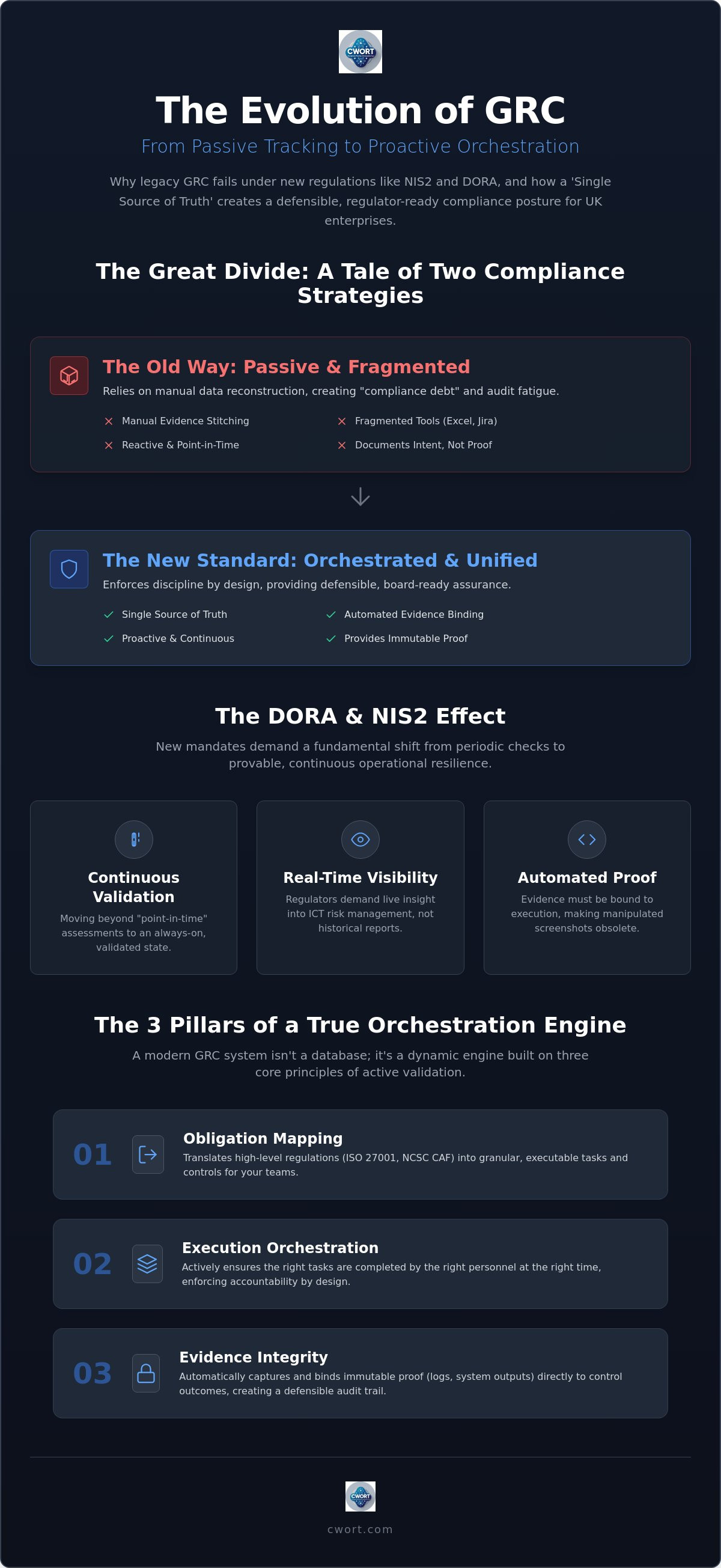
If your compliance strategy still relies on manual data reconstruction from Jira and Excel, you aren't managing risk; you're merely documenting a pending failure. You've likely felt the mounting pressure of audit fatigue as NIS2 and DORA requirements tighten their grip on UK enterprises. It's exhausting to spend weeks stitching together fragmented evidence when you lack a single source of truth for compliance. You need a system that enforces discipline by design rather than one that forces you to chase ghosts in a spreadsheet.
This article demonstrates how the next generation of enterprise GRC validation tools, led by platforms like CWORT, has evolved into a proactive orchestration engine. Discover how modern tools move beyond static tracking toward defensible, evidence-bound orchestration for ISO 27001 and the UK NIS framework. We'll examine the transition from passive record-keeping to automated evidence binding. This shift ensures your audit trails are regulator-ready whilst significantly reducing the manual workload that currently drains your team's resources. By the end of this guide, you'll understand how to transform compliance from a reactive burden into a structured, board-level asset.
Key Takeaways
- Identify why passive tracking in traditional GRC platforms leads to audit failure and how to avoid the hidden costs of manual evidence reconstruction.
- Implement a single source of truth for compliance that translates high-level regulatory obligations into executable workflows with automated, immutable evidence binding.
- Master the transition from abstract governance to technical validation, ensuring your organisation meets the rigorous demands of DORA, NIS2, and ISO 27001.
- Utilise a structured buyer’s framework to assess tool capabilities, prioritising UK-specific mandates like the NCSC CAF and automated proof generation.
- Discover how unified orchestration replaces fragmented trackers to enforce accountability and provide definitive, board-ready assurance.
Table of Contents
- Why Traditional GRC Platforms Fail the Validation Test in 2026
- What is a Single Source of Truth for Compliance?
- Critical Capabilities: What to Look for in a GRC Validation Tool
- Evaluating GRC Validation Tools: A Buyer’s Framework
- CWORT: The Single Orchestrated System for Enterprise Validation
Why Traditional GRC Platforms Fail the Validation Test in 2026
Traditional GRC platforms have become legacy anchors for the modern UK enterprise. Most organisations still treat these systems as a passive "database of record," which is a dangerous trap in a high-stakes regulatory environment. These platforms record what you intend to do, yet they fail to prove what your team actually executed. This gap between policy and reality leads to systemic audit failure during rigorous inspections. To understand the root of the problem, one must first ask: What is GRC? Historically, it was a administrative layer. In 2026, it must be a technical validator.
The hidden cost of manual evidence reconstruction is staggering. UK enterprises facing multi-framework audits often spend hundreds of hours stitching together data from Jira tickets, Slack logs, and emails. This fragmented approach creates "compliance debt." It's a liability that stays hidden until a DORA or NIS2 inspector demands a single source of truth for compliance that your current stack simply cannot provide. Regulators have moved beyond static policy documentation. They now demand validated execution. They want to see that your controls were active, effective, and bound to specific outcomes at the moment of execution.
The Spreadsheet Crisis: Why Excel is No Longer Defensible
Excel is a productivity tool, not an audit trail. It lacks the version control and immutable logging required for modern defensibility. When you rely on manual trackers, you're inviting human error into high-pressure regulatory inspections. Auditors in 2026 are increasingly rejecting screenshot-based evidence. They recognise that a static image is easily manipulated and lacks the structural integrity of an orchestrated system. Without automated evidence binding, your compliance posture is merely a collection of unverified claims. Transitioning to a single source of truth for compliance replaces these fragile spreadsheets with a disciplined, auditable workflow.
The DORA and NIS2 Effect: Escalating Requirements for Evidence
New mandates like DORA and NIS2 have fundamentally shifted the goalposts from periodic check-box exercises to continuous operational resilience. You can't rely on a "point-in-time" assessment when the law requires real-time visibility into ICT risk management. For financial entities, this means proving that every change, every access request, and every vulnerability patch was handled according to policy in real-time. DORA mandates that UK financial institutions provide evidence of continuous, real-time ICT risk management rather than periodic snapshots. This level of scrutiny makes passive tracking obsolete. You need a system that doesn't just watch the work but orchestrates and validates it by design.
What is a Single Source of Truth for Compliance?
A single source of truth for compliance is not a static repository for policies or a central folder of PDF documents. It is a dynamic orchestration engine that translates complex regulatory obligations into specific, executable activities. While legacy systems focus on governance as an abstract concept, modern validation tools treat compliance as a technical reality. This shift is fundamental. You aren't just documenting what should happen; you're enforcing and recording exactly what does happen in real-time. This provides the auditable proof that regulators now demand under frameworks like DORA and NIS2.
The architecture of a true orchestrated system relies on three distinct pillars that separate it from basic automation. First, it requires obligation mapping, where requirements from standards like the NIST Cybersecurity Framework are decomposed into granular tasks. Second, it employs execution orchestration to ensure these tasks are completed by the right personnel. Finally, it maintains evidence integrity by binding proof directly to the control outcome. This structural rigour ensures that your compliance posture is defensible and transparent at every level of the organisation.
From Passive Monitoring to Active Orchestration
Monitoring is a reactive behaviour. It identifies a control failure only after the risk has materialised. Orchestration is proactive. It enforces the execution of controls by design, ensuring that specific duties are performed by authorised individuals at the precise intervals required by law. By defining these execution activities within a unified system, you eliminate the ambiguity of manual workflows. This creates a self-generating audit trail where every action is accounted for, providing a level of professional maturity that passive trackers cannot replicate.
The need for such disciplined systems extends beyond GRC; for example, Paritor provides specialised management software that helps music and performing arts services move away from manual tracking toward cloud-based efficiency.
The Role of Evidence Binding in Modern Compliance
Evidence binding is the process of creating an immutable link between a control outcome and its definitive proof. In traditional environments, evidence is often reconstructed weeks after an event, which compromises its reliability. Modern validation requires binding to occur at the exact moment of execution. This real-time capture is essential for ensuring compliance evidence integrity and delivering high-fidelity reports to the board. When proof is bound to the task, the result is a state of total assurance. If you want to see how this level of rigour can transform your audit readiness, you might consider how to explore an orchestrated validation demo tailored for UK enterprise standards.
Critical Capabilities: What to Look for in a GRC Validation Tool
Selecting the right validation tool requires a shift in perspective from administrative tracking to technical enforcement. A robust validation tool must serve as a single source of truth for a variety of records, ensuring that every data point is linked to a specific regulatory requirement. This goes beyond simple storage. It involves the active translation of complex legal text from DORA or NIS2 into clear, executable tasks that your technical teams can actually perform. Without this translation layer, your compliance efforts will remain disconnected from your daily operations.
Evidence integrity and automated proof generation are equally vital. In a high-pressure audit, you cannot afford to manually reconstruct events or verify that proof hasn't been tampered with. Modern tools must provide immutable evidence binding at the point of execution. This ensures that the single source of truth for compliance remains untainted and defensible—a commitment to quality and purity that many UK executives also prioritise in their home environments through specialists like PureH2O Ltd. Furthermore, the tool must scale across multiple frameworks, including ISO 27001, UK NIS, and the NCSC CAF, allowing you to manage diverse obligations without duplicating effort or creating data silos.
Enforcing Separation of Duties (SoD) by Design
Separation of Duties is a non-negotiable requirement for achieving operational resilience under DORA and UK NIS mandates. A sophisticated validation tool prevents the same individual from both executing and approving a high-risk control. For instance, in an ICT risk management workflow, the engineer who applies a critical firewall patch should not be the same person who validates the success of that patch. By enforcing SoD by design, the system creates a built-in layer of accountability that satisfies the most rigorous auditor inspections whilst reducing the risk of internal error or fraud.
Audit-Ready Output vs. Raw Data Exports
Raw data exports and standard CSV files are often insufficient for board-level or regulator-level reporting. Auditors don't want a mountain of data; they want structured, contextualised proof that controls are functioning as intended. Moving from raw data to structured outputs can reduce audit preparation time from weeks to mere minutes. This is where regulatory compliance workflow automation becomes a strategic advantage. By generating reports that map directly to regulatory articles, you provide the clarity and professional maturity that UK regulators expect, moving your organisation from a state of constant preparation to a state of permanent readiness.
Evaluating GRC Validation Tools: A Buyer’s Framework
Selecting a validation platform is a strategic decision that determines whether your organisation achieves auditable certainty or remains trapped in administrative chaos. You must evaluate potential solutions based on their ability to act as a single source of truth for compliance, moving beyond simple checklists to a model of enforced execution. A robust buyer’s framework ensures that the tool you choose actually solves the problem of evidence fragmentation rather than adding another layer of technical debt. It's about finding a system that replaces the anxiety of an audit with the confidence of a validated reality.
Given the significant investment and technical requirements involved, professional support from RightCostIQ during the RFP and negotiation phase can help organisations secure a platform that is perfectly tailored to their compliance needs.
Follow these five critical steps to assess any candidate:
- Step 1: Assess Framework Coverage. Verify that the tool supports UK-specific mandates. It must handle the granular technical requirements of the UK NIS framework and the NCSC CAF assessment.
- Step 2: Test Evidence Binding. Demand a demonstration of how proof is captured. It must be automated, immutable, and linked directly to the execution activity at the moment it occurs.
- Step 3: Evaluate User Experience. Adoption is non-negotiable. If Subject Matter Experts (SMEs) find the workflow cumbersome, they'll revert to shadow compliance in spreadsheets.
- Step 4: Check for Integration. The tool should replace fragmented systems like Jira and Excel. It must consolidate disparate data into a unified orchestration engine.
- Step 5: Verify Reporting. Ensure the platform produces board-ready dashboards out of the box. You shouldn't need a massive consulting project just to build basic reports.
Framework Specificity: DORA, NIS2, and Beyond
Generic GRC platforms often fail because they treat all frameworks as identical sets of text. This approach is insufficient for the rigorous demands of DORA compliance validation, which requires specific ICT risk management evidence. A sophisticated tool must map controls across multiple frameworks, allowing an SME to perform one task that satisfies ISO 27001, NIS2, and the NCSC CAF assessment simultaneously. This cross-mapping eliminates redundant work and reinforces the single source of truth for compliance across the entire enterprise, ensuring that data remains consistent regardless of the framework being audited.
Implementation Strategy: Phased vs. Big Bang
Attempting to automate every framework at once is a recipe for organisational fatigue. Instead, adopt a phased approach by starting with a high-priority framework like ISO 27001 to build internal momentum. This allows your team to master the orchestration workflow before scaling to more complex mandates like NIS2. Professional implementation services are essential to help map your existing custom control models into the platform with precision. You must also ensure that you onboard your consulting teams early in the validation process to align strategic goals with technical execution. If you are ready to see how this framework applies to your specific environment, you can request a tailored validation demo to explore the possibilities.
CWORT: The Single Orchestrated System for Enterprise Validation
CWORT represents the definitive shift from passive administration to active orchestration. It replaces the fragmented chaos of Jira tickets and disconnected Excel sheets with a unified orchestration engine built specifically for the UK regulatory environment. By establishing a single source of truth for compliance, CWORT moves your organisation beyond the "database of record" trap. It enforces a model of "Validated Execution," ensuring that every control is not just monitored but actively performed and evidenced in one seamless flow. This discipline by design replaces administrative anxiety with the calm of auditable certainty.
UK organisations increasingly choose CWORT to manage the high-stakes requirements of DORA, NIS2, and ISO 27001. Unlike legacy platforms that merely track status, CWORT enforces accountability. It ensures that separation of duties is maintained and that evidence is bound to outcomes at the moment of execution. This transition from an administrative burden to strategic certainty allows leadership to focus on operational resilience rather than audit survival. It creates a professional maturity that regulators now expect as a standard, not an exception.
Translating Obligations into Action
Ambiguity is the primary enemy of effective compliance. CWORT eliminates this by decomposing complex DORA and NIS2 obligations into structured, granular execution activities. Control owners and technical SMEs no longer need to interpret dense legal text; they simply execute the specific tasks assigned by the system. This rigorous process is perfectly illustrated by our ISO 27001 control mapping tool, which serves as a foundational blueprint for translating abstract requirements into defensible reality. This level of precision ensures that your single source of truth for compliance remains accurate, actionable, and entirely transparent at all times.
Audit-Ready Assurance for the Board
Leadership requires strategic clarity, not mountains of raw data. CWORT provides instant, board-level reporting that demonstrates control effectiveness through immutable, bound evidence. This capability transforms compliance from a reactive drain on resources into a clear competitive advantage. You can face intense regulatory scrutiny with confidence, knowing that your audit trails are complete and cannot be disputed. Reducing the friction of evidence gathering allows your security and risk teams to prioritise actual resilience rather than manual reconstruction. If you're ready to move beyond tracking and start orchestrating your success, request a CWORT demonstration to see orchestration in action.
Securing Your Regulatory Future through Orchestration
The era of treating GRC as a mere administrative record has ended. In 2026, the technical complexity of DORA and NIS2 requires a fundamental shift towards technical orchestration and automated proof. By establishing a single source of truth for compliance, you eliminate the fragmentation that leads to audit failure and replace it with a disciplined, auditable reality. Relying on legacy spreadsheets and passive trackers only creates compliance debt. You need a system that binds evidence to execution by design, ensuring every control is defensible and transparent.
CWORT delivers the UK-based regulatory expertise and automated evidence binding technology necessary to navigate this high-stakes landscape. Our platform is purpose-built for DORA and NIS2 readiness, allowing you to generate regulator-ready outputs whilst significantly reducing manual workloads. It's time to move beyond the anxiety of potential failure and embrace the certainty of validated execution. Orchestrate your compliance with CWORT and transform your regulatory obligations into a strategic asset for your organisation.
Frequently Asked Questions
What is the difference between a GRC tool and a compliance validation tool?
Traditional GRC tools act as passive repositories for policies and risks, whilst a compliance validation tool serves as an active execution engine. While a legacy system tracks what you intend to do, a validation tool provides a single source of truth for compliance by binding immutable evidence to real-time activities. This shift from administrative record-keeping to technical orchestration ensures every regulatory obligation is met with definitive proof rather than just a status update.
How does an enterprise GRC validation tool help with DORA compliance?
A validation tool translates DORA’s complex ICT risk management requirements into structured technical tasks for your teams. It ensures that operational resilience is a verified reality through continuous monitoring and automated evidence capture. By enforcing specific workflows for incident reporting and third-party risk, the platform provides the auditable certainty required by the FCA and PRA during rigorous inspections.
Can a validation tool replace our existing Jira or Excel trackers?
Yes, a validation tool is designed to consolidate fragmented data from Jira and Excel into a unified orchestration system. Legacy trackers lack the immutable audit trails and evidence binding necessary for modern regulatory defensibility. Transitioning to an orchestrated platform eliminates compliance debt and creates a single source of truth for compliance that remains regulator-ready without the need for manual data reconstruction.
Why is separation of duties so important in GRC orchestration?
Separation of duties prevents the same individual from both performing and approving a high-risk control, which is a critical requirement for DORA and UK NIS. Orchestration systems enforce this by design, blocking unauthorised approvals and creating a transparent record of accountability. This structural discipline reduces the risk of internal fraud and human error whilst ensuring your organisation meets the highest standards of professional maturity.
How does evidence binding work in practice for auditors?
Evidence binding creates an immutable link between a technical outcome and its definitive proof at the exact moment of execution. In practice, this means an auditor can trace a specific firewall change or access request directly to its approval and technical log without searching through disparate systems. This real-time capture ensures evidence integrity and eliminates the risk of retroactive fabrication that often occurs during manual audit preparation.
Does CWORT support UK-specific frameworks like NCSC CAF and UK NIS?
CWORT provides full native support for UK-specific frameworks, including the NCSC CAF assessment and UK NIS framework management. Our platform maps these specific UK requirements alongside international standards like ISO 27001 to prevent duplicate work. This ensures that UK enterprises maintain a defensible posture that satisfies both local regulators and global compliance obligations within a single orchestrated environment.
How long does it take to implement an enterprise GRC validation tool?
Implementation typically follows a phased approach, with high-priority frameworks like ISO 27001 being operational within weeks. The timeline depends on the complexity of your existing control environment and the number of frameworks being integrated. Starting with a specific mandate allows your team to build momentum and master the orchestration workflow before scaling the system across the entire enterprise for total assurance.
What kind of reporting can the board expect from a validation platform?
The board can expect high-fidelity, structured dashboards that demonstrate real-time control effectiveness and regulatory readiness. Unlike raw data exports, these reports provide strategic clarity on ICT risk and operational resilience. This level of reporting replaces vague status updates with definitive, evidence-based proof, allowing leadership to make informed decisions and communicate confidence to stakeholders and regulators alike.
Disclaimer
The content on this site is provided for general information and educational purposes only. It does not constitute legal, regulatory, financial, or professional advice. CWORT provides AI-assisted insights and workflow automation, but all compliance decisions remain the responsibility of your organisation and its management. Always seek qualified legal or regulatory guidance for decisions relating to the UK NIS Regulations, CAF, DORA, NIS2, ISO 27001, or other obligations.
Related posts
Streamlining Regulatory Compliance Processes: From Manual Tracking to Orchestrated Validation
Stop wasting money on manual compliance. Learn about streamlining regulatory compliance processes to reduce personal liability under DORA & NIS2 and gain aud...
ISO 27001 Control Mapping Tool: A Strategic Guide for UK Enterprises in 2026
Prepare for 2026 UK cyber laws. Discover the essential ISO 27001 control mapping tool to replace risky spreadsheets and automate your audit evidence.
Auditable Compliance Proof Software: A Strategic Guide to Regulatory Validation in 2026
Stop documenting history and start managing risk. Our guide to defensible compliance evidence software prepares your organisation for tough 2026 regulatory a...
Article by
Michael Iyiola
Co-Founder, CWORT
Michael Iyiola is a co-founder of CWORT and a Cyber and AI Security Engineer with deep experience in vulnerability management, detection engineering and operational resilience across UK critical national infrastructure, including rail, energy and financial services. At CWORT, he designs scalable, evidence-driven workflows that help teams meet modern regulatory and security demands.
Build Your Foundation of Auditable Certainty
Take control of your regulatory obligations and secure your infrastructure with CWORT.