Compliance Orchestration Engine: Transforming Regulatory Validation for UK Enterprises in 2026

Michael Iyiola
Co-Founder, CWORT
Ditch risky spreadsheets. See how a compliance orchestration engine transforms UK regulatory validation for 2026. Automate proof for DORA & gain real-time vi...
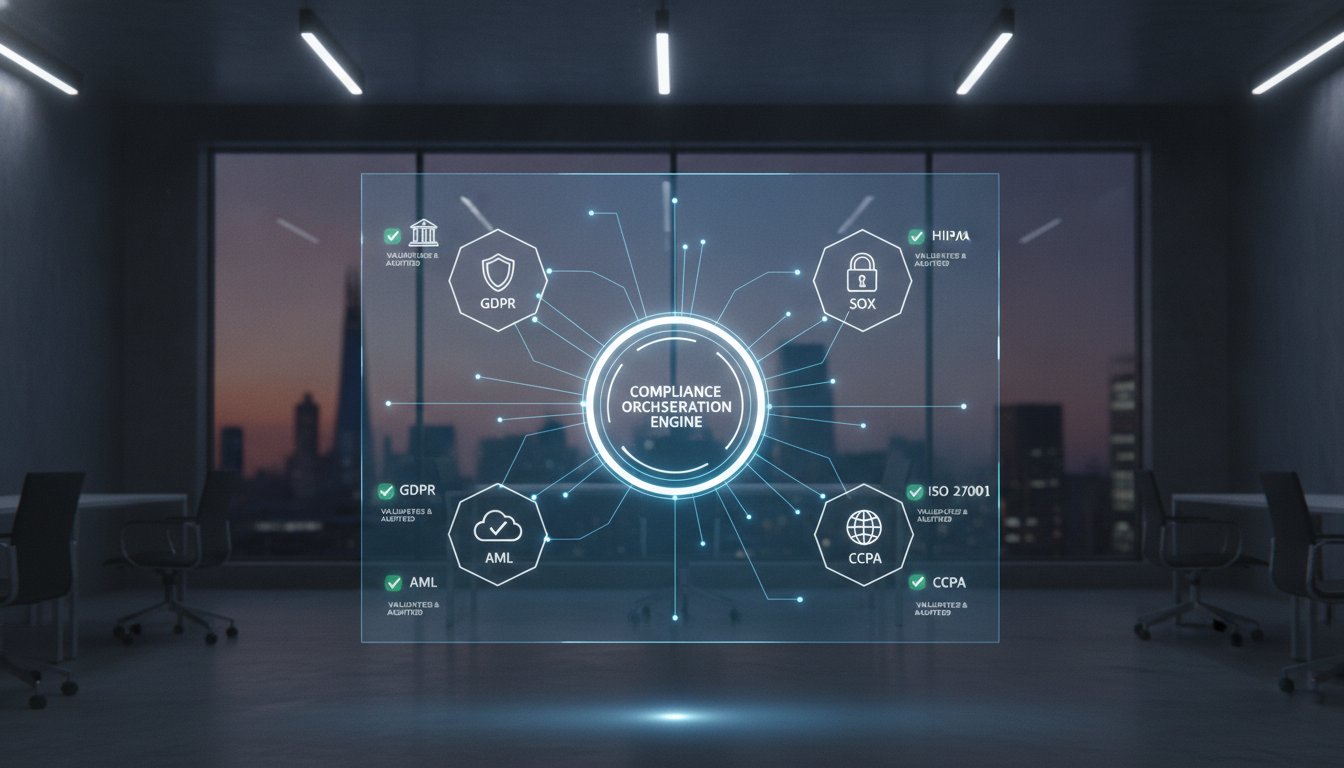
Your spreadsheet-based tracking isn't a safety net; it's a liability that will fail under the scrutiny of 2026 regulatory standards. You've likely spent hundreds of hours manually reconstructing evidence for auditors, only to find that your proof lacks the deterministic rigour required by DORA or the UK's Cyber Security and Resilience Bill. It's an exhausting cycle of administrative box-ticking that leaves boards blind to the actual state of organisational resilience. You know that tracking a task in Jira isn't the same as proving a control is active, and this gap between documentation and reality is where significant regulatory risk lives.
This article demonstrates how a compliance orchestration engine replaces fragmented manual processes with an audit-defensible system that turns abstract obligations into proven operational reality. You'll learn how to move beyond passive GRC tools to an active framework that enforces discipline by design. We'll explore the transition from reactive evidence gathering to a state of continuous, auditable certainty that provides leadership with the real-time visibility they demand. It's time to stop tracking compliance and start orchestrating it.
Key Takeaways
- Understand why UK regulators in 2026 reject manual spreadsheets as insufficient evidence of operational resilience and cyber security.
- Discover how a compliance orchestration engine bridges the gap between abstract regulatory obligations and concrete, executable activities.
- Learn to leverage a taxonomy of over 1,355 controls to implement the "Assess Once, Report Many" methodology across DORA, NIS2, and ISO 27001.
- Identify the critical architecture required to integrate evidence from your existing security stack into a unified, audit-defensible view.
- Shift your organisational focus from passive administrative tracking to a deterministic model of auditable certainty for the board.
Table of Contents
- What is a Compliance Orchestration Engine? Defining the New Standard
- The Architecture of Orchestration: How the Engine Drives Execution
- Orchestration vs. Manual Trackers: Why Spreadsheets are an Audit Risk
- Strategic Implementation: Orchestrating DORA, NIS2, and ISO 27001
- CWORT: The Enterprise Engine for Auditable Assurance
What is a Compliance Orchestration Engine? Defining the New Standard
A compliance orchestration engine is not merely a digital filing cabinet for regulatory certificates. It is a centralised system that translates abstract, high-level obligations into structured, executable activities across an enterprise. Whilst traditional methods rely on manual interpretation, orchestration enforces a deterministic link between a regulatory requirement and the technical evidence of its execution. This evolution represents a critical branch of Regulatory technology (RegTech), shifting the focus from administrative oversight to operational validation.
Modern UK regulators, such as Ofgem and the NCSC, have moved beyond accepting "compliance theatre"-the superficial performance of adherence through policy documents. They now demand definitive proof of operational reality. An orchestration engine, such as the platform provided by CWORT, provides this by creating a single source of truth for the cyber-security operating model. This ensures that every control is not just documented but actively verified, replacing the anxiety of "what if" with the auditable certainty of "what is."
The Core Components of Regulatory Orchestration
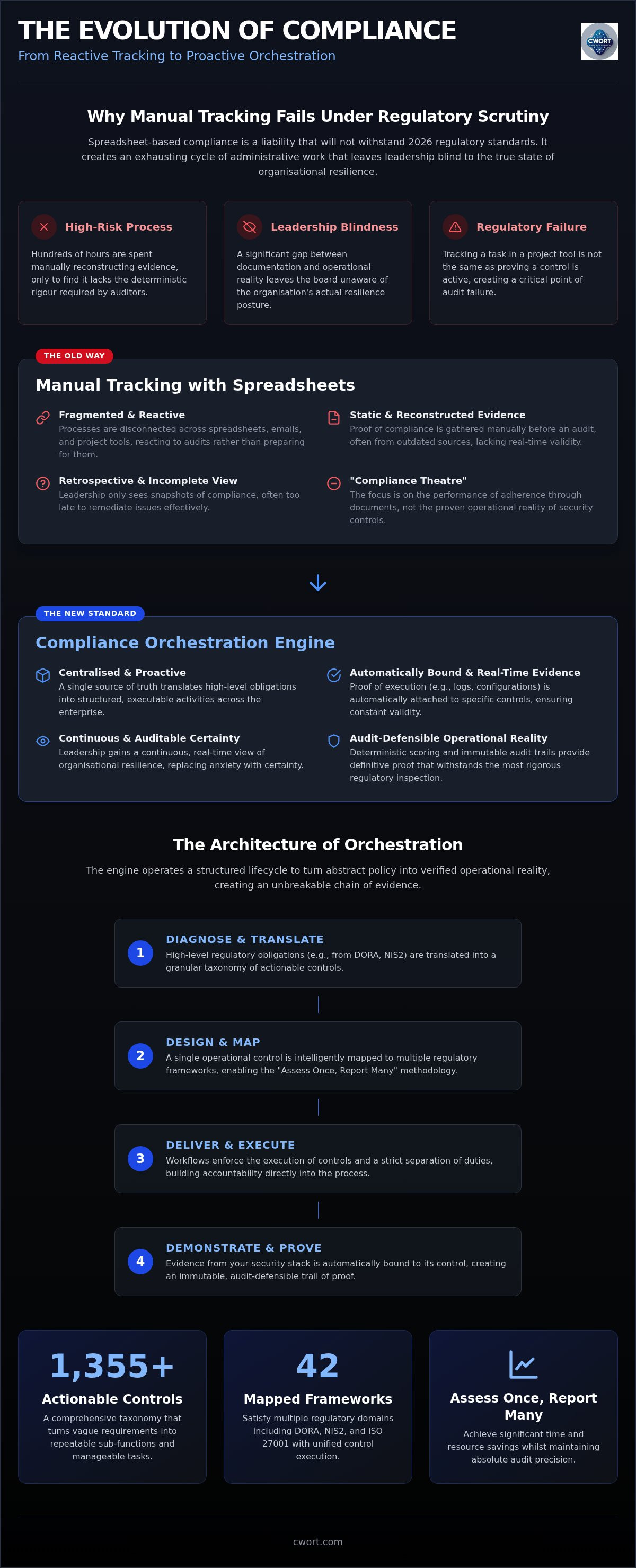
Effective orchestration relies on three pillars that transform passive data into active assurance. Control mapping allows organisations to link a single operational action to multiple regulatory frameworks simultaneously, such as DORA and ISO 27001. Evidence binding then automatically attaches proof of execution, such as logs or system configurations, directly to specific control outcomes. Finally, the system enforces a strict separation of duties within the workflow itself. This ensures that accountability is built into the process by design, rather than being a retrospective claim in a policy manual.
Orchestration vs. Traditional GRC Tools
Traditional GRC platforms often become data graveyards for static information and outdated spreadsheets. They record risks but rarely manage the active execution of the controls intended to mitigate them. Transitioning to a compliance orchestration engine represents a move from snapshots to real-time visibility. Instead of a frantic scramble to reconstruct evidence before an audit, leadership gains a continuous view of organisational resilience. This active management ensures that compliance is a constant state of being, not an annual event triggered by a looming deadline.
The Architecture of Orchestration: How the Engine Drives Execution
The architecture of a compliance orchestration engine acts as a command-and-control layer sitting above the existing security stack. It consumes raw evidence from SIEM, IAM, and vulnerability management tools to present a unified view of operational health. This system follows a structured lifecycle: Diagnose, Design, Deliver, and Demonstrate. By operating within a single digital environment, enterprises move away from fragmented point-tool analysis toward a holistic, defensible model of resilience. This structural integrity ensures that every control is not just a policy but a verified operational reality.
Translating Obligations into Actionable Activities
High-level regulations like DORA or NIS2 are often too abstract for service owners to execute effectively. The engine addresses this by translating these obligations into a taxonomy of over 1,355 controls mapped across 42 frameworks. This granularity turns vague requirements into repeatable sub-functions and manageable tasks. It establishes a common language for maturity that technical teams and executive leadership both understand. This "assess once, report many" efficiency ensures that one validated action satisfies multiple regulatory domains, saving significant time and resource whilst maintaining absolute precision.
Evidence Integrity and Deterministic Scoring
Audit defensibility requires deterministic results where identical evidence always yields the same compliance score. The engine maintains this rigour through immutable audit trails that prove control effectiveness without ambiguity. Evidence binding is the immutable link between a control activity and its auditable proof. While AI advisory components can identify remediation gaps or suggest improvements, they don't interfere with the reproducible scoring model. This creates a state of auditable certainty that withstands the most rigorous regulatory inspections. Organisations looking to modernise their approach can see the engine in action to understand how these layers integrate.
Orchestration vs. Manual Trackers: Why Spreadsheets are an Audit Risk
Relying on legacy spreadsheets to manage complex regulatory requirements is no longer a viable strategy; it's an operational hazard. Manual tracking introduces a hidden tax on your organisation through version control conflicts, administrative fatigue, and fragmented data silos. Whilst an Excel sheet might record that a control exists, it provides no structural link to the evidence required to prove its effectiveness. This disconnect creates a state of perpetual anxiety, where the true status of your resilience is only "discovered" during the frantic, manual reconstruction of evidence ahead of an audit. By 2026, UK regulators have made it clear that point-in-time snapshots are insufficient proof of a robust cyber-security operating model.
The common trend of "Jira-fication"-using task management tools to track compliance-similarly fails the test of rigorous governance. Jira is designed for workflow velocity, not for the deterministic validation required by DORA or the UK NIS regulations. It lacks the inherent capability to bind evidence to outcomes or enforce the strict separation of duties that auditors demand. A compliance orchestration engine bridges this gap, moving beyond task tracking to provide a system of record that is both active and defensible. It ensures that every action taken at the operational level translates directly into board-level assurance.
The Failure of Fragmented Tooling
Data silos are the enemy of audit readiness. When evidence is scattered across disparate systems, proving ensuring compliance evidence integrity becomes a monumental manual task. This fragmentation prevents a holistic view of organisational maturity, leaving leadership blind to systemic gaps until they manifest as a failure. Manual reconstruction is not just slow; it's prone to error and lacks the traceability required for modern validation. An orchestration engine eliminates these silos by centralising the validation process, ensuring that evidence is captured, bound, and verified in real-time as part of the standard workflow.
Regulator Expectations in 2026
Regulators in 2026, including the NCSC and financial authorities, have shifted their focus toward "explainability" and real-time capacity. They expect board-ready reports that demonstrate not just what you plan to do, but what you have actually achieved. A compliance orchestration engine provides this by delivering a deterministic view of your resilience posture. It replaces the "check-box" mentality with a system that proves capability through reproducible data. This transition provides senior leadership with the calm of auditable certainty, knowing that their regulatory obligations are being met through a disciplined, systematic approach rather than administrative guesswork.
Strategic Implementation: Orchestrating DORA, NIS2, and ISO 27001
Implementing a compliance orchestration engine requires a disciplined transition from fragmented manual tracking to a unified, executable framework. This process begins with mapping current capabilities against a comprehensive taxonomy library of 1,355+ controls. By identifying where existing activities align with regulatory requirements, organisations establish a baseline of operational reality. Once mapped, leadership must design a target operating model that highlights critical remediation gaps. This stage is vital for prioritising resource allocation towards the most significant areas of non-compliance, ensuring that efforts are directed where they provide the greatest risk reduction.
Execution relies on clear accountability. Assign ownership for every control and enforce a strict separation of duties across the organisation to meet the governance standards expected by UK regulators. The engine then automates evidence capture by integrating directly with your security tooling, such as SIEM and IAM platforms. This removes the burden of manual collection and ensures that proof of compliance is generated as a natural byproduct of daily operations. Finally, the system produces regulator-ready outputs and maturity heat-maps. These visualisations provide the board with an objective, data-driven view of organisational resilience that is both reproducible and defensible.
Specific Focus: DORA and NIS2 Readiness
For financial institutions, orchestrating ICT risk management and incident reporting is no longer optional under the Digital Operational Resilience Act. A structured approach to DORA compliance validation ensures that every technical requirement is linked to a specific, auditable action. Similarly, organisations managing critical national infrastructure must meet the stringent resilience mandates of NIS2 and the UK Cyber Security and Resilience Bill. Orchestration allows these entities to manage complex supply chain risks and incident notification timelines through a single, disciplined interface, replacing fragmented spreadsheets with a rigorous system of record.
Continuous Monitoring and Reassessment
Compliance is a recurring cycle of validation rather than a one-time project. Organisations must leverage maturity assessments to drive continuous improvement across their cyber-security functions, ensuring that resilience evolves alongside the threat landscape. By using framework cross-walks, enterprises maintain ISO 27001:2022 readiness whilst simultaneously meeting new statutory obligations like NIS2. This "assess once, report many" methodology prevents duplication of effort and ensures that your regulatory posture remains current. To begin modernising your validation process, request a demo of the orchestration engine and see how it transforms abstract duties into proven reality.
CWORT: The Enterprise Engine for Auditable Assurance
CWORT provides the definitive orchestration layer for UK enterprises seeking absolute auditable assurance. It sits above your existing security stack, consuming data from disparate tools to present a unified, board-ready view of maturity. The "Assess Once, Report Many" methodology allows organisations to satisfy multiple regulatory demands through a single validation event. This efficiency is essential for firms managing the overlapping requirements of DORA, NIS2, and the UK Cyber Security and Resilience Bill. By centralising these efforts, a compliance orchestration engine transforms compliance from a fragmented burden into a streamlined operational reality.
Protection of intellectual property remains a core design principle within the platform. Through the Bring Your Own Content (BYOC) capability, enterprises can integrate their proprietary control sets and internal standards without compromising data security. This ensures that your unique organisational intelligence remains a private asset whilst benefiting from a rigorous validation framework. Leadership gains access to maturity reports that translate technical execution into strategic insight. These visualisations are vital for securing investment and prioritising risk mitigation based on objective, reproducible data rather than subjective guesswork.
Why CWORT is the Strategic Choice for 2026
Success in a high-stakes regulatory environment requires precision. CWORT offers proven coverage across 217 domains and sub-functions, with 98.6% of active controls carrying direct framework references. This depth is particularly valuable for entities using NCSC CAF assessment software to meet critical infrastructure standards. Every outcome is driven by deterministic scoring, ensuring that your compliance proof is always audit-defensible and reproducible. It replaces the anxiety of manual reconstruction with the calm of a system that enforces discipline by design.
Getting Started with Compliance Orchestration
Initiate your transition through a rapid document-to-assessment conversion process. This provides immediate insight into your current resilience posture without the need for lengthy manual mapping. Move away from static trackers and adopt a governed, reusable model for long-term operational intelligence. This approach ensures that every validation activity builds a cumulative record of assurance that strengthens over time. To secure your organisation's regulatory future, request a demo to see the CWORT compliance orchestration engine in action and move from passive tracking to active validation.
Securing Auditable Certainty in a Complex Regulatory Landscape
Transitioning from passive tracking to active validation is no longer a strategic choice; it's a regulatory necessity for 2026. You've seen how manual spreadsheets create unacceptable risks and how a compliance orchestration engine binds evidence directly to outcomes. By leveraging a taxonomy of 1,355 controls mapped across 42 frameworks, your organisation can finally achieve the "Assess Once, Report Many" efficiency required for DORA and NIS2. With 98.6% of active controls carrying direct framework references, you replace administrative guesswork with definitive, evidence-based proof.
Our deterministic, reproducible scoring model ensures your compliance posture is always audit-defensible. This system doesn't just record activity; it enforces discipline and accountability by design. It's time to provide your board with the real-time visibility they demand whilst securing your operational resilience. Request a demo of the CWORT compliance orchestration engine to transform your regulatory obligations into a proven operational reality. You can move forward with the confidence that your resilience is not just claimed, but validated.
Frequently Asked Questions
What is a compliance orchestration engine and how does it differ from GRC?
A compliance orchestration engine is an active system of execution, whilst GRC tools often act as passive trackers. Traditional GRC platforms function as data repositories for risk recording and policy documentation. In contrast, an orchestration engine translates abstract obligations into executable tasks and binds evidence to outcomes in real-time. This shift ensures that compliance is a verified operational reality, enforcing discipline by design rather than relying on manual administrative exercises.
Can a compliance orchestration engine replace our existing security tools?
No, it functions as a strategic layer that sits above your existing security stack. It integrates with tools like SIEM, IAM, and vulnerability scanners to consume raw evidence. Instead of replacing these point-tools, the engine centralises their outputs into a unified, audit-defensible view. This creates a single source of truth for the board, ensuring technical data from various systems is validated against specific regulatory controls and frameworks.
How does orchestration help with DORA and NIS2 compliance?
Orchestration manages complex cross-framework requirements by mapping a single activity to multiple regulatory domains simultaneously. This "Assess Once, Report Many" capability is vital for UK firms facing the Digital Operational Resilience Act and the Cyber Security and Resilience Bill. The engine breaks down abstract legislation into a taxonomy of 1,355 controls, ensuring that ICT risk management and incident reporting activities are consistently executed, documented, and auditable.
Is it possible to use our own maturity models within the engine?
Yes, the platform supports Bring Your Own Content (BYOC) maturity assessments. This allows enterprises to integrate proprietary maturity models or internal standards directly into the orchestration workflow. It protects your organisational intellectual property whilst providing the same deterministic scoring and validation rigour applied to standard frameworks like ISO 27001 or the NCSC CAF. This flexibility ensures the system aligns perfectly with your specific operational needs and governance requirements.
How does the engine ensure separation of duties during compliance execution?
The engine enforces separation of duties by building it directly into the digital workflow. It requires that the person executing a control activity is different from the individual validating the evidence. This isn't just a policy claim; it's a structural enforcement that prevents conflicts of interest. By automating this governance, the system provides auditors with definitive proof that accountability and oversight are inherent to the process by design.
What kind of evidence is required for a deterministic compliance score?
A deterministic score requires objective, reproducible evidence such as system logs, configuration files, or timestamped reports from security tools. The engine binds this proof to specific control outcomes to ensure that identical evidence always yields the same result. This eliminates the subjectivity often found in manual assessments. Such rigour is essential for creating an audit-defensible record that withstands the scrutiny of regulators like the NCSC or Ofgem.
How long does it take to implement a compliance orchestration engine?
Implementation typically begins with a rapid document-to-assessment conversion process, providing immediate visibility into maturity gaps. Whilst full enterprise-wide deployment depends on the complexity of your security stack, the compliance orchestration engine is designed for quick integration. Most organisations start seeing value within weeks as they move from fragmented spreadsheets to a governed, reusable model. This phased approach ensures a smooth transition from obligation to proven operational reality.
Does the system provide board-level reporting for cyber resilience?
Yes, the engine generates real-time maturity heat-maps and regulator-ready reports for senior leadership. These visualisations translate granular technical execution into strategic insights that the board can use to prioritise risk and investment. Instead of retrospective audit snapshots, leadership gains a continuous, data-driven view of organisational resilience. This transparency provides the auditable certainty needed to satisfy both internal governance standards and external statutory mandates across the United Kingdom.
Disclaimer
The content on this site is provided for general information and educational purposes only. It does not constitute legal, regulatory, financial, or professional advice. CWORT provides AI-assisted insights and workflow automation, but all compliance decisions remain the responsibility of your organisation and its management. Always seek qualified legal or regulatory guidance for decisions relating to the UK NIS Regulations, CAF, DORA, NIS2, ISO 27001, or other obligations.
Related posts
The Shift to Compliance Orchestration Platforms: Beyond Enterprise GRC Automation
Struggling with DORA & NIS2? Move beyond failing GRC tools with a compliance orchestration platform for automated, auditor-ready evidence and real-time overs...
Auditable Compliance Proof Software: A Strategic Guide to Regulatory Validation in 2026
Stop documenting history and start managing risk. Our guide to defensible compliance evidence software prepares your organisation for tough 2026 regulatory a...
Regulatory Compliance Workflow Automation for UK Enterprise: A Strategic Guide
Ditch spreadsheets for DORA & NIS2. Our guide to regulatory compliance workflow automation delivers auditable certainty and board-level assurance for UK ente...
Article by
Michael Iyiola
Co-Founder, CWORT
Michael Iyiola is a co-founder of CWORT and a Cyber and AI Security Engineer with deep experience in vulnerability management, detection engineering and operational resilience across UK critical national infrastructure, including rail, energy and financial services. At CWORT, he designs scalable, evidence-driven workflows that help teams meet modern regulatory and security demands.
Build Your Foundation of Auditable Certainty
Take control of your regulatory obligations and secure your infrastructure with CWORT.