Enterprise GRC Platform Alternatives for UK SMEs: A 2026 Strategic Guide

Michael Iyiola
Co-Founder, CWORT
Discover enterprise GRC platform alternatives UK SMEs can trust. Replace audit anxiety with evidence-based compliance across DORA, NIS2 & NCSC CAF in 2026.

Most enterprise GRC platforms are little more than expensive filing cabinets that consume headcount without producing certainty. For UK SMEs, the reality of managing complex frameworks like NIS2 or DORA often descends into a fragmented mess of Excel spreadsheets and Jira tickets. You likely feel the constant pressure of audit anxiety, knowing that your current tools require a full-time administrator just to keep the lights on whilst failing to provide actual proof of control effectiveness. Transitioning to enterprise GRC platform alternatives UK organisations can actually trust requires a fundamental shift from passive tracking to active, evidence-based orchestration.
It's time to stop treating compliance as an administrative "black hole" and start treating it as a deterministic system. This guide reveals why traditional models fail and how to implement a reproducible, audit-defensible assurance system that reduces manual work. We will outline a strategic path to board-ready reporting that proves control effectiveness using the NCSC CAF and DORA frameworks. By moving to a model that binds evidence directly to outcomes, you can replace regulatory fear with the calm of auditable certainty.
Key Takeaways
- Identify why legacy GRC platforms often increase headcount requirements and fail to map effectively to UK-specific frameworks like the NCSC CAF.
- Master the "assess once, report many" philosophy to streamline compliance across DORA, NIS2, and ISO 27001 without redundant manual effort.
- Compare the leading enterprise GRC platform alternatives UK to find a solution that balances technical depth with operational efficiency.
- Establish a deterministic evidence-collection process that integrates with your existing security tools to ensure audit-defensible results.
- Transform your compliance programme from an administrative cost centre into a strategic asset through board-ready reporting and control orchestration.
Table of Contents
- Beyond Legacy GRC: Why UK SMEs are Seeking Alternatives in 2026
- Compliance Orchestration: The Strategic Alternative to Administrative GRC
- Evaluating Leading GRC Alternatives in the UK Market
- How to Select a GRC Alternative for DORA and NIS2 Compliance
- CWORT: The Deterministic Alternative for Auditable Validation
Beyond Legacy GRC: Why UK SMEs are Seeking Alternatives in 2026
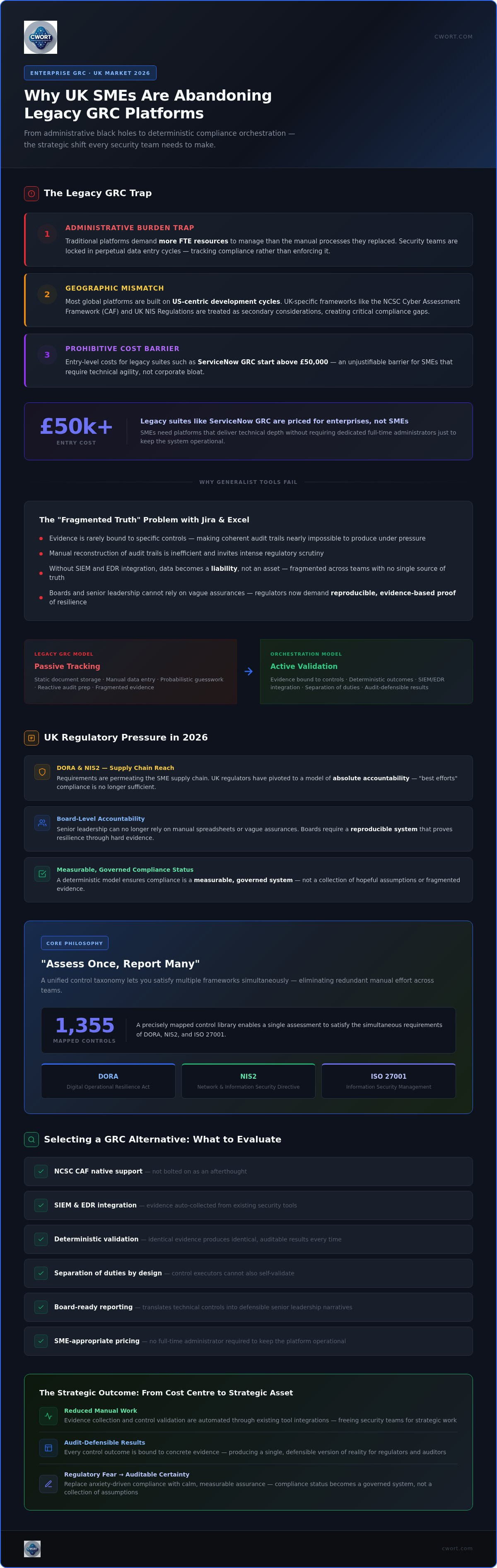
Traditional enterprise GRC platforms often transform into the very administrative burden they promised to solve. For UK SMEs, these systems frequently demand more full-time equivalent (FTE) resources to manage than the manual processes they were intended to replace. This "Administrative Burden" trap forces security teams into a perpetual cycle of data entry whilst providing little actual insight into control effectiveness. When evaluating enterprise GRC platform alternatives UK, the goal must shift from simple tracking to active, deterministic validation. You don't need another repository for static documents; you need an orchestration engine that enforces accountability by design.
The geographic mismatch remains a critical failure point for most legacy tools. Most global platforms originate from US-centric development cycles, treating UK-specific requirements like the NCSC Cyber Assessment Framework (CAF) or the UK NIS regulations as secondary considerations. Forcing UK obligations into US templates creates significant compliance gaps and increases the risk of regulatory failure. Additionally, the financial barrier is often insurmountable. Entry-level costs for legacy suites like ServiceNow GRC frequently start above £50,000, which is an unjustifiable expense for SMEs requiring technical agility over corporate bloat. True alternatives represent a fundamental shift from passive risk registers to active compliance orchestration that binds evidence directly to regulatory outcomes.
The Failure of Generalist GRC Tools
Don't mistake general productivity tools for auditable compliance systems. Relying on Jira or Excel for DORA or NIS2 compliance is a strategic risk that creates a "fragmented truth" across the organisation. In these environments, evidence is rarely bound to specific controls, making it nearly impossible to produce a coherent audit trail under pressure. Manual reconstruction of these trails is not only inefficient but also invites intense regulatory scrutiny. Without a system designed for orchestration, your data remains a liability. You need a platform that consumes data from your existing SIEM and EDR tools to provide a single, defensible version of reality.
Regulatory Pressure in the UK Market
The regulatory landscape in 2026 demands more than just "best efforts" compliance. As DORA and NIS2 requirements permeate the SME supply chain, UK regulators have pivoted towards a model of absolute accountability. Senior leadership can no longer rely on vague assurances or manual spreadsheets; they require a reproducible system that proves resilience through hard evidence. Boards demand defensible reality to protect the organisation from the consequences of fragmented oversight. Transitioning to a deterministic model ensures that your compliance status is a measurable, governed system rather than a collection of hopeful assumptions.
Compliance Orchestration: The Strategic Alternative to Administrative GRC
Compliance shouldn't be a task to be tracked; it's a process to be enforced. Whilst legacy systems focus on the passive storage of documents, compliance orchestration focuses on the active execution of regulatory obligations. This shift is fundamental for organisations moving away from high-maintenance administrative tools. As you evaluate enterprise GRC platform alternatives UK, the transition from probabilistic guesswork to deterministic validation is non-negotiable. You need a system where identical evidence consistently produces identical results, removing the subjectivity that often triggers regulatory red flags.
The "Assess Once, Report Many" philosophy is the cornerstone of this strategic alternative. By utilising a unified taxonomy, such as a library of 1,355 precisely mapped controls, you can satisfy the requirements of DORA, NIS2, and ISO 27001 simultaneously. This approach eliminates the redundant manual work that plagues fragmented organisations. It bridges the gap between technical cyber-security functions and board-level operating models, providing a single, defensible version of reality that senior leadership can trust. To see how this model functions in practice, you can request a demonstration of a deterministic orchestration system.
From Passive Tracking to Active Validation
Orchestration enforces a rigorous "separation of duties" by design. It ensures that those responsible for executing a control are not the same individuals validating its effectiveness. By binding evidence directly to specific regulatory obligations, the system creates an immutable audit history. This isn't about periodic check-box exercises; it's about continuous operating model intelligence. You move from a state of "hoping" the controls work to "knowing" they do because the evidence is structurally linked to the outcome.
The Lifecycle of Modern Compliance
A mature orchestration model follows a disciplined four-stage lifecycle:
- Diagnose: Use UK-specific framework cross-walks to identify exact compliance gaps across DORA or the NCSC CAF.
- Design: Build target operating models that align with regulator expectations and organisational goals.
- Deliver: Execute control activities within a structured system that enforces accountability at every level.
- Demonstrate: Generate board-ready maturity reports that prove execution through auditable evidence rather than narrative claims.
This systematic progression ensures that every regulatory obligation is accounted for, designed for, and ultimately proven. It replaces the anxiety of potential failure with the calm of structural integrity. When enterprise GRC platform alternatives UK are selected based on their ability to orchestrate these stages, the result is a resilient and defensible governance posture.
Evaluating Leading GRC Alternatives in the UK Market
Selecting a governance model requires a clear understanding of the three distinct tiers currently available in the market. Most SMEs find themselves caught between bloated legacy suites and superficial automation tools that fail to meet the rigor of UK regulators. Navigating enterprise GRC platform alternatives UK organisations can trust involves weighing technical depth against operational overhead. You must choose a system that matches your specific regulatory obligations without becoming a permanent drain on your internal resources.
Tier 1 consists of heavy enterprise suites like ServiceNow and RSA Archer. These are designed for global conglomerates with massive compliance departments and nearly infinite budgets. For an SME, they are often overkill, requiring significant professional implementation fees and a dedicated GRC Manager just to maintain the software. Tier 2 features high-velocity compliance automation platforms. Whilst these are effective for basic SOC2 or Cyber Essentials readiness, they often lack the deterministic depth required for DORA or NCSC CAF. Tier 3 represents the strategic "Goldilocks" solution: Validation and Orchestration platforms. These systems provide the rigor of an enterprise suite whilst maintaining the agility of a modern technical tool, specifically engineered for the UK regulatory landscape.
Comparing Deployment and Resource Requirements
Hidden costs often lurk within professional implementation fees for legacy GRC platforms. These can easily double the initial software price and extend onboarding timelines to six months or more. Your alternative should offer a clear "pilot-to-production" path that delivers value in weeks, not quarters. Evaluate whether the tool requires a dedicated administrator or if it can be managed by your existing security and operations teams. A truly effective system reduces headcount demands by automating the evidence-collection process and enforcing accountability by design.
The Importance of Framework Coverage
Examine the depth of the control taxonomy library before committing to a platform. A robust system should offer at least 1,000+ precisely mapped controls to ensure comprehensive coverage across DORA, NIS2, and ISO 27001. For organisations in the critical national infrastructure sector, support for OT/ICS environments is a non-negotiable requirement. Furthermore, ensure that any integrated AI functions as an advisory tool rather than a deterministic decision-maker. AI should assist your team in mapping evidence, but the final validation must remain a human-governed process to satisfy auditors and maintain structural integrity.
How to Select a GRC Alternative for DORA and NIS2 Compliance
Selecting enterprise GRC platform alternatives UK organisations can rely on requires a move beyond superficial feature lists. You must evaluate a platform based on its ability to handle the rigorous "Operating Model" requirements mandated by DORA and NIS2. This isn't merely about data residency; it's about the structural integrity of your governance system. Start by mapping your specific regulatory obligations, such as DORA ICT risk management or NIS2 Article 21, directly to your control environment. A platform that cannot consume data from your existing SIEM, EDR, and IAM tools will inevitably become a manual data-entry burden rather than a strategic asset.
Test every prospective vendor for "Determinism" to ensure your compliance scores are based on objective evidence rather than subjective opinion. Ask whether identical evidence consistently yields the same maturity score across different assessments. You must also verify that the platform enforces a strict "Separation of Duties" by design, preventing the same user from both performing and validating a control. Finally, review the board-level outputs. Your leadership team requires explainable heat-maps and maturity reports that provide a defensible reality of the organisation's resilience. To secure this level of auditable certainty, you should book a platform walkthrough to evaluate these orchestration capabilities firsthand.
DORA-Specific Evaluation Criteria
Effective DORA compliance requires more than a risk register; it demands a system for validating ICT third-party risk management workflows. You must be able to prove operational resilience through reproducible assessment blueprints that auditors can verify. This level of rigor ensures that your resilience claims are backed by hard data rather than narrative promises. For a deeper dive into these requirements, consult our DORA Compliance Validation Guide.
NIS2 and UK NIS Alignment
Aligning with NIS2 and the UK NIS regulations requires mapping NCSC CAF maturity directly to international standards like ISO 27001. Your platform should automate incident early warning notifications for UK regulators to ensure you meet strict reporting deadlines. This systematic approach replaces fragmented tracking with a unified governance model that satisfies both domestic and international requirements. Explore how to centralise these obligations with a NIS2 Compliance Platform UK solution designed for technical depth.
By focusing on these specific criteria, you move from passive administration to active orchestration. This ensures your compliance posture remains resilient, defensible, and fully aligned with the expectations of UK regulators in 2026.
CWORT: The Deterministic Alternative for Auditable Validation
CWORT represents the final evolution in the search for enterprise GRC platform alternatives UK leaders can implement with total confidence. Unlike generalist tools that merely track tasks, CWORT functions as a deterministic orchestration engine designed specifically for the UK regulatory climate. It shifts the focus from administrative maintenance to Operating Model Intelligence, turning cyber-security into a measurable and governed system. By utilising a library of 1,355 precisely mapped controls, the platform enables an "assess once, report many" capability that supports 42+ frameworks, including the NCSC CAF and Ofgem requirements.
Fragmented Jira tickets and scattered spreadsheets are replaced by a single, governed digital environment. This creates immutable audit trails where evidence is structurally bound to specific regulatory outcomes. This level of rigor ensures that every control activity is traceable, defensible, and fully aligned with the expectations of auditors. It provides the structural integrity that legacy platforms promise but rarely deliver to the SME market. It is the proactive system that enforces discipline and accountability by design.
Turning Intellectual Property into Action
For UK consultancies and enterprises with established methodologies, the BYOC (Bring Your Own Content) capability is a critical differentiator. It allows organisations to upload bespoke maturity models and proprietary assessment criteria directly into the orchestration engine. This protects your unique intellectual property whilst ensuring it is applied with mechanical consistency across the organisation. By integrating regulatory compliance workflow automation, you transform abstract expertise into a repeatable, high-velocity validation process.
Board-Ready Maturity and Assurance
Senior leadership requires more than a status update; they need definitive proof of resilience. CWORT generates regulator-ready evidence registers without the need for manual reconstruction or frantic data gathering before an audit. Heat-map dashboards provide risk committees with an uncompromisingly objective view of control maturity and operational gaps. This transition from GRC administration to strategic cyber resilience allows the board to make informed decisions based on defensible reality. It replaces the anxiety of the unknown with the calm of auditable certainty.
Securing Your Regulatory Future with Deterministic Orchestration
Transitioning from passive tracking to active orchestration is the only way to survive the 2026 regulatory landscape. You've seen how legacy tools create administrative "black holes" whilst failing to provide the definitive evidence UK regulators demand. By adopting enterprise GRC platform alternatives UK organisations can actually operationalise, you move from fragmented spreadsheets to a unified, deterministic system. Utilising a taxonomy of 1,355 precisely mapped controls ensures you meet DORA, NIS2, and UK NIS requirements with a single, reproducible workflow that satisfies both auditors and senior leadership.
It's time to replace audit anxiety with the calm of structural integrity. You can prove your control effectiveness and generate board-ready reports without the manual overhead of traditional GRC suites. Take the first step toward a resilient operating model today. Request a CWORT Pilot to Validate Your Compliance Operating Model and experience the power of auditable certainty firsthand. Your path to defensible compliance starts with a system designed for execution, accountability, and professional maturity.
Frequently Asked Questions
What is the best alternative to ServiceNow GRC for a UK-based SME?
CWORT stands as the definitive alternative to ServiceNow GRC for UK SMEs seeking technical agility without the enterprise bloat. Whilst legacy platforms demand extensive professional services and dedicated managers, CWORT provides a deterministic orchestration engine that delivers results in weeks. It is specifically engineered to meet the gravity of the UK regulatory environment, offering a more efficient and cost-effective path to auditable certainty for organisations with limited headcount.
How does a compliance orchestration platform differ from a traditional GRC tool?
Traditional GRC tools act as passive repositories for static documents and narrative claims. Compliance orchestration represents a shift to active enforcement where evidence is structurally bound to regulatory outcomes. It enforces a rigorous separation of duties by design, ensuring that control execution and validation are distinct processes. This model replaces fragmented tracking with a measurable, governed system that proves resilience through hard data rather than optimistic self-assessments.
Can I use CWORT to manage DORA and NIS2 compliance simultaneously?
You can manage DORA, NIS2, and ISO 27001 simultaneously within the CWORT environment. The platform utilises an "assess once, report many" engine powered by a library of 1,355 precisely mapped controls. This unified taxonomy allows you to satisfy multiple regulatory obligations through a single evidence-collection process. It is a core reason why CWORT is the preferred choice amongst enterprise GRC platform alternatives UK firms implement to reduce manual work.
Why do UK regulators prefer deterministic compliance scores over manual assessments?
UK regulators prefer deterministic scores because they remove the subjectivity and optimism bias inherent in manual assessments. In a deterministic system, identical evidence must yield identical maturity scores, creating a reproducible and defensible audit trail. This level of rigor provides boards and regulators with a single version of reality. It replaces narrative promises with structural integrity, ensuring that compliance status is based on objective validation rather than individual interpretation.
Does CWORT support the NCSC Cyber Assessment Framework (CAF)?
CWORT provides native support for the NCSC Cyber Assessment Framework (CAF) and was designed with UK regulators in mind. The platform maps your existing control environment directly to CAF maturity indicators, allowing for rapid gap analysis and remediation planning. This alignment ensures that your governance posture meets the specific expectations of UK oversight bodies, such as Ofgem, whilst maintaining full compatibility with international standards like ISO 27001.
Is CWORT suitable for SMEs in the energy sector with OT/ICS environments?
The platform is specifically engineered for SMEs in the energy sector and other critical national infrastructure industries. It includes dedicated controls and maturity models for OT/ICS environments, ensuring that technical resilience is measured alongside corporate governance. This capability allows energy firms to manage the complex requirements of the UK NIS regulations whilst protecting their operational technology from emerging cyber threats through a unified, governed system.
How long does it take to implement a GRC alternative like CWORT?
Implementation typically takes weeks rather than the six to twelve months required by legacy enterprise suites. CWORT follows a disciplined "pilot-to-production" path that focuses on rapid evidence binding and control mapping. This accelerated timeline ensures that organisations can achieve audit readiness quickly without the need for extensive implementation fees. It is designed to integrate seamlessly with your existing SIEM, EDR, and IAM tools to provide immediate visibility.
Can I import my existing ISO 27001 control mappings into CWORT?
You can import your existing ISO 27001 control mappings and proprietary maturity models using the Bring Your Own Content (BYOC) capability. This feature allows you to protect your established intellectual property whilst benefiting from the platform's deterministic validation engine. Once imported, your custom content is cross-walked against the 1,355 controls in the taxonomy library, ensuring total alignment with DORA, NIS2, and other critical frameworks required for your sector.
Disclaimer
The content on this site is provided for general information and educational purposes only. It does not constitute legal, regulatory, financial, or professional advice. CWORT provides AI-assisted insights and workflow automation, but all compliance decisions remain the responsibility of your organisation and its management. Always seek qualified legal or regulatory guidance for decisions relating to the UK NIS Regulations, CAF, DORA, NIS2, ISO 27001, or other obligations.
Related posts
Streamlining Regulatory Compliance Processes: From Manual Tracking to Orchestrated Validation
Stop wasting money on manual compliance. Learn about streamlining regulatory compliance processes to reduce personal liability under DORA & NIS2 and gain aud...
Regulatory Compliance Workflow Automation for UK Enterprise: A Strategic Guide
Ditch spreadsheets for DORA & NIS2. Our guide to regulatory compliance workflow automation delivers auditable certainty and board-level assurance for UK ente...
Automated Compliance Status Reporting for the Board
Replace risky manual reports with automated compliance reporting. Learn to provide your board with real-time, defensible proof for DORA & NCSC CAF audits.
Article by
Michael Iyiola
Co-Founder, CWORT
Michael Iyiola is a co-founder of CWORT and a Cyber and AI Security Engineer with deep experience in vulnerability management, detection engineering and operational resilience across UK critical national infrastructure, including rail, energy and financial services. At CWORT, he designs scalable, evidence-driven workflows that help teams meet modern regulatory and security demands.
Build Your Foundation of Auditable Certainty
Take control of your regulatory obligations and secure your infrastructure with CWORT.