Evidence-Based Compliance: 2026 UK Strategic Guide

Michael Iyiola
Co-Founder, CWORT
Prepare for the 2026 UK NIS Bill. Learn how an evidence based compliance platform transforms manual tracking into auditable certainty for your organisation.

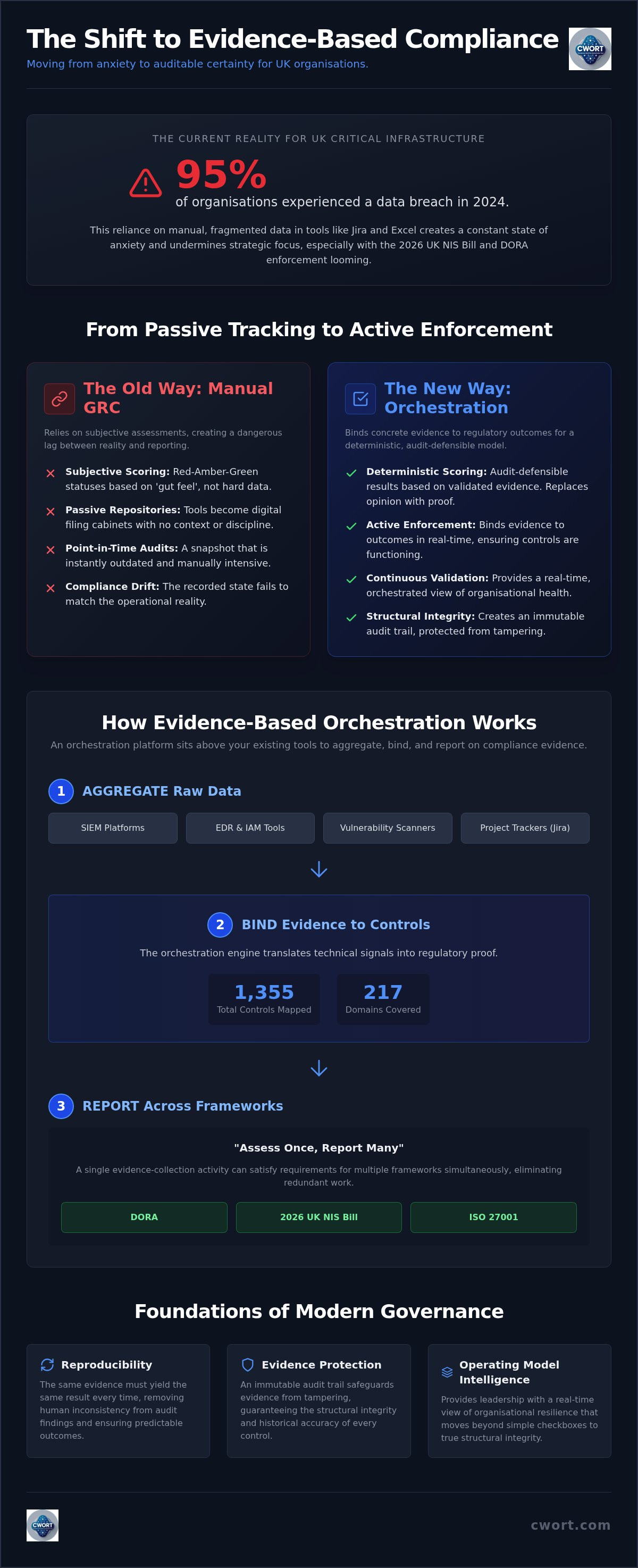
Your compliance posture isn't defined by the policies you've written; it's defined by the evidence you can actually produce under pressure. In a regulatory environment where the 2026 UK NIS Bill and DORA enforcement have removed the margin for error, relying on fragmented data in Jira or Excel is no longer a viable strategy for UK organisations. You likely feel the weight of this manual burden, especially when 95% of the UK's critical national infrastructure organisations experienced a data breach in 2024. Reconstructing audit trails for the board shouldn't be a source of persistent anxiety that undermines your strategic focus.
This guide demonstrates how to leverage an evidence based compliance platform to move beyond administrative tracking. You'll learn how to build a deterministic, audit-defensible operating model that binds concrete evidence directly to regulatory outcomes. We'll preview the shift towards a single, orchestrated view of compliance health, where regulator-ready outputs are generated automatically and scoring remains consistent across every framework you manage. It's time to replace the fear of failure with the calm of auditable certainty.
Key Takeaways
- Understand how an evidence based compliance platform transforms raw security data into deterministic, audit-defensible regulatory outcomes.
- Shift from manual, point-in-time audits to a model of continuous validation that provides a real-time view of your organisational health.
- Learn the mechanics of binding evidence from existing tools to specific controls, ensuring every claim is backed by rigorous, auditable proof.
- Discover why regulators like Ofgem and the NCSC require orchestrated validation rather than simple, black-box automation.
- Implement a structured operating model that allows you to assess once and report across multiple frameworks, including DORA and the 2026 UK NIS Bill.
Table of Contents
- What is an Evidence Based Compliance Platform?
- The Mechanics of Evidence Binding and Control Outcomes
- Compliance Automation vs. Evidence-Based Validation
- Implementing a Governed Compliance Operating Model
- CWORT: The Orchestration Engine for UK Regulatory Readiness
What is an Evidence Based Compliance Platform?
An evidence based compliance platform is not merely a digital filing cabinet for audit logs. It is a rigorous system that binds raw data directly to specific regulatory control outcomes. This approach mirrors the principles of evidence-based policy, where objective proof dictates decision-making rather than administrative assumptions. By 2026, the transition from "point-in-time" audits to continuous, validated assurance is no longer optional. Regulators demand a model where evidence is inseparable from the control it supports.
Reproducibility is the core of this architecture. If the same evidence is presented twice, it must yield the same result every time. This removes the human factor that often leads to inconsistent audit findings. This structural integrity creates what we call Operating Model Intelligence. It's the foundation of modern governance, providing leadership with a real-time view of organisational resilience that moves beyond simple checkboxes to true structural integrity.
The Shift from GRC to Compliance Orchestration
Traditional GRC tools often degrade into passive repositories. They store documents but fail to enforce discipline. They rely on manual uploads and retrospective updates, which creates a dangerous lag between reality and reporting. An orchestration engine like CWORT changes this by translating abstract obligations into concrete execution activities. It moves compliance from a static state to a dynamic, enforced process.
- Passive repositories: These tools store data without context, leading to compliance drift where the recorded state doesn't match the operational reality.
- Active enforcers: An orchestration engine binds evidence to outcomes in real-time, ensuring that controls are functioning as described.
- Operational efficiency: Orchestration reduces the compliance tax on technical teams whilst increasing rigour. It automates the collection of evidence from the tools your teams already use, such as Jira or SIEM platforms.
Deterministic vs. Subjective Scoring
Many organisations still rely on subjective red-amber-green (RAG) statuses. These are often based on a manager's gut feel rather than hard data. This creates significant risk during DORA or NIS2 audits because the status cannot be defended with data. CWORT’s deterministic model ensures audit-defensible results by requiring evidence validation before a status is updated. It replaces opinion with proof.
Reproducible scoring is the gold standard for 2026 audits, ensuring that compliance metrics are calculated through a fixed, transparent logic that remains consistent across all frameworks.
The Mechanics of Evidence Binding and Control Outcomes
Traditional security tools generate vast amounts of telemetry, yet they rarely provide the context required for a formal audit. An effective evidence based compliance platform does not replace your security stack. Instead, it sits above existing systems, aggregating raw data from SIEM, EDR, IAM, and vulnerability management tools to create a unified view of organisational health. This orchestration layer translates technical signals into regulatory proof, ensuring that every control is backed by a verifiable record.
The CWORT taxonomy library contains 1,355 controls mapped across 217 domains, providing a rigorous structure for data aggregation. This level of granularity ensures that technical evidence is never left floating in isolation. To maintain the highest standards of structural integrity, the platform employs an evidence protection layer. This safeguards the audit trail from tampering, ensuring that the history of every control remains immutable. This methodology aligns with the UK evidence-based regulatory framework, which prioritises objective proof as the foundation for high-stakes decision-making.
Mapping Controls to Multiple Frameworks
The modern regulatory landscape is fragmented, but your execution model shouldn't be. By adopting an "Assess Once, Report Many" philosophy, a single evidence-collection activity can satisfy requirements for DORA, NIS2, and ISO 27001 simultaneously. Utilising framework cross-walks eliminates redundant work whilst ensuring that no control is overlooked. For organisations looking to maintain these standards, Ensuring Compliance Evidence Integrity offers a blueprint for protecting the data that underpins your assurance register. This approach allows you to optimise your control mapping across diverging UK and EU standards.
Enforcing Separation of Duties (SoD)
Regulators, particularly under the DORA mandate, now demand explicit proof of Separation of Duties within compliance workflows. The platform enforces this accountability by design, preventing the dangerous practice of "self-marking" homework. By separating the roles of evidence providers, assessors, and approvers, the system ensures that every validation is objective and defensible. Immutable audit histories provide the necessary proof to the board that SoD was maintained throughout the entire compliance lifecycle, replacing trust with definitive validation. This level of rigour is essential for an evidence based compliance platform to remain audit-ready in 2026.
Compliance Automation vs. Evidence-Based Validation
Simple automation often promises a hands-off approach, but regulators in 2026 are increasingly wary of "black box" solutions. Whilst basic automation might pull data from various sources, an evidence based compliance platform focuses on orchestrated validation. This distinction is critical. Organisations like Ofgem and the NCSC require results that are not just automated but fully explainable. If a system cannot demonstrate exactly why a control passed or failed, it's a liability. Relying on an "autopilot" approach without contextual binding leads to the high-stakes risk of manual reconstruction during an audit. This creates a state of Corporate Governance in an Era of Compliance where leadership must have absolute certainty in the underlying data.
AI plays a specific role in this ecosystem. It serves as an advisory layer, highlighting anomalies or suggesting improvements. However, it must never alter deterministic outcomes. In a high-stakes environment, the final verdict on a control must remain grounded in hard evidence, not probabilistic AI guesses. This level of rigour is why an evidence based compliance platform is essential for modern boards. It ensures that the transition from obligation to evidence is transparent and defensible.
Why Spreadsheets and Jira Fall Short
Spreadsheets remain a primary source of audit failure. They suffer from version control issues and a complete lack of evidence binding. A cell in a spreadsheet is an assertion, not proof. Jira, whilst excellent for task management, is an execution tool rather than a compliance orchestration system. It tracks what people are doing but doesn't validate whether those actions met regulatory standards. Transitioning to a dedicated system is vital for Regulatory Compliance Workflow Automation for UK Enterprise. This move eliminates manual errors and ensures every activity is tied to a specific outcome.
Reproducibility: The Auditor’s Favourite Metric
In the context of a 2026 regulatory audit, reproducibility means an auditor can follow the logic from obligation to evidence and reach the same conclusion every time. Deterministic systems provide audit-ready outputs that require no manual cleanup. This speed is driven by precision. With 98.6% of active controls carrying direct framework references in the CWORT library, auditors can verify compliance posture in hours rather than weeks. This efficiency transforms the audit from a defensive struggle into a routine validation of an already-proven state.
Implementing a Governed Compliance Operating Model
Implementing a governed compliance operating model requires a shift from passive observation to active enforcement. To build a resilient posture, organisations must follow a structured, five-step progression that replaces administrative chaos with auditable certainty. This methodology ensures that compliance is a functioning operating model rather than a series of disconnected tasks.
- Step 1: Translate regulatory obligations into a structured control taxonomy, utilising the 1,355 controls available in the taxonomy library.
- Step 2: Configure the assessment blueprint and assign specific scope and owners to ensure clear accountability.
- Step 3: Capture responses and bind evidence to specific control outcomes within an evidence based compliance platform.
- Step 4: Calculate maturity and confidence levels using deterministic scoring to remove subjective bias.
- Step 5: Generate board-ready maturity reports and prioritise remediation based on real-time risk data.
Bring Your Own Content (BYOC) Maturity Assessments
Many organisations and consultancies possess proprietary maturity models that reflect their unique risk appetite or industry expertise. A high-calibre evidence based compliance platform allows you to import these models into a governed digital workflow. This Bring Your Own Content (BYOC) approach follows a rigorous seven-step process: blueprinting, scoping, assignment, execution, validation, calculation, and prioritisation. This allows you to maintain your intellectual property whilst leveraging standardised governance controls to enforce discipline. It transforms static documents into dynamic, auditable frameworks that stay consistent across the enterprise.
From Diagnosis to Demonstration
Moving from a state of uncertainty to total assurance involves a four-stage lifecycle: Diagnose, Design, Deliver, and Demonstrate. You begin by identifying gaps in your current posture and then design the necessary controls to close them. Once those controls are delivered, you must demonstrate their effectiveness through deterministic proof. Heat-map dashboards are essential during this final stage. They provide the visual clarity needed to communicate complex risk profiles to the board, turning technical data into strategic intelligence. If you are managing critical infrastructure, using specialised NCSC CAF Assessment Software ensures your demonstration phase meets the highest UK standards. To see how this operating model can be applied to your specific regulatory needs, you should request a demo of the CWORT platform today.
CWORT: The Orchestration Engine for UK Regulatory Readiness
CWORT serves as the definitive evidence based compliance platform for organisations navigating the 2026 UK regulatory landscape. It isn't just a tool; it's a rigorous orchestration engine designed to handle the complexity of DORA, NIS2, and the updated UK NIS Bill. By merging operating model intelligence with deterministic validation, CWORT provides a single, authoritative view of your organisational health. This allows leadership to shift from reactive firefighting to proactive governance. Every control is tied to a verifiable outcome, replacing the ambiguity of manual tracking with the precision of automated orchestration.
For consultancies, the platform offers a powerful way to productise proprietary maturity models. You can wrap your unique intellectual property in a governed digital workflow, ensuring that your clients receive consistent, high-quality results. This combination of proprietary expertise and standardised orchestration creates a defensible reality that auditors can trust. It enables you to scale your services whilst maintaining the highest levels of rigour and accountability across your entire client portfolio.
Regulator-Ready Outputs for DORA and NIS2
Generating an Assurance Evidence Register is a mandatory step for financial institutions and CNI providers. CWORT automates this process by binding raw telemetry directly to the 1,355 controls in its taxonomy library. This ensures that your DORA Compliance Validation is backed by immutable proof rather than administrative assertions. The platform specifically addresses the diverging requirements of EU and UK regulations, allowing you to maintain a unified posture whilst meeting local mandates. It replaces the anxiety of an impending audit with the calm of a regulator-ready output that is always current and fully defensible.
Continuous Operating Model Intelligence
Compliance shouldn't be a one-off event. CWORT facilitates recurring, evidence-backed assurance that stays aligned with your operational reality. This continuous visibility is particularly valuable for private equity firms and enterprise transformation offices managing diverse portfolios. It provides a standardised lens through which to view maturity across multiple business units. This structural integrity ensures that every investment or strategic move is grounded in a clear understanding of risk and resilience. You gain the ability to monitor compliance health in real-time, identifying drift before it becomes a regulatory failure.
We invite senior leaders to join us for a short working session to map the CWORT taxonomy to your specific programme. This session will demonstrate how to transition your existing data into a deterministic operating model that satisfies even the most rigorous auditors. Don't leave your 2026 readiness to chance. Enquire about a CWORT pilot today and secure your organisation's auditable future with a platform built for the highest stakes.
Achieving Defensible Truth in UK Compliance
The transition from administrative tracking to deterministic validation is now a regulatory imperative. By implementing an evidence based compliance platform, you move beyond passive reporting to a state of continuous, orchestrated assurance. You've learned how binding raw telemetry to specific outcomes removes the anxiety of manual audit reconstruction and ensures your posture is always regulator-ready. This approach doesn't just satisfy auditors; it builds a foundation of structural integrity that supports long-term organisational resilience.
CWORT delivers the rigour required for 2026, offering 1,355 controls in its taxonomy library and a 98.6% framework reference rate. It's a system designed to withstand the intensity of Ofgem and NCSC scrutiny whilst providing the board with absolute clarity. Don't let fragmented data or subjective RAG statuses undermine your strategic objectives. It's time to replace trust with definitive, auditable proof.
Request a CWORT working session to map your compliance programme and start building a future grounded in auditable certainty. You have the tools to turn regulatory complexity into a clear competitive advantage.
Frequently Asked Questions
Is an evidence-based compliance platform different from a GRC tool?
Yes, an evidence-based compliance platform differs from traditional GRC tools by focusing on active orchestration rather than passive storage. Whilst GRC tools act as repositories for static documents, an evidence based compliance platform binds raw data directly to control outcomes. This shift replaces subjective assertions with deterministic proof. It ensures that every claim in your assurance register is backed by verifiable telemetry, creating a dynamic operating model that reflects your actual security posture.
Can CWORT help with DORA compliance for UK financial institutions?
CWORT provides a comprehensive framework for DORA compliance validation, specifically designed for the rigorous requirements of UK financial institutions. The platform translates DORA's ICT risk management and incident reporting mandates into structured execution activities. By using the taxonomy library's 1,355 controls, you can map evidence to specific DORA articles. This ensures your ICT third-party risk management is audit-defensible and ready for scrutiny by regulators like the FCA or PRA.
How does the platform handle the separation of duties requirement?
Accountability is enforced by design through a structured workflow that prevents individuals from validating their own work. The platform mandates the assignment of separate roles for evidence provision, assessment, and approval within each control lifecycle. This systematic approach ensures that separation of duties is not just a policy but a technical reality. Immutable audit trails provide definitive proof to regulators that these boundaries were maintained, eliminating the risk of self-marking during high-stakes audits.
What is Bring Your Own Content (BYOC) in compliance management?
Bring Your Own Content (BYOC) allows organisations to import their proprietary maturity models and assessment frameworks into a governed digital environment. This capability ensures that unique intellectual property or industry-specific standards can be orchestrated with the same rigour as global frameworks like NIS2. By digitising custom content, you maintain control over your specific governance methodology whilst leveraging the platform's deterministic scoring and board-ready reporting engines to drive consistent, auditable results across the enterprise.
Can I map one assessment to multiple frameworks like ISO 27001 and NIS2?
You can achieve significant efficiency by adopting an Assess Once, Report Many strategy within the platform. By utilising framework cross-walks, a single evidence-collection activity can satisfy overlapping requirements across ISO 27001, NIS2, and DORA. This reduces the compliance tax on operational teams, as 98.6% of active controls carry direct framework references. It ensures that data gathered for one framework automatically populates relevant controls across all 42 mapped standards in the library.
What happens if our evidence is stored in multiple different security tools?
The platform functions as an orchestration layer that sits above your existing security stack to aggregate disparate data. It pulls telemetry from SIEM, EDR, IAM, and vulnerability management tools to create a unified view of compliance health. This centralisation ensures that evidence scattered across the organisation is bound to its respective regulatory control. It eliminates the need for manual reconstruction, providing a single, defensible assurance register that draws from your entire technical environment.
Is the AI in CWORT used to make compliance decisions?
AI within the CWORT platform is strictly advisory only and never alters deterministic results. It serves as a sophisticated assistant that highlights anomalies or suggests remediation actions based on current evidence. However, the final verdict on any control outcome remains grounded in hard data and human validation. This ensures that your compliance posture is always explainable to regulators, avoiding the black box risks associated with fully automated, AI-driven decision-making processes.
How does deterministic scoring improve our audit readiness?
Deterministic scoring replaces subjective RAG statuses with a reproducible, evidence-backed calculation of maturity. This ensures that identical evidence always yields the same result, providing auditors with the consistency they require. By using an evidence based compliance platform, you generate reports that are inherently defensible because they are built on logic rather than opinion. This precision accelerates the audit process and provides the board with a transparent, accurate reflection of the organisation's true risk profile.
Disclaimer
The content on this site is provided for general information and educational purposes only. It does not constitute legal, regulatory, financial, or professional advice. CWORT provides AI-assisted insights and workflow automation, but all compliance decisions remain the responsibility of your organisation and its management. Always seek qualified legal or regulatory guidance for decisions relating to the UK NIS Regulations, CAF, DORA, NIS2, ISO 27001, or other obligations.
Related posts
Streamlining Regulatory Compliance Processes: From Manual Tracking to Orchestrated Validation
Stop wasting money on manual compliance. Learn about streamlining regulatory compliance processes to reduce personal liability under DORA & NIS2 and gain aud...
Regulatory Compliance Workflow Automation for UK Enterprise: A Strategic Guide
Ditch spreadsheets for DORA & NIS2. Our guide to regulatory compliance workflow automation delivers auditable certainty and board-level assurance for UK ente...
The Shift to Compliance Orchestration Platforms: Beyond Enterprise GRC Automation
Struggling with DORA & NIS2? Move beyond failing GRC tools with a compliance orchestration platform for automated, auditor-ready evidence and real-time overs...
Article by
Michael Iyiola
Co-Founder, CWORT
Michael Iyiola is a co-founder of CWORT and a Cyber and AI Security Engineer with deep experience in vulnerability management, detection engineering and operational resilience across UK critical national infrastructure, including rail, energy and financial services. At CWORT, he designs scalable, evidence-driven workflows that help teams meet modern regulatory and security demands.
Build Your Foundation of Auditable Certainty
Take control of your regulatory obligations and secure your infrastructure with CWORT.