Implementing a Compliance Orchestration Platform: Best Practices for 2026

Michael Iyiola
Co-Founder, CWORT
Master implementing a compliance orchestration platform best practices. Move from manual chaos to automated, audit-ready assurance for DORA, NIS2, and ISO 27...

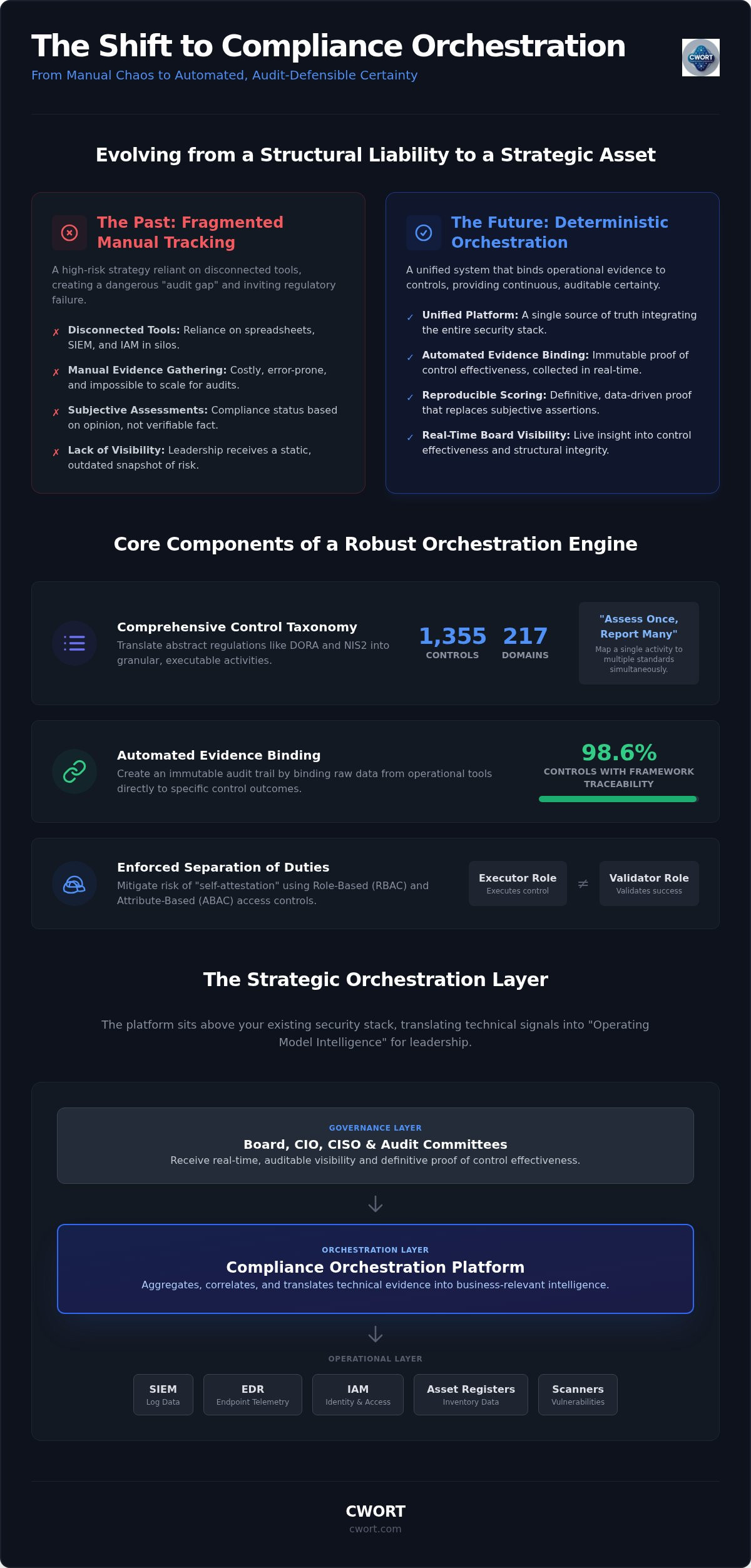
Your existing reliance on spreadsheets and disconnected tracking tools is no longer a mere inefficiency; it's a structural liability that leaves your organisation exposed to systemic regulatory failure. You likely recognise the frustration of evidence scattered across SIEM, IAM, and asset registers, making manual audit preparation a high-risk, high-cost endeavour. Adopting a structured approach to implementing a compliance orchestration platform best practices is the only way to move beyond this administrative chaos. You need a system that doesn't just track tasks but actively binds operational evidence to regulatory outcomes with uncompromising precision.
This article demonstrates how to transition from fragmented manual processes to a deterministic, audit-defensible assurance system that satisfies DORA, NIS2, and ISO 27001. We'll explore the strategic shift from passive tracking to proactive orchestration, ensuring your board receives real-time visibility into control effectiveness. By following these industry-leading methodologies, you will achieve automated evidence binding and a reproducible scoring model that transforms compliance from an annual crisis into a state of continuous, auditable certainty.
Key Takeaways
- Transition from fragmented manual tracking to a deterministic orchestration system to satisfy the rigorous evidence requirements of DORA and NIS2.
- Adopt a structured methodology for implementing a compliance orchestration platform best practices to ensure every control is mapped to a defensible operational reality.
- Utilise a comprehensive taxonomy of 1,355 controls to achieve an "assess once, report many" framework, eliminating redundant administrative labour across multiple standards.
- Integrate high-level governance directly with operational point-tools like SIEM and IAM to provide the board with real-time, auditable visibility.
- Replace subjective assessments with a reproducible scoring engine that delivers definitive proof of control effectiveness and structural integrity.
Table of Contents
- Beyond GRC: Why Compliance Orchestration is Mandatory in 2026
- Core Components of a Robust Compliance Orchestration Engine
- Strategic Integration: Connecting Point-Tools to Regulatory Outcomes
- Implementation Roadmap: From Fragmented to Orchestrated
- Achieving Auditable Certainty with CWORT
Beyond GRC: Why Compliance Orchestration is Mandatory in 2026
Traditional Governance, Risk, and Compliance (GRC) tools are fundamentally ill-equipped for the 2026 regulatory environment. Compliance orchestration represents a definitive shift from administrative "tracking" to a deterministic governance system that binds operational evidence directly to control outcomes. Whilst tracking relies on manual updates and subjective assertions, orchestration enforces the automated validation of operational reality. It ensures that every control in your framework is supported by immutable proof, creating a defensive posture that withstands the most rigorous regulatory scrutiny. You aren't just checking a box; you're proving a capability through a disciplined, systematic approach.
The Failure of Fragmented Compliance Tracking
Attempting to manage complex requirements like DORA or NIS2 within Jira tickets or Excel spreadsheets is a high-risk strategy that invites failure. These tools create a dangerous "audit gap" where the evidence of a control's execution is decoupled from the governance record. When regulators demand proof of resilience, relying on manual reconstruction is both costly and prone to error. Fragmented systems lack the structural integrity required to demonstrate continuous compliance. They offer a static snapshot of the past rather than a live view of current capability. Without a centralised system, your organisation remains vulnerable to compliance theatre rather than actual, defensible assurance.
Defining the Orchestration Layer
A true orchestration layer sits above your existing security stack, integrating data from SIEM, EDR, and IAM platforms without altering their primary functions. It translates these technical signals into "Operating Model Intelligence," allowing leadership to measure maturity and capacity with precision. This is a critical component for CIOs, CISOs, and Audit Committees who require definitive truth over abstract promises. By implementing a compliance orchestration platform best practices, you move from siloed data workflows to a unified system of record. This system provides a reproducible scoring model across a library of 1,355 controls, ensuring that your operating model is performing as intended. It replaces the anxiety of potential failure with the calm of auditable certainty.
Core Components of a Robust Compliance Orchestration Engine
A robust orchestration engine relies on a comprehensive control taxonomy to translate abstract regulatory obligations into granular, executable activities. It requires a library of 1,355 controls across 217 domains to ensure total coverage of the modern threat landscape. This structure enables an "assess once, report many" framework, allowing organisations to map a single operational activity to multiple standards like DORA, NIS2, and ISO 27001 simultaneously. Deterministic scoring is essential here; it removes subjectivity and ensures results are reproducible during an audit. Without this mathematical rigour, your compliance status remains an opinion rather than a fact.
Evidence Binding and Control Taxonomy
Effective orchestration requires precise mapping between technical signals and governance requirements. You must ensure that 98.6% of active controls carry clear framework references to maintain absolute traceability. Implementing a compliance orchestration platform best practices involves binding raw evidence from operational tools, such as SIEM or vulnerability scanners, directly to specific control outcomes. This process creates an immutable audit trail, providing definitive proof of control effectiveness whilst maintaining tenant isolation for maximum security. It replaces vague assertions with a disciplined system of record that auditors can trust implicitly.
Enforcing Separation of Duties
Maintaining audit integrity requires rigorous access controls and defined accountability. Enforcing separation of duties under DORA is a critical implementation best practice that prevents the dangerous concentration of power. By utilising role-based and attribute-based access controls (RBAC/ABAC), the platform ensures that those who execute a control cannot be the same individuals who validate its success. This prevents the risk of "self-attestation" through governed digital workflows, enforcing a level of discipline that manual systems cannot replicate. To see how these components function in a live environment, you might consider how to optimise your audit readiness through a structured demonstration of these core features.
Security is further reinforced through immutable audit logs that capture every interaction within the system. These logs ensure that once evidence is bound to a control, it cannot be altered or deleted without a clear record of the attempt. This level of structural integrity is vital for organisations operating in high-stakes regulatory environments where the cost of failure is absolute. By centring your strategy on these core components, you build a system that is not only compliant but inherently resilient.
Strategic Integration: Connecting Point-Tools to Regulatory Outcomes
Strategic integration acts as the essential conduit between raw technical telemetry and regulatory assurance. Implementing a compliance orchestration platform best practices requires you to systematically ingest data from core sources like SIEM, Vulnerability Management, and Identity and Access Management (IAM). This process isn't merely about data collection. It involves the disciplined aggregation of evidence without compromising the deterministic nature of your results. Every data point must be mapped to a specific control outcome to ensure the transition from abstract monitoring to concrete, auditable truth. Maintaining evidence integrity across the entire lifecycle is the only way to ensure your operating model remains defensible under pressure.
Building the Integration Layer
For organisations managing critical infrastructure, the integration layer must extend beyond standard IT assets to consume evidence from Operational Technology (OT) and Industrial Control Systems (ICS). The platform should remain content-agnostic, supporting bespoke organisational criteria whilst simultaneously mapping to global standards. This flexibility allows leadership to move from a "diagnose" phase, where gaps are identified, to a "demonstrate" phase, where immutable proof of control effectiveness is produced within a single governed environment. It ensures that asset registers and monitoring tools aren't just silos of data but active components of your compliance posture.
Maintaining Audit-Defensibility
Deterministic results represent the calculated, non-subjective output of a control assessment, providing the foundational logic for ensuring compliance evidence integrity. Within this framework, Artificial Intelligence serves as an advisory tool rather than a decision-maker. It can provide suggestions for remediation or mapping, yet it must never be permitted to modify the underlying audit trail. This separation ensures that the final determination remains human-led and audit-defensible. To maintain this integrity, the evidence register must utilise rigorous version control and reusable templates, ensuring that every submission is consistent, traceable, and ready for regulatory examination.
Implementation Roadmap: From Fragmented to Orchestrated
Moving from a state of fragmented manual tracking to a unified governance system requires a disciplined, multi-phase execution strategy. Implementing a compliance orchestration platform best practices involves more than just software deployment; it necessitates the structural realignment of how evidence is collected, validated, and reported. By following a structured roadmap, organisations can replace the anxiety of manual audit preparation with the certainty of a deterministic assurance system. This transition ensures that every regulatory obligation is backed by immutable proof and clear accountability.
- Phase 1: Define and import the maturity model. Utilise a "Bring Your Own Content" (BYOC) approach to establish your regulatory baseline, whether using standard frameworks or bespoke organisational criteria.
- Phase 2: Configure the assessment blueprint. Assign scope and owners across the enterprise to ensure every control has a designated point of accountability.
- Phase 3: Capture responses and bind evidence. Integrate technical telemetry directly into the governance record to create a live link between operations and compliance.
- Phase 4: Calculate maturity scores. Use the deterministic engine to prioritise remediation efforts based on business priority, risk, and required effort.
- Phase 5: Conduct a governed pilot. Validate the end-to-end workflow within a controlled environment to ensure the process is reproducible before a full-scale roll-out.
The 'Governed Reusable Model' Strategy
Avoid the pitfall of rapid "document-to-assessment" conversions that provide only temporary snapshots of compliance. Instead, adopt a strategy focused on a durable model catalogue. This approach employs approval lifecycles and consistent scoring rules, ensuring that once a maturity model is validated, it remains a reliable asset for the entire organisation. Testing this model across 3-5 sub-functions during a pilot phase allows you to refine the governance logic before committing to an enterprise-wide mandate. This consistency is essential for maintaining the structural integrity of your audit trail.
Prioritising Remediation and Improvement
A sophisticated prioritisation engine removes the guesswork from risk management by ranking remediation actions by their actual impact on the business. This allows CISOs to allocate resources where they're most needed, shifting the focus from administrative volume to strategic resilience. The result is the ability to generate board-ready maturity reports featuring heat-map dashboards that provide definitive proof of progress. Continuous reassessment becomes a natural byproduct of this workflow, ensuring you maintain a state of permanent audit-readiness. To begin your transition to a more disciplined governance model, you can request a demonstration of these orchestration capabilities.
Achieving Auditable Certainty with CWORT
CWORT terminates the era of subjective compliance by replacing fragmented manual tracking with a deterministic orchestration engine. It translates abstract regulatory obligations into structured execution activities, ensuring that your governance record is a live reflection of operational reality. By implementing a compliance orchestration platform best practices, your organisation moves beyond the limitations of traditional GRC tools. You gain a definitive source of truth that satisfies the board, auditors, and regulators with equal precision. This transition eliminates administrative anxiety, replacing it with the calm of auditable certainty.
The platform's efficiency is rooted in its "assess once, report many" capability. A single control validation can be simultaneously mapped across UK NIS, NIS2, and ISO 27001, removing the redundant labour that typically plagues multi-regulated firms. This isn't just about saving time; it's about maintaining the structural integrity of your evidence across divergent standards. Senior leadership can finally view compliance maturity as a real-time metric rather than a retrospective document. It shifts the focus from mere administrative tracking to definitive, evidence-based proof.
The CWORT Advantage for UK Enterprises
Speed to value is critical in high-stakes environments. CWORT features 42 frameworks already mapped within the platform, including NCSC CAF and DORA, to accelerate regulatory compliance workflow automation. The "Assess-Design-Deliver-Demonstrate" lifecycle ensures that every stage of your assurance programme is accounted for and defensible. We invite you to a professional working session to map your current compliance programme against our library of 1,355 controls and 217 domains. This session provides a clear path from your current obligations to a state of total assurance through a disciplined and systematic approach.
Next Steps for Compliance Leaders
The path to orchestration begins with a focused, governed pilot. By selecting a specific sub-function to demonstrate end-to-end evidence binding, you can prove the value of the platform before an enterprise-wide roll-out. This approach allows you to transition away from viewing compliance as a periodic project and start treating it as a core operating model. A disciplined operating model enforces accountability by design, ensuring that resilience is a permanent state rather than a temporary achievement. To begin this transition, you should book a CWORT implementation session to secure your compliance posture and move toward a deterministic future.
Transitioning to a Defensible Governance Future
Adopting a deterministic orchestration engine is the only way to replace fragmented evidence and subjective assertions with a disciplined system of record. Implementing a compliance orchestration platform best practices ensures your operating model is not just compliant in theory but resilient in practice. Utilising a unified taxonomy of 1,355 pre-mapped controls across 42 frameworks allows you to assess once and report many, providing senior leadership with the auditable certainty required for UK CNI and financial sectors.
Your path toward a reproducible, audit-defensible assurance system requires moving beyond spreadsheets and siloed point-tools. CWORT provides the structural integrity needed to satisfy DORA, NIS2, and ISO 27001 through a deterministic scoring model that regulators trust implicitly. Don't leave your organisation's security to manual reconstruction or administrative anxiety. Secure your regulatory posture with the CWORT orchestration platform and begin building a more resilient, transparent, and controlled future today.
Frequently Asked Questions
What is the difference between a GRC tool and a compliance orchestration platform?
Compliance orchestration is a proactive system that binds operational evidence directly to control outcomes, whilst traditional GRC tools function as passive administrative trackers. Orchestration enforces discipline through a deterministic engine that validates whether a control is actually performing as intended. It shifts the focus from manually updating status fields to producing immutable proof of operational reality. This approach ensures that your governance record is always a live reflection of your actual security posture.
How does compliance orchestration help with DORA and NIS2 audits?
Orchestration simplifies DORA and NIS2 compliance by automating the collection of evidence and mapping it to a library of 1,355 pre-mapped controls. By implementing a compliance orchestration platform best practices, you achieve an "assess once, report many" capability that satisfies multiple regulators simultaneously. This removes the high cost of manual audit preparation and ensures that your responses are always backed by a deterministic scoring system that regulators can trust implicitly.
Can I use my existing maturity models within a compliance orchestration system?
You can import any proprietary maturity model through the "Bring Your Own Content" (BYOC) module to run it within a governed digital environment. This allows organisations to retain their unique intellectual property whilst leveraging CWORT’s workflow, analytics, and version control. The platform remains content-agnostic, supporting custom criteria and weighting to turn your specific methods into a repeatable, evidence-backed management system. It provides portfolio-level visibility without losing granular component detail.
Why is 'deterministic scoring' important for regulatory compliance?
Deterministic scoring ensures that identical evidence always yields the same result, removing the subjectivity and bias inherent in manual assessments. This reproducibility is the cornerstone of audit-defensibility, providing a mathematical guarantee of control effectiveness that withstands external scrutiny. In a high-stakes regulatory environment, having an objective scoring engine allows senior leadership to demonstrate a state of auditable certainty. It replaces the anxiety of potential failure with disciplined, evidence-based proof of resilience.
How does orchestration handle evidence from multiple security tools like SIEM or IAM?
The platform features an integration layer that sits above your existing security stack to consume telemetry from tools like SIEM, IAM, and asset registers. It translates raw technical signals into governance-ready evidence without altering the underlying data. This enables the platform to present a single, explainable view of maturity across 217 domains. By aggregating these disparate data sources into a unified assurance register, leadership gains a comprehensive understanding of both capability maturity and operational capacity.
Is it possible to automate board-level compliance reporting?
CWORT generates board-ready maturity reports and heat-map dashboards automatically, providing senior leadership with real-time visibility into compliance status. These outputs are designed for risk and audit committees, offering a clear, non-technical view of control effectiveness and remediation progress. By automating the roll-up of data from individual owners to a centralised dashboard, the system eliminates the need for manual report reconstruction. This ensures that the board always has access to a defensible source of truth.
How do I ensure separation of duties within the platform?
The platform enforces separation of duties through governed digital workflows and rigorous role-based and attribute-based access controls (RBAC/ABAC). This ensures that the individuals responsible for executing a control are distinct from those who validate the evidence and approve the assessment. Every interaction is captured in an immutable audit history, preventing self-attestation and maintaining the structural integrity of the governance process. These controls are essential for demonstrating the accountability and discipline required under modern regulatory frameworks.
Does compliance orchestration replace my existing security stack?
No, compliance orchestration does not replace your security stack; it enhances it by acting as a validation layer that sits above your point-tools. It consumes telemetry from your SIEM, EDR, and vulnerability management systems to prove to regulators that these tools are delivering the required outcomes. By implementing a compliance orchestration platform best practices, you integrate these siloed signals into a single governed environment. This transforms your technical telemetry into a strategic asset for demonstrating continuous compliance.
Disclaimer
The content on this site is provided for general information and educational purposes only. It does not constitute legal, regulatory, financial, or professional advice. CWORT provides AI-assisted insights and workflow automation, but all compliance decisions remain the responsibility of your organisation and its management. Always seek qualified legal or regulatory guidance for decisions relating to the UK NIS Regulations, CAF, DORA, NIS2, ISO 27001, or other obligations.
Related posts
Jira for Compliance vs Orchestration: Why Task Tracking Fails Regulatory Audits
Discover why Jira fails DORA & NIS2 audits. In the debate of Jira for compliance vs orchestration, learn why task tracking isn't proof & how to automate assu...
The Shift to Compliance Orchestration Platforms: Beyond Enterprise GRC Automation
Struggling with DORA & NIS2? Move beyond failing GRC tools with a compliance orchestration platform for automated, auditor-ready evidence and real-time overs...
Streamlining Regulatory Compliance Processes: From Manual Tracking to Orchestrated Validation
Stop wasting money on manual compliance. Learn about streamlining regulatory compliance processes to reduce personal liability under DORA & NIS2 and gain aud...
Article by
Michael Iyiola
Co-Founder, CWORT
Michael Iyiola is a co-founder of CWORT and a Cyber and AI Security Engineer with deep experience in vulnerability management, detection engineering and operational resilience across UK critical national infrastructure, including rail, energy and financial services. At CWORT, he designs scalable, evidence-driven workflows that help teams meet modern regulatory and security demands.
Build Your Foundation of Auditable Certainty
Take control of your regulatory obligations and secure your infrastructure with CWORT.