ISO 27001 Control Effectiveness Proof: A Strategic Guide to Audit-Defensible Evidence

Michael Iyiola
Co-Founder, CWORT
Go beyond static documents. Learn to generate deterministic ISO 27001 control effectiveness proof that withstands UKAS audits and eliminates manual tracking.

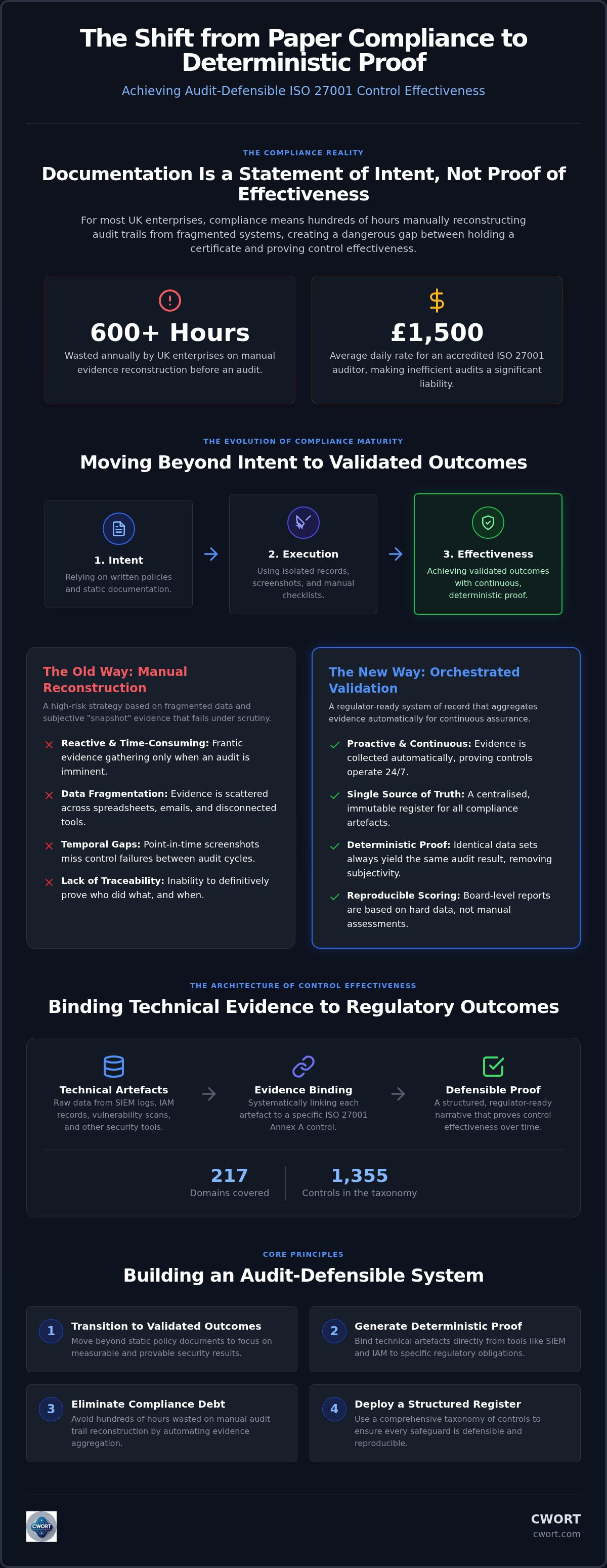
Documentation is not evidence. It is merely a statement of intent that collapses the moment a UKAS auditor demands deterministic validation. For most UK enterprise leaders, the reality of compliance involves spending hundreds of hours manually reconstructing audit trails from fragmented systems. You likely feel the anxiety of a looming external audit, especially when you cannot definitively prove separation of duties or real-time control status. This highlights the critical gap between holding a certificate and possessing actual ISO 27001 control effectiveness proof that stands up to rigorous scrutiny.
We agree that reliance on manual spreadsheets is an organisational liability, especially with the average daily rate for an accredited ISO 27001 auditor reaching £1,500 in 2026. It's time to move beyond the friction of administrative tracking. This strategic guide provides the blueprint to generate deterministic evidence that is regulator-ready. You'll learn how to replace manual checklists with a system of record that aggregates evidence automatically. We will examine the shift from subjective assessments to reproducible scoring, ensuring your board receives maturity reports based on an immutable source of truth rather than manual reconstruction.
Key Takeaways
- Transition from static documentation to validated outcomes by distinguishing between mere policy intent and measurable security results.
- Generate deterministic ISO 27001 control effectiveness proof by binding technical artefacts from SIEM and IAM tools directly to specific regulatory obligations.
- Eliminate the compliance debt of manual tracking and avoid the hundreds of hours typically wasted on reconstructing audit trails before UKAS assessments.
- Deploy a structured evidence register across 217 domains using a taxonomy of 1,355 controls to ensure every safeguard is defensible and reproducible.
Table of Contents
- Beyond Documentation: Why Paper Compliance Fails ISO 27001 Audits
- The Architecture of Control Effectiveness: Binding Evidence to Outcomes
- Manual Reconstruction vs Orchestrated Validation: A Strategic Comparison
- Step-by-Step: Building an Audit-Defensible ISO 27001 Evidence Register
- Orchestrating ISO 27001 Assurance with CWORT
Beyond Documentation: Why Paper Compliance Fails ISO 27001 Audits
Documentation is a declaration of intent, not a guarantee of security. In high-stakes regulatory environments, relying on paper-based compliance creates a dangerous illusion of safety. ISO 27001 control effectiveness proof is the definitive, measurable evidence that a specific safeguard achieves its intended security outcome over time. It represents the final stage of maturity. You must move past the "Intent" of written policies and the "Execution" of isolated records into the realm of "Effectiveness" through validated outcomes.
UKAS auditors in 2026 have fundamentally shifted their methodology. They no longer accept periodic sampling as a proxy for security. Instead, they demand continuous validation that proves controls are operating as designed every day of the year. This shift has exposed a massive "Evidence Gap". UK enterprises report wasting an average of 600 hours annually on manual evidence reconstruction. This administrative burden stems from a reactive posture where teams scramble to find proof only when an audit is imminent. It is a costly, inefficient cycle that diverts resources from actual security work.
The Evolution of ISO/IEC 27001:2022 Standards
The ISO/IEC 27001:2022 update formalised the requirement for operational monitoring. Clause 9.1 explicitly mandates performance evaluation. This requires organisations to determine exactly what needs to be monitored, who is responsible, and how results are evaluated. Static Statements of Applicability (SoA) are no longer sufficient for enterprise-grade assurance. To maintain certification, leadership must prove that controls aren't just present but are functioning correctly as part of a live operating model. This demands a transition from "check-box" compliance to a system of continuous oversight.
Common Pitfalls in Manual Evidence Collection
Many organisations fall victim to the "Snapshot Fallacy". This occurs when a single screenshot or log entry is presented as proof of a sustained control. Auditors now recognise that a point-in-time record doesn't reflect the ongoing health of a system. Fragmented data across Jira, Excel, and email further complicates the process. These silos lead to broken audit trails and inconsistent reporting that cannot survive a deep-dive investigation.
- Data Fragmentation: Storing evidence in disparate locations makes it impossible to provide a single source of truth.
- Temporal Gaps: Manual collection often misses critical failures that occur between audit cycles.
- Lack of Traceability: Difficulty proving who performed a control and when, undermining the principle of accountability.
Paper compliance is a high-risk strategy that fails under regulatory scrutiny. Relying on manual reconstruction ensures that your evidence remains anecdotal rather than deterministic.
The Architecture of Control Effectiveness: Binding Evidence to Outcomes
Move beyond passive lists. True ISO 27001 control effectiveness proof relies on deterministic evidence. This is a state where identical data sets always yield the same audit result, eliminating the risk of subjective interpretation by external assessors. To achieve this, you must implement evidence binding. This process links technical artefacts, such as SIEM logs or IAM records, directly to specific ISO 27001 Annex A controls. It transforms raw data into a structured narrative of compliance that's both explainable and defensible.
Mapping Technical Artefacts to Annex A Controls
Bind technical artefacts to specific outcomes. This ensures that a vulnerability scan isn't just a file in a folder but a validated proof of Control A.8.8 (Management of technical vulnerabilities). Link your automated scan results directly to the control to prove that assessments occur at the required frequency. Similarly, proving Control A.5.3 (Segregation of duties) requires more than a policy statement. It demands immutable workflow logs that show a clear separation between the requester and the approver. By adopting this systematic approach, you align with best practices highlighted by ISACA on ISO 27001 and NIST, which emphasises the need for integrated framework management. Deterministic scoring then removes auditor bias by providing a clear, reproducible metric of success based on hard data rather than opinion.
Ensuring Evidence Integrity and Immutability
Evidence loses its value if its integrity is questionable. You must protect every captured artefact from alteration after the moment of capture. This requires a robust metadata layer that includes precise timestamping, clear ownership, and integrity protection. Every change to a control's status or its associated evidence must be recorded in an immutable audit history. This level of rigour is essential for high-stakes regulatory environments where traditional documentation fails to meet the standard of proof. For a deeper technical exploration of these safeguards, read our guide on Ensuring Compliance Evidence Integrity.
Orchestrating these workflows ensures that your ISO 27001 control effectiveness proof is always available, accurate, and ready for scrutiny. It replaces the anxiety of manual reconstruction with the calm of auditable certainty. You can request a demo to see how this architecture functions in a live enterprise environment whilst reducing operational friction.
Manual Reconstruction vs Orchestrated Validation: A Strategic Comparison
Stop treating compliance as an administrative post-script. Traditional "Checklist" approaches rely on point-in-time snapshots that fail to capture the reality of your security posture. By contrast, an orchestrated validation lifecycle-Diagnose, Design, Deliver, and Demonstrate-ensures that ISO 27001 control effectiveness proof is a byproduct of daily operations rather than a frantic pre-audit exercise. This structured progression creates a repeatable workflow where every control is assessed, configured, and validated against real-world data.
Manual tracking generates significant "Compliance Debt." This is the cumulative burden of unverified controls and missing evidence that eventually requires expensive remediation. Orchestration platforms sit above your existing security stack, aggregating data from SIEM, EDR, and IAM tools to provide a unified view. Whilst AI can provide advisory support for policy drafting, it cannot replace the deterministic outcome generation required for a UKAS audit. Only a systematic validation engine can offer the auditable certainty that regulators demand.
Why Jira and Excel are Not Compliance Orchestration Tools
Generic project management tools lack the structural integrity required for governance. They don't enforce "Separation of Duties" (SoD) by design, allowing the same user to assign, execute, and approve a task without a formal audit trail. This leads to the "Audit Reconstruction Tax", the hundreds of hours spent hunting for evidence years after a control was supposedly performed. Status tracking in a spreadsheet merely records that a box was ticked; it does not provide execution validation. You need a system that proves the control worked, not just that someone said it did.
The "Assess Once, Report Many" Advantage
UK enterprises operating in regulated sectors face a complex web of obligations. An orchestrated approach allows you to satisfy ISO 27001, DORA, and NIS2 requirements through a single assessment process. By using a strategic multi-framework cross-walk, you can map technical evidence across the NCSC CAF, NIST, and ISO standards simultaneously. This efficiency reduces operational friction and ensures that your maturity reports are always board-ready. Utilising a dedicated ISO 27001 Control Mapping Tool enables you to scale these proofs across multiple frameworks without duplicating effort. This transition from manual tracking to orchestrated validation transforms compliance from a cost centre into a strategic asset.
Step-by-Step: Building an Audit-Defensible ISO 27001 Evidence Register
Constructing a robust evidence register requires a departure from static spreadsheets. You must define the scope and configure an assessment blueprint within a governed digital environment that enforces accountability by design. This involves assigning clear ownership and participants across 217 specific control domains. By capturing real-time responses and binding them directly to immutable evidence artefacts, you create a defensible record of ISO 27001 control effectiveness proof. This structured approach allows you to calculate maturity and confidence scores based on evidence density and quality, rather than subjective self-assessments. A risk-based engine then identifies gaps, allowing leadership to prioritise improvements where they will have the most significant impact on the organisation's security posture.
Defining Capability and Capacity
Audit-defensible proof must address two distinct dimensions of performance: capability and capacity. Capability proves that a control achieves its intended security outcome under test conditions. Capacity demonstrates that your team possesses the resources and bandwidth to sustain that control over the long term. Heat-map dashboards provide the Board with a high-level view of these metrics, translating technical validation into strategic intelligence. Continuous monitoring of capacity metrics ensures that compliance requirements do not exceed the operational threshold, effectively preventing compliance burnout amongst security teams. This dual focus ensures that your certification remains resilient between formal audit cycles.
Managing the Evidence Lifecycle
Evidence is not a static asset. You must implement version control for both your control models and evidence templates to ensure traceability as your operating model evolves. Setting up automated reassessment triggers is essential. These triggers should fire based on specific time intervals or whenever a control failure is detected in the underlying security stack. This proactive orchestration ensures that board-level reporting remains audit-ready at all times without the need for manual intervention or frantic data gathering. By automating the lifecycle, you replace the anxiety of the unknown with the certainty of a validated, real-time compliance posture.
Transform your compliance approach from a reactive burden into a streamlined, automated process. You can request a demo to see how an orchestrated evidence register provides total assurance for your ISO 27001 certification.
Orchestrating ISO 27001 Assurance with CWORT
CWORT functions as the primary "Operating Model Intelligence" layer, sitting above your existing security stack to translate technical data into strategic assurance. It doesn't merely track tasks; it orchestrates the entire validation lifecycle. By leveraging a comprehensive taxonomy of 1,355 controls, the platform provides a structured path to readiness that eliminates the guesswork associated with manual mapping. This system ensures that 98.6% of active controls are directly linked to framework references, providing the deterministic ISO 27001 control effectiveness proof required for high-stakes UKAS audits.
Flexibility is central to the platform’s design. The "Bring Your Own Content" (BYOC) capability allows leadership to integrate bespoke maturity models or internal standards into the governed digital environment. This ensures your specific organisational requirements are validated with the same rigour as international standards whilst maintaining operational context. The platform manages the entire progression from "Diagnose" to "Demonstrate," providing a single, explainable view that aggregates evidence from SIEM, EDR, and IAM tools. You replace fragmented administrative tracking with a disciplined system of record that enforces accountability at every stage.
Board-Level and Regulator-Ready Outputs
Communication with stakeholders is a critical component of any compliance programme. CWORT generates sophisticated heat-maps and maturity reports that translate granular technical evidence into the language of senior leadership. These outputs are designed to satisfy the rigorous demands of UK regulators, such as Ofgem and the NCSC, through transparent and reproducible scoring. By providing a clear view of both capability and capacity, you can demonstrate resilience orchestration that aligns with the NCSC CAF Assessment Software standards. This "Assess Once, Report Many" capability ensures that your ISO 27001 efforts simultaneously satisfy overlapping obligations like DORA and NIS2.
Next Steps: From GRC to Orchestration
Transitioning from manual GRC to automated orchestration is a strategic shift that requires a focused approach. We recommend initiating a pilot programme on a specific sub-function or business unit to prove the end-to-end validation workflow. This allows your team to experience the efficiency of automated evidence binding before scaling across the entire enterprise. You'll move from a state of fragmented tracking to a reproducible assurance system that requires zero manual reconstruction. Secure your certification with minimal operational friction. Request a demo of CWORT’s compliance validation engine to see how deterministic evidence can transform your audit outcomes.
Securing Your Certification Through Deterministic Validation
Relying on paper-based compliance is no longer a viable strategy for UK enterprises. To survive a UKAS audit in 2026, you must transition from static documentation to a live system of record. This shift replaces the anxiety of manual evidence gathering with the certainty of ISO 27001 control effectiveness proof. By binding technical artefacts directly to regulatory obligations, you eliminate the "Audit Reconstruction Tax" and ensure your security posture is always defensible. You don't just state your intent; you prove your execution.
CWORT provides the strategic orchestration layer needed to manage this complexity at scale. With 1,355 controls in our taxonomy library and 98.6% of active controls carrying direct framework references, we offer the precision required by UK Critical National Infrastructure. You can move beyond fragmented spreadsheets and adopt a reproducible assurance system that satisfies boards and regulators alike. It's time to transform your compliance function into a proactive driver of organisational resilience. Request a demo to see how CWORT produces audit-defensible proof of ISO 27001 effectiveness.
Frequently Asked Questions
What is the difference between ISO 27001 documentation and evidence?
Documentation defines the rules; evidence proves they were followed. A policy stating you perform monthly vulnerability scans is documentation. The actual scan report from your technical tools is the evidence. Auditors look for a consistent trail of these reports to verify that your operational reality matches your written intent. Without this link, your security posture remains an unverified claim rather than a defensible fact.
How much evidence does an ISO 27001 auditor typically require?
Auditors typically request a sample of evidence covering the entire certification cycle, often looking at the last 12 months. For high-risk controls, they might demand proof for every instance of execution. In 2026, UKAS auditors have moved away from simple sampling toward requiring ISO 27001 control effectiveness proof that demonstrates consistent performance. They seek to ensure that safeguards didn't just work on the day of the audit but remained active throughout the year.
Can I use Jira to manage ISO 27001 control effectiveness proof?
Jira is a project management tool, not a compliance orchestration system. It lacks the built-in "Separation of Duties" and immutable audit trails necessary for regulatory rigour. Whilst it can track that a task was completed, it doesn't validate the quality or integrity of the output. Using generic tools often leads to "Audit Reconstruction Tax" where teams spend hundreds of hours manually verifying data that wasn't captured in a governed digital environment.
How often should I review my ISO 27001 evidence register?
Review your evidence register continuously rather than treating it as a periodic event. Mature organisations implement automated reassessment triggers based on time intervals or control failures. If you only review proof before an external audit, you'll likely discover gaps too late to remediate them. A real-time approach ensures that your board-ready maturity reports are always accurate and that your certification remains resilient against unexpected regulatory scrutiny or operational shifts.
What happens if an auditor finds my ISO 27001 control evidence is insufficient?
Insufficient evidence leads to a formal non-conformity report (NCR). A major non-conformity can result in the immediate suspension or withdrawal of your ISO 27001 certification. You'll be required to implement a remediation action plan and undergo a follow-up audit to prove the issues are resolved. This process is expensive, time-consuming, and can damage your reputation with enterprise clients who view certification as a baseline requirement for doing business.
Does ISO 27001:2022 require continuous monitoring of controls?
The ISO/IEC 27001:2022 update places a much heavier emphasis on operational monitoring and review. Clause 9.1 specifically mandates that organisations evaluate the performance and effectiveness of their Information Security Management System (ISMS). You must determine what needs to be monitored and how often. This shift requires a move toward generating ISO 27001 control effectiveness proof through ongoing validation rather than relying on point-in-time snapshots that quickly become obsolete.
How do I prove separation of duties for ISO 27001 audits?
Proving "Separation of Duties" (SoD) requires immutable workflow logs that identify distinct individuals for conflicting roles. You must show that the person who requests access is not the same person who approves it. Auditors look for technical evidence within your IAM or orchestration tools that enforces this rule by design. Demonstrating this through structured, reproducible records is far more defensible than presenting a policy document that merely describes the requirement without proof of enforcement.
What is deterministic scoring in the context of compliance audits?
Deterministic scoring is a reproducible system where identical data sets always produce the same audit result. It removes the subjectivity often found in traditional "self-assessment" models where scores are based on opinion. By using a data-driven engine, you calculate maturity based on evidence density and quality. This provides a transparent, explainable view of your compliance posture that regulators can trust, ensuring your reporting is based on hard technical artefacts rather than anecdotal claims.
Disclaimer
The content on this site is provided for general information and educational purposes only. It does not constitute legal, regulatory, financial, or professional advice. CWORT provides AI-assisted insights and workflow automation, but all compliance decisions remain the responsibility of your organisation and its management. Always seek qualified legal or regulatory guidance for decisions relating to the UK NIS Regulations, CAF, DORA, NIS2, ISO 27001, or other obligations.
Related posts
ISO 27001 Control Effectiveness Proof: Moving Beyond Static Certification to Defensible Validation
Move beyond static ISO 27001 certification. Discover how an ISO 27001 compliance validation tool delivers continuous, defensible proof for UK regulators.
Automated Compliance Proof Generation: Transitioning from Manual Tracking to Validated Evidence
Ditch manual spreadsheets. Learn how automated compliance proof generation creates regulator-ready, validated evidence for DORA & NIS2, ensuring a defensible...
ISO 27001 Continuous Compliance Monitoring: The 2026 Strategic Shift
Prepare for 2026. See how ISO 27001 compliance validation software replaces risky snapshot audits with a real-time, evidence-led monitoring framework.
Article by
Michael Iyiola
Co-Founder, CWORT
Michael Iyiola is a co-founder of CWORT and a Cyber and AI Security Engineer with deep experience in vulnerability management, detection engineering and operational resilience across UK critical national infrastructure, including rail, energy and financial services. At CWORT, he designs scalable, evidence-driven workflows that help teams meet modern regulatory and security demands.
Build Your Foundation of Auditable Certainty
Take control of your regulatory obligations and secure your infrastructure with CWORT.