ISO 27001 Control Effectiveness Proof: Moving Beyond Static Certification to Defensible Validation

Michael Iyiola
Co-Founder, CWORT
Move beyond static ISO 27001 certification. Discover how an ISO 27001 compliance validation tool delivers continuous, defensible proof for UK regulators.

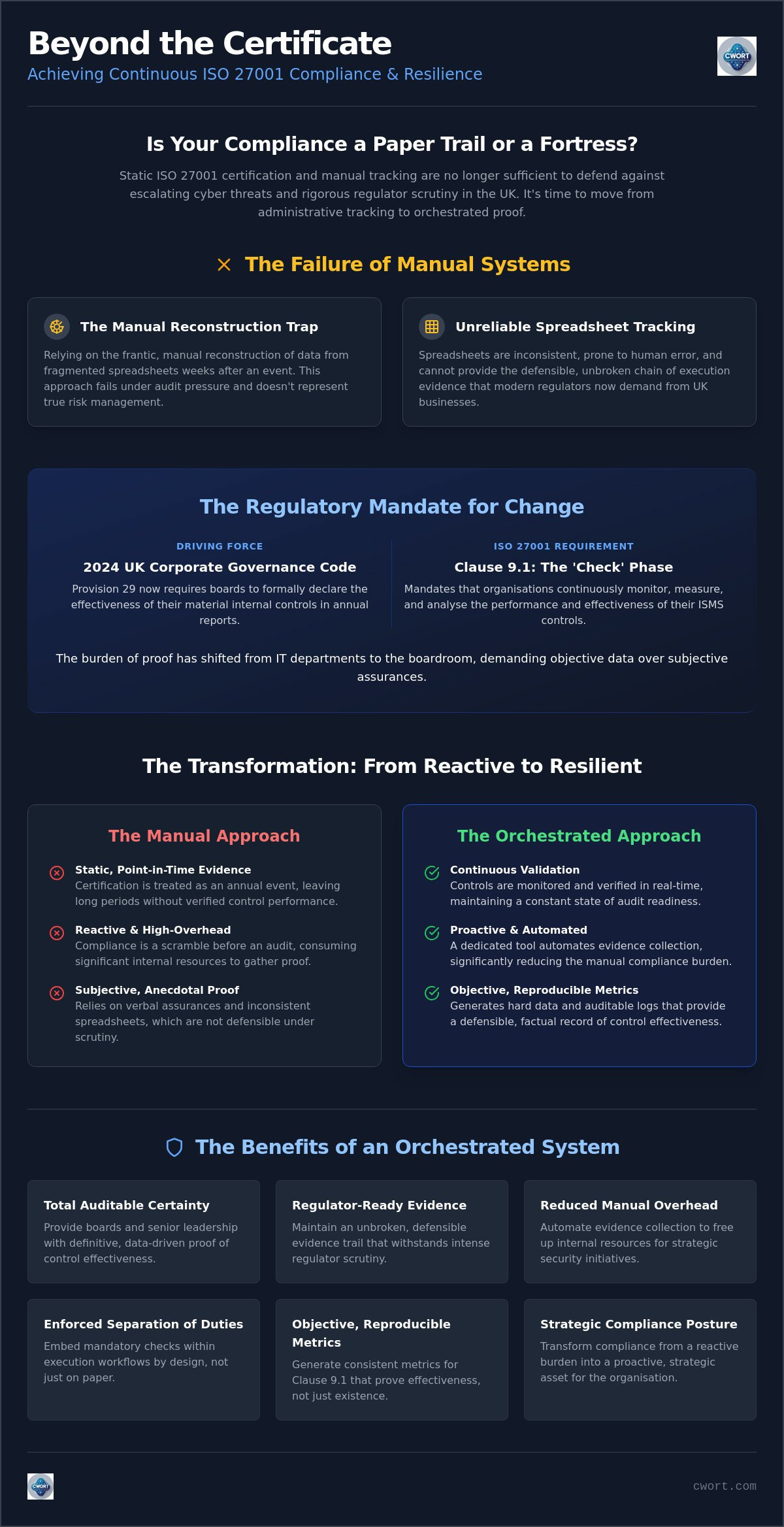
Static ISO 27001 certification is no longer a sufficient shield against rigorous regulator scrutiny or the escalating cyber threats facing UK businesses. If your evidence relies on the manual reconstruction of data weeks after an event, you aren't managing risk; you're merely managing a paper trail. Achieving true operational resilience requires a dedicated ISO 27001 compliance validation tool that moves beyond administrative tracking into the realm of definitive, orchestrated proof.
We recognise the exhaustion of spreadsheet-based tracking and the persistent anxiety of proving separation of duties under audit pressure. You shouldn't have to scramble for evidence when the board demands certainty or when the UK Corporate Governance Code requires a declaration of control effectiveness. This article demonstrates how to transform your compliance posture from a manual exercise into a rigorous, orchestrated system of auditable truth. We will explore the shift from point-in-time snapshots to continuous validation; this ensures your organisation remains regulator-ready whilst significantly reducing the manual overhead that often drains your internal resources.
Key Takeaways
- Transition from static, point-in-time certification to a model of continuous validation that aligns with the 2024 UK Corporate Governance Code requirements.
- Eliminate the "Manual Reconstruction" trap by deploying a dedicated ISO 27001 compliance validation tool to replace fragmented spreadsheets and inconsistent tracking.
- Establish reproducible metrics for Clause 9.1 that provide objective proof of control effectiveness rather than mere administrative existence.
- Enforce mandatory separation of duties by design within your execution workflows to ensure your evidence trail remains defensible under intense regulator scrutiny.
- Shift compliance from a reactive administrative burden into a strategic, orchestrated system that provides total auditable certainty for boards and senior leadership.
Table of Contents
- Defining ISO 27001 Control Effectiveness Proof in 2026
- The Mechanics of Clause 9.1: Monitoring, Measurement, and Analysis
- The Failure of Manual Systems: Why Spreadsheets Undermine Your Proof
- Constructing a Validated Execution Workflow for Defensible Evidence
- CWORT: Orchestrating Regulator-Ready Proof for UK Enterprises
Defining ISO 27001 Control Effectiveness Proof in 2026
Control effectiveness proof isn't a badge of honour; it's the objective, auditable evidence that a security measure achieves its intended outcome every time it's invoked. In the current UK regulatory environment, simply pointing to the existence of a policy is no longer sufficient. Auditors and regulators now demand a transition from point-in-time snapshots to a model of continuous validation. This shift is driven by a heightened expectation for transparency, particularly following the implementation of Provision 29 of the 2024 UK Corporate Governance Code. This mandate requires boards of premium-listed companies to declare the effectiveness of their material internal controls in their annual reports, moving the burden of proof from IT departments to the boardroom.
The foundation of this requirement lies within Clause 9.1 of ISO/IEC 27001. This clause mandates that organisations monitor, measure, and analyse their Information Security Management System (ISMS) performance. It moves the focus away from static documentation toward a dynamic evaluation of how controls behave amongst evolving threats. To meet these standards, leadership teams are increasingly turning to a dedicated ISO 27001 compliance validation tool to generate the reproducible metrics auditors now require. Without these metrics, your compliance status is merely a subjective opinion rather than a defensible fact.
For small and medium-sized businesses that find this level of technical rigour challenging, it can be helpful to explore Managed IT Services as a way to secure the proactive support and cybersecurity expertise required for a robust ISMS.
The Transition from Implementation to Validation
Ticking the box on Annex A controls is an administrative task; proving those controls function in a live environment is a strategic one. Modern auditors have become more sophisticated, looking past the presence of a control to examine its effectiveness. A control might be present in your policy but fail during execution due to human error or technical misconfiguration. Defensible proof is evidence that survives forensic audit scrutiny by demonstrating a consistent, unbroken chain of execution. It's the difference between saying you have a backup policy and proving that every scheduled backup was successful, verified, and stored securely over the last twelve months. This demand for verified performance is universal across industries; for instance, ISO-certified manufacturers like Compass Wire Cloth Corporation must demonstrate similar rigour when producing industrial aggregate screens to meet strict quality specifications.
Similarly, in the high-end architectural sector, the creation of bespoke orangeries West Sussex requires a comparable level of precision and adherence to strict standards to ensure structural integrity and regulatory compliance.
Furthermore, in sectors such as industrial automation and critical infrastructure, OT Sec UK, US, AE and IN offers specialist consultancy to ensure that operational technology (OT) environments meet the stringent validation requirements demanded by modern regulators.
Why 'Feeling Secure' is No Longer a Defensible Position
Relying on anecdotal evidence from system administrators is a high-risk strategy that invites regulator scepticism. When an auditor asks for proof of access reviews or patch management, a verbal assurance or a vague spreadsheet update won't suffice. UK regulators now prioritise hard data over policy assertions, seeking a level of rigour that manual systems cannot provide. Organisations must move toward the ensuring compliance evidence integrity model to avoid the pitfalls of manual reconstruction. By utilising an ISO 27001 compliance validation tool, enterprises can replace subjective status updates with objective, data-driven reality that leaves no room for doubt during a high-stakes audit.
The Mechanics of Clause 9.1: Monitoring, Measurement, and Analysis
Clause 9.1 represents the critical 'Check' phase of the Plan-Do-Check-Act (PDCA) cycle. It demands that organisations don't just implement controls but actively verify their performance. For many UK enterprises, this is where the compliance process breaks down. Without a systematic approach, monitoring becomes a reactive scramble rather than a disciplined workflow. An ISO 27001 compliance validation tool provides the necessary framework to automate this evaluation, ensuring that every Annex A control is subject to rigorous, scheduled scrutiny.
The standard requires you to determine exactly what needs to be monitored, who is responsible for the analysis, and when these activities must occur. This isn't a suggestion; it's a mandate for structural accountability. By defining the timing and frequency of monitoring activities, you move away from the anxiety of the annual audit and toward a state of constant audit readiness. This disciplined rhythm ensures that gaps are identified and remediated in real-time, rather than being discovered by a third-party assessor during a certification cycle.
Establishing Reproducible Metrics for Annex A Controls
Valid metrics must be objective and reproducible. If two different auditors review the same control, they should reach the same conclusion based on the evidence provided. For complex areas like access management or encryption, you must move beyond binary "yes/no" statuses. Instead, focus on performance indicators such as the percentage of access reviews completed within the required timeframe or the success rate of automated patch deployments. Leveraging established frameworks, such as the NIST SP 800-53 security controls, can help you define these metrics by providing clear implementation and assessment guidance that maps directly back to ISO 27001 requirements. This ensures your methodology is comparable and defensible across different regulatory jurisdictions.
Distinguishing Between Data Collection and Strategic Evaluation
Collecting logs is not the same as evaluating control effectiveness. A database full of unreviewed events provides zero assurance. Clause 9.1 requires an analytical layer where data is interpreted against the organisational risks identified in Clause 6.1. To maintain objectivity, you must enforce a clear separation of duties; those responsible for monitoring the data should not be the same individuals who analyse its success. This structural integrity prevents internal teams from marking their own homework with 'vanity metrics' that look good on a dashboard but fail to prove actual risk reduction. If you're ready to move beyond manual tracking, you can explore how orchestrated execution simplifies this process. By integrating an ISO 27001 compliance validation tool, you ensure that monitoring is continuous, evidence is bound to outcomes, and your ISMS remains resilient amongst a shifting threat landscape.
The Failure of Manual Systems: Why Spreadsheets Undermine Your Proof
Manual tracking systems are the primary point of failure for UK enterprises seeking defensible validation. Relying on spreadsheets or generic task managers creates an illusion of control whilst leaving the organisation vulnerable to forensic audit failure. These tools lack the structural integrity required to bind evidence to specific outcomes. They fail to enforce the discipline necessary for a rigorous ISMS. Implementing a purpose-built ISO 27001 compliance validation tool is the only way to eliminate the "metric tax" currently levied on your most expensive risk managers and SMEs. Instead of executing security measures, these professionals are often reduced to administrative clerks, chasing updates across fragmented files and non-specialised systems.
Fragmented data creates "tamper-evident" gaps that are impossible to defend during a high-stakes investigation. When evidence is scattered across disparate emails, chat logs, and local drives, the chain of custody is broken. This lack of traceability forces organisations into a reactive posture, where they spend more time justifying their tracking methods than improving their security performance. A disciplined approach requires a single, orchestrated engine that enforces accountability by design.
This requirement for data integrity is particularly critical when deploying emerging technologies like AI agents, which often handle sensitive operational context. Using a privacy-first memory layer such as NovaCortex ensures that these agents operate within a secure, self-hosted environment, preventing the data leakage that can occur with fragmented or third-party storage solutions.
The 'Manual Reconstruction' Trap During External Audits
Preparing for an external audit shouldn't involve a three-week scramble to aggregate data. This "Manual Reconstruction" trap is a symptom of a broken process where evidence is gathered reactively rather than generated through orchestrated execution. Regulators view manually compiled spreadsheets with inherent suspicion. They lack a verifiable audit trail and fail to prove that the data hasn't been retroactively adjusted to satisfy the assessor. To achieve a state of continuous readiness, you need an ISO 27001 control mapping tool that automates history by design. Adhering to the ISO/IEC 27004:2016 guidelines ensures your monitoring and measurement activities are not just present but are technically sound and reproducible.
Why Jira and Excel Lack Compliance Orchestration
Jira is an excellent tool for managing software development tasks; it is a catastrophic choice for managing regulatory obligations. Task completion is not the same as compliance validation. A ticket marked as 'done' in Jira does not constitute proof for an ISO 27001 auditor. It lacks the context of the underlying obligation and the necessary "Four-Eyes" validation to ensure separation of duties (SoD). Spreadsheets are even more problematic. They offer no native way to enforce SoD or ensure that the person performing a control isn't the same person validating its effectiveness. An ISO 27001 compliance validation tool enforces these principles by design, ensuring that every piece of evidence is validated by an independent party within a structured workflow. This level of orchestration transforms compliance from a series of disconnected tasks into a single, defensible engine of truth.
Constructing a Validated Execution Workflow for Defensible Evidence
Moving from a static checklist to an active execution workflow is the only way to achieve auditable certainty. Static lists tell you what you should do; validated workflows prove what you have done. This transition requires a disciplined approach to how obligations are handled within your organisation. By utilising a dedicated ISO 27001 compliance validation tool, you can enforce a structured progression that turns abstract requirements into concrete, defensible reality. This isn't merely about tracking progress. It's about orchestrating a system where every action is recorded, validated, and bound to a specific regulatory outcome.
To implement a robust execution engine, follow this five-step progression:
- Step 1: Translate broad regulatory obligations into granular, actionable execution activities that leave no room for interpretation.
- Step 2: Enforce separation of duties by design, ensuring the person performing the task is never the one validating it.
- Step 3: Bind evidence, such as logs, system screenshots, or digital approvals, to the specific control outcome at the exact point of action.
- Step 4: Automate the generation of audit-ready outputs to eliminate the need for manual reconstruction during external assessments.
- Step 5: Review performance and iterate through board-level dashboards to identify and remediate control gaps before they become liabilities.
Binding Evidence to Specific Control Outcomes
Evidence-based compliance management operates on the principle that the act of performing a security measure should simultaneously create the proof of its execution. This prevents the dangerous decoupling of evidence from its purpose, ensuring every log or screenshot is inextricably linked to the specific control outcome it validates. Context is everything in a forensic audit. If an auditor cannot see exactly which requirement a piece of evidence satisfies, that evidence is effectively worthless. Binding ensures that your audit trail is not just a collection of files but a coherent narrative of successful risk mitigation.
Enforcing Separation of Duties (SoD) within the Workflow
Trust in any security control effectiveness proof rests on the integrity of the validation process. Separation of duties is the cornerstone of this trust. You must automate the handover between the 'executor' who performs the task and the 'validator' who reviews the outcome to ensure total accountability. Orchestration engines prevent a single user from both performing and approving a critical action, removing the risk of internal collusion or simple oversight. This systematic enforcement of the 'Four-Eyes' principle provides boards with the certainty that controls are being objectively assessed. If you're ready to replace manual tracking with a disciplined execution engine, you can request a demonstration of our validation platform to see these workflows in action.
CWORT: Orchestrating Regulator-Ready Proof for UK Enterprises
CWORT represents the definitive shift from passive administration to active orchestration. It replaces the fragmented, high-friction tracking methods that currently plague many UK enterprises with a single, disciplined execution engine. By deploying this ISO 27001 compliance validation tool, organisations can finally move beyond the "Manual Reconstruction" trap and the associated "metric tax" on senior risk managers. The platform doesn't just record that a task was completed; it enforces the specific, auditable reality required by modern regulators. This transition ensures that every security control is bound to a validated outcome, providing a level of structural integrity that generic task managers or spreadsheets simply cannot replicate.
Fragmented tracking is a liability that creates unnecessary exposure during an audit. CWORT centralises disparate obligations from ISO 27001, DORA, and NIS2 into one orchestrated system, creating a single source of truth for the board, the SME, and the external auditor. This consolidation is a core component of the regulatory compliance workflow automation pillar. It eliminates the need for cross-referencing multiple systems, reducing professional friction and ensuring that evidence is contextually linked to the correct regulatory requirement at all times. By automating the history of every control, CWORT ensures your evidence remains defensible under forensic scrutiny without requiring weeks of manual preparation.
Replacing Fragmented Tracking with a Single Execution Engine
The complexity of the UK regulatory landscape demands a unified approach to governance. CWORT acts as a proactive system that enforces discipline and accountability by design, rather than acting as a passive repository for files. It bridges the gap between abstract policy and concrete execution, ensuring that every Annex A control is managed through a consistent, repeatable workflow. This orchestration prevents the decoupling of evidence from its purpose, allowing SMEs to spend their time on high-value security tasks whilst the platform handles the rigorous demands of traceability and structural integrity. In this context, Woloyem helps you to learn and master projet and service management by offering specialised training for those managing high-stakes projects.
Generating Board-Level Assurance and Audit-Ready Outputs
Strategic leadership requires more than technical jargon and hope. CWORT generates board-level assurance by translating complex security metrics into clear, strategic risk reporting that leadership can actually use to make informed decisions. Instead of presenting a collection of unreliable, colour-coded sheets, you provide the board with auditable certainty regarding your actual control status. This level of transparency is essential for fulfilling the requirements of the 2024 UK Corporate Governance Code. Auditor-ready outputs are generated automatically, significantly decreasing audit duration and allowing your team to focus on core security operations rather than administrative reconstruction. To see how validated execution can transform your ISMS into a high-performance engine of proof, request a CWORT demo today.
Secure Your Compliance Future with Orchestrated Proof
The era of static, point-in-time certification has ended. Modern UK regulatory standards demand a shift toward continuous validation and objective evidence. Relying on manual reconstruction or fragmented spreadsheets is no longer a defensible strategy; it's a structural risk that undermines board-level certainty. You must move from merely having a control to proving its effectiveness through a disciplined execution engine.
Implementing a dedicated ISO 27001 compliance validation tool transforms your ISMS from an administrative burden into a strategic asset. By centralising obligations and enforcing separation of duties by design, you eliminate the professional friction that typically precedes an audit. CWORT provides the auditable certainty required to meet high-stakes governance mandates whilst reducing the manual overhead on your senior risk managers. This transition ensures your evidence is always bound to outcomes and ready for forensic scrutiny.
Request a CWORT demo to orchestrate your ISO 27001 proof and gain access to auditor-ready evidence binding, automated separation of duties enforcement, and board-level compliance dashboards. Take control of your compliance narrative and replace audit anxiety with the calm of validated truth.
Frequently Asked Questions
What is the difference between control monitoring and control effectiveness testing?
Control monitoring is the ongoing process of checking that a security measure is present and performing its basic function. Effectiveness testing is a more rigorous, strategic evaluation that validates whether the control actually achieves the risk treatment objective defined in your ISMS. Monitoring provides the raw data; effectiveness testing requires an analytical layer to prove the control is mitigating threats as intended.
Can I use Jira to provide ISO 27001 control effectiveness proof?
Jira is fundamentally unsuitable for providing defensible proof because it lacks native orchestration and mandatory separation of duties. While it's an excellent tool for tracking software tasks, it doesn't bind evidence to specific regulatory obligations or prevent the person performing a task from also approving it. Auditors require a more disciplined system that enforces accountability and provides a tamper-evident audit trail.
What are the common pitfalls in ISO 27001 Clause 9.1 implementation?
The most frequent pitfall is relying on subjective status updates rather than objective, reproducible metrics. Many UK organisations also fail to separate the monitoring of data from the strategic analysis of that data, which leads to biased reporting. Another common error is treating Clause 9.1 as a periodic exercise rather than a continuous workflow, resulting in the frantic "Manual Reconstruction" trap during audits.
How often should I test the effectiveness of my Annex A controls?
Testing frequency must be determined by the risk profile of the specific control and the volatility of the environment it protects. Critical technical controls, such as access management or firewalls, often require continuous or monthly validation to maintain security integrity. Less dynamic organisational controls might only require quarterly or annual testing, provided this frequency is justified within your ISMS performance evaluation plan.
What evidence do auditors typically look for during an ISO 27001 recertification?
Auditors look for a consistent, unbroken chain of evidence that covers the entire three-year certification cycle. This typically includes system-generated logs, dated screenshots, and formal approval records that demonstrate controls have operated effectively over time. They'll also scrutinise your Clause 9.1 analytical reports to ensure you've been actively measuring and improving ISMS performance rather than just collecting data.
How does separation of duties contribute to control effectiveness?
Separation of duties (SoD) is the cornerstone of trust in any validation process. It ensures that the person responsible for executing a control is not the same person who validates its success, thereby eliminating internal bias and the risk of "marking your own homework." Enforcing SoD through an automated workflow provides the objective proof that auditors require to trust your compliance assertions.
What is the role of reproducible metrics in ISO 27001 audits?
Reproducible metrics ensure that your compliance status is based on objective data that leads different auditors to the same conclusion. Without these metrics, your ISMS performance evaluation is merely a subjective opinion. Establishing a consistent methodology for measurement allows you to demonstrate that your controls are functioning reliably and that your security posture is improving over time.
How can I automate the collection of compliance evidence for the board?
You can automate this process by deploying a dedicated ISO 27001 compliance validation tool that binds evidence to specific outcomes at the point of execution. This orchestration removes the need for manual data aggregation and provides real-time, board-level dashboards. It replaces technical jargon with strategic risk reporting, ensuring leadership has the auditable certainty required by the 2024 UK Corporate Governance Code.
Disclaimer
The content on this site is provided for general information and educational purposes only. It does not constitute legal, regulatory, financial, or professional advice. CWORT provides AI-assisted insights and workflow automation, but all compliance decisions remain the responsibility of your organisation and its management. Always seek qualified legal or regulatory guidance for decisions relating to the UK NIS Regulations, CAF, DORA, NIS2, ISO 27001, or other obligations.
Related posts
Reducing Audit Preparation Time and Costs: A Strategic Guide for UK Enterprises
Tired of costly audit seasons? Our guide for UK enterprises shows you how to stop the manual scramble, reducing audit preparation time and costs with automat...
GRC Platform vs Compliance Validation Tool: Choosing the Right Architecture for 2026
GRC platform vs compliance validation tool: Is your GRC ready for 2026? Learn how automated validation provides the defensible proof needed for DORA & NIS2.
Automated IT Audit Preparation: Streamlining Compliance Workflows
Ditch spreadsheets for automated IT audit preparation. Learn how to streamline compliance for DORA & NIS2, and provide your board with total auditable assura...
Article by
Michael Iyiola
Co-Founder, CWORT
Michael Iyiola is a co-founder of CWORT and a Cyber and AI Security Engineer with deep experience in vulnerability management, detection engineering and operational resilience across UK critical national infrastructure, including rail, energy and financial services. At CWORT, he designs scalable, evidence-driven workflows that help teams meet modern regulatory and security demands.
Build Your Foundation of Auditable Certainty
Take control of your regulatory obligations and secure your infrastructure with CWORT.