Managing Compliance Obligations: A 2026 Practical Guide

Michael Iyiola
Co-Founder, CWORT
Learn how to manage compliance obligations effectively. Link requirements to controls and evidence to build defensible, auditable oversight for your business.

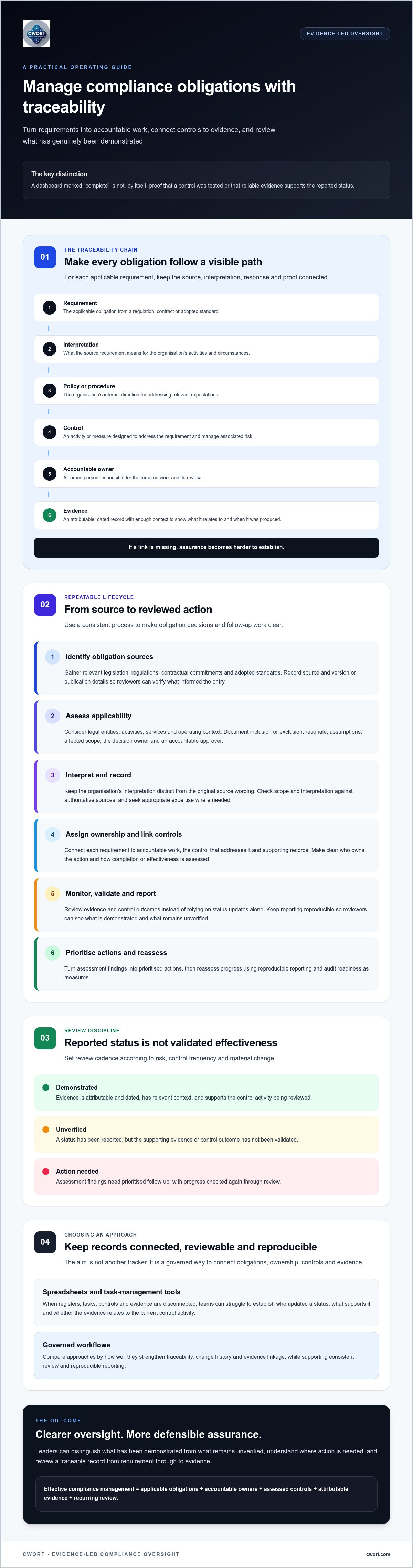
What if your compliance status looked complete on a dashboard but couldn’t be traced back to tested controls and reliable evidence? For leaders asking how to manage compliance obligations effectively, that distinction matters. Requirements spread across regulations, policies, spreadsheets and task-management tools can leave teams unsure who owns each obligation, what evidence supports it, and whether reported progress reflects genuine control effectiveness.
The answer isn’t another tracker. It’s a repeatable operating process that turns applicable obligations into accountable work, connects each requirement to controls and evidence, and makes review consistent. Without that traceability, leadership reporting can create confidence without providing defensible assurance.
This guide sets out a practical lifecycle for identifying and interpreting obligations, assigning ownership, validating controls and reviewing evidence. It explains how to maintain clear links from requirements to accountable owners, control outcomes and supporting records, then produce reproducible reporting for management decisions and regulatory scrutiny. The result is a more disciplined way to move from fragmented compliance activity to evidence-led oversight.
Key Takeaways
- Learn how to manage compliance obligations effectively by connecting each applicable requirement to an accountable owner, relevant controls and supporting evidence.
- Use a repeatable lifecycle to identify obligation sources, assess applicability, record interpretations and schedule reviews.
- Compare spreadsheets, task tools and governed workflows to choose an approach that strengthens traceability, change history and evidence linkage.
- Set review cadence according to risk, control frequency and material change, and distinguish reported status from validated control effectiveness.
- Turn assessment findings into prioritised actions, then reassess progress using reproducible reporting and audit readiness as measures.
Table of Contents
- What does it mean to manage compliance obligations effectively?
- How do you identify, interpret and maintain compliance obligations?
- How to Assign Ownership and Link Obligations to Controls
- How can you monitor, validate and report compliance obligations?
- How can you improve compliance management and prove progress?
What does it mean to manage compliance obligations effectively?
Effective compliance management connects each applicable obligation to an accountable owner, the controls that address it, evidence of how those controls operate, and a recurring review. Locating a requirement or adding it to a register is only the first step. Organisations also need to establish what it means for their activities and demonstrate how they respond. This is the practical challenge behind how to manage compliance obligations effectively.
Start by distinguishing the source requirement from the organisation’s interpretation and response. A regulation, contractual commitment or adopted standard may describe what is expected, but applicability depends on the organisation’s activities, structure and circumstances. Check scope and interpretation against authoritative sources, and seek appropriate expertise where needed. The Regulatory compliance overview provides general context, but it does not determine whether a particular requirement applies to your organisation.
Disconnected registers create risk because the obligation, assigned work, control and evidence may sit in separate spreadsheets or task tools. A status marked “complete” can then be difficult to verify. Who updated it? What evidence supports it? Does that evidence relate to the current control activity? Without clear links and provenance, reviewers may struggle to distinguish a reported position from a validated one.
How is an obligation different from a policy or control?
An obligation is a requirement that the organisation must assess and interpret in context. A policy sets internal direction on how the organisation intends to meet relevant expectations. A control is an activity or measure designed to address a requirement and manage the associated risk. These terms are connected, but they are not interchangeable.
For example, an organisation might translate an applicable requirement into an internal policy, then establish a control with a named owner and defined evidence. The evidence could be a dated record showing that the activity took place. The traceable chain is requirement, interpretation, policy or procedure, control, owner and evidence. If one link is missing, assurance becomes harder to establish.
What should effective compliance management demonstrate?
For every obligation, reviewers should be able to establish who is accountable, what action is required, which control addresses it, and how completion or effectiveness is assessed. Evidence should be attributable and dated, with enough context to show what it relates to and when it was produced. This makes review and challenge more disciplined than relying on an owner’s status update alone.
Effective compliance management makes each applicable obligation traceable to an accountable owner, an assessed control and attributable evidence, then tests that chain through recurring review. That gives teams a practical basis for oversight and helps leadership see what has been demonstrated, what remains unverified and where action is needed.
How do you identify, interpret and maintain compliance obligations?
A reliable register starts with a controlled lifecycle, not a collection of copied requirements. To determine how to manage compliance obligations effectively, separate the authoritative source from your organisation’s interpretation, decision and operational response. The effective compliance management system guidance from the University of Pittsburgh School of Law also emphasises assessing requirements and assigning responsibility as foundational steps.
- Identify sources. Gather relevant legislation, regulations, contractual commitments and adopted standards. Record each source and its version or publication details so reviewers can verify what informed the entry.
- Assess applicability. Consider the organisation’s legal entities, activities, services and operating context. Document whether each requirement is included or excluded, the rationale and assumptions, the affected scope, a named decision owner and an accountable approver.
- Interpret the requirement. Translate applicable source text into a clear statement of what the organisation needs to address. Keep this interpretation distinct from the original wording, internal guidance and voluntary standards.
- Record the obligation. Keep the source, interpretation, applicability decision, approval, affected scope and review date together. Link each entry to the relevant policy, control and evidence process where known.
- Assign accountability. Name the role responsible for coordinating the response and the owner responsible for carrying out or overseeing related control activity.
- Review and update. Reassess entries when requirements, organisational activities or relevant frameworks change, and retain the decision history.
How should an organisation decide which obligations apply?
Start with what the organisation does, the services it provides, where and how it operates, and the commitments it has made through contracts. Adding a framework name to a register does not establish applicability. Record the evidence and reasoning behind each decision, including assumptions and exclusions. If scope or meaning is uncertain, escalate it to suitably qualified legal or regulatory specialists rather than recording an unresolved judgement as settled.
How can obligation registers remain current?
Assign named owners to monitor relevant regulatory, framework and organisational changes, then define how potential changes are assessed and approved. Version entries and retain prior wording, change rationale, review dates and approval records. This lets reviewers see what changed and why, rather than relying on a silently overwritten register. Where DORA may apply, use a relevant DORA compliance validation guide alongside authoritative sources and appropriate specialist review. A governed workflow can help organise review and validation. See information about CWORT’s compliance validation workflow in relation to your register requirements.
How to Assign Ownership and Link Obligations to Controls
Once an obligation has been assessed as applicable, make its route into operational work explicit. A clear map connects the requirement to controls, named roles and evidence. This lets teams see not only whether a task was completed, but whether the control’s intended outcome was assessed. That traceability is central to how to manage compliance obligations effectively.
Choose the method that gives reviewers a clear route from source requirement to control result. A task marked complete confirms that an activity was recorded; it does not, by itself, demonstrate that the control operated as intended. Evidence needs to be relevant to the control, attributable and reviewable. For more on preserving trust in supporting records, consult the article on compliance evidence integrity, where available.
What should an obligation-to-control map contain?
For each entry, record the obligation reference, applicability rationale, mapped control, accountable owner and evidence requirement. Add the control frequency, validation approach, current status and material dependencies. This detail clarifies what is expected and what would count as adequate support for an assessment.
Where requirements overlap, framework crosswalks can map shared controls to multiple frameworks and reduce repeated assessment. Keep requirement-level references visible, however. A shared control does not make the underlying obligations identical or remove the need to assess each one in context.
How do you make accountability and separation of duties visible?
Distinguish who performs a control, who reviews its evidence and who approves the result. Assign these responsibilities by role, with escalation paths suited to the organisation’s governance. CWORT provides separation-of-duties capability within its compliance validation workflow. This supports visible role separation but does not determine regulatory interpretation. Its compliance validation platform is designed to bring control execution and evidence into a governed view.
How can you monitor, validate and report compliance obligations?
Monitoring turns an assigned control into an ongoing assurance process. Set review dates according to the obligation’s requirements, the risk being managed, how often the control operates and any material change to the organisation or its environment. A frequently performed control may need evidence checks at a different interval from a control reviewed periodically. Reassess the schedule when assumptions change, because a fixed calendar alone may miss emerging issues.
Separate self-reported status from validated evidence. An owner’s update can show that work is reported as complete, but it doesn’t establish that the control operated as intended. Review evidence against defined criteria, record who assessed it and capture the result. If evidence is missing, out of date or insufficient, mark the control as unverified or raise an exception rather than implying assurance.
What makes compliance evidence useful for assurance?
Check whether each record is relevant to the control outcome, attributable to a source or owner, dated, and clear about the activity or period it supports. Retain review decisions and subsequent changes so another reviewer can reproduce how the conclusion was reached.
Evidence supports assurance only when it substantiates the control outcome, not merely the activity reported as complete.
Use a consistent exception process. Assign an accountable owner, describe the evidence gap or control failure, set a proportionate remediation action and track it to closure. Record the closure rationale and validation performed. Don’t close an issue solely because an action was marked complete.
How should compliance status reach executives and auditors?
Provide concise reporting that shows obligation coverage, control status, evidence gaps, overdue remediation and material changes. Make clear which results are self-reported and which have been validated. Executives need a readable view of exposure and decisions required; auditors need a route from the summary to the relevant obligation, control, evidence and review history.
Keep reporting logic consistent between review cycles so status changes are explainable and comparable. Where workflow design needs deeper treatment, use a relevant regulatory compliance workflow automation guide alongside your organisation’s governance requirements.
If you’re assessing how to manage compliance obligations effectively, check whether your current process can reproduce a control decision from its underlying evidence and history. The CWORT demonstration page describes a governed compliance validation workflow that you can consider against that review.
How can you improve compliance management and prove progress?
Improvement should follow a repeatable maturity loop: assess gaps, prioritise actions, assign owners, validate remediation and reassess. This closes the gap between identifying a weakness and demonstrating that it has been addressed. To decide how to manage compliance obligations effectively, measure progress through evidence and repeatable outcomes, not the number of actions marked complete.
How do you prioritise remediation without losing accountability?
Rank actions using documented risk, business priority, effort and expected value. Record why an action takes precedence so decisions can be explained when priorities compete. Then assign each action an accountable owner, target date, evidence requirement and review point. Reassess the relevant control before confirming closure. Declared completion is a status, not proof that the underlying gap has been resolved.
Review the cycle as a whole. Are the same evidence gaps recurring? Do ownership or approval paths need clarification? Are mapped controls supporting more than one applicable framework? These questions help leaders distinguish genuine improvement in control performance from a change in reporting alone.
When is a compliance validation platform worth evaluating?
Consider a governed platform when multiple frameworks, teams or evidence sources make it difficult to reconstruct how a control decision was reached. Evaluate the approach against clear criteria:
- Reproducibility: Can reviewers follow the same evidence and assessment logic to understand a result?
- Governance: Are ownership, review responsibilities and change history visible?
- Cross-framework mapping: Can shared controls support multiple mapped frameworks without losing requirement-level detail?
- Audit readiness: Can reporting be traced back to control outcomes and supporting records?
CWORT is an enterprise compliance validation and operating-model platform that maps controls across frameworks, structures execution activities and binds evidence to control outcomes. Its deterministic scoring and audit history support reproducible reporting, while cross-framework mapping can make shared controls visible across assessments. The platform works above existing security tooling, bringing evidence from those tools into a governed view. These capabilities support assessment and reporting; they don’t replace regulatory interpretation or guarantee compliance.
Test a workflow with a controlled pilot focused on one real sub-function. Assess whether owners can complete their activities, reviewers can validate evidence and leaders can reproduce the resulting view. Read about the CWORT platform to consider whether this approach fits a specific compliance challenge.
Turn compliance obligations into demonstrable progress
Effective compliance is a disciplined cycle: identify and interpret applicable obligations, assign accountable owners, connect requirements to controls and evidence, then review and validate results. Keep applicability decisions and changes traceable, and treat reported completion as a starting point for assurance, not proof of control effectiveness.
That is the practical foundation for how to manage compliance obligations effectively. Prioritise gaps with clear rationale, assign each action an owner and review point, and confirm closure through reassessment. The result is reporting that helps leaders understand what has been demonstrated, what remains uncertain and where action is needed.
CWORT supports this approach with deterministic, reproducible assessment results linked to control evidence, alongside cross-framework control mapping and separation-of-duties capabilities. These help structure governed execution and reporting; they don’t replace regulatory interpretation or guarantee compliance.
Bring one real compliance challenge to a focused evaluation. Request a CWORT demonstration to explore how a governed workflow could support your organisation’s requirements. With clear ownership and evidence-led review, you can build a more consistent, defensible approach to compliance.
Frequently Asked Questions
What is the most effective way to manage compliance obligations?
The most effective approach is a governed lifecycle that links each applicable requirement to an owner, control, evidence and recurring review. To decide how to manage compliance obligations effectively, document applicability, set approval and escalation points, and track changes. Measure progress through validated control outcomes, not register completion alone. Tailor the process to organisational scope, and seek qualified legal or compliance advice where interpretation is uncertain.
How do you identify which compliance obligations apply to an organisation?
Compare authoritative sources with the organisation’s activities, services, operating context and relevant commitments. For each potential obligation, record the applicability decision, rationale, affected scope, assumptions and approver. If interpretation is uncertain, escalate it to a qualified legal or compliance specialist rather than treating it as settled. Revisit the decision when the organisation, its services or relevant requirements change. A framework won’t necessarily apply in the same way to every organisation.
Can a spreadsheet be used to manage compliance obligations effectively?
Yes, a spreadsheet can work for a small, stable register if access is controlled, ownership is clear, version history is retained and reviews happen consistently. As obligations, teams or evidence sources grow, manual updates can make traceability and reporting harder to govern. Before moving to a structured workflow, compare options against evidence linkage, change history, separation of duties and reproducibility. The right choice depends on the complexity and oversight needs of the organisation.
How often should compliance obligations be reviewed?
Set review frequency according to each obligation, its associated risk, the control cycle and the likelihood of change. Review promptly when relevant requirements, frameworks, services or organisational responsibilities change. Record the review date, decision, owner and supporting evidence. A single annual review may not be sufficient where obligations or operational controls need more frequent monitoring. Use defined review triggers as well as scheduled checks so material changes aren’t left until the next calendar review.
What evidence should an organisation retain to demonstrate compliance?
Retain evidence that relates directly to the control, identifies its source or owner, and is current for the period being assessed. Record how reviewers assessed it and the outcome they reached. Keep relevant approvals, exceptions and remediation records so the decision can be understood later. Evidence requirements vary by obligation, so confirm them against applicable authoritative requirements and internal policies. A file’s presence alone doesn’t show that it supports the control outcome.
How can an organisation prove that its compliance controls are effective?
Define the intended outcome of each control and the criteria used to assess it. Gather relevant evidence for the period under review, test it against those criteria, and record the result, reviewer and any exceptions. Assign corrective actions and confirm closure through reassessment. A completed task or approved policy isn’t, on its own, proof that a control operated effectively. The assessment should show what was checked and how the evidence supports the conclusion.
When should an organisation consider compliance management software?
Consider software when multiple frameworks, teams or evidence sources make traceability, version control and reporting difficult to maintain manually. Define the operating requirements first, then assess access governance, evidence protection, audit history and reproducibility. Test a focused workflow against a real organisational sub-function before wider adoption. A platform such as CWORT can structure compliance execution and link evidence to control outcomes, but software doesn’t replace regulatory interpretation or accountable decisions.
Disclaimer
The content on this site is provided for general information and educational purposes only. It does not constitute legal, regulatory, financial, or professional advice. CWORT provides AI-assisted insights and workflow automation, but all compliance decisions remain the responsibility of your organisation and its management. Always seek qualified legal or regulatory guidance for decisions relating to the UK NIS Regulations, CAF, DORA, NIS2, ISO 27001, or other obligations.
Related posts
Streamlining Regulatory Compliance Processes: From Manual Tracking to Orchestrated Validation
Stop wasting money on manual compliance. Learn about streamlining regulatory compliance processes to reduce personal liability under DORA & NIS2 and gain aud...
The Strategic Risks of Using Excel for Compliance Management in 2026
Discover the strategic risks of using Excel for compliance management. Learn why spreadsheets fail audits and how to build an audit-ready framework for 2026.
Mastering the Regulatory Obligation Execution Workflow: A Guide to Auditable Certainty
Struggling with UK compliance audits? Learn to build a regulatory obligation execution workflow for auditable certainty and replace risky spreadsheets with t...
Article by
Michael Iyiola
Co-Founder, CWORT
Michael Iyiola is a co-founder of CWORT and a Cyber and AI Security Engineer with deep experience in vulnerability management, detection engineering and operational resilience across UK critical national infrastructure, including rail, energy and financial services. At CWORT, he designs scalable, evidence-driven workflows that help teams meet modern regulatory and security demands.
Build Your Foundation of Auditable Certainty
Take control of your regulatory obligations and secure your infrastructure with CWORT.