UK NIS Evidence Management Platform: Orchestrating Auditable Compliance in 2026

Michael Iyiola
Co-Founder, CWORT
Is your NIS evidence audit-ready for 2026? A UK NIS evidence management platform orchestrates compliance, replacing risky spreadsheets to avoid £17m fines.

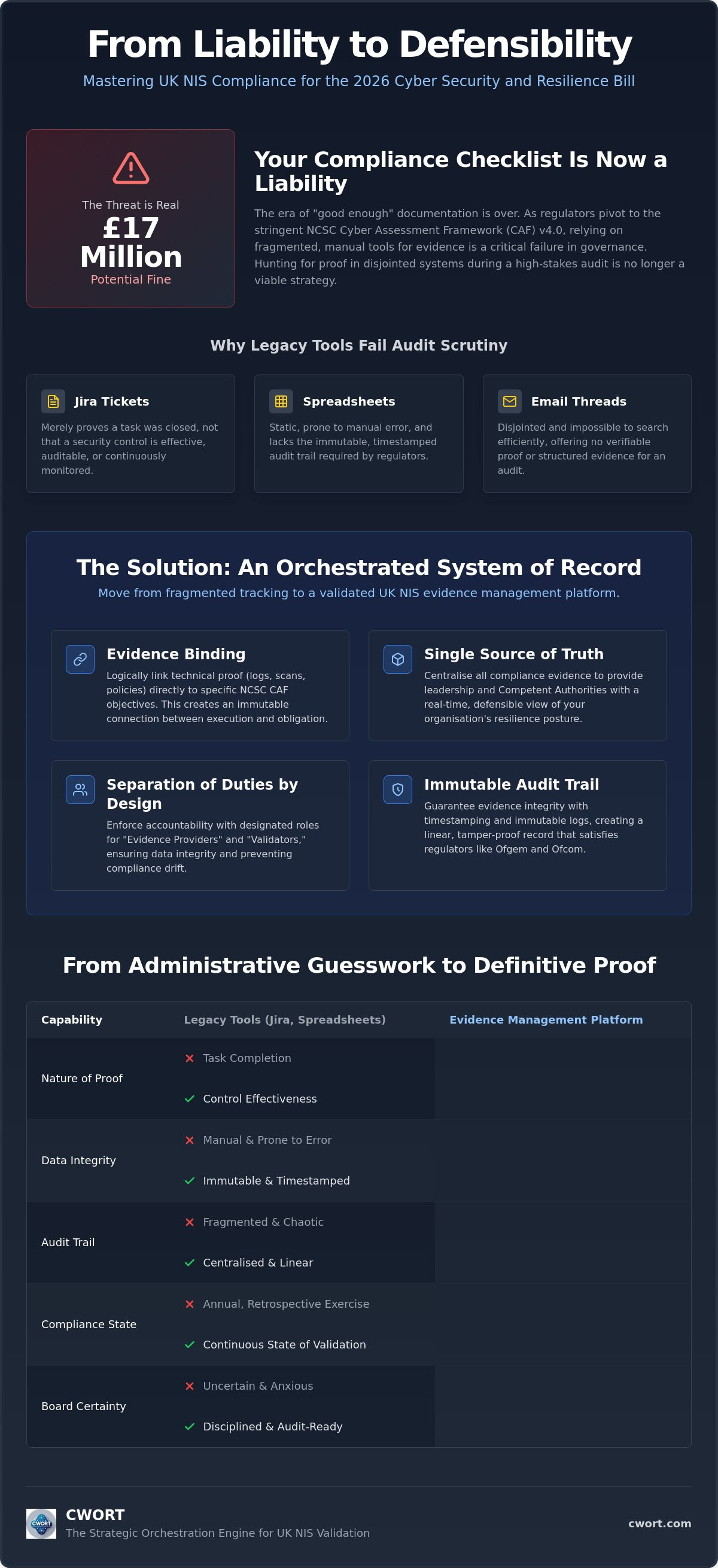
Your compliance checklist is no longer a shield. It is a liability that will crumble under the weight of the 2026 Cyber Security and Resilience Bill. As regulators pivot toward the stringent CAF v4.0 standards, the era of "good enough" documentation has ended. You likely recognise the frustration of hunting for evidence buried in Jira tickets, Excel spreadsheets, and disjointed email threads whilst the threat of a £17 million fine looms.
It is exhausting to manually reconcile fragmented data to prove "Separation of Duties" during a high-stakes audit. This article shows you how to move beyond static tracking by implementing a dedicated UK NIS evidence management platform. You will learn to replace administrative guesswork with a validated orchestration system that binds evidence directly to control outcomes. We will explore how to establish a single source of truth that satisfies Competent Authorities and provides the board with the auditable certainty they demand. By the end of this guide, you will understand the path from fragmented obligation to definitive, defensible proof of your organisation's resilience.
Key Takeaways
- Understand how a dedicated UK NIS evidence management platform transforms abstract regulatory obligations into a disciplined, orchestrated system of record.
- Learn the methodology of "evidence binding" to map technical proof directly to specific NCSC CAF objectives for total audit transparency.
- Discover why general-purpose tools like Jira and spreadsheets fail to provide the rigorous "Separation of Duties" required for modern governance.
- Build a defensible compliance strategy by systematically aligning your execution activities with the 14 core principles of the NCSC Cyber Assessment Framework.
- Explore how a strategic orchestration engine replaces fragmented tracking with a single source of truth for board-ready regulatory reporting.
Table of Contents
- Defining the UK NIS Evidence Management Platform
- The Architecture of Evidence: Binding Proof to Control Outcomes
- Why Spreadsheets and Jira Fail UK NIS Audit Scrutiny
- Building an Audit-Ready Evidence Strategy with the NCSC CAF
- CWORT: The Strategic Orchestration Engine for UK NIS Validation
Defining the UK NIS Evidence Management Platform
A UK NIS evidence management platform is a specialised orchestration system designed to translate abstract legal requirements into concrete, technical proof. Whilst law enforcement Digital Evidence Management Systems (DEMS) focus on the chain of custody for criminal prosecution, these regulatory platforms focus on the validation of technical controls and operational resilience. Their primary function is to secure the integrity of the evidence used to satisfy the UK Network and Information Systems Regulations 2018 and the more stringent requirements introduced by the Cyber Security and Resilience Bill.
Central to this process is the NCSC Cyber Assessment Framework (CAF). It serves as the definitive repository for CAF evidence, ensuring that every indicator of good practice is backed by verifiable data. Solutions like CWORT move the organisation away from the anxiety of hoping for a successful audit toward the certainty of a disciplined, audit-ready posture. By centralising this proof, leadership can maintain a real-time view of their compliance status across complex, distributed environments. It replaces the chaos of manual collection with a structured, automated workflow that guarantees data integrity.
Evidence Management vs. Compliance Tracking
Tracking a task in Jira doesn't prove a control is effective; it merely proves a ticket was closed. A true UK NIS evidence management platform requires the "binding" of evidence to specific regulatory obligations. This means a screenshot, log file, or policy document isn't just stored; it's logically linked to a specific CAF objective. Organisations must transition from a passive, retrospective checklist to an active orchestration engine that enforces accountability. This shift ensures that compliance is a continuous state of validation rather than a frantic exercise performed once a year. It's the difference between merely hoping you're secure and having the data to prove it.
The Role of the Competent Authority
Regulators such as Ofgem, Ofcom, and the Civil Aviation Authority (CAA) don't want to see your project plans. They demand a linear, tamper-proof audit trail that demonstrates sustained compliance over time. During a review, these Competent Authorities evaluate the quality and timeliness of your evidence. Defensible truth is the only currency that carries weight in these high-stakes environments. If you can't produce a validated record of a control's effectiveness immediately, you're essentially conceding a failure in governance. A robust system ensures your evidence is structured to mirror the regulator's own assessment criteria, providing total transparency and reducing the risk of significant financial penalties.
The Architecture of Evidence: Binding Proof to Control Outcomes
Modern compliance demands more than a digital filing cabinet. A robust UK NIS evidence management platform functions at the activity level, ensuring that every piece of data is tethered to a functional outcome. Validation occurs only when evidence is mapped directly to a specific NCSC Cyber Assessment Framework (CAF) objective, such as B1.a (Identity and Access Management) or B2.b (Asset Management). This architectural rigour prevents "compliance drift," where controls exist on paper but lack active, verifiable proof. Without this binding, your evidence is merely a collection of files; with it, it becomes a defensible asset that proves your resilience posture.
Translating Obligations into Execution
Complex regulatory requirements must be deconstructed into manageable execution activities to avoid organisational paralysis. Assigning clear roles is essential for maintaining accountability across the enterprise. Every activity requires a designated "Evidence Provider" to supply the raw data and a "Validator" to verify its accuracy against the standard. This creates a clear separation of duties by design. Evidence binding is the process of tethering digital proof to a specific regulatory requirement. By establishing this link, organisations create an immutable connection between what was done and why it satisfies the law, ensuring that no requirement remains unaddressed or undocumented.
Ensuring Evidence Integrity in 2026
The 2026 regulatory environment leaves no room for ambiguity or manual error. Timestamping and immutable logs are critical to prevent evidence tampering and ensure that your historical records remain defensible during a Competent Authority review. Managing diverse data types, from sprawling system logs to static policy documents, requires automated metadata tagging. This ensures every record is searchable by its framework objective, owner, and date, allowing for rapid retrieval during an audit. Ensuring compliance evidence integrity is vital for UK enterprises that wish to avoid the escalating penalties associated with the Cyber Security and Resilience Bill. These features work together to create a system that doesn't just store data but actively defends it.
If your current system relies on manual uploads without logical binding, it's time to see how orchestration can secure your future. You can explore our validation engine to see this architecture in action and move toward a state of total audit assurance.
Why Spreadsheets and Jira Fail UK NIS Audit Scrutiny
Relying on legacy tools for high-stakes regulatory environments is a strategic failure. Spreadsheets lack the inherent controls, such as immutable version history and granular access restrictions, required by modern governance standards. They are easily manipulated, which invalidates them as a source of "defensible truth" during a rigorous review. Similarly, Jira functions as a project management tool rather than a compliance validation system. It tracks the progress of tasks but lacks the auditable finality needed to satisfy a Competent Authority. A closed ticket doesn't constitute validated proof; it merely indicates that a workflow step was completed without necessarily verifying the quality of the outcome.
The Separation of Duties Problem
Regulators demand clear evidence that the person performing a control isn't the same individual validating its success. Spreadsheets and Jira tickets rarely enforce this distinction at a structural level, creating a significant audit risk. CWORT eliminates this vulnerability by enforcing a rigorous separation of duties directly within the validation workflow. This ensures that every piece of evidence is independently verified before it's finalised in the system of record. Enforcing separation of duties under DORA follows the same logic that's now essential for UK NIS compliance. Without this programmatic enforcement, your governance framework remains structurally flawed and susceptible to internal bias.
Manual reconstruction of evidence is a high-risk activity prone to human error and data loss. When an audit is announced, teams often scramble to assemble data from personal email folders and disparate local drives. This reactive approach is no longer acceptable under the 2026 regulatory regime. Regulators increasingly reject these manual trackers as insufficient for demonstrating continuous, proactive compliance. A dedicated UK NIS evidence management platform replaces this frantic manual labour with a disciplined system that's always audit-ready. It moves the organisation from a state of perpetual "audit prep" to a state of permanent readiness.
The Hidden Cost of Compliance Manual Labour
The "compliance tax" on your internal subject matter experts is staggering when using fragmented tools. Significant time that should be spent on technical security improvements is instead wasted on administrative data gathering and report generation. This inefficiency creates a hidden cost that drains resources and slows down strategic resilience initiatives. For those looking to bolster their security operations while reducing this administrative burden, you can learn more about CyberOne and their managed security solutions. Orchestration reduces this burden by automating the collection and binding process. By centralising evidence in a UK NIS evidence management platform, you reclaim thousands of man-hours and shift your focus back to defending the enterprise. This transition ensures that your experts are focused on outcomes rather than paperwork.
Building an Audit-Ready Evidence Strategy with the NCSC CAF
The National Cyber Security Centre (NCSC) Cyber Assessment Framework (CAF) is the definitive benchmark for achieving UK NIS compliance. It moves organisations away from generic security checklists toward a rigorous, outcome-based model. To build a defensible strategy, you must first map your specific organisational obligations to the 14 CAF principles. This ensures that your compliance efforts align with the legal requirements of the Cyber Security and Resilience Bill. Once mapped, identify the specific Indicators of Good Practice (IGPs) relevant to your sector. These indicators provide the granular detail needed to prove that a control is not just present, but effective.
Effective execution requires clear accountability. Assign evidence-gathering tasks to the relevant system owners across your technical and operational teams. This prevents data silos and ensures that the individuals closest to the controls are responsible for providing the proof. Finally, utilise a validation engine to confirm that the gathered evidence meets the "Achieved" status defined by the NCSC. A dedicated UK NIS evidence management platform orchestrates this entire lifecycle, ensuring that no principle is left unvalidated. It creates a disciplined path from regulatory obligation to technical reality.
Mastering the NCSC CAF Assessment
Achieving compliance requires more than a qualitative description of your security posture. You must leverage NCSC CAF assessment software to automate the scoring process and eliminate subjectivity. The framework demands a clear differentiation between "Achieved," "Partially Achieved," and "Not Achieved" statuses based on objective proof. The NCSC CAF requires proactive evidence of outcome, not just a description of intent. By automating this validation, you ensure that your assessment reflects the technical reality of your environment rather than optimistic projections. This rigour is what separates a resilient organisation from one that is merely compliant on paper.
Board-Level Reporting and Oversight
Leadership requires clarity, not clutter. A robust UK NIS evidence management platform translates granular technical evidence into high-level risk dashboards designed for board-level oversight. These visualisations allow directors to monitor progress toward compliance goals in real-time, identifying gaps before they become regulatory liabilities. This transparency is vital for the annual UK NIS submission. It provides the board with the confidence to sign off on the organisation's resilience posture, backed by a definitive system of record. It replaces vague assurances with a data-driven narrative of control effectiveness that survives any level of scrutiny.
Stop managing your CAF submission through guesswork and disjointed documents. To see how our validation engine can transform your reporting, book a demonstration of our NCSC CAF tool today.
CWORT: The Strategic Orchestration Engine for UK NIS Validation
CWORT serves as the definitive system designed to bridge the gap between abstract regulatory obligation and auditable execution. It replaces the inherent instability of fragmented tracking with a single, disciplined system of record that enforces accountability by design. Built specifically for the UK market, the platform aligns with the rigorous demands of the Cyber Security and Resilience Bill and the NCSC CAF v4.0. It moves your organisation beyond the era of manual data gathering, providing a structured environment where every technical control is backed by immutable proof. This is not merely a tracking tool; it's a validation engine that ensures your resilience posture is always defensible.
The platform generates audit-ready outputs automatically, eliminating the need for the high-risk manual reconstruction of evidence. Competent Authorities require a linear, transparent history of control effectiveness that spreadsheets simply cannot provide. By centralising your compliance data within a dedicated UK NIS evidence management platform, you ensure that every submission is accurate, complete, and verified. This systematic approach removes the ambiguity from regulatory reporting, allowing leadership to focus on strategic growth rather than the fear of non-compliance. It provides the structural integrity necessary to navigate the most demanding audit cycles with professional certainty.
From Obligation to Evidence in One System
Orchestrating the entire compliance lifecycle requires a system that can translate high-level legal requirements into granular, actionable tasks. CWORT manages this transition seamlessly, ensuring that every obligation is mapped to a specific execution activity with a clear owner and validator. The SaaS-based architecture is particularly beneficial for distributed enterprise teams, allowing for real-time collaboration and evidence submission regardless of geographical location. It breaks down the silos that typically hinder large-scale compliance programmes. You can explore how CWORT transforms your regulatory posture by replacing administrative friction with automated validation and clear, outcome-based reporting.
Ready for the 2026 Audit Cycle
Starting your orchestration journey now is a strategic imperative for any organisation within the scope of the updated NIS Regulations. The 2026 audit cycle will prioritise continuous validation over periodic snapshots, making manual processes a significant liability. CWORT reduces the friction of compliance for both IT and Legal teams by providing a shared language and a unified workspace for evidence management. It ensures that your organisation's "defensible truth" is preserved in a tamper-proof environment, ready for immediate review. Don't wait for a regulatory notice to discover the gaps in your evidence strategy. You can request a demonstration of the CWORT platform today to secure your path toward auditable certainty.
Securing Your Regulatory Future in 2026
The transition from passive tracking to active orchestration is the only way to survive the 2026 regulatory cycle. Regulators now demand definitive, technical proof that is bound directly to the NCSC CAF framework. By centralising your governance activities within a dedicated UK NIS evidence management platform, you eliminate the risks of data fragmentation and human error inherent in spreadsheets. You establish a disciplined system of record that enforces separation of duties and ensures your resilience posture remains permanently defensible.
CWORT delivers the UK-based regulatory expertise required to navigate these high-stakes environments with confidence. Our platform is already used by regulated UK enterprises to generate audit-ready outputs by design, significantly reducing the "compliance tax" on your internal subject matter experts. It's time to replace the anxiety of manual audit prep with the calm of auditable certainty. You can Request a CWORT Demonstration today to see how orchestration secures your organisation's future. Achieving total audit assurance is within your reach.
Frequently Asked Questions
What is a UK NIS evidence management platform?
A UK NIS evidence management platform is a dedicated orchestration system designed to translate regulatory obligations into a disciplined, auditable system of record. It manages the collection, binding, and validation of technical proof to satisfy the requirements of Competent Authorities. Unlike generic storage tools, these platforms ensure the integrity of evidence and guarantee that every control is backed by verifiable data.
How does the NCSC CAF relate to the UK NIS Regulations?
The NCSC Cyber Assessment Framework (CAF) serves as the definitive assessment tool used by UK regulators to measure compliance with the NIS Regulations. It provides a structured set of 14 principles and Indicators of Good Practice (IGPs) that organisations must satisfy. Achieving compliance requires you to demonstrate that you meet these specific outcomes through tangible, validated evidence rather than mere descriptions of intent.
Can I use Jira for UK NIS evidence management?
Jira is insufficient for regulatory validation because it lacks the auditable finality and structural rigour required for a high-stakes audit. Whilst it tracks task progress, it cannot enforce the programmatic "Separation of Duties" or provide a tamper-proof evidence trail. Relying on project management tools creates significant gaps in your governance framework that regulators will likely reject during a formal review.
What evidence do I need to provide to my Competent Authority?
You must provide objective proof of control effectiveness mapped directly to the 14 CAF principles. This includes system logs, configuration screenshots, and policy documents that demonstrate sustained resilience over time. A UK NIS evidence management platform ensures this data is timestamped and logically tethered to specific regulatory objectives, allowing for rapid retrieval during a Competent Authority audit.
How does CWORT handle the Separation of Duties requirement?
CWORT enforces the Separation of Duties by mandating distinct roles within every compliance workflow. It ensures that the individual responsible for providing evidence cannot be the same person who validates its accuracy. This programmatic enforcement replaces manual oversight with a disciplined architecture. It ensures that your evidence is independently verified before it's finalised in the system of record.
Is CWORT suitable for ISO 27001 as well as UK NIS?
The platform is designed to support ISO 27001 control mapping alongside its core UK NIS framework management capabilities. It allows organisations to harmonise their evidence collection across multiple standards, which reduces administrative overlap. This multi-framework approach provides a unified view of your security posture whilst maintaining the specific rigour required for each distinct regulatory obligation.
What happens if our evidence is found to be insufficient during a UK NIS audit?
Insufficient evidence leads to immediate regulatory scrutiny and potential enforcement actions. Under the Cyber Security and Resilience Bill, organisations face significant financial penalties, with fines potentially reaching £17 million for serious non-compliance. Failure to produce a defensible audit trail suggests a fundamental lack of governance, which significantly increases the likelihood of severe sanctions and reputational damage.
Disclaimer
The content on this site is provided for general information and educational purposes only. It does not constitute legal, regulatory, financial, or professional advice. CWORT provides AI-assisted insights and workflow automation, but all compliance decisions remain the responsibility of your organisation and its management. Always seek qualified legal or regulatory guidance for decisions relating to the UK NIS Regulations, CAF, DORA, NIS2, ISO 27001, or other obligations.
Related posts
NCSC CAF Assessment Software: Orchestrating UK Cyber Resilience in 2026
Ditch spreadsheets. Discover how NCSC CAF assessment software helps you meet the 2026 Cyber Resilience Bill, automate reporting, and build a defensible audit...
UK NIS Audit Readiness Software: Orchestrating Evidence-Based Compliance in 2026
Prepare for 2026 with UK NIS audit readiness software. Ditch spreadsheets and automate compliance with NCSC CAF v4.0 to avoid £17m fines. Master your audit.
How to Prove Compliance to Auditors in the UK: A Strategic Guide for 2026
Master how to prove compliance to auditors UK. Our 2026 guide helps you swap manual chaos for automated, continuous validation and regulator-ready evidence.
Article by
Michael Iyiola
Co-Founder, CWORT
Michael Iyiola is a co-founder of CWORT and a Cyber and AI Security Engineer with deep experience in vulnerability management, detection engineering and operational resilience across UK critical national infrastructure, including rail, energy and financial services. At CWORT, he designs scalable, evidence-driven workflows that help teams meet modern regulatory and security demands.
Build Your Foundation of Auditable Certainty
Take control of your regulatory obligations and secure your infrastructure with CWORT.