How to Prove Compliance to Auditors in the UK: A Strategic Guide for 2026

Michael Iyiola
Co-Founder, CWORT
Master how to prove compliance to auditors UK. Our 2026 guide helps you swap manual chaos for automated, continuous validation and regulator-ready evidence.

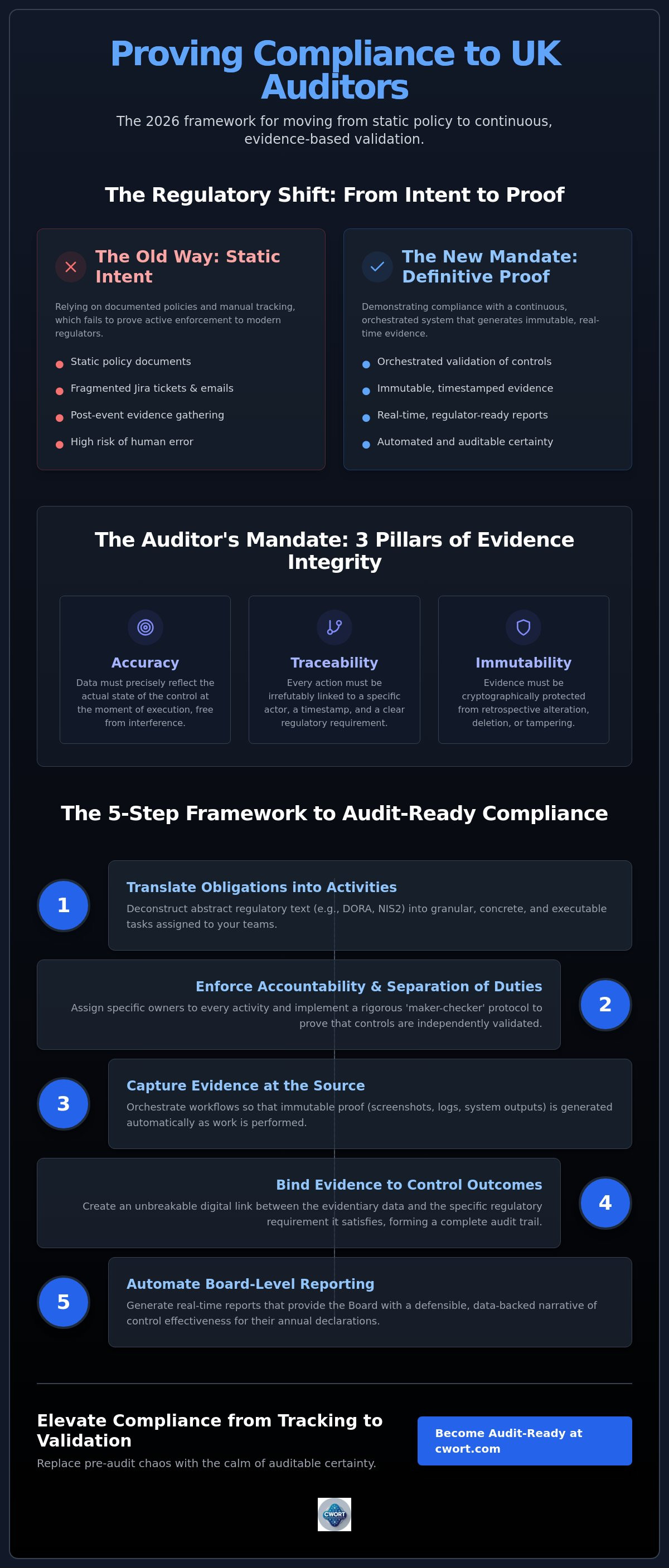
In 2026, a well-documented policy is no longer enough to satisfy a UK regulator; they now demand real-time, orchestrated validation of every control outcome. The era of "intent" has ended, replaced by a rigorous requirement for definitive proof under the updated UK Corporate Governance Code. If you’re still relying on fragmented Jira tickets, static Excel sheets, and buried email chains to demonstrate your posture, you're likely facing a significant gap in your defensibility. You aren't alone in feeling the pressure of reconstructing audit trails under tight deadlines. We understand the anxiety that comes with trying to prove separation of duties whilst manual evidence gathering consumes your team's valuable resources.
This guide establishes a clear path for how to prove compliance to auditors UK by shifting from manual tracking to a state of continuous, evidence-based validation. You'll learn how to implement a repeatable, automated process for generating regulator-ready reports that satisfy even the most demanding scrutiny. We'll explore how to ensure your evidence is immutably bound to control outcomes, replacing the chaos of pre-audit preparation with the calm of auditable certainty.
Key Takeaways
- Understand why UK regulators now prioritise continuous validation and "evidence integrity" over simple, static policy documentation.
- Learn how to prove compliance to auditors UK by replacing fragmented manual tracking with an orchestrated, definitive source of truth.
- Identify the critical "evidence integrity" gaps in spreadsheets and Jira that frequently fail to satisfy rigorous regulatory scrutiny.
- Master a structured five-step framework to translate abstract regulatory obligations into concrete, validated execution activities.
- Establish a repeatable process for binding immutable evidence to control outcomes, ensuring your organisation is always audit-ready.
Table of Contents
- Understanding the Auditor’s Mindset in 2026 UK Regulation
- The 5-Step Framework to Proving Compliance in the UK
- Why Spreadsheets and Jira Fail the UK Audit Test
- Orchestrating an Audit-Ready Compliance Trail
- CWORT: Elevating Compliance from Tracking to Validation
Understanding the Auditor’s Mindset in 2026 UK Regulation
The mindset of a UK auditor in 2026 has shifted from passive review to active interrogation. To understand how to prove compliance to auditors UK, leadership must recognise that the traditional concept of what an audit is has evolved from a point-in-time inspection into a demand for continuous validation. Regulators now prioritise "evidence integrity" over simple policy documentation. A static policy document merely signals intent; it doesn't prove execution. Auditors today require "regulator-ready" outputs defined by three non-negotiable pillars:
- Accuracy: The data must reflect the actual state of the control at the precise time of execution.
- Traceability: Every action must be linked to a specific actor and a specific regulatory requirement.
- Immutability: The evidence must be protected from retrospective alteration or tampering.
The Board's role has moved from the periphery to the centre of this process. Under Provision 29 of the 2024 UK Corporate Governance Code, which became effective for financial years beginning on or after 1 January 2026, boards are required to include a declaration in their annual report on the effectiveness of their material controls. This mandate covers operational, compliance, and reporting controls—including physical safety obligations where the fire risk assessment cost is a key consideration for budget transparency. Since the UK government decided in early 2026 not to proceed with the Audit Reform and Corporate Governance Bill, the Financial Reporting Council (FRC) remains the primary authority. Their focus is now on outcomes. They expect boards to provide a narrative of effectiveness backed by data, not just a description of a framework's existence.
For enterprises operating across borders, this narrative of effectiveness must also encompass tax and regulatory reporting; CiDATax SRL provides the specialised oversight needed to navigate these requirements across the UK, Italy, the EU, and the US.
The Evolution of Evidence: From Documents to Data
A signed PDF policy is an artifact of the past. It provides no proof of control effectiveness. Auditors now test for active enforcement. They want to see that a control was triggered, executed, and recorded without human interference. Timestamped, bound evidence is the only way to demonstrate that a control functioned as intended at the precise moment it was required. This transition from "documents" to "data" means your audit trail must be live. For example, managing software assets through a Microsoft 365 license optimization tool ensures that your compliance status is based on real-time data rather than outdated manual records. If you're reconstructing an audit trail weeks after the fact, you've already lost the auditor's trust.
Regulatory Specifics: DORA, NIS2, and UK NIS
Frameworks like DORA, NIS2, and the UK NIS share a common demand: orchestrated proof. These regulations overlap in their focus on operational resilience and supply chain security. A recurring theme in 2026 audits is the rigorous testing of "separation of duties." You must prove that the individual defining a control isn't the same person executing or validating it. Compliance validation is the process of binding evidence to specific regulatory outcomes. By using systems like CWORT, organisations can move beyond fragmented tracking into a state of definitive proof.
The 5-Step Framework to Proving Compliance in the UK
Mastering how to prove compliance to auditors UK requires a transition from passive tracking to a disciplined execution framework. It's no longer enough to maintain a register of risks; you must demonstrate that controls are active, enforced, and validated in real-time. This framework replaces the frantic manual reconstruction of audit trails with a methodical, orchestrated process that ensures you are always "audit-ready."
- Step 1: Translate obligations into activities. Deconstruct abstract regulatory text into granular, executable tasks.
- Step 2: Enforce accountability. Assign specific owners to every activity and implement a rigorous "maker-checker" protocol to ensure separation of duties.
- Step 3: Capture evidence at the source. Orchestrate workflows so that proof is generated automatically whilst the work is being performed.
- Step 4: Bind evidence to outcomes. Create an immutable link between the evidentiary data and the specific regulatory requirement it satisfies.
- Step 5: Automate reporting. Generate real-time reports that provide the Board with a defensible narrative of control effectiveness.
Translating Obligations into Action
Success begins by moving beyond a static ISO 27001 control mapping tool. Whilst mapping is a necessary foundation, it often fails because it doesn't translate into daily operations. You must map specific UK legal requirements to actual "jobs to be done" for your technical and operational teams. Every stakeholder must understand their specific contribution to the compliance posture. When an obligation is translated into a structured activity, compliance becomes a byproduct of standard workflow rather than an administrative burden. To see this transition in practice, you may request a demonstration of orchestrated validation.
Binding Evidence to Outcomes
A document repository is not an evidence system. Auditors in 2026 are trained to spot gaps between a "stored file" and a "validated outcome." Evidence binding ensures that once a control activity is completed, the proof is timestamped and locked against a specific regulatory requirement. This prevents any possibility of retroactive tampering, providing the "defensible truth" that UK regulators demand. This approach also allows for the capture of "negative evidence." You can definitively prove that unauthorised actions did not occur, such as demonstrating that no code was deployed without a secondary review. This level of granular proof aligns perfectly with the transparency expectations of the UK Corporate Governance Code, ensuring that Board declarations are backed by immutable data rather than optimistic assumptions.
Why Spreadsheets and Jira Fail the UK Audit Test
Relying on general-purpose tools like Jira or Excel to manage high-stakes regulatory requirements is a strategy built on fragile foundations. Whilst these tools are excellent for task management or basic data entry, they fundamentally lack the "Evidence Integrity" that UK auditors now demand. When considering how to prove compliance to auditors UK, you must recognise that manual trackers are easily dismissed. They lack the immutability and structural rigor required to survive a modern inspection. Auditors in 2026 view a spreadsheet not as a record of truth, but as a document prone to human error and retrospective manipulation.
The fragmentation of compliance data across disparate silos creates a significant operational risk. When evidence is scattered amongst Jira tickets, email chains, and shared drives, the organisation is forced into "Audit Fire Drills." These are the high-cost, high-stress periods where teams scramble to reconstruct an audit trail minutes before an inspection. This manual effort isn't only inefficient; it's inherently defensive. It signals to the auditor that your compliance posture is a performance rather than a lived reality. To achieve true defensibility, you must consolidate your evidence into an orchestrated system that enforces discipline by design.
This emphasis on foundational quality is a principle shared across industries; for example, just as I R. Wilson Roofing ensures the physical integrity of a building through expert craftsmanship, a digital orchestration system ensures the integrity of your compliance data.
The Limitations of General-Purpose Project Management
Jira’s greatest strength—its flexibility—is its primary liability in a regulatory context. Standard project management tools don't natively enforce "separation of duties" or provide the binding engine necessary for validation. A Jira ticket marked "status: complete" is merely a claim that a task was finished; it's not a validated control outcome. For example, achieving DORA compliance validation requires definitive proof that specific technical controls were executed by authorised personnel. In a standard task manager, there's no immutable link between the ticket and the evidentiary data, leaving a gap that auditors will inevitably exploit.
The Spreadsheet Trap: A Resilience Nightmare
Spreadsheets are a resilience nightmare for any organisation subject to FRC oversight. They suffer from chronic version control issues and the constant risk of accidental data deletion. Auditors view Excel-based compliance registers with extreme scepticism because they lack a transparent, tamper-proof audit trail. Shifting to regulatory compliance workflow automation is the only way to eliminate these manual vulnerabilities. By moving from static grids to automated workflows, you ensure that evidence is captured, bound, and protected at the point of execution, providing the auditable certainty that manual tools simply cannot offer.
Orchestrating an Audit-Ready Compliance Trail
Orchestration represents the final transition from defensive posturing to offensive confidence. To master how to prove compliance to auditors UK, you must establish a single source of truth that spans every relevant regulatory framework. It isn't just about storage; it's about active coordination. Automate your evidence collection to remove the burden from technical teams. This allows them to focus on core operations whilst the system silently captures proof of execution. By centralising these workflows, you replace fragmented silos with a disciplined, unified posture.
Real-time dashboards provide continuous monitoring, replacing the "point-in-time" anxiety of traditional audits. These dashboards allow leadership to identify where controls are failing before an auditor arrives. Perhaps most importantly, creating "Audit-Ready" views allows inspectors to self-serve information. When an auditor can access a pre-validated, immutable trail of evidence without needing to interview half your staff, their confidence in your governance increases exponentially. This transparency transforms the audit from a confrontation into a validation of your existing excellence.
Building the Single Orchestration Engine
Integrate DORA, NIS2, and ISO 27001 into a unified validation workflow. Most organisations waste hundreds of hours on redundant work because they treat these frameworks as separate projects. A unified engine maps controls across multiple standards, ensuring that a single validated activity satisfies multiple obligations. Ensuring compliance evidence integrity isn't just a regulatory checkbox; it's a competitive advantage that demonstrates operational maturity to partners and investors alike. It proves your organisation is built on a foundation of structural integrity rather than administrative luck.
Reporting to the Board and the Regulator
Translating granular technical evidence into strategic risk insights is a critical Board-level requirement. Directors don't need a list of firewall rules; they need a defensible narrative of effectiveness. Use automated reporting to produce a "Regulator-Ready" report in minutes rather than weeks. This is especially vital when preparing for the NCSC CAF assessment. Using specialised NCSC CAF assessment software ensures that your submission is structured correctly and backed by the required evidence. To see how these workflows can be automated for your organisation, you can request a demo of our orchestration engine.
CWORT: Elevating Compliance from Tracking to Validation
CWORT represents a fundamental shift in the governance landscape, moving organisations away from the administrative burden of tracking into a state of definitive validation. Whilst traditional tools act as passive repositories for completed work, CWORT functions as a proactive orchestration system that enforces discipline by design. It replaces the fragmented silos of Jira, spreadsheets, and email chains with a single, authoritative environment where every regulatory obligation is linked to a concrete execution activity. This is the definitive answer to how to prove compliance to auditors UK: you provide a system that makes non-compliance impossible by structural design.
The core of this transformation is the "Binding Engine." This technology ensures that evidence isn't merely collected but is permanently and immutably linked to specific control outcomes. In a standard audit, an inspector might question the validity of a standalone screenshot or a manually updated log. With CWORT, the evidence is captured at the point of execution and bound to the regulatory requirement in real-time. This creates a tamper-proof audit trail that satisfies the most rigorous scrutiny of the Financial Reporting Council. By enforcing this level of technical rigor, the system prevents control bypasses and unauthorised overrides, ensuring that your declared posture matches your operational reality.
As we navigate the regulatory requirements of 2026, CWORT provides built-in support for the most critical frameworks affecting UK enterprises. This includes native orchestration for DORA, NIS2, and the UK NIS Framework. Rather than managing these as isolated compliance projects, CWORT allows leadership to view their entire regulatory landscape through a single lens. This unified approach ensures that a single validated action can satisfy multiple overlapping requirements, significantly reducing the "compliance tax" on your technical teams.
The CWORT Advantage: Orchestration vs. Tracking
Orchestration is the only viable path to meeting modern UK standards because it drives the activity rather than just recording it. CWORT translates complex, abstract obligations into simple, executable tasks for your staff. This eliminates the ambiguity that often leads to control failures. When every stakeholder has a clear "job to be done" within a validated workflow, the anxiety of an upcoming inspection is replaced by the calm of "Audit-Ready" certainty. You no longer need to hope your controls are working; you have the data to prove they are.
Getting Started: From Chaos to Validation
The implementation process is designed to be methodical and non-disruptive. We begin by mapping your custom control models to the relevant UK regulatory frameworks, ensuring total alignment with your specific operational needs. Once the mapping is established, your teams are onboarded to a validated execution workflow where evidence capture becomes a natural byproduct of their daily tasks. This transition replaces the chaos of manual evidence gathering with a disciplined, automated system that is always ready for inspection. Discover how CWORT orchestrates your path to definitive compliance validation and learn how to prove compliance to auditors UK with absolute confidence.
Securing Your Regulatory Future with Orchestrated Validation
The transition from manual tracking to orchestrated validation isn't merely a technical upgrade; it's a strategic necessity. As UK regulators under the FRC shift their focus toward the continuous effectiveness of controls, organisations must move beyond the "point-in-time" audit model. You've seen why fragmented data in spreadsheets fails to provide the defensible truth required in 2026. By adopting a structured framework that binds immutable evidence directly to control outcomes, you eliminate the anxiety of reconstruction and replace it with the calm of auditable certainty.
Establishing a definitive answer for how to prove compliance to auditors UK requires a system built for the specific rigours of DORA, NIS2, and ISO 27001. CWORT, the UK-based orchestration engine by Lapace Services UK Ltd, provides the structural integrity needed to satisfy even the most uncompromising scrutiny. It ensures your board declarations are backed by data, not just documentation. It's time to take control of your regulatory narrative and lead with confidence.
Request a CWORT demo to see how we orchestrate audit-ready compliance validation. Embrace the security of a system that enforces discipline by design and protects your organisation's future.
Frequently Asked Questions
What is the difference between compliance tracking and compliance validation?
Compliance validation is the active process of binding evidence to specific control outcomes, whereas tracking is merely recording that a task occurred. Validation provides definitive proof of effectiveness whilst tracking often relies on self-reported status updates. UK auditors now prioritise validation because it demonstrates that a control functioned correctly at the point of execution, rather than just existing on a checklist. It moves the organisation from a state of administrative hope to one of auditable certainty.
How does an auditor verify "separation of duties" in a UK enterprise?
Auditors verify separation of duties by interrogating the audit trail for "maker-checker" evidence across critical workflows. They look for immutable logs that prove the individual who initiated a change is not the same person who authorised it. In a 2026 UK regulatory environment, simply pointing to a policy is insufficient. You must provide orchestrated proof that the system technically enforced this separation during every transaction, ensuring no single actor maintained end-to-end control.
Maintaining this level of accountability also relies on the integrity of the staff involved. For those seeking roles in these highly regulated environments, using WorkReferences to provide verified employment history can be an essential step in securing a job offer and demonstrating professional reliability.
Can I use Jira or Excel to prove DORA compliance to the FCA or PRA?
Jira and Excel are generally insufficient for DORA compliance because they lack the "evidence integrity" required for financial sector resilience. Whilst they can track tasks, they don't bind evidence immutably to control outcomes, leaving gaps that regulators like the FCA will exploit. To satisfy DORA's rigorous standards, organisations must move toward orchestrated systems that provide a definitive, tamper-proof record of technical validation. Relying on manual trackers introduces unacceptable risks of data deletion and retrospective manipulation.
What happens if a UK regulatory inspector arrives without advance notice?
Unannounced inspections require an immediate demonstration of your "regulator-ready" posture through self-service dashboards. If you rely on manual reconstruction, you'll likely fail to provide the necessary evidence within the inspector's timeframe. Mastering how to prove compliance to auditors UK involves maintaining a live, orchestrated source of truth that allows inspectors to verify control effectiveness without requiring extensive staff interviews. This transparency transforms a high-stakes inspection into a routine validation of your existing excellence.
How does binding evidence to a control outcome improve audit results?
Binding evidence creates an unbreakable link between a regulatory requirement and the technical proof of its execution. This eliminates the ambiguity that often leads to audit findings and "recommendations for improvement." When evidence is bound at the source, it becomes immutable, providing auditors with a high-fidelity record that requires no further explanation or context. This structural integrity significantly reduces the time spent defending your compliance posture and increases the auditor's confidence in your governance.
Is automated compliance proof acceptable for ISO 27001 audits in 2026?
Automated proof is not only acceptable but increasingly expected by ISO 27001 auditors as a sign of operational maturity. Automation removes the risk of human error in evidence collection and ensures that controls are monitored continuously rather than periodically. Providing a validated, automated audit trail demonstrates a commitment to the "continuous improvement" principle at the heart of the ISO framework. It replaces manual sampling with total population testing, leading to faster and more successful certification cycles.
How can I prove continuous compliance rather than just a point-in-time snapshot?
Proving continuous compliance requires the implementation of real-time monitoring dashboards that reflect the live state of every material control. You must move away from retrospective reporting and adopt a model where evidence is captured automatically during every operational activity. This approach provides a persistent narrative of effectiveness, ensuring you can demonstrate how to prove compliance to auditors UK at any given moment. It replaces the anxiety of the audit window with the security of constant, validated readiness.
What are the most common reasons UK auditors reject compliance evidence?
UK auditors typically reject evidence due to a lack of traceability, missing timestamps, or signs of retrospective alteration. Evidence that lives in silos, such as fragmented email chains or disconnected Jira tickets, often fails the "integrity test" because it cannot be definitively linked to a specific control outcome. Auditors require evidence that is bound, immutable, and generated at the point of execution. If the evidence appears to be reconstructed after the fact, it loses its status as a defensible truth.
Disclaimer
The content on this site is provided for general information and educational purposes only. It does not constitute legal, regulatory, financial, or professional advice. CWORT provides AI-assisted insights and workflow automation, but all compliance decisions remain the responsibility of your organisation and its management. Always seek qualified legal or regulatory guidance for decisions relating to the UK NIS Regulations, CAF, DORA, NIS2, ISO 27001, or other obligations.
Related posts
UK NIS Evidence Management Platform: Orchestrating Auditable Compliance in 2026
Is your NIS evidence audit-ready for 2026? A UK NIS evidence management platform orchestrates compliance, replacing risky spreadsheets to avoid £17m fines.
Binding Evidence to Control Outcomes for Regulatory Audits
Stop failing audits. Shift to evidence based compliance management to bind proof to controls and achieve real-time, defensible validation for DORA & NIS2.
Compliance Evidence Management Software: Proving Regulatory Readiness in 2026
Prepare for DORA & NIS2. See how compliance evidence management software replaces chaotic audit trails with a single, defensible source of truth.
Article by
Michael Iyiola
Co-Founder, CWORT
Michael Iyiola is a co-founder of CWORT and a Cyber and AI Security Engineer with deep experience in vulnerability management, detection engineering and operational resilience across UK critical national infrastructure, including rail, energy and financial services. At CWORT, he designs scalable, evidence-driven workflows that help teams meet modern regulatory and security demands.
Build Your Foundation of Auditable Certainty
Take control of your regulatory obligations and secure your infrastructure with CWORT.