Benefits of Separating Duties in Compliance: A Practical Guide

Michael Iyiola
Co-Founder, CWORT
Explore the benefits of separating duties in compliance. Learn how to map controls, reduce risk, and maintain robust audit trails with our practical guide.

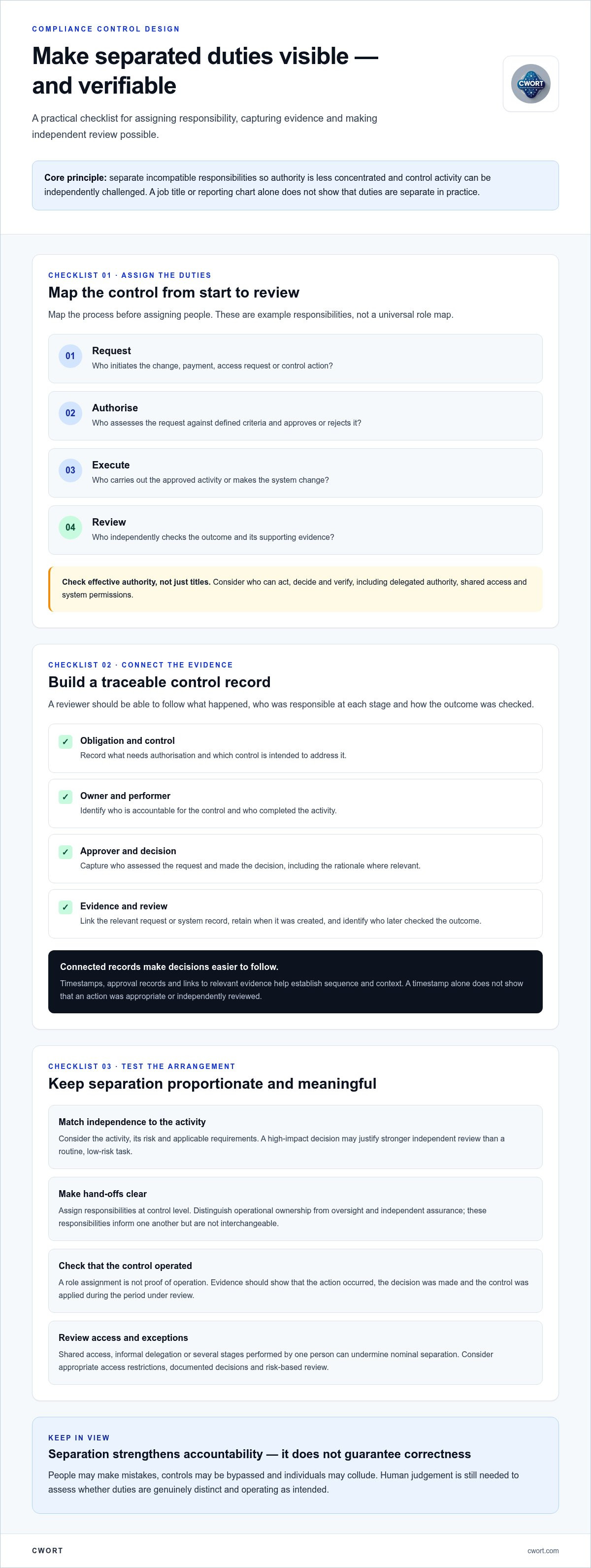
A control nobody can independently verify is only an assertion. The benefits of separating duties in compliance go beyond reducing the risk of error or misuse: clear ownership and independent review help show whether a control operated as intended. When approvals span teams and evidence sits across systems, proving that separation can take more effort than performing the control itself.
Compliance and risk leaders need proportionate oversight, not extra sign-offs for their own sake, and a documented trail that stands up to internal scrutiny and external assurance. Separation of duties won’t guarantee compliance or eliminate human judgement, but it can make accountability and review more robust.
This guide explains where separation adds practical value, how to assign and periodically review responsibilities, and what evidence shows that roles are genuinely distinct. It also looks at how structured workflows can connect ownership, execution and evidence, reducing the need to reconstruct decisions when assurance is required.
Key Takeaways
- The benefits of separating duties in compliance depend on assigning incompatible responsibilities to distinct people or roles, not simply documenting job titles.
- Trace each control from its obligation through ownership, execution, approval and review to identify gaps in accountability or evidence.
- Compare single-owner, manual-review and workflow-enforced approaches to choose a proportionate level of independence without unnecessary process.
- Map duties to specific controls, set approval points, retain relevant evidence and test that the arrangement works as intended.
- Governed workflows can structure responsibilities and connect evidence to control outcomes, making assurance easier to review.
Table of Contents
- What separation of duties means in compliance, and why it matters
- How separation of duties strengthens compliance control evidence
- Separation of duties versus single-owner controls: benefits and trade-offs
- How to design and evidence separation of duties in a compliance programme
- How CWORT supports governed separation of duties and auditable compliance
What separation of duties means in compliance, and why it matters
In compliance, separation of duties means dividing incompatible responsibilities for a process among distinct people or roles. One person may initiate an activity, another authorise it, and someone else review whether it was completed appropriately. The aim isn’t to add sign-offs by default. It is to avoid concentrating authority over consequential steps and make independent challenge possible.
A list of job titles or a reporting chart doesn’t show that duties are separate in practice. Two roles may sit in different teams but share access, or one person may perform several stages using separate accounts. Effective separation concerns who can act, decide and verify within the process, including delegated authority and system permissions. Start with the general account of Separation of duties (SoD), then apply the principle to the organisation’s actual controls.
If one individual can request, approve and record a transaction, an error or inappropriate action may pass through the process without independent scrutiny. Concentrated responsibility can also make it harder to establish accountability afterwards. The right design depends on the activity, its risk and applicable requirements. A high-impact decision may justify stronger independent review than a routine, low-risk task.
Which responsibilities should compliance teams separate?
Map the process before assigning people to its stages. Depending on the activity, incompatible duties may include:
- Requesting: initiating a change, payment, access request or control action.
- Authorising: assessing the request against defined criteria and approving or rejecting it.
- Executing: carrying out the approved activity or changing a system.
- Reviewing: independently checking the outcome and supporting evidence.
These are examples, not a universal role map. In a smaller team, practical safeguards may require a different mix of approval and subsequent review. Distinguish operational ownership from oversight as well: the first line performs and manages controls, second-line functions monitor or challenge them, and independent assurance evaluates whether governance and controls are working. These responsibilities inform one another, but they aren’t interchangeable.
What separation of duties can, and cannot, achieve
Separation of duties divides incompatible responsibilities so authority is less concentrated and control activity can be independently challenged. That is the central control purpose, and it explains the benefits of separating duties in compliance: clearer accountability, more visible approval and a stronger basis for examining how a decision was made.
Role separation doesn’t prove that every action is correct. People may make mistakes, controls may be bypassed and individuals may collude. Nor does a nominal division guarantee independence if the same person retains effective authority through shared access or informal delegation. Treat separation as one part of control design, supported by appropriate access restrictions, documented decisions and risk-based review. Human judgement is still needed to assess whether the arrangement is meaningful and operating as intended.
How separation of duties strengthens compliance control evidence
A control record is more useful when it shows what happened, who was responsible at each stage and how the outcome was checked. Separation of duties can make those relationships visible. Trace the control from the obligation it addresses through the accountable person, the activity performed, the approval decision, the evidence retained and the review completed.
For example, a control requiring access changes to be authorised might record:
- Obligation and control: what needs authorisation and the control intended to address it.
- Owner and performer: who is accountable for the control and who completed the access change.
- Approver: who assessed the request and made the decision, including the rationale where relevant.
- Evidence and review: the linked request or system record, when it was created, and who later checked the outcome.
This chain lets a reviewer follow the decision instead of inferring it from disconnected files. Timestamps, approval records and links to relevant evidence help establish sequence and context. See this guide to compliance evidence integrity for further guidance on maintaining reliable records.
From assigned roles to a traceable control record
Assign responsibilities at control level, not just by department. Make clear who performs the activity, who approves it and who reviews whether it was carried out as intended. This makes hand-offs and accountability easier to examine. A role assignment alone isn’t proof that a control operated: evidence needs to show that the action occurred, the decision was made and the control was applied during the period under review.
Keep the record connected. If evidence sits in separate systems, identify the relevant item and preserve enough context to interpret it. A timestamp can show when an action occurred, but it can’t establish by itself that the action was appropriate or independently reviewed.
Why independent review improves assurance
A reviewer who wasn’t responsible for performing or approving the activity can challenge missing support, unusual outcomes or decisions that don’t align with the control criteria. Independence depends on the reviewer’s relationship to the specific activity, not their seniority or job title. A senior manager who approved a decision may not be independent when reviewing that same decision.
Distinct responsibilities turn control activity into evidence that another person can examine, challenge and trace to an outcome. This is one practical benefit of separating duties in compliance, but it doesn’t establish effectiveness automatically. Record the reviewer’s challenge, any exceptions identified and how they were resolved. This allows assurance to assess both the evidence and the quality of the review.
Separation of duties versus single-owner controls: benefits and trade-offs
Not every control needs the same degree of independence. A single owner can make routine, low-impact work straightforward, but may leave no separate person to challenge the decision or verify the outcome. Manual review adds oversight, while a workflow-enforced approach can make responsibilities and hand-offs more consistent. Choose an approach based on the risk, process complexity and evidence required.
These are operating-model trade-offs, not guarantees. A workflow can structure approvals, but it can’t establish that a decision was sound or evidence sufficient without appropriate human review. The benefits of separating duties in compliance are clearest when independent challenge addresses a real risk, rather than adding a sign-off simply to create another step.
Where separation of duties delivers the clearest benefit
Prioritise activities involving sensitive access, consequential system changes or decisions with material impact. For example, the person requesting a privileged access change might not also authorise and implement it. A distinct approver can assess whether the request is justified; a later review can check whether the change matched the approval. This clarifies responsibility without imposing identical checks on every routine task.
For organisations assessing operational resilience obligations, the DORA compliance validation guide provides a framework-specific example of structured compliance validation for control assessment. It’s an illustration, not a reason to treat DORA as the subject of every separation-of-duties decision.
How to manage delay, small teams and competing responsibilities
Additional approvals can slow work when the control is disproportionate. Focus separation where the likelihood and impact of error or misuse justify an extra check; keep lower-risk activities simpler where appropriate. In a small team, full separation may not be practical. A documented compensating review can add a further check if it is performed by someone suitably independent of the activity.
Keep exceptions controlled rather than informal. Record why separation wasn’t practicable, who approved the exception, what review will compensate for it and when that review took place. This gives decision-makers a basis for assessing whether the trade-off remains acceptable and whether the arrangement needs to change.
How to design and evidence separation of duties in a compliance programme
Build the arrangement around the control, not an organisation chart. Connect the risk being addressed to the people who act, approve and check, then test whether the design works in practice. Keep the record specific enough to reveal conflicts across teams, systems and outsourced responsibilities.
- Identify the risk and control objective. Define what could go wrong and what the control is intended to achieve. For example, an access-change control might require a justified request and approval before implementation.
- Map the process and duties. Set out the activity steps, decision points and access needed at each stage. Identify who can initiate, authorise, execute or review actions, including permissions that could let one person bypass a hand-off.
- Assign accountable roles. Name the control owner and identify who performs each activity, approves it and reviews its operation. Map responsibilities to the specific control, not broad labels such as “IT” or “Compliance”.
- Define approvals and exceptions. Specify what the approver assesses, what happens if approval is refused and how an exception is authorised. Record the rationale and any compensating review where full separation isn’t practicable.
- Retain relevant evidence. Link the control to records showing the activity, decision and review. Capture enough context to identify the responsible roles, timing, outcome and follow-up without collecting material that doesn’t support the control.
- Test operation and review the design. Sample completed activities and check that the evidence reflects assigned responsibilities. Set review frequency according to risk and change, such as changes to the process, access or team structure, rather than applying an arbitrary interval to every control.
Map incompatible duties and assign accountable owners
Check the process end to end. Someone may appear separate from an approver in a role matrix yet hold system permissions that let them perform both actions. Include outsourced responsibilities and hand-offs between teams in the map. Record who owns remediation if a conflict emerges; otherwise, a gap may be identified without anyone being accountable for resolving it.
Repeatable ownership and execution are easier to maintain when responsibilities are structured consistently. A regulatory workflow automation guide can help frame how defined activities and hand-offs fit into a governed process.
Test operation and retain evidence of review
Use a concise role matrix or checklist to make recurring checks consistent. For each sample, confirm that the performer and reviewer were distinct where required, the approval matched the control criteria, and the evidence supports the recorded outcome. If a conflict or gap appears, document its cause, approval, remediation owner and closure evidence. Reassess the design after material changes, not only on a calendar cycle.
How CWORT supports governed separation of duties and auditable compliance
Separation of duties becomes operational when responsibilities are reflected in the workflow and evidence can be traced to the relevant control. CWORT translates obligations into structured activities, enforces separation of duties within governed workflows and binds evidence to control outcomes. It sits above existing security tools, bringing compliance and operating-model intelligence together without replacing those tools.
This structure connects a control’s purpose to its execution and supporting evidence. An activity can show who is responsible for completing a task and which evidence relates to the control outcome. The resulting view supports assurance, while human judgement remains necessary to assess whether the evidence and control design are appropriate.
From obligation to governed, reviewable execution
Role-based and attribute-based access support defined permissions within the workflow. Tenant isolation separates organisational environments, while immutable audit history preserves a record of activity. These governance features help make responsibility and events traceable. They don’t by themselves demonstrate that a control operated effectively; reviewers still need to assess the activity, evidence and outcome.
An assurance evidence register lets teams track evidence and status across controls instead of reconstructing progress from disconnected records. CWORT binds evidence to control outcomes, giving assurance a structured basis for examining what is complete and what remains outstanding. This makes the benefits of separating duties in compliance more demonstrable: responsibilities sit within a governed process and evidence remains associated with the relevant control.
Framework requirements can provide a practical lens for this work. A DORA separation-of-duties explainer, for example, can illustrate how the principle applies in a specific compliance context without making one framework a template for every organisation.
What to evaluate in a compliance validation workflow
Check whether role rules, evidence links and audit history remain visible throughout each activity, including hand-offs and review. Confirm that the workflow distinguishes assigned responsibilities and connects evidence to the control outcome, rather than merely collecting files. Deterministic, reproducible scoring supports consistent assurance; CWORT’s AI advisory provides suggestions only and does not change deterministic results.
Suggestions can inform human consideration, but shouldn’t be confused with a control decision or assurance result. A governed workflow should show what was assessed, which evidence informed the outcome and who remains accountable for decisions or remediation.
Make separation practical and provable
Choose a high-impact process and use it to test whether responsibilities are clear, review is genuinely independent and evidence is straightforward to examine. The aim isn’t to add another approval to every task. It is to establish a proportionate design that can be sustained as people, processes and systems change.
The benefits of separating duties in compliance are strongest when the control is more than a documented arrangement. CWORT enforces separation of duties within governed workflows, binds evidence to control outcomes and uses deterministic, reproducible scoring to support consistent assurance. These capabilities structure the work, while people remain responsible for applying judgement and assessing what the evidence shows.
To see how CWORT can support your compliance programme, request a CWORT demonstration. Start with one process, define what good evidence looks like and build a clearer path to assurance.
Frequently Asked Questions
Is separation of duties required in every compliance framework?
No. Requirements depend on the framework, specific control, organisation and risk context. Separation of duties is a widely useful internal-control principle, not a universal legal rule prescribing the same role split everywhere. Map applicable obligations and control criteria to the activities in scope, then document why the assigned roles meet them. A control may require authorisation without specifying which department must provide it.
Can a small team use separation of duties when there are not enough people?
Yes, although limited headcount can make full separation impractical; it doesn’t make accountability irrelevant. For example, a person completing a supplier payment might be subject to a documented review of the bank details and payment record by an owner not involved in execution. Record who performed the check and what they examined. Assess residual risk, and keep exceptions visible rather than treating different job titles as proof of independent control.
What should happen when an urgent change cannot wait for independent approval?
Define an emergency route before an urgent change occurs. Limit it to justified circumstances, such as restoring a critical service, and record who acted, the reason, the change’s scope and its timing. Arrange independent review as soon as practicable, including whether the action stayed within scope and whether follow-up is needed. An emergency exception isn’t permission to routinely bypass ordinary approval; repeated use should prompt a review of the process.
Does separation of duties prevent fraud or mistakes completely?
No. Separation can reduce concentrated authority and make some mistakes or unauthorised actions easier to identify, but it can’t eliminate risk. Collusion may defeat divided roles, while excessive system access or a cursory review can undermine the intended check. The benefits of separating duties in compliance depend on supporting controls, reliable evidence and effective challenge. Treat it as one part of risk management, not a guarantee of compliant outcomes.
How should separation of duties apply to outsourced providers?
Include outsourced work in the control map rather than treating it as outside the process. Specify who can access systems, perform tasks, approve changes and provide records, including how exceptions are escalated. A provider may execute a service while the organisation oversees whether it meets control objectives. Retain evidence of approvals and reviews, and align responsibilities with applicable contractual and regulatory requirements; outsourcing alone doesn’t transfer accountability.
Can compliance software replace an independent human reviewer?
No. Software can assign tasks, apply configured workflow rules and retain activity records, but those functions don’t determine whether evidence is persuasive or a control worked effectively. A reviewer may need to assess context, challenge anomalies and judge whether remediation is adequate. Evaluate whether the system preserves role distinctions, links records to the relevant activity and captures review decisions. Use automation to support assurance, not replace independent human judgement.
Disclaimer
The content on this site is provided for general information and educational purposes only. It does not constitute legal, regulatory, financial, or professional advice. CWORT provides AI-assisted insights and workflow automation, but all compliance decisions remain the responsibility of your organisation and its management. Always seek qualified legal or regulatory guidance for decisions relating to the UK NIS Regulations, CAF, DORA, NIS2, ISO 27001, or other obligations.
Related posts
How to Demonstrate Control Effectiveness to Regulators: A Strategic Guide
Learn how to demonstrate control effectiveness to regulators with our guide. Shift from chaos to an evidence-based, audit-ready compliance programme today.
CISO Guide to DORA Operational Resilience: Orchestrating Validated Compliance
Master validated compliance with our CISO guide to DORA operational resilience. Swap manual evidence gathering for an orchestrated, audit-ready security post...
Ensuring Compliance Evidence Integrity: A Strategic Guide for UK Enterprises in 2026
Master ensuring compliance evidence integrity for 2026. Our UK guide helps you move from risky spreadsheets to an audit-ready system for DORA & NIS2.
Article by
Michael Iyiola
Co-Founder, CWORT
Michael Iyiola is a co-founder of CWORT and a Cyber and AI Security Engineer with deep experience in vulnerability management, detection engineering and operational resilience across UK critical national infrastructure, including rail, energy and financial services. At CWORT, he designs scalable, evidence-driven workflows that help teams meet modern regulatory and security demands.
Build Your Foundation of Auditable Certainty
Take control of your regulatory obligations and secure your infrastructure with CWORT.