How to Demonstrate Control Effectiveness to Regulators: A Strategic Guide

Michael Iyiola
Co-Founder, CWORT
Learn how to demonstrate control effectiveness to regulators with our guide. Shift from chaos to an evidence-based, audit-ready compliance programme today.

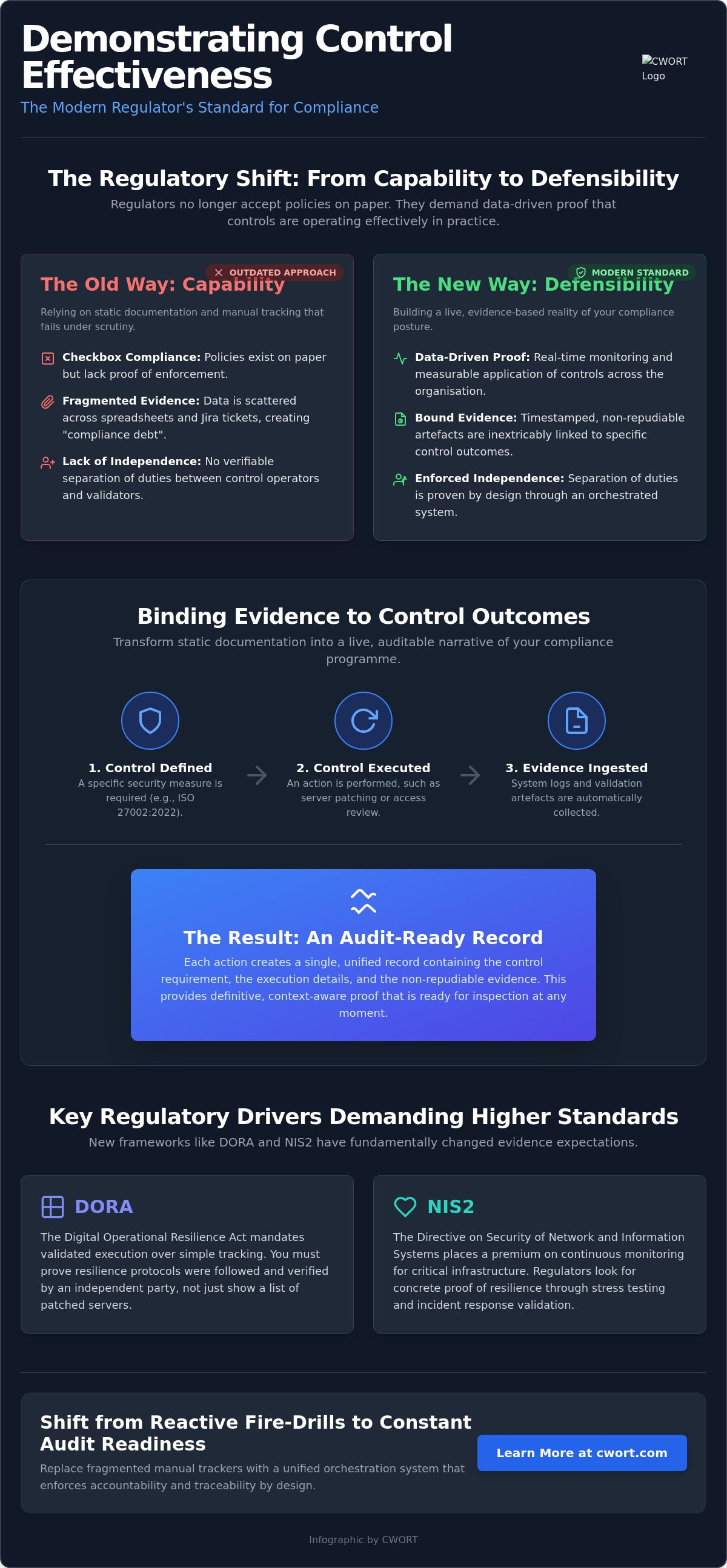
If your audit strategy relies on a collection of disconnected spreadsheets and Jira tickets, you aren't demonstrating control; you're documenting chaos. The Department of Justice’s updated Evaluation of Corporate Compliance Programs makes the new standard clear: regulators now demand data-driven proof that controls are not just designed, but are operating effectively in practice. Understanding how to demonstrate control effectiveness to regulators has shifted from a checkbox exercise to a requirement for definitive, evidence-based validation.
You likely recognise the exhaustion of chasing fragmented data whilst the anxiety of an impending audit looms. It is difficult to prove rigorous standards like the separation of duties required by ISO 27002:2022 when your evidence is scattered across the business. This guide provides a strategic framework for binding evidence directly to control outcomes, ensuring your compliance posture is always regulator-ready. We will examine the systematic process of orchestrating auditable proof to replace manual tracking with absolute certainty.
Key Takeaways
- Understand why modern regulators are shifting from policy-based capability to evidence-based defensibility to ensure your compliance programme survives high-stakes scrutiny.
- Master the systematic process of how to demonstrate control effectiveness to regulators by inextricably binding timestamped, non-repudiable evidence to specific control outcomes.
- Enforce operational independence by proving a clear separation of duties, ensuring that the individuals executing controls are never the ones validating their success.
- Shift from reactive fire-drill responses to a state of constant audit readiness by organising your data into a centralised and evidence-ready framework.
- Discover how to replace fragmented manual trackers with a unified orchestration system that enforces accountability and traceability by design.
Table of Contents
- The Regulatory Shift from Capability to Defensibility
- Binding Evidence to Control Outcomes
- Proving Operational Independence and Separation of Duties
- Steps to Organise an Evidence-Ready Compliance Programme
- Transitioning to Compliance Orchestration with CWORT
The Regulatory Shift from Capability to Defensibility
Modern regulators have moved beyond the era of trusting "checkbox compliance" that exists only on paper. High-profile data breaches throughout 2024 and 2025 have repeatedly demonstrated that a signed policy is not the same thing as a functioning control. Today, defensibility is the only currency that matters. You must transition from simply possessing a security capability to proving its consistent, measurable application across the organisation. If you can't prove it happened, in the eyes of an auditor, it didn't.
This shift is particularly evident in the UK and EU, where authorities now demand proof of a robust internal control environment that produces reliable, repeatable outcomes. Learning how to demonstrate control effectiveness to regulators means moving away from static procedural frameworks and toward a live, evidence-based reality. Regulators are no longer satisfied with "what" you intend to do; they're scrutinising "how" you actually did it during a specific window of operation. The Department of Justice’s 2024 updates to the Evaluation of Corporate Compliance Programs (ECCP) reinforce this. Prosecutors now evaluate whether compliance personnel have access to the data necessary to monitor programme effectiveness in real-time. If your data is siloed or static, you cannot meet this standard of proactive oversight.
The Impact of DORA and NIS2 on Evidence Expectations
The regulatory environment has fundamentally changed with the implementation of DORA and NIS2. Under DORA, ICT risk management mandates validated execution over simple administrative tracking. It's no longer enough to show a list of patched servers. You must prove that the patching process followed your specific resilience protocols and was verified by an independent party. Similarly, NIS2 requirements for critical infrastructure place a premium on continuous control monitoring. Regulators now look for concrete proof of resilience through stress testing and incident response validation. They want to see that your controls held firm under pressure, not just that they looked good during a scheduled walkthrough.
Why Spreadsheets and Jira Fail the Scrutiny Test
If you're still relying on manual trackers, you're building your compliance on sand. Spreadsheets and Jira tickets lack the structural integrity required to prove that evidence hasn't been tampered with or retroactively adjusted. This creates a massive "compliance debt" that organisations are forced to pay during high-pressure audit periods. Regulators increasingly reject these manual methods because they cannot enforce a separation of duties by design. They don't want to see a ticket that says a task was completed; they want to see a system-generated artefact that proves the person performing the control was not the same person validating its success. Transitioning to a platform like CWORT allows you to replace these fragmented trackers with an orchestrated system that enforces accountability automatically, ensuring every action is timestamped and auditable.
Binding Evidence to Control Outcomes
Effectiveness is proven when evidence is inextricably linked to the specific execution of a control. Simply storing a log file in a generic folder is no longer sufficient. To succeed, you must adopt a "binding" strategy where every control outcome is supported by timestamped, non-repudiable artefacts that prove exactly what happened, when it happened, and who authorised it. This approach transforms static documentation into a live narrative of compliance. It provides the definitive answer to how to demonstrate control effectiveness to regulators by ensuring that the proof is always context-aware and ready for inspection.
A robust framework requires you to automate the ingestion of evidence whilst maintaining human oversight for high-risk validation activities. This balance is vital. Whilst machines can collect logs, humans must often validate the qualitative success of complex interventions. Your evidence repository should be structured to organise data by regulatory obligation rather than by file type. This ensures that when an auditor asks for proof of NIS2 compliance, you aren't searching through a "Logs" folder; you're presenting a curated set of artefacts tied directly to that specific legal requirement. As highlighted in the Comptroller's Handbook on Internal Control, the quality and relevance of information are paramount to maintaining a sound control environment. Without this binding, your evidence is merely data without a purpose.
Technical vs Administrative Proof
Your evidence strategy must account for both technical and administrative proof. Technical proof includes system logs, configuration snapshots, and vulnerability scan results that provide objective data on system states. Conversely, administrative proof consists of meeting minutes, signed approvals, and policy acknowledgement records that document human intent and governance. Balancing these two types provides a holistic view of your control environment's behaviour. It proves that your systems are secure and that your leadership is actively steering that security. Regulators look for the intersection of these two proof points to confirm that a control is not just automated but properly governed.
Implementing Control Telemetry
Static audits are failing because they only capture a single moment in time. You need control telemetry. By capturing real-time data streams, you can identify whether a control is active or failing as it happens. This allows you to move from annual "point-in-time" assessments to continuous compliance validation. Building dashboards that translate raw technical signals into business-level effectiveness metrics gives leadership the certainty they need. If you want to see how this level of orchestration can transform your audit readiness, you can explore a tailored demonstration of these automated workflows. Moving to telemetry ensures you are never surprised by a control failure during a high-stakes regulatory review.
Proving Operational Independence and Separation of Duties
Separation of duties (SoD) serves as a primary indicator that a control is structurally sound and designed to prevent fraud. Regulators don't just ask if a control exists; they examine whether the person performing the control is the same person validating its success. This operational independence must be enforced by the system, not just suggested by a static policy. If your framework allows a single user to initiate and approve a high-risk change, your compliance posture is fundamentally flawed. Defend your position by showing a clear audit trail that documents who did what, and who verified it, in real-time.
Gaining a deeper perspective on Understanding Internal Controls reveals that organisational integrity depends on these distinct roles remaining separate. When considering how to demonstrate control effectiveness to regulators, you must move beyond verbal assurances. You need a system that makes it impossible to bypass validation steps. This provides the "compliance by design" that modern auditors expect to see during high-stakes reviews. Regulators are increasingly savvy; they know that policies can be ignored, but system-enforced workflows provide an objective truth that is difficult to dispute.
The Role of Orchestration in SoD Enforcement
Orchestrate your compliance workflows to ensure tasks are automatically routed to the correct independent parties. Move away from manual hand-offs that are prone to error or manipulation. By using a platform like CWORT, you can replace fragile verbal agreements with system-enforced duties. This ensures that every validation step is completed by a qualified, independent observer before a control is marked as "effective". This level of orchestration is particularly vital under NIS2 and DORA, where ICT risk management requires validated execution. It transforms compliance from a post-hoc reporting exercise into an active, governed process that enforces accountability amongst your team members by design.
Eliminating the Risk of Manual Reconstruction
Manual reconstruction of audit trails is often viewed by regulators as a sign of weak or failing controls. If you're spending weeks before an audit "gathering" evidence or stitching together Jira tickets, you're essentially admitting your controls aren't working autonomously in the background. Provide a system-generated history of control execution that requires no manual intervention to produce. Ensure every action is captured whilst it happens amongst the daily business operations. This level of transparency eliminates the "fire-drill" response and gives you the certainty that your evidence is always ready for scrutiny. System-generated logs are inherently more trustworthy because they remove the human element of selection and potential bias, providing a raw and honest account of your operational state.
Steps to Organise an Evidence-Ready Compliance Programme
Regulators reward organisations that can produce evidence instantly. If you're still operating in a reactive mode, you're failing the defensibility test. Shift your focus from periodic data gathering to a proactive state of constant audit readiness. This requires a disciplined approach to the integrity of the evidence lifecycle, ensuring that every artefact is captured, timestamped, and stored securely from the moment of creation. In the UK, aligning your efforts with the NCSC Cyber Assessment Framework (CAF) is essential for demonstrating resilience. This framework provides the objective benchmarks needed to satisfy high-stakes scrutiny and provides a clear roadmap for how to demonstrate control effectiveness to regulators through measurable outcomes.
Mapping Obligations to Execution Activities
Translate abstract regulatory clauses into concrete, repeatable execution activities for your subject matter experts. Assign clear accountability for each activity to ensure evidence is generated at the source, rather than being "found" later. You can achieve this alignment by linking these activities directly to a robust ISO 27001 control mapping tool. This ensures that every technical task is mapped back to a specific governance requirement, closing the gap between policy and practice. When execution is tied to obligation, the audit trail becomes a natural byproduct of daily operations.
Establishing Continuous Monitoring Cycles
Define the frequency of control validation based on the risk profile of your business processes. High-risk areas require daily or weekly telemetry, whilst lower-risk operations might only need monthly reviews. Use automated alerts to notify control owners when evidence binding has failed or is overdue. This level of oversight allows you to review effectiveness trends monthly, identifying deteriorating controls long before a regulator arrives for an inspection. Proactive monitoring transforms compliance from a "fire-drill" into a steady state of operational excellence.
Preparing Board-Level Status Reports
Summarise granular control telemetry into high-level effectiveness ratings for senior leadership. Provide the board with the auditable certainty that regulatory obligations are being met across the entire enterprise. These reports should highlight any gaps in evidence integrity, providing the objective data needed to justify strategic investments in compliance orchestration. To see how these granular insights are transformed into board-ready reports, request a tailored demonstration of the CWORT platform today. Moving toward high-level reporting ensures that leadership can defend the organisation’s posture with total confidence.
Transitioning to Compliance Orchestration with CWORT
CWORT provides a single orchestrated system that replaces the fragmented trackers and manual workflows that often cripple compliance teams. It enforces separation of duties and evidence binding by design within its central engine. This proactive approach eliminates the need for manual audit reconstruction, a process that regulators often view with suspicion. By choosing orchestration, you bridge the gap between abstract regulatory obligations and a defensible, evidence-based reality. This is the definitive answer to how to demonstrate control effectiveness to regulators with total professional confidence.
Moving to an orchestrated model ensures that your compliance posture is not a static document but a living, breathing system. Regulators value the structural integrity that comes from automated validation. When you remove the human element of manual data entry, you remove the primary source of audit failure. Transitioning to this model allows your team to focus on strategic risk management whilst the platform handles the rigorous demands of evidence collection and binding.
Generating Automated Compliance Proof for UK Regulators
Structured execution is the hallmark of a mature programme. CWORT translates complex DORA compliance validation requirements into discrete, manageable activities for your technical teams. This ensures that every action taken is recorded as auditable proof in real-time. Deliver board-level dashboards that offer a real-time view of control effectiveness and risk, removing the ambiguity from your reporting. You can also utilise the platform to manage UK NIS framework obligations with a level of precision that manual spreadsheets simply cannot match. These automated outputs are designed to satisfy the most stringent regulatory enquiries without the need for additional manual preparation.
Securing Evidence Integrity
Integrity is the foundation of any defensible posture. Ensure that every artefact bound to a control outcome is protected and traceable through its entire lifecycle. For a deeper analysis of the technical standards required for this level of rigour, consult our guide on ensuring compliance evidence integrity. By adopting these standards, you position your organisation as a mature strategic partner rather than a reactive entity. Compliance orchestration through CWORT enforces discipline by design, replacing the anxiety of potential failure with the calm of auditable certainty. Stop chasing data and start orchestrating outcomes that prove your security controls are functioning exactly as intended.
Achieving Defensible Audit Readiness
The era of static compliance is over. Defensibility now rests on your ability to prove consistent control execution through non-repudiable evidence. You've learned that effective oversight requires binding timestamped artefacts directly to control outcomes whilst enforcing a strict separation of duties. Mastering how to demonstrate control effectiveness to regulators requires a fundamental shift from manual tracking to systematic orchestration. This transition replaces the anxiety of audit failure with the calm of auditable certainty.
CWORT is built specifically for DORA, NIS2, and ISO 27001 validation. It enforces separation of duties by design and produces regulator-ready audit trails automatically. Don't wait for a regulatory enquiry to discover gaps in your evidence. Orchestrate your compliance validation with CWORT to secure your organisation's future. You can move forward with the confidence that your compliance posture is not just a policy, but a proven, defensible reality.
Frequently Asked Questions
What is the difference between control implementation and control effectiveness?
Control implementation refers to the initial setup and design of a security measure, whereas control effectiveness is the proof that the measure operates as intended over a sustained period. Implementation is merely a design state; effectiveness is an operational reality. Regulators look for outcomes, not just existence. You must move from showing a policy exists to providing timestamped evidence that the policy was enforced during every relevant transaction.
How much evidence is enough to satisfy a regulator during a DORA audit?
There is no fixed volume of evidence, but you must provide a comprehensive trail for every ICT risk management lifecycle stage. DORA requires validated execution for all critical functions. Instead of focusing on high volume, prioritise high-integrity artefacts that link specific actions to regulatory outcomes. One non-repudiable system log that proves a control worked is worth more than a dozen manual spreadsheets that lack structural integrity.
Can we use Jira or Excel to demonstrate control effectiveness to regulators?
Using Jira or Excel is increasingly insufficient because these tools lack the structural integrity to prevent tampering or prove separation of duties. Regulators often reject manual trackers because they require human intervention to reconstruct audit trails. To understand how to demonstrate control effectiveness to regulators with authority, you must replace these fragmented tools with a centralised orchestration system that captures evidence automatically as it happens.
What happens if a control is found to be ineffective during a regulatory examination?
Finding an ineffective control typically results in immediate remediation orders, increased supervisory oversight, and potential financial penalties. Regulators view an ineffective control as a systemic failure of your internal governance. Beyond fines, the reputational damage amongst stakeholders is often irreparable. You must identify and fix deteriorating controls through monthly effectiveness reviews before they are discovered by an external auditor during a high-stakes review.
How does separation of duties prove that a control is operating effectively?
Separation of duties proves effectiveness by ensuring that no single individual can bypass security protocols without independent validation. When the person executing a task is different from the person approving it, the system creates an objective check on the control's operation. This operational independence is a primary signal of a mature programme. It transforms a simple task into a governed process that is inherently more difficult to subvert or ignore.
Is continuous monitoring a mandatory requirement for UK NIS2 compliance?
Continuous monitoring is a fundamental requirement for maintaining the high premium on resilience expected under NIS2. Regulators demand proof of continuous control monitoring for all critical infrastructure entities to ensure they can withstand ICT threats. Static, point-in-time assessments are no longer acceptable. You must capture real-time telemetry that signals whether your controls are active or failing, ensuring you can respond to incidents before they escalate into systemic failures.
How do we demonstrate control effectiveness for third-party service providers?
You demonstrate effectiveness for third-party providers by requiring them to provide the same level of granular, timestamped evidence as your internal teams. The SEC’s 2024 amendments to Regulation S-P confirm that firms remain responsible for safeguarding data even when handled by vendors. You must integrate third-party control outcomes into your own orchestration engine. This ensures you have a unified view of compliance across your entire supply chain, satisfying the regulator’s focus on vendor risk.
Disclaimer
The content on this site is provided for general information and educational purposes only. It does not constitute legal, regulatory, financial, or professional advice. CWORT provides AI-assisted insights and workflow automation, but all compliance decisions remain the responsibility of your organisation and its management. Always seek qualified legal or regulatory guidance for decisions relating to the UK NIS Regulations, CAF, DORA, NIS2, ISO 27001, or other obligations.
Related posts
NIS2 Audit Readiness Tool: Orchestrating Evidence-Based Compliance in 2026
Is your NIS2 compliance built on spreadsheets? Discover how a dedicated NIS2 audit readiness tool orchestrates evidence to deliver auditable proof and certai...
CISO Guide to DORA Operational Resilience: Orchestrating Validated Compliance
Master validated compliance with our CISO guide to DORA operational resilience. Swap manual evidence gathering for an orchestrated, audit-ready security post...
Enterprise Compliance Evidence Management: A 2026 Checklist for Regulated Firms
Is your firm ready for DORA & NIS2? Our 2026 checklist for enterprise compliance evidence management shows how to replace manual tracking with a defensible, ...
Article by
Michael Iyiola
Co-Founder, CWORT
Michael Iyiola is a co-founder of CWORT and a Cyber and AI Security Engineer with deep experience in vulnerability management, detection engineering and operational resilience across UK critical national infrastructure, including rail, energy and financial services. At CWORT, he designs scalable, evidence-driven workflows that help teams meet modern regulatory and security demands.
Build Your Foundation of Auditable Certainty
Take control of your regulatory obligations and secure your infrastructure with CWORT.