Board Level Cyber Resilience Reporting Software: Bridging the Gap from Technical Control to Governance Proof

Michael Iyiola
Co-Founder, CWORT
Ditch risky spreadsheets. Discover board level cyber resilience reporting software that turns technical data into defensible, real-time proof for UK regulators.

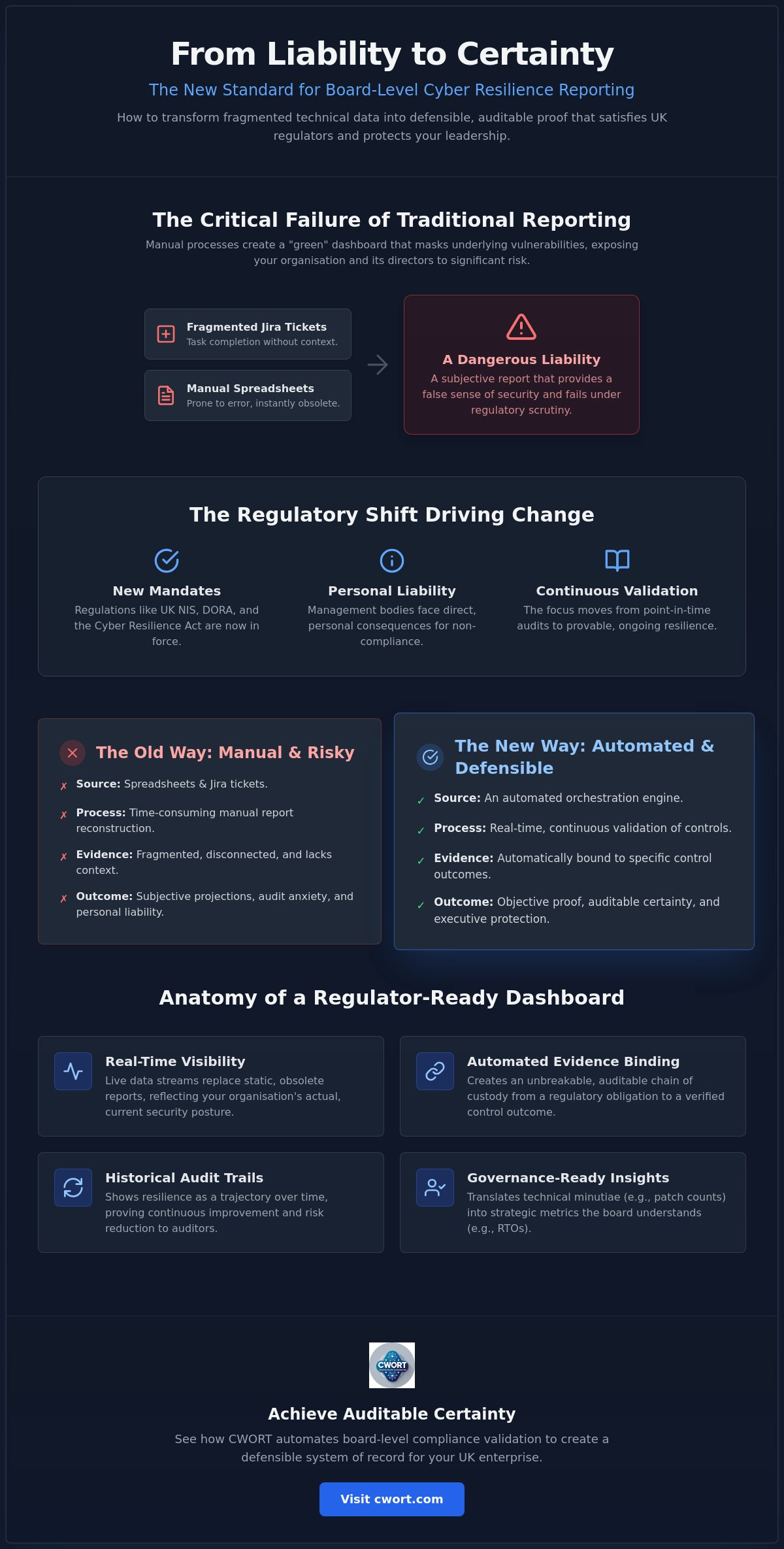
Your "green" dashboard is a liability if it lacks the underlying evidence to withstand a rigorous regulatory audit. As organisations scramble to implement robust board level cyber resilience reporting software, the margin for error has vanished under the weight of new personal liability rules. You likely spend days manually reconstructing reports from fragmented Jira tickets and Excel spreadsheets, only to present data that feels like a projection rather than proof. It's an exhausting reality amongst leaders who recognise that subjective status updates cannot protect them from the legal consequences of cyber failures.
This article demonstrates how to transform fragmented technical data into real-time, auditable reports that satisfy UK regulators and ensure executive accountability. We will explore the transition from manual tracking to automated orchestration, creating a clear separation of duties that provides the calm of auditable certainty. Discover how to bridge the gap between technical control and governance proof whilst replacing administrative anxiety with defensible, real-time evidence.
Key Takeaways
- Recognise why the shift from point-in-time audits to continuous resilience validation is now mandatory for DORA and NIS2 compliance.
- Discover how board level cyber resilience reporting software eliminates the inherent risks of manual spreadsheets by automating the binding of evidence to specific control outcomes.
- Identify the critical components of a regulator-ready dashboard that provides real-time visibility into your organisation's actual security posture.
- Master the structured workflow required to translate fragmented technical data into sophisticated, governance-ready insights for executive stakeholders.
- Learn how to leverage an orchestration engine to create a defensible system of record that satisfies the UK's increasingly stringent audit requirements.
Table of Contents
- Strategic Cyber Resilience: Why Board-Level Reporting is the New Governance Standard
- Essential Components of a Regulator-Ready Cyber Resilience Dashboard
- The Critical Failure of Spreadsheets and Jira for Resilience Validation
- Orchestrating Evidence: Moving from Subjective Claims to Objective Proof
- CWORT: Automating Board-Level Compliance Validation for UK Enterprises
Strategic Cyber Resilience: Why Board-Level Reporting is the New Governance Standard
Cyber resilience has evolved beyond a technical checkbox to become a central component of Enterprise Risk Management (ERM). It's no longer sufficient to maintain a perimeter; you must prove that your organisation can withstand, recover from, and adapt to sophisticated threats. Board-level cyber resilience reporting is the systematic translation of technical security data into governance-ready insights. It shifts the focus from administrative tracking to definitive, evidence-based proof that satisfies both internal stakeholders and external auditors.
The 2026 regulatory landscape has eliminated the concept of "reasonable effort." Under the EU NIS2 Directive and the Cyber Resilience Act (CRA), management bodies now face direct personal liability for non-compliance. This shift replaces subjective assertions with a requirement for auditable proof of control effectiveness. Organisations must move from "point-in-time" audits to continuous resilience validation. This transition ensures that resilience is not a static state but an orchestrated, ongoing process that remains visible to leadership at all times. Deploying board level cyber resilience reporting software is the only viable way to maintain this level of transparency across complex, distributed environments.
The Evolution of Accountability in UK Enterprise
UK NIS and DORA have redefined the "Duty of Care" for corporate directors. It's no longer enough to delegate security to the CISO whilst remaining detached from the outcomes. Directors must now demonstrate active oversight. Traditional Red-Amber-Green (RAG) dashboards often mask underlying vulnerabilities with subjective optimism. Regulators, including the Prudential Regulation Authority (PRA), increasingly reject manual trackers or Jira task lists as insufficient. They demand evidence-bound reporting that proves a control was not just "completed" but was effective at the moment of validation. Accountability now requires a direct link between a regulatory obligation and a verified piece of evidence. To ensure your technical security controls are robust enough to generate this evidence, you can check out CyberOne for expert managed security support.
Translating Regulatory Obligations into Strategic Metrics
Boards require metrics that align with business continuity rather than technical minutiae. They prioritise Recovery Time Objectives (RTOs) and validated control coverage over firewall logs or patch counts. Utilising the NCSC CAF Assessment Tool provides a structured resilience framework that UK firms can use to benchmark their progress. High-quality board level cyber resilience reporting software acts as the essential bridge between the Security Operations Centre (SOC) and the Boardroom. It organises complex technical evidence into a lexicon of risk and recovery that allows executives to make informed, defensible decisions. This orchestration ensures that every regulatory obligation is backed by a verifiable execution outcome, replacing anxiety with the calm of auditable certainty. Visit cwort.com to see how this transition from obligation to evidence is automated for the modern enterprise.
Essential Components of a Regulator-Ready Cyber Resilience Dashboard
A regulator-ready dashboard must transcend mere visual appeal. It needs to provide real-time visibility into regulatory obligation execution. Whether you are tracking DORA, NIS2, or ISO 27001, the data must be live. Static reports are obsolete the moment they are printed. High-performance board level cyber resilience reporting software ensures that every control outcome is visible and validated. It provides historical audit trails that show resilience as a trajectory, not a single data point. This allows the Board to see how investments in security are actually reducing risk over time, rather than just seeing a "green" status that lacks context.
Manual reconstruction of reports is the enemy of auditable truth. When teams pull data from Jira or Excel to build a board deck, the chain of custody is broken. A sophisticated dashboard automates the binding of evidence to specific control outcomes. This removes the human element from report generation, ensuring that the data presented to the Board is an accurate reflection of technical reality. It creates a defensible system of record that auditors can verify without needing to interview dozens of staff members. This level of transparency is what separates a mature governance framework from a reactive IT department.
Evidence Binding: The Core of Auditable Truth
Evidence binding is the process of attaching a specific artefact to a regulatory requirement at the point of execution. This eliminates the "Audit Gap" where teams scramble to find proof months after a control was supposedly performed. "Orphaned" evidence found in disconnected file shares or email threads is a major red flag for auditors. It suggests a lack of systematic control and an inability to trace actions back to specific mandates. Modern systems ensure non-repudiation by timestamping and cryptographically linking evidence to the control outcome. This level of rigour is essential to measure cyber resilience effectively, moving beyond technical metrics to business-focused assurance.
Enforcing Separation of Duties (SoD)
Regulators increasingly scrutinise internal governance integrity. They want to see that no single individual can bypass security controls. Separation of Duties (SoD) is a core requirement of DORA, particularly within ICT risk management frameworks. Your reporting must clearly track who performed a control and who validated it. If your current dashboard doesn't visualise this distinction, you aren't providing a complete picture of governance. Effective board level cyber resilience reporting software highlights these roles explicitly. It demonstrates to the Board that the organisation has built-in checks and balances that prevent rogue actions or administrative errors from compromising the system. You can explore how to automate these governance checks to ensure your reporting remains uncompromisingly objective and regulator-ready at all times.
The Critical Failure of Spreadsheets and Jira for Resilience Validation
Many organisations mistakenly rely on project management tools or manual trackers to manage their resilience posture. This approach creates a dangerous "Audit Gap" where the appearance of activity is confused with the proof of protection. Tools like Jira or Excel are designed for velocity and task management, not for the rigorous demands of corporate governance. Regulators now routinely reject manual trackers because they lack the necessary integrity and traceability. You cannot prove a control was executed correctly simply because a ticket was moved to "Done."
The fundamental issue lies in the conflict between a "Project Mindset" and a "Compliance Mindset." Project teams focus on getting tasks finished to maintain momentum. Conversely, auditors and regulators require proof that the task achieved the specific control outcome required by law. This disconnect is where board level cyber resilience reporting software becomes an operational necessity. It replaces subjective status updates with orchestrated, objective evidence. Without this dedicated layer of validation, your organisation remains exposed to the "Compliance Tax"—the hidden cost of senior SMEs spending hundreds of hours manually reconstructing reports for Board meetings rather than securing the enterprise.
Why Jira is Not a Compliance Orchestration Tool
Jira lacks the rigid evidence-binding required for evidence based compliance management. It's a developer-centric platform built for flexibility, which is the exact opposite of what a high-stakes audit requires. Enforcing strict regulatory workflows in such a fluid environment is nearly impossible. Fragmented data across thousands of tickets makes Board-level aggregation a nightmare of manual data mining. You cannot extract a single, defensible system of record from a tool that allows users to edit history or bypass validation steps without a permanent, immutable audit trail.
The Dangers of 'Excel-Based' Resilience
Spreadsheets are the primary source of "false positives" in modern resilience reporting. They are fragile, prone to human error, and lack any meaningful version control. When a Board reviews a spreadsheet-based report, they're often looking at "stale" data that was manually entered days or weeks prior. Specific risks of Excel-based reporting include:
- Lack of Traceability: Inability to prove who verified the data or where the original evidence resides.
- No Separation of Duties: Flat files cannot enforce or visualise the distinction between the person performing the control and the person validating it.
- Integrity Failures: Formulas can be broken and data can be manipulated, making the final report a liability in a regulatory investigation.
Relying on manual tools isn't just inefficient; it's a governance failure. To satisfy the Prudential Regulation Authority (PRA) or meet NIS2 requirements, organisations must deploy board level cyber resilience reporting software that automates the link between technical activity and governance proof. This ensures that the Board receives a real-time, validated view of resilience that is built on a foundation of auditable truth.
Orchestrating Evidence: Moving from Subjective Claims to Objective Proof
Transitioning from subjective assertions to objective truth requires a disciplined methodology. It's no longer enough for a CISO to claim that a control is "effective" based on a feeling or a spot check. High-performance board level cyber resilience reporting software provides the framework to replace these claims with definitive, evidence-based proof. This transition is achieved through a structured orchestration process that binds technical activity to regulatory requirements in real time.
To achieve a state of total assurance, organisations must follow a rigorous 5-step path to evidence orchestration:
- Step 1: Map every regulatory obligation from DORA, NIS2, and ISO 27001 into a single, unified execution workflow.
- Step 2: Define the exact evidence requirements for every control outcome to ensure there is no ambiguity during an audit.
- Step 3: Enforce execution through a validated workflow that makes evidence submission a mandatory part of the technical process.
- Step 4: Automatically aggregate this validated data into a live, Board-ready dashboard that reflects the actual resilience posture.
- Step 5: Generate regulator-ready reports instantly, eliminating the need for manual data mining or retrospective report building.
This systematic approach ensures that every data point presented to the Board is backed by a verifiable artefact. It creates a seamless link between the granular work of the technical teams and the strategic oversight required by leadership. By automating this progression, you remove the risk of human error and ensure that your governance remains uncompromisingly objective.
Defining the Execution Workflow
Success begins by breaking down complex regulations into structured execution activities. You must assign clear accountability to specific owners whilst maintaining central oversight of the entire landscape. Crucially, validation must be a mandatory step within the workflow rather than an afterthought. This ensures that no task is marked as "complete" until the required evidence has been uploaded and verified by a separate party. This disciplined structure enforces the separation of duties and provides the traceability that regulators now demand.
Continuous Validation vs. Periodic Assessment
A "live" resilience posture offers significant advantages over the traditional annual audit cycle. Periodic assessments only provide a snapshot of a moment in time, which is often outdated by the time the report reaches the Board. Conversely, regulatory compliance workflow automation allows for continuous monitoring of control effectiveness. This reduces the stress of surprise regulatory inspections and ensures that business continuity is always backed by real-time proof. You can request a demo of our orchestration engine to see how continuous validation can transform your governance from a reactive burden into a strategic asset.
CWORT: Automating Board-Level Compliance Validation for UK Enterprises
CWORT serves as the definitive enterprise orchestration engine for organisations operating in high-stakes regulatory environments. It consolidates fragmented data into a single, immutable system of record for DORA, NIS2, and the UK NIS framework. By deploying CWORT as your board level cyber resilience reporting software, you eliminate the risks associated with manual data aggregation and subjective status updates. The platform enforces discipline by design, ensuring that every claim made to the Board is backed by a validated execution outcome. It replaces administrative tracking with definitive, evidence-based proof.
The "Evidence Binding" feature is central to CWORT's architecture. It ensures that every control outcome is auditable and defensible by cryptographically linking artefacts to specific regulatory requirements at the point of action. This replaces the frantic search for proof during an audit with a structured, real-time repository of truth. When the Board asks for a status update, CWORT generates regulator-ready reports at the touch of a button. This level of automation allows senior leadership to focus on strategic risk management rather than administrative verification. It provides the structural integrity required for modern corporate oversight.
Designed for the UK Regulatory Landscape
CWORT provides specific support for NCSC CAF assessment software workflows, allowing UK firms to align with national standards seamlessly. It maps these requirements alongside international frameworks like ISO 27001 to provide a holistic view of resilience. This ensures that your organisation remains compliant with the latest operational resilience expectations set by the Prudential Regulation Authority (PRA) and the Financial Conduct Authority (FCA). By centralising these diverse mandates into a single execution engine, CWORT provides the rigorous validation required to satisfy the most demanding UK auditors. It ensures that "reasonable effort" is replaced by auditable reality across all jurisdictions.
Furthermore, operational resilience is heavily dependent on the reliability of underlying communication systems. For businesses in Essex looking to modernise their infrastructure as part of a broader continuity plan, read more about how hosted telephony solutions can enhance organisational stability.
Empowering the Board with Auditable Certainty
Leadership teams in 2026 require a "no-nonsense" approach to governance that replaces anxiety with the calm of auditable certainty. CWORT facilitates this by providing a transparent, evidence-based reporting system that leadership can trust implicitly. It removes the ambiguity of "green" dashboards that lack supporting data, offering instead a definitive record of resilience. This transition from obligation to evidence creates a sense of professional maturity and control across the entire organisation. Stop relying on manual reconstruction and start building a defensible truth. Book a consultation to see how CWORT orchestrates your Board-level resilience reporting and secures your organisation's governance future.
Securing the Future of Governance through Evidence-Based Orchestration
The transition from technical activity to governance proof is now a regulatory mandate. Boards must move beyond the "Project Mindset" of Jira tickets and spreadsheets, which fail to provide the traceability required by UK regulators. Implementing dedicated board level cyber resilience reporting software is the definitive step in moving from subjective status updates to a defensible truth. This shift ensures that resilience is not a static claim but a continuous, validated process.
CWORT provides the UK-based orchestration needed to satisfy DORA, NIS2, and UK NIS frameworks through rigorous evidence binding. It replaces manual Excel reconstruction with a proactive system that enforces discipline by design. This ensures every control outcome is auditable, removing the anxiety of personal liability and replacing it with the calm of auditable certainty. By centralising your compliance validation, you establish a single system of record that satisfies both auditors and executive stakeholders.
Establish the high-level strategic partnership your organisation deserves. Request a demo of the CWORT compliance validation platform to secure your organisation's governance future and replace manual trackers with a defensible system of record. You can lead your enterprise toward a state of total assurance with confidence.
Frequently Asked Questions
What is Board-level cyber resilience reporting software?
Board level cyber resilience reporting software is a specialised orchestration engine that translates granular technical security metrics into auditable governance insights. It moves beyond passive administrative tracking by enforcing a disciplined workflow that binds evidence to specific regulatory obligations. This ensures that every status update presented to leadership is backed by definitive, real-time proof of execution rather than subjective claims.
How does DORA affect Board-level reporting requirements in 2026?
DORA imposes direct personal liability on management bodies for systemic cyber failures, making the accuracy of reporting a legal necessity. By January 2025, firms must have established frameworks for ICT risk management and incident reporting. In 2026, the focus shifts to continuous validation. Boards must prove they have active oversight of third-party risks and operational resilience through auditable evidence that stands up to regulatory scrutiny.
Can we use our existing GRC tool for cyber resilience reporting?
Most legacy GRC tools lack the granular orchestration required for continuous resilience validation. Whilst they are effective for high-level risk registers, they often rely on manual data entry that creates "stale" reports. To satisfy modern auditors, you need a system that binds technical artefacts directly to controls. This provides a live view of your posture that static GRC platforms cannot replicate.
What is the difference between a project management tool and a compliance orchestration platform?
Project management tools like Jira prioritise velocity and task completion, which often overlooks the rigorous evidence requirements of a regulatory audit. A compliance orchestration platform, such as CWORT, enforces a rigid workflow where a task is only marked "complete" once the required evidence is validated. This distinction replaces the "Project Mindset" of getting things done with a "Compliance Mindset" of proving things were done correctly.
How does evidence binding improve our audit readiness?
Evidence binding ensures that every control outcome is cryptographically linked to a specific regulatory requirement at the moment of execution. This eliminates the "Audit Gap" where teams struggle to reconstruct reports months after an event occurred. It provides auditors with a transparent, non-repudiable chain of custody that proves your organisation's resilience assertions are based on objective reality.
What are the specific reporting requirements for NIS2 in the UK?
Under NIS2, essential and important entities must provide an initial notification of significant incidents to their national authority within 24 hours. The directive also requires management bodies to approve cybersecurity risk-management measures and oversee their implementation. Failure to maintain these standards can lead to significant financial penalties and direct oversight by regulatory bodies.
How can software help enforce separation of duties for compliance?
Software enforces the separation of duties by hard-coding distinct roles into the compliance workflow. It prevents the individual performing a technical control from being the same person who validates the evidence of its success. This creates a transparent audit trail that visualises internal checks and balances for the Board, satisfying a core requirement of the DORA framework.
What should be included in a cyber resilience dashboard for the Board?
A Board-ready dashboard should prioritise strategic metrics such as Recovery Time Objectives (RTOs) and validated control coverage across DORA or NIS2. It must include real-time visibility into obligation execution and historical audit trails that show resilience as a continuous trajectory. This allows leadership to move away from "green" status symbols toward a data-driven understanding of actual risk.
Disclaimer
The content on this site is provided for general information and educational purposes only. It does not constitute legal, regulatory, financial, or professional advice. CWORT provides AI-assisted insights and workflow automation, but all compliance decisions remain the responsibility of your organisation and its management. Always seek qualified legal or regulatory guidance for decisions relating to the UK NIS Regulations, CAF, DORA, NIS2, ISO 27001, or other obligations.
Related posts
The Shift to Compliance Orchestration Platforms: Beyond Enterprise GRC Automation
Struggling with DORA & NIS2? Move beyond failing GRC tools with a compliance orchestration platform for automated, auditor-ready evidence and real-time overs...
ICT Risk Management Reporting Software: Orchestrating Audit-Defensible Compliance in 2026
Struggling with DORA compliance? See how ICT risk management reporting software replaces manual reporting with automated, audit-ready evidence for total cert...
Reducing Audit Preparation Time and Costs: A Strategic Guide for UK Enterprises
Tired of costly audit seasons? Our guide for UK enterprises shows you how to stop the manual scramble, reducing audit preparation time and costs with automat...
Article by
Michael Iyiola
Co-Founder, CWORT
Michael Iyiola is a co-founder of CWORT and a Cyber and AI Security Engineer with deep experience in vulnerability management, detection engineering and operational resilience across UK critical national infrastructure, including rail, energy and financial services. At CWORT, he designs scalable, evidence-driven workflows that help teams meet modern regulatory and security demands.
Build Your Foundation of Auditable Certainty
Take control of your regulatory obligations and secure your infrastructure with CWORT.