ICT Risk Management Reporting Software: Orchestrating Audit-Defensible Compliance in 2026

Michael Iyiola
Co-Founder, CWORT
Struggling with DORA compliance? See how ICT risk management reporting software replaces manual reporting with automated, audit-ready evidence for total cert...

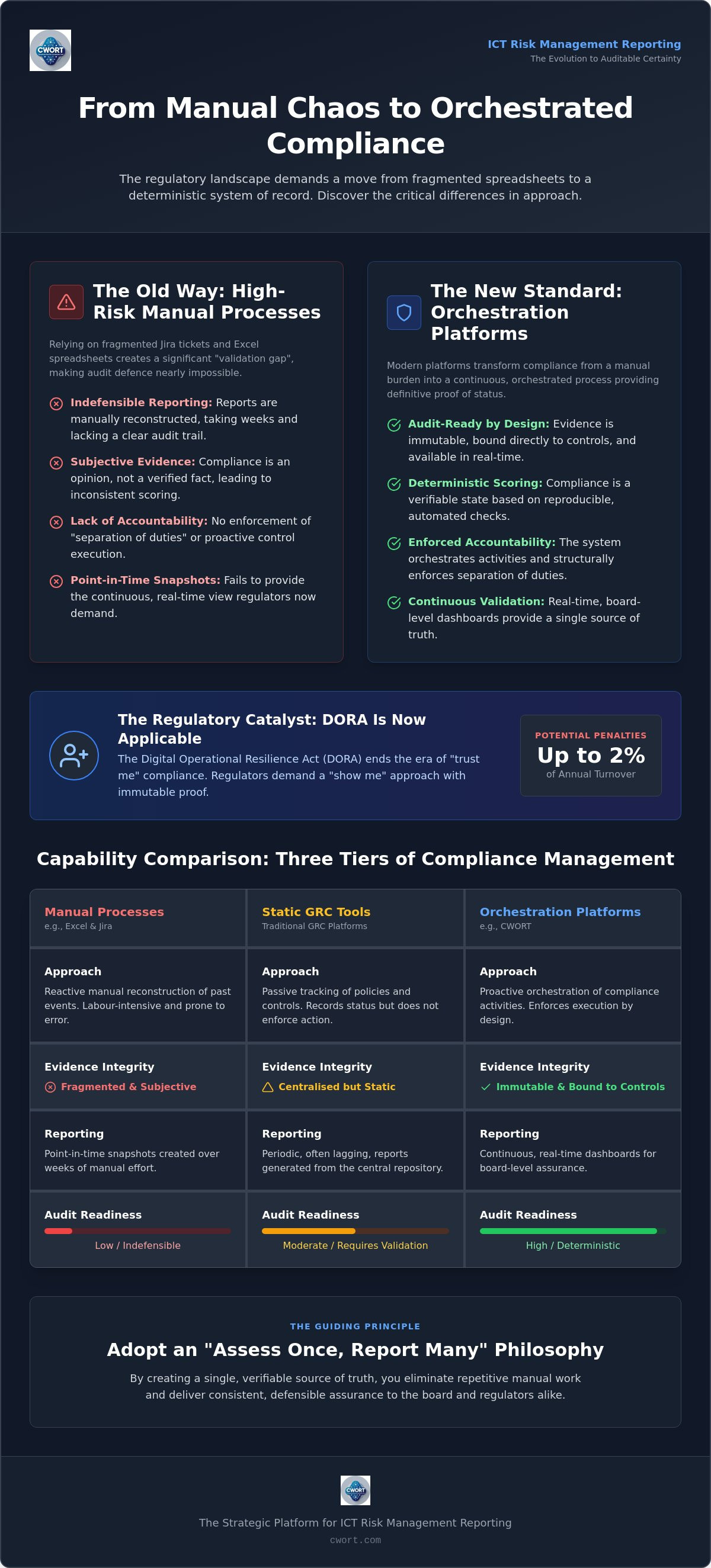
Your reliance on fragmented Jira tickets and manual Excel spreadsheets isn't just a productivity drain; it's a direct threat to your firm's regulatory standing. With DORA now fully applicable and carrying penalties of up to 2% of annual turnover, a reporting system built on manual reconstruction is no longer defensible. You must move towards a deterministic approach where every control is mapped to a framework and every piece of evidence remains immutable. Implementing the right ICT risk management reporting software is the only way to replace the anxiety of potential failure with the calm of auditable certainty.
We recognise the exhaustion of spending weeks manually reconstructing reports only to struggle with proving "separation of duties" to a sceptical auditor. This article will show you how to transition from passive tracking to a proactive orchestration layer that enforces accountability by design. You'll discover how to leverage real-time, board-level dashboards and automated evidence registers to reduce your reporting burden whilst achieving a deterministic compliance score that satisfies the most rigorous oversight requirements.
Key Takeaways
- Recognise why manual spreadsheets and fragmented Jira tracking are no longer defensible under DORA and how to transition to continuous validation.
- Evaluate ICT risk management reporting software based on its capacity for deterministic scoring and the production of immutable, audit-ready evidence.
- Identify the critical differences between static GRC tools and orchestration platforms that enforce execution and accountability across the organisation.
- Align your reporting infrastructure with specific mandates like NIS2 and UK NIS whilst ensuring robust tenant isolation and rigorous access controls.
- Adopt an "Assess Once, Report Many" philosophy to eliminate manual reconstruction and deliver consistent, board-level assurance.
Table of Contents
- The Evolution of ICT Risk Management Reporting: Beyond Manual Spreadsheets
- Core Capabilities of Enterprise ICT Risk Management Reporting Software
- Comparison: Manual Processes vs. GRC Tools vs. Orchestration Platforms
- Selecting and Implementing the Right Reporting Software
- CWORT: The Strategic Platform for ICT Risk Management Reporting
The Evolution of ICT Risk Management Reporting: Beyond Manual Spreadsheets
The regulatory environment in 2026 demands more than just a list of completed tasks. With the full applicability of the Digital Operational Resilience Act (DORA), financial entities can no longer rely on static spreadsheets to prove their resilience. Traditional methods fail because they offer only a point-in-time snapshot. Regulators now require a deterministic view of IT risk management that demonstrates continuous control and operational integrity. The era of subjective compliance is over.
This shift has exposed a significant "validation gap" in many organisations. You might have policies in place, but can you prove they were executed correctly at 2:00 PM last Tuesday? Manual reporting lacks the structural integrity required to answer this question. Moving to a dedicated ICT risk management reporting software allows you to bridge this gap by binding evidence directly to regulatory obligations. It transforms compliance from a seasonal burden into a continuous, orchestrated process that provides definitive proof of status.
For accounting and tax professionals who need to establish a formal Written Information Security Plan (WISP) before automating their reporting, click here to access specialised cybersecurity solutions.
The Failure of Fragmented Compliance Tracking
Jira and Excel were designed for project management and data entry; they weren't built for the rigours of a regulatory audit. Relying on these tools forces your team into a cycle of manual report reconstruction that can take weeks of intensive labour. This fragmentation leads to inconsistent risk scoring amongst different departments. It creates a landscape where "compliance" is a subjective opinion rather than a verified fact. Without a centralised orchestration layer, you risk presenting conflicting data to auditors, which can trigger deeper scrutiny and potential fines.
Defining Regulator-Ready Outputs in 2026
UK regulators, including the NCSC and Ofgem, have moved beyond "trust me" models of oversight. They now expect "show me" evidence that is both granular and immutable. Your ICT risk management reporting software must produce outputs that are immediately defensible. Board-level dashboards are only useful if every green light is backed by a transparent audit trail. Evidence must be immutable. Leadership teams require a real-time view of risk that they can present with confidence, knowing that the underlying data is secure, traceable, and untampered with. This is the new standard for corporate oversight.
If your firm is also exploring strategic guidance for your security posture, you might check out SeComPass for expert advisory and assurance services.
Core Capabilities of Enterprise ICT Risk Management Reporting Software
Effective ICT risk management reporting software does more than record status; it enforces the execution of compliance. It must translate the high-level guidance found in documents like NIST SP 800-221A into granular, structured activities. This ensures that every team member knows exactly what evidence is required to satisfy a specific control. By integrating directly with tools like SIEM, EDR, and IAM, the system creates a unified view of your security posture. It removes the need for manual data collection. It builds a defensible reality based on facts, not narratives. You aren't just tracking risk; you're orchestrating the very activities that mitigate it.
A robust system also enforces a strict separation of duties within the reporting workflow itself. It ensures that the individuals responsible for control execution aren't the ones validating the results. This structural integrity is vital for satisfying the rigorous demands of 2026 regulatory audits. By automating the roll-up of evidence into a single source of truth, you eliminate the "validation gap" that often plagues fragmented security stacks. The result is a system that provides total assurance to the board and regulators alike.
For many small and medium-sized businesses, maintaining the underlying infrastructure to support this level of assurance is a significant undertaking. Partnering with a specialist like Proactive Networking Ltd for managed IT support and outsourcing can ensure that your systems are always audit-ready and professionally managed.
Deterministic Scoring and Evidence Binding
Audit-defensibility relies on reproducibility. If two different auditors review the same evidence, they should arrive at the same conclusion. Modern platforms achieve this by binding evidence directly to control outcomes through deterministic scoring models. This eliminates the variability of subjective human analysis. Whilst some tools use AI for advisory purposes, systems like CWORT ensure that AI never alters these deterministic results. The score is a direct reflection of verified data. It's a binary state of compliance: either the evidence exists and meets the criteria, or it doesn't. This level of rigour is essential for maintaining trust with external oversight bodies.
Framework Cross-walks and Control Taxonomy
Managing multiple regulations like DORA, NIS2, and ISO 27001 often leads to redundant work. A sophisticated ICT risk management reporting software platform solves this through an "assess once, report many" capability. It uses a comprehensive control library, such as the 1,355 controls found in the CWORT taxonomy, to map a single activity to multiple regulatory requirements. Currently, 98.6% of active controls in our system carry specific framework references across 42 different frameworks. This allows you to maintain framework-specific reporting without duplicating effort. It organises your compliance function into a scalable operating model. If you want to see how this orchestration works in practice, you can request a platform demonstration to explore these capabilities.
Comparison: Manual Processes vs. GRC Tools vs. Orchestration Platforms
Stop treating compliance as a side project and start viewing it as a core operational requirement. Organisations typically fall into one of three maturity tiers: manual chaos, passive tracking, or orchestrated execution. Manual processes, involving Excel and Jira, are inherently indefensible because they lack traceability and evidence integrity. Traditional GRC tools offer a step up by centralising data, yet they frequently become "expensive spreadsheets" that require constant manual updates. To achieve true audit-readiness in 2026, you must adopt an orchestration engine that enforces discipline across your entire security stack.
The cost-benefit analysis of this transition is clear. Manual report reconstruction often takes weeks of intensive labour, whilst an orchestrated ICT risk management reporting software platform delivers real-time, board-ready dashboards. This automation doesn't just save time; it eliminates the human error that leads to regulatory fines. By shifting the focus from administrative tracking to deterministic validation, you ensure that every control is backed by immutable proof. This is the only way to manage high-stakes regulatory environments with absolute certainty.
Why Traditional GRC Tools Fall Short
Most GRC platforms were designed for policy management rather than technical execution. They act as passive repositories that wait for users to upload data, failing to enforce the necessary workflows to ensure compliance is maintained. This lack of enforcement creates a "validation gap" where policies exist on paper but aren't consistently applied in practice. These tools also struggle to ingest technical evidence from SIEM or EDR tools, leaving your team to bridge the gap manually. For a deeper look at solving these inefficiencies, explore our guide on Regulatory Compliance Workflow Automation for UK Enterprise. Without direct evidence integration, your GRC tool remains a disconnected island of data.
The Orchestration Advantage for UK Enterprises
Transition from simply diagnosing problems to demonstrating solutions within a single digital environment. An orchestration platform like CWORT sits above your existing security tooling, acting as a command-and-control layer for compliance. It replaces the administrative burden of manual tracking with strategic operating model intelligence. Instead of reacting to audit requests, you proactively manage your posture through an "Assess Once, Report Many" philosophy. This approach organises your cyber-security functions into a measurable, repeatable operating model that satisfies DORA, NIS2, and ISO 27001 simultaneously. You gain a unified view of risk that is both transparent to the board and defensible to the regulator.
Selecting and Implementing the Right Reporting Software
Selecting the right ICT risk management reporting software requires a shift from evaluating features to assessing operational resilience. You must first define your specific regulatory landscape, whether that involves DORA, NIS2, or the UK NIS regulations. Implementation fails when software is too rigid. Look for platforms that support "Bring Your Own Content" (BYOC), allowing you to integrate bespoke maturity models alongside standard frameworks whilst maintaining a single source of truth. Scalability is equally critical. Your chosen system should offer a comprehensive control taxonomy that can grow with your organisation's complexity. Before a full roll-out, initiate a pilot programme on a single sub-function to demonstrate an end-to-end workflow from obligation to evidence.
Security architecture must be a primary selection criterion. Evaluate every vendor for robust tenant isolation and attribute-based access controls (ABAC) to ensure that sensitive compliance data remains protected. In a high-stakes environment, the ability to restrict data access based on specific user attributes is not a luxury; it is a fundamental requirement for maintaining the "separation of duties" that auditors demand. Your reporting platform should be as secure as the systems it monitors.
A Seven-Step Assessment Process for Implementation
A disciplined implementation follows a logical progression from abstract requirement to concrete proof. Use this structured approach to ensure your reporting system is audit-ready from day one:
- Define the Model: Establish the specific regulatory frameworks and internal standards that govern your operations.
- Configure Blueprints: Create assessment templates that satisfy both internal risk appetites and external auditor expectations.
- Assign Accountability: Clearly define who is responsible for executing controls and who will validate the results.
- Capture Evidence: Use automated integrations to pull immutable data directly from your security stack.
- Deterministic Scoring: Apply reproducible scoring models to remove subjectivity from maturity assessments.
- Gap Analysis: Identify specific areas where evidence is missing or controls are failing.
- Prioritise Remediation: Focus your resources on the actions that provide the greatest reduction in business risk.
Governance and Security Requirements
Regulators in 2026 will not accept reports that can be altered after the fact. Your platform must maintain immutable audit histories for every change, providing a transparent record of who did what and when. This level of traceability is essential for Ensuring Compliance Evidence Integrity throughout the reporting lifecycle. Defensive content processing ensures that every piece of evidence is handled with the rigour required to stand up to intense scrutiny. By enforcing these standards, you move from a state of administrative tracking to one of definitive, auditable certainty.
To see how this structured implementation can transform your compliance function, request a platform demo and explore our orchestration capabilities.
CWORT: The Strategic Platform for ICT Risk Management Reporting
CWORT functions as the definitive orchestration layer for organisations that can no longer afford the risks of fragmented compliance tracking. It transforms disparate cyber-security functions into a structured, measurable operating model that aligns technical execution with executive oversight. By integrating directly with your existing security stack, this ICT risk management reporting software replaces manual data collection with a deterministic system of record. It provides the board with real-time heat maps and regulators with granular evidence registers, ensuring that your resilience is always demonstrable and never merely assumed. You move from a state of reactive reporting to a disciplined posture of auditable certainty.
The platform is designed to bridge the gap between granular technical controls and high-level governance requirements. Whilst traditional tools often leave leadership guessing about the true state of compliance, CWORT delivers a transparent view of risk backed by immutable proof. It organises your resilience activities into a repeatable workflow, allowing you to manage complex mandates like DORA and NIS2 without increasing your administrative headcount. This is the strategic partner you need to navigate the high-stakes regulatory landscape of 2026.
Operating Model and Compliance Intelligence
Sustainable resilience requires more than just meeting a checklist; it requires measuring both capability maturity and the capacity for execution. CWORT’s "Assess Once, Report Many" philosophy allows you to map a single control activity to over 42 different frameworks. With a taxonomy library containing 1,355 controls, 98.6% of which carry direct framework references, the system eliminates redundant work whilst maintaining framework-specific integrity. This intelligence is particularly vital for UK financial services navigating the complexities of European and domestic mandates. For a deeper analysis of these requirements, consult our DORA Compliance Validation Guide to understand how to structure your readiness assessments effectively.
Audit-Defensible Assurance by Design
Audit committees demand reproducibility, and CWORT delivers this through deterministic results that remain consistent regardless of who performs the assessment. This rigour is what makes the platform the preferred choice for organisations facing intense regulatory scrutiny. We leverage AI as a sophisticated advisor to guide your teams through complex remediation, yet we ensure that AI never compromises the deterministic nature of the control scoring. Every result is based on verified evidence, not algorithmic guesswork. This approach enforces a strict separation of duties and maintains a transparent audit trail that stands up to the most demanding oversight. To secure your organisation's regulatory future, enquire about CWORT Compliance Validation today and begin the transition to a truly orchestrated ICT risk management reporting software environment.
Secure Your Regulatory Standing Through Deterministic Orchestration
The transition from manual spreadsheets to orchestrated validation is no longer optional. Regulators in 2026 demand immutable evidence and deterministic results that prove compliance beyond a reasonable doubt. By adopting a system that maps controls across 42 different frameworks, you eliminate redundant effort whilst ensuring total transparency for the board. You shift the focus from mere administrative tracking to definitive, evidence-based proof.
Implementing a dedicated ICT risk management reporting software platform like CWORT allows you to manage 1,355 controls within a taxonomy designed for absolute precision. This moves your organisation from a state of compliance anxiety to one of auditable certainty. You gain the power to demonstrate resilience through a structured operating model that satisfies both auditors and executive leadership. It's time to replace fragmented data with a single source of truth.
Take the first step towards a defensible reality. Book a CWORT Pilot to Orchestrate Your Compliance Readiness and replace manual reporting burdens with strategic, automated control. You've the capability to lead your firm into a future of uncompromising operational standards.
Frequently Asked Questions
What is the best software for DORA ICT risk management reporting?
The best ICT risk management reporting software for DORA is a platform that prioritises deterministic orchestration over passive data entry. You need a system that binds immutable evidence directly to regulatory obligations to ensure every report is audit-defensible. CWORT provides this by replacing subjective tracking with a rigorous operating model. This approach ensures your firm can meet the strict 2026 requirements with absolute certainty and professional maturity.
How does ICT risk reporting software improve audit readiness?
Reporting software improves audit readiness by replacing point-in-time assessments with continuous validation. Instead of spending weeks on manual report reconstruction, the system maintains an "always-on" evidence register. This transparency allows you to produce regulator-ready outputs instantly. It ensures that every green light on your dashboard is backed by a granular, untampered audit trail that stands up to the most intense external scrutiny.
Can I use ICT risk software to manage multiple frameworks like NIS2 and ISO 27001?
Modern orchestration platforms allow you to manage multiple frameworks within a single digital environment. By using a comprehensive control taxonomy, you can map one activity to several mandates simultaneously. CWORT’s library maps controls to 42 frameworks, including NIS2 and ISO 27001. This "assess once, report many" philosophy eliminates redundant work whilst ensuring your reporting remains framework-specific and regulator-ready. It organises your compliance function into a scalable, repeatable process.
What is the difference between a GRC tool and an orchestration platform?
GRC tools typically function as passive repositories for data entry, whilst orchestration platforms enforce the actual execution of compliance workflows. A traditional GRC tool often becomes an expensive spreadsheet that lacks real-time evidence integration. In contrast, an orchestration platform sits above your security tools to validate controls automatically. It ensures that policies aren't just recorded in a document but are actively verified through deterministic scoring and immutable evidence collection.
How does software help in proving "separation of duties" to regulators?
Software enforces separation of duties through attribute-based access controls and structured approval workflows. It ensures that the individuals responsible for implementing a control aren't the same people validating the evidence. This creates a rigorous, defensible record of accountability that satisfies the most demanding regulatory requirements. By hard-coding these rules into the system, you prove that your organisation maintains the necessary discipline to manage high-stakes technical risks.
What are board-ready maturity reports in the context of ICT risk?
Board-ready reports bridge the gap between technical reality and executive oversight. They translate complex security data into strategic maturity scores and clear heat maps that leadership can understand at a glance. These reports provide a high-level view of risk without sacrificing granular detail. Each score is backed by deterministic data, giving the board total confidence that the reported status is a verified fact rather than a subjective opinion.
Is it possible to automate evidence collection for ICT risk reports?
Automating evidence collection is a prerequisite for satisfying the tight reporting deadlines of regulations like DORA. Leading ICT risk management reporting software integrates directly with your existing SIEM, EDR, and IAM tools to capture data automatically. This removes the risk of human error and ensures your reports are based on verifiable operational facts. Automation doesn't just save time; it provides the immutable audit trail that regulators now expect as standard.
Disclaimer
The content on this site is provided for general information and educational purposes only. It does not constitute legal, regulatory, financial, or professional advice. CWORT provides AI-assisted insights and workflow automation, but all compliance decisions remain the responsibility of your organisation and its management. Always seek qualified legal or regulatory guidance for decisions relating to the UK NIS Regulations, CAF, DORA, NIS2, ISO 27001, or other obligations.
Related posts
DORA Compliance Validation: A Guide for Financial Institutions
Master DORA compliance validation. Our guide shows you how to replace risky manual tracking with an automated, auditable system for definitive regulatory proof.
Compliance Evidence Management Software: Proving Regulatory Readiness in 2026
Prepare for DORA & NIS2. See how compliance evidence management software replaces chaotic audit trails with a single, defensible source of truth.
The Evolution of the Enterprise GRC Validation Tool: From Tracking to Orchestration in 2026
Stop chasing compliance ghosts in spreadsheets. Create a single source of truth for compliance with GRC orchestration to master NIS2, DORA, and UK audit dema...
Article by
Michael Iyiola
Co-Founder, CWORT
Michael Iyiola is a co-founder of CWORT and a Cyber and AI Security Engineer with deep experience in vulnerability management, detection engineering and operational resilience across UK critical national infrastructure, including rail, energy and financial services. At CWORT, he designs scalable, evidence-driven workflows that help teams meet modern regulatory and security demands.
Build Your Foundation of Auditable Certainty
Take control of your regulatory obligations and secure your infrastructure with CWORT.