Common ISO 27001 Certification Pitfalls to Avoid in 2026

Michael Iyiola
Co-Founder, CWORT
Avoid common pitfalls in ISO 27001 certification. Learn how to connect risks, assign clear ownership, and build verifiable control evidence for your audit.

What if an ISO 27001 certification effort fails not because policies are missing, but because nobody can show that the controls work? This is one of the common pitfalls in ISO 27001 certification: documented requirements become detached from accountable owners, day-to-day practice and verifiable evidence.
Teams often encounter this problem when responsibilities are unclear, records are scattered or gaps emerge only as an audit approaches. The transition deadline to ISO/IEC 27001:2022 passed on 31 October 2025, so relying on 2013-era control references can create further readiness problems.
This article examines the process, evidence and governance failures that can undermine certification, and explains how to build a more defensible route to readiness. Learn how to connect risks to relevant controls, assign clear ownership, demonstrate that controls operate and close gaps through a repeatable, auditable process. We also cover common weaknesses in the Statement of Applicability and why a clear evidence trail matters more than a collection of policies.
Key Takeaways
- Define the ISMS scope and assign clear ownership so relevant teams, services and information assets aren't overlooked.
- Connect risk assessment decisions to the Statement of Applicability and the controls selected to address those risks.
- Understand how the common pitfalls in ISO 27001 certification can leave documented controls without convincing evidence of operation.
- Use a disciplined readiness sequence to record audit findings, assign actions, verify closure and retain supporting evidence.
- Build a repeatable workflow for scoping, mapping, evidence and review, with traceability across each readiness activity.
Table of Contents
- Common pitfalls in ISO 27001 certification begin with weak scope and ownership
- Risk assessment and the Statement of Applicability: avoid disconnected decisions
- Control implementation and evidence: avoid the documented-but-unproven trap
- Internal audits, management review and corrective action: close readiness gaps early
- Build a more defensible ISO 27001 certification readiness workflow
Common pitfalls in ISO 27001 certification begin with weak scope and ownership
Certification readiness starts with a defined information security management system (ISMS) scope. This sets the boundaries for what the organisation will assess and manage, including the services, teams, sites, information assets and dependencies covered. The ISO/IEC 27001 Wikipedia article gives an overview of the standard and its development. Your readiness decisions, however, need to reflect how your own organisation operates.
A defined ISMS scope describes what the organisation’s certification covers; it is not a claim that every part of the organisation complies. Confusing the two can leave relevant operations outside the assessment or create expectations that the certification scope doesn’t support.
Pitfall: defining an ISMS scope that does not match operational reality
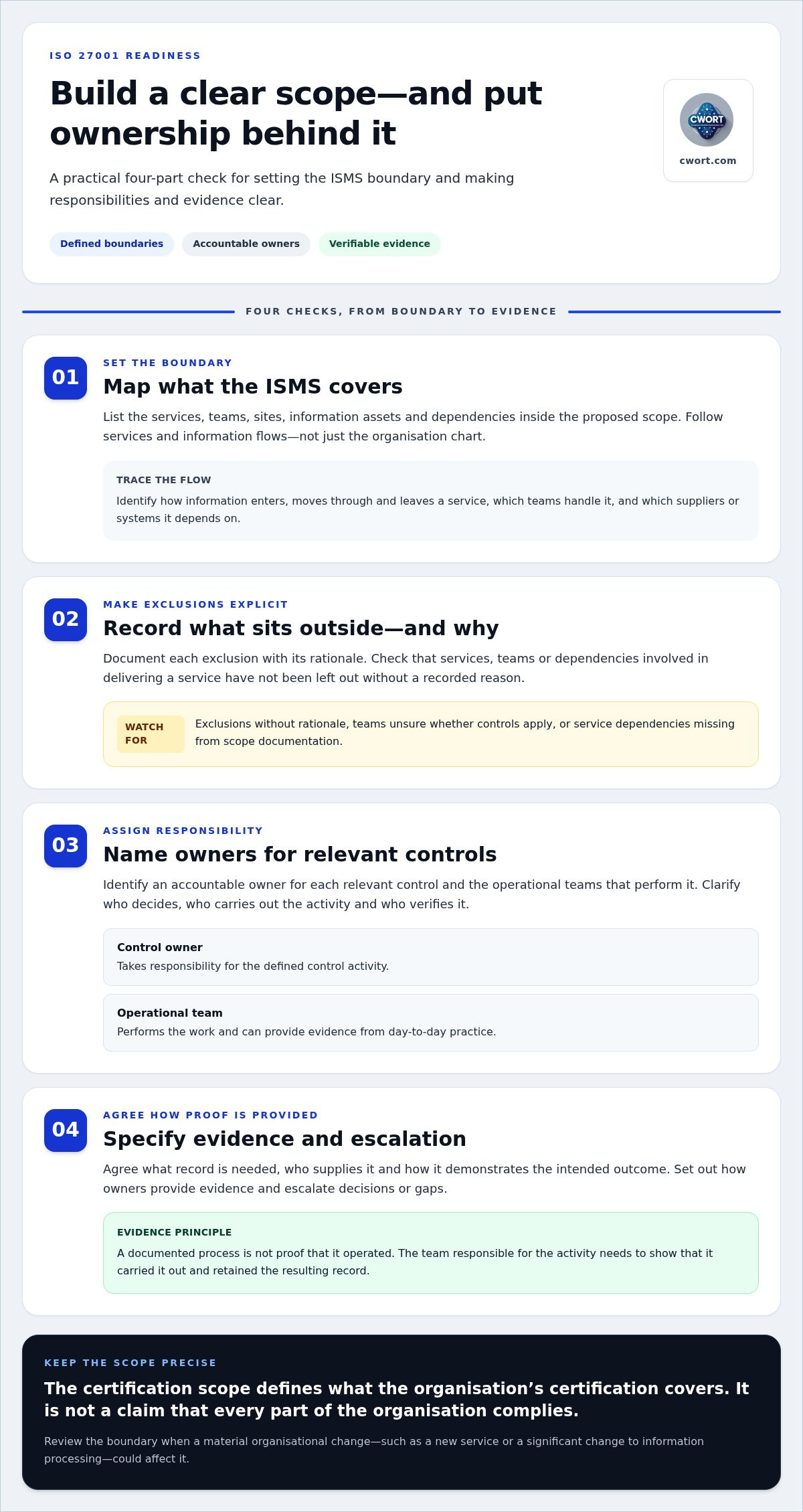
Scope boundaries should follow services and information flows, not just the organisation chart. Trace how information enters, moves through and leaves a service. Identify the teams that handle it and the suppliers or systems it depends on. If a team or service involved in those flows is excluded, associated risks and control activities may go unexamined.
Look for warning signs: exclusions without a recorded rationale, operational teams unsure whether controls apply to them, or dependencies involved in service delivery but missing from scope documentation. Record the scope, its rationale and relevant interfaces. Review it when a material organisational change, such as a new service or a significant change to information processing, could affect those boundaries.
Pitfall: treating certification as a compliance team project
A compliance team can coordinate the programme, but it can’t provide evidence for activities it doesn’t perform. Executive sponsorship helps set priorities and resolve decisions that cut across teams. ISMS leadership coordinates the management system, while named control owners take responsibility for defined activities and provide evidence from their operational work. Clarify who decides, who performs and who verifies. Without that distinction, actions can stall, be duplicated or remain unresolved.
For example, a central team may document an access review process, but the team responsible for reviewing access needs to show that it carried out the process and retained the resulting record. Assign ownership at control level, then specify the evidence expected: what record is needed, who supplies it and how it demonstrates the intended outcome. An ISO 27001 control mapping approach can connect mapped controls to accountable owners and evidence instead of leaving responsibilities scattered across separate trackers.
Start with a practical scope-and-ownership check:
- List the services, teams, sites, information assets and dependencies inside the proposed boundary.
- Record exclusions and explain why they sit outside the ISMS scope.
- Identify an accountable owner for each relevant control and the operational teams that perform it.
- Agree how owners will provide evidence and escalate decisions or gaps.
These are foundational common pitfalls in ISO 27001 certification because they shape every later risk, control and evidence decision. Resolve them early to give the readiness effort a clear boundary and accountable people to carry it forward.
Risk assessment and the Statement of Applicability: avoid disconnected decisions
A risk register supports ISO 27001 readiness only when it reflects the risks within the defined ISMS scope and informs actual treatment decisions. A generic register copied from another business, or maintained separately from the ISMS, can assign priorities that don’t match the organisation’s services, information flows or dependencies. This creates a gap between what the organisation says matters and the controls it selects or operates.
Control selection should be traceable to documented risk-treatment decisions, not assembled as a separate checklist. The Statement of Applicability (SoA) makes that reasoning visible. Under ISO/IEC 27001:2022, it identifies the controls necessary to implement risk treatment, explains their inclusion, records whether they’re implemented and justifies the exclusion of Annex A controls. It should reflect considered decisions, not simply reproduce a control catalogue.
Pitfall: using a generic or stale risk assessment
Copied risks can preserve assumptions that no longer fit the organisation. A register might describe a supplier dependency that has changed, for example, or omit a risk created by a new information flow. Inconsistent scoring can also obscure why one risk received treatment while a comparable one did not. No single scoring scale suits every organisation. What matters is applying documented criteria consistently and making decisions understandable.
Pitfall: completing the Statement of Applicability as a paperwork exercise
Each inclusion, exclusion or implementation status needs a rationale that aligns with the risk-treatment record and the organisation’s actual control activity. If the SoA says a control is implemented but the evidence indicates otherwise, or the register identifies a risk with no corresponding treatment decision, the mismatch invites avoidable questions. Keep the rationale current as assessments and control implementation change.
Build a traceable chain for each material risk:
- Record the risk in the context of the ISMS, including the affected information, service or dependency.
- Apply the organisation’s documented assessment criteria and identify the accountable decision-maker.
- Document the chosen treatment and link it to the relevant control or controls.
- Record each control’s SoA rationale and implementation status, then connect it to evidence of operation where available.
For example, if an assessment identifies a risk associated with access to sensitive information, record the treatment decision and the controls selected to address it. Then check that the SoA rationale and status match the implemented process and its supporting records. A control map connecting risks, controls and evidence makes these relationships easier to follow. Structured compliance evidence workflows can also help keep control outcomes traceable as readiness work progresses.
These common pitfalls in ISO 27001 certification often arise when risk, treatment and applicability records are updated in isolation. Review them together after material changes and during readiness checks, so inconsistencies surface before they become unresolved audit questions. Explore a readiness workflow for mapping decisions and evidence.
Control implementation and evidence: avoid the documented-but-unproven trap
A policy explains what an organisation intends to do. On its own, it doesn’t show that people follow the process or that a control achieves its intended outcome. One of the common pitfalls in ISO 27001 certification is treating a complete set of documents as proof of effective operation. Readiness depends on connecting documented requirements to relevant, current evidence.
A control is more defensible when evidence shows what happened, when it happened, who was responsible and how the activity relates to the control. The right evidence format depends on the control and how the organisation operates. A record, system extract or other artefact can be useful when it has enough context to be interpreted and reviewed.
These examples are illustrative, not mandatory evidence formats. The key test is whether the evidence is appropriate to the control and demonstrates the activity or outcome being assessed. A policy remains valuable, but it usually needs to be considered alongside evidence of implementation and operation.
Pitfall: collecting evidence without traceability or review
An undated file with no owner or explanation can be impossible to place in context. Even a relevant artefact may raise questions if it doesn’t identify the period, system, process or control it supports. Link each control outcome to its evidence, record an accountable owner and preserve enough provenance to understand where the record came from and whether it has changed.
Review evidence before relying on it. Check whether it is relevant to the control, complete for the stated period and scope, consistent with related records and current enough to support the readiness assessment. Flag gaps rather than treating an uploaded file as proof by default. Stale artefacts, duplicate versions and records linked to the wrong control can obscure weaknesses instead of resolving them.
A structured compliance evidence workflow connects controls, owners and supporting artefacts. This makes missing evidence easier to identify and follow-up work easier to assign, rather than leaving a folder of documents with no clear purpose.
Internal readiness checks help an organisation assess its own implementation, find gaps and improve its evidence before certification activity. They are not a substitute for the certification body’s independent assessment or decision. Keep that distinction clear: internal evidence supports preparation and governance, while the certification body evaluates the ISMS independently. Clear provenance and review make your readiness position easier to substantiate without implying a particular audit outcome.
Internal audits, management review and corrective action: close readiness gaps early
Some common pitfalls in ISO 27001 certification surface late because internal audits are left until certification is imminent, or findings are recorded without a route to verified closure. ISO/IEC 27001:2022 treats internal audit, management review and corrective action as distinct parts of the management system. An audit evaluates whether the ISMS conforms to the organisation’s requirements and the standard. Management review gives leadership a structured opportunity to consider performance and make decisions. Corrective action addresses nonconformities and their causes.
Keep the response disciplined:
- Conduct an internal audit against defined scope and criteria.
- Record findings clearly, with supporting details and the affected area.
- Assign an accountable owner to each finding.
- Agree corrective actions, responsibilities and due dates.
- Verify whether the actions have addressed the issue and its cause.
- Retain the closure evidence and update the finding’s status.
A finding isn’t closed until corrective action and its verification are evidenced. A rushed review or an unowned finding leaves uncertainty in the readiness position, even if the issue appears minor.
Pitfall: leaving internal audit until certification is imminent
Plan audits early enough to assess and address findings before certification activity. Use risk and organisational change to inform audit coverage rather than treating every area as equally urgent. Record the audit’s scope, criteria, results and follow-up. No single audit frequency should be assumed for every organisation; planning should reflect the ISMS and applicable requirements. An internal audit should provide useful assurance about your own system, not merely rehearse a certification-body assessment.
Pitfall: recording findings without verifying corrective action
Separate correction from corrective action. Correction deals with the immediate issue; corrective action investigates why it occurred and addresses the cause to reduce the risk of recurrence. Assign an owner, due date and status, then specify the evidence that will demonstrate completion and whether the action was effective. Closing a ticket because a task is marked done is not the same as verifying that the underlying weakness has been addressed.
Management review should not become another audit report. It is a governance forum for considering relevant ISMS performance and deciding whether changes or improvements are needed. Keep its records distinct from audit findings and action logs, while linking decisions to any resulting work. This preserves a clear line from assurance, through leadership oversight, to resolution.
A governed workflow makes actions, owners, status and closure evidence easier to follow across teams. See how CWORT structures compliance readiness to support traceable remediation and review.
Build a more defensible ISO 27001 certification readiness workflow
Readiness is more manageable when it runs as a connected operating model, not a series of disconnected tasks. The sequence is straightforward: scope the ISMS, assess risks, map controls, assign owners, gather evidence, review progress and improve. Each stage should create the information needed for the next. If a risk changes, for example, trace whether the treatment decision, mapped controls, ownership and evidence need attention.
Spreadsheets and ticketing systems can help teams manage individual tasks. But when records are scattered across files and platforms, dependencies may be hidden, ownership can become ambiguous and statuses can drift out of date. It may also be difficult to reconstruct who changed a decision or why evidence was linked to a particular control. Use a consistent record for decisions, responsibilities, actions and supporting proof, with enough traceability to review how readiness has progressed.
Pitfall prevention through governed execution
Governed workflows connect work to accountability. They let teams track an owner’s actions and status alongside the evidence supporting a control outcome, rather than relying on informal follow-up. Separation of duties helps distinguish responsibilities within the workflow, while an immutable audit history preserves a record of activity and changes. These features support governance and traceability; they don’t establish that a control is effective without appropriate assessment and evidence.
CWORT is an enterprise compliance validation platform that structures obligations, execution activities and evidence against control outcomes. Its assessment results are deterministic. AI advisory can offer suggestions, but it doesn’t alter those results. Keeping advisory input separate from the recorded assessment position gives teams a clear basis for readiness decisions.
When ISO 27001 sits alongside other frameworks
Organisations working to multiple frameworks can benefit from mapping controls that address shared outcomes. Mapping can reveal where control activities overlap while retaining each framework’s context, rationale and evidence requirements. A shared activity doesn’t automatically make every piece of evidence interchangeable: its relevance still depends on the specific control outcome and scope being assessed.
The June 2026 CWORT taxonomy snapshot lists 1,355 controls across 42 frameworks and standards, organised across 217 domains. This breadth supports structured cross-framework mapping where ISO 27001 sits alongside other obligations, without treating distinct requirements as identical. CWORT connects mapped controls with execution and evidence, helping teams follow relationships while preserving the context of each framework.
Use a workflow to organise readiness, expose gaps and support evidence-based review. It does not guarantee certification or replace the certification body’s independent assessment and decision. Request a CWORT demo to explore how structured control mapping and evidence workflows can support your readiness process.
Turn readiness into a repeatable discipline
Make readiness part of how the organisation manages change, not a one-off effort before an assessment. Set a clear review rhythm, keep decisions accountable and make unresolved gaps visible early. This discipline helps prevent the common pitfalls in ISO 27001 certification from returning as teams, services and priorities change.
CWORT supports this approach with control-to-framework mapping and evidence linked to control outcomes. Its governed workflows support separation of duties and immutable audit history, while assessment results remain deterministic. AI advisory is limited to suggestions and doesn’t change those results. The platform helps structure readiness work; it doesn’t guarantee certification or replace independent assessment.
Build a more controlled route from obligations to evidence, using a process your teams can sustain and review. Request a CWORT demo to explore how it can support your ISO 27001 readiness work. A clear, evidence-led approach gives your organisation a stronger basis for moving forward with confidence.
Frequently Asked Questions
What are the most common pitfalls in ISO 27001 certification?
The most common pitfalls in ISO 27001 certification include an unclear ISMS boundary, gaps in ownership, risk decisions that don’t connect to selected controls, evidence that doesn’t show controls operating, late internal audits and corrective actions that aren’t verified. These are readiness risks, not automatic grounds for failure. Their significance depends on the organisation’s context, scope and implementation, so a generic checklist can’t replace a relevant, evidence-based assessment.
Can an organisation fail ISO 27001 certification because of missing evidence?
Missing or weak evidence can make it difficult to demonstrate that a relevant process or control is implemented and operating. The implications depend on the finding, audit scope and applicable requirements, so no specific certification outcome should be assumed. Improve readiness by checking whether evidence can be retrieved, understood and connected to the activity it supports. For example, reconcile a sample of recorded approvals with the process and period they’re intended to demonstrate.
How early should an internal audit take place before ISO 27001 certification?
Schedule internal audit activity early enough to investigate findings, assign actions and verify closure before the external assessment. There’s no universal lead time that suits every organisation. Build the plan around the ISMS scope, complexity, recent changes and current readiness, then leave room for follow-up if an audit identifies a material weakness. Check timing expectations against the current standard and the organisation’s audit programme rather than relying on a fixed rule of thumb.
Does ISO 27001 certification require implementing every Annex A control?
No. ISO/IEC 27001:2022 does not mean every Annex A control must automatically be implemented by every organisation. Control selection should reflect the organisation’s risk assessment and treatment decisions, with applicability and rationale recorded in the Statement of Applicability. An exclusion without a defensible explanation, or an implementation status that conflicts with practice, can prompt further scrutiny. Assess each decision in context and verify it against the current standard’s requirements.
Is a risk assessment spreadsheet enough for ISO 27001 readiness?
A spreadsheet can be a useful record, but the file alone doesn’t show whether decisions are consistent, current or connected to control treatment. Check that it records the assessment approach, accountable decision-makers, review points and treatment rationale. For example, if an operational change alters an assumption behind a risk, the process should make it possible to identify affected decisions and update them. Choose a method your organisation can maintain and review reliably.
What happens if the Statement of Applicability does not match implemented controls?
A mismatch can make it difficult to explain a control’s applicability, stated status or relationship to risk treatment. First establish which records are authoritative and determine whether the discrepancy reflects outdated documentation, incomplete implementation or an incorrect assessment. Record the decision, update connected records and assign any required follow-up. Don’t assume all mismatches have the same significance; assess each one in the context of the ISMS and its evidence.
Can compliance software guarantee ISO 27001 certification?
No. Software can support readiness by organising assessments, actions and records, but it can’t guarantee certification or replace an organisation’s responsibility to implement and operate its ISMS. Certification follows an independent assessment against applicable requirements. Before adopting a tool, consider whether it helps preserve clear decision records, accountable ownership and evidence relationships as the programme changes. Treat technology as a means of strengthening governance, not as a substitute for effective controls or independent judgement.
Disclaimer
The content on this site is provided for general information and educational purposes only. It does not constitute legal, regulatory, financial, or professional advice. CWORT provides AI-assisted insights and workflow automation, but all compliance decisions remain the responsibility of your organisation and its management. Always seek qualified legal or regulatory guidance for decisions relating to the UK NIS Regulations, CAF, DORA, NIS2, ISO 27001, or other obligations.
Related posts
ISO 27001 Control Effectiveness Proof: Moving Beyond Static Certification to Defensible Validation
Move beyond static ISO 27001 certification. Discover how an ISO 27001 compliance validation tool delivers continuous, defensible proof for UK regulators.
Streamlining Regulatory Compliance Processes: From Manual Tracking to Orchestrated Validation
Stop wasting money on manual compliance. Learn about streamlining regulatory compliance processes to reduce personal liability under DORA & NIS2 and gain aud...
How to Streamline ISO 27001 Internal Audits with Orchestration Software in 2026
Learn how ISO 27001 internal audit software replaces spreadsheet chaos with automated orchestration for a flawless, defensible compliance posture.
Article by
Michael Iyiola
Co-Founder, CWORT
Michael Iyiola is a co-founder of CWORT and a Cyber and AI Security Engineer with deep experience in vulnerability management, detection engineering and operational resilience across UK critical national infrastructure, including rail, energy and financial services. At CWORT, he designs scalable, evidence-driven workflows that help teams meet modern regulatory and security demands.
Build Your Foundation of Auditable Certainty
Take control of your regulatory obligations and secure your infrastructure with CWORT.