Common NIS2 Compliance Mistakes: A Strategic Guide to Avoiding Audit Failure in 2026

Michael Iyiola
Co-Founder, CWORT
Avoid costly NIS2 audit failure in 2026. This guide reveals common NIS2 compliance mistakes and shows how to build a defensible, audit-ready strategy.

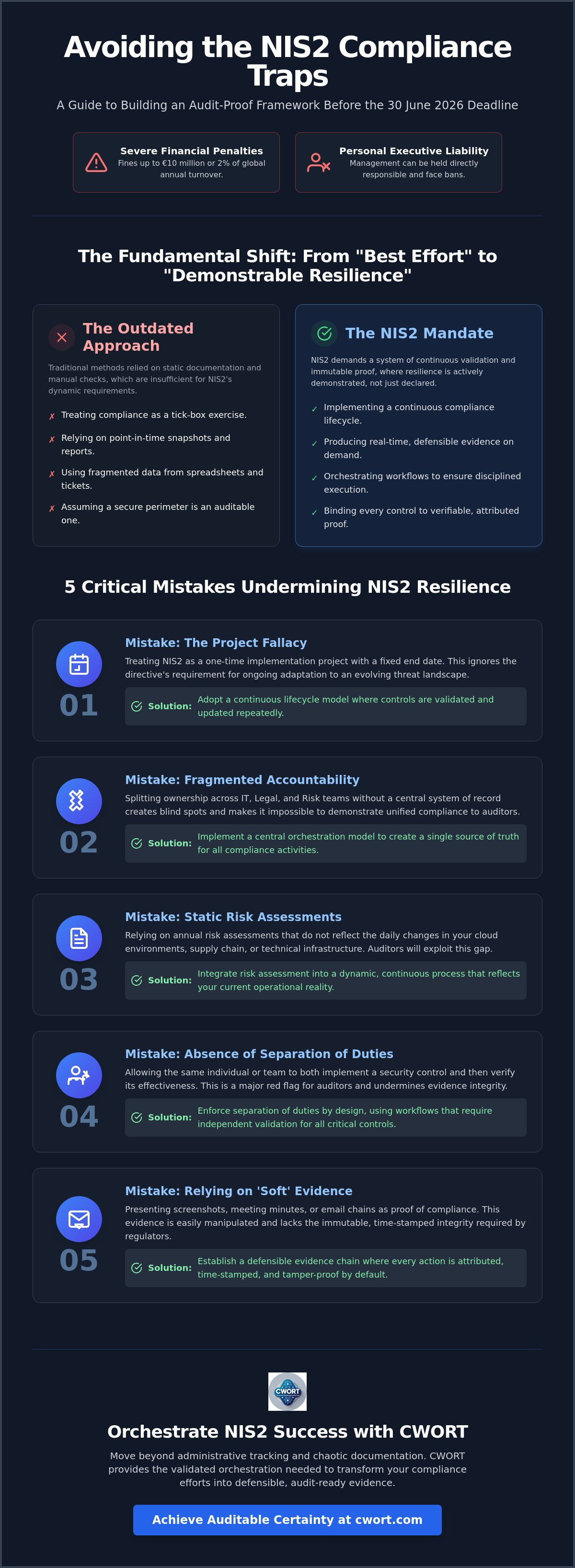
With the 30 June 2026 audit deadline now a reality, many organisations are discovering that their existing security measures don't translate into regulatory proof. It's a sobering realisation that having a secure perimeter is not the same as having an auditable one. Most teams are currently drowning in fragmented data across Jira tickets and Excel spreadsheets, leaving leadership exposed to the directive's stringent personal liability provisions. You likely feel the mounting pressure to prove a clear separation of duties to auditors whilst managing a complex web of evidence. These common NIS2 compliance mistakes aren't just administrative hurdles; they're structural failures that invite regulatory scrutiny and fines of up to 2% of global turnover.
This guide identifies the specific flaws in your current implementation strategy and provides the roadmap required to rectify them. We'll move beyond mere tracking to establish a system of validated orchestration. You'll learn how to transform chaotic documentation into defensible, audit-ready evidence that ensures your organisation remains both secure and compliant under the gaze of national authorities. By shifting the focus from administrative tracking to definitive proof, you can replace the anxiety of potential failure with the calm of auditable certainty.
Key Takeaways
- Identify and rectify common NIS2 compliance mistakes such as treating the directive as a one-time project rather than a continuous lifecycle.
- Recognise the strategic shift from "best effort" security to "demonstrable resilience" to meet the rigorous audit standards of 2026.
- Evaluate why manual trackers and task management tools fail to provide the immutability and integrity required for regulatory scrutiny.
- Master the principles of "Evidence Binding" to ensure every security control is supported by timely, attributed, and defensible proof.
- Implement a structured orchestration model to translate fragmented NIS2 obligations into disciplined, auditable execution workflows.
Table of Contents
- Beyond the Checklist: Why NIS2 Compliance Fails in 2026
- 5 Critical NIS2 Compliance Mistakes Undermining Enterprise Resilience
- The Tooling Trap: Why Spreadsheets and Jira Fail NIS2 Audits
- Establishing a Defensible Evidence Chain for NIS2 Validation
- Orchestrating NIS2 Success with CWORT Compliance Validation
Beyond the Checklist: Why NIS2 Compliance Fails in 2026
Compliance in 2026 is no longer a static milestone to be reached and forgotten. It's a continuous validation process that requires real-time oversight and immutable proof. One of the most common NIS2 compliance mistakes is treating the directive as a traditional "tick-box" exercise. This outdated mindset assumes that having a policy on a shelf satisfies the regulator. In reality, the NIS2 Directive has shifted the burden of proof from "best effort" security to "demonstrable resilience." Organisations must now prove they can withstand, respond to, and recover from incidents through a rigorous chain of evidence.
Traditional GRC approaches often fail because they rely on manual reporting and point-in-time snapshots. These methods cannot keep pace with the modern requirement for orchestrated evidence. Whilst an Excel sheet might track a task, it cannot validate an outcome. To survive an audit in 2026, firms must move beyond administrative tracking. They must implement a system that enforces discipline by design, ensuring that every control is active, monitored, and supported by defensible data.
The Evolution of Regulatory Expectations
Regulators have moved beyond reviewing high-level policies. They now inspect the granular execution of security controls. The "all-hazards" approach mandates that entities protect against both cyber and physical threats, including human error and technical failures. This creates a significant gap for those still relying on static documentation. Validating a control outcome requires more than just stating a policy exists; it requires showing the control worked at a specific time, performed by a specific individual, with a verifiable result. If you can't produce this evidence on demand, your compliance framework is effectively non-existent in the eyes of an auditor.
The High Cost of Compliance Misinterpretation
The stakes for failure are unprecedented. Beyond the potential €10 million or 2% global turnover fine, NIS2 introduces personal liability for the "management body." Under Article 20, executives are directly responsible for the implementation and oversight of cybersecurity measures. Failure can lead to temporary bans from management functions, turning a corporate risk into a personal one. This shift makes it imperative to avoid common NIS2 compliance mistakes like fragmented accountability or poor evidence integrity. Demonstrable compliance is the ability to produce tamper-proof evidence on demand. Without this capability, leadership remains exposed to significant legal and professional repercussions.
5 Critical NIS2 Compliance Mistakes Undermining Enterprise Resilience
Identifying structural flaws in your framework is the first step toward audit readiness. Many organisations fall into predictable traps that compromise their standing with regulators. These common NIS2 compliance mistakes often stem from a fundamental misunderstanding of the directive's operational requirements. To ensure a defensible position, leadership must move beyond superficial tracking and address these five critical failures.
- Mistake 1: The Project Fallacy. Treating NIS2 as a one-time implementation project is a recipe for failure. Compliance is a continuous lifecycle. Once initial controls are set, they must be validated repeatedly to reflect the evolving threat landscape.
- Mistake 2: Fragmented Accountability. Ownership split amongst IT, Legal, and Risk teams without a central orchestrator creates blind spots. It makes it impossible to prove that the organisation meets the official NIS2 Directive policy objectives as a unified entity.
- Mistake 3: Static Risk Assessments. Infrastructure changes daily; risk assessments should too. Relying on an annual report that doesn't reflect your current cloud environment or supply chain status is a critical oversight that auditors will exploit.
- Mistake 4: Absence of Separation of Duties. Allowing the same individual to implement a control and verify its success is a major red flag. Rigorous orchestration must enforce this distinction by design to ensure integrity.
- Mistake 5: Relying on Soft Evidence. Screenshots and email chains are not defensible data. They lack the immutability and timestamped attribution required to withstand professional scrutiny during a high-stakes audit.
Fragmented Accountability and the "Silo" Problem
Siloed data prevents a holistic view of cyber resilience. When IT handles technical controls whilst Risk manages the registry in isolation, the result is a fragmented narrative that fails under audit. Security in isolation leads to failure because it lacks the cross-functional validation required by the directive. To fix this, organisations must implement a framework for orchestration that synchronises these disparate functions into a single, verifiable stream of truth. This ensures that every department is working toward the same validated outcome rather than operating in a vacuum.
The Failure to Enforce Separation of Duties (SoD)
Auditors prioritise SoD as a core control because it prevents collusion and reduces the risk of human error. If your system allows an administrator to self-certify their own patches or configurations, you have a structural vulnerability. This requirement mirrors the DORA separation of duties enforcement found in the financial sector. Enforcing this requires a system that proactively blocks conflicting actions and requires independent validation for every critical task. To see how automated workflows can enforce these boundaries, you might consider how to orchestrate your compliance activities more effectively.
The Tooling Trap: Why Spreadsheets and Jira Fail NIS2 Audits
Relying on a legacy tech stack to manage modern regulatory obligations is one of the most dangerous common NIS2 compliance mistakes an organisation can make. Many leadership teams assume that because they have Jira for tasks and Excel for tracking, they're "audit-ready." This is a false sense of security. These tools were designed for productivity and project management; they weren't built to provide the immutable, timestamped evidence required by national competent authorities. When an auditor arrives in 2026, they won't look for a list of completed tickets. They'll look for a validated chain of custody that proves every control was executed correctly, by the right person, at the right time.
Manual tracking creates a "reconstruction nightmare" during surprise inspections. If an auditor asks for proof of a specific security patch applied 14 months ago, searching through disparate systems and email threads is a recipe for failure. You need a system that translates abstract obligations into concrete, defensible reality. Contrast this manual chaos with automated compliance validation, where every action is recorded in a way that is both transparent and impossible to alter retroactively. This shift from passive tracking to active orchestration is what separates a resilient enterprise from one facing a 2% turnover fine.
The Fragility of the "Compliance Spreadsheet"
Spreadsheets lack the version control and audit trails necessary for multi-year regulatory oversight. Manual data entry introduces human error as a systemic risk, where a single accidental deletion or an unverified update can compromise your entire compliance posture. There is no way to prove who changed what, or why, without a dedicated integrity layer. For a deeper analysis on moving beyond these manual risks, consider the strategic benefits of replacing spreadsheets for regulatory compliance with a validated system of record. Auditors prioritise data integrity; a spreadsheet offers none.
Why Task Management is Not Compliance Orchestration
Jira is an excellent tool for developers, but it's not a compliance engine. There is a fundamental difference between "doing a task" and "validating a regulatory obligation." A Jira ticket can be closed without the necessary evidence being bound to the outcome, leaving a gap in your audit trail. These tickets don't constitute "binding evidence" because they lack the structural rigour required to prove separation of duties or immutable attribution. You need a system that doesn't just track work but enforces the discipline of compliance by design, ensuring that no obligation is considered met until the evidence is validated and secured.
Establishing a Defensible Evidence Chain for NIS2 Validation
Correcting common NIS2 compliance mistakes requires a fundamental shift in how your organisation handles proof. It is no longer enough to claim a control exists; you must bind the evidence directly to the outcome. This concept of "Evidence Binding" ensures that every security measure is backed by a specific, verifiable data point. Without this link, your compliance framework is merely a collection of assertions that will likely crumble under professional regulatory scrutiny. A defensible evidence chain relies on three non-negotiable pillars: timeliness, attribution, and immutability. These elements transform raw data into a narrative of disciplined execution that auditors can trust.
Automating the collection of technical standards data is the only way to maintain this chain at scale. Manual collection is slow, prone to error, and creates a lag that renders evidence obsolete by the time it reaches a report. By implementing automated validation, you ensure that board-level reporting is based on real-time reality rather than historical guesswork. This level of transparency is essential for leadership. It provides the certainty needed to sign off on compliance statements whilst mitigating the risks associated with personal liability provisions.
The Anatomy of Audit-Ready Evidence
Defensible evidence must answer three questions with absolute certainty: Who performed the action, What was the specific outcome, and When did it occur? Metadata often carries more weight than the content itself because it provides the context of integrity. An auditor needs to see the system-generated timestamps and the unique identifiers of the individuals involved to validate that the control was active. For a comprehensive look at maintaining these standards, read our guide on ensuring compliance evidence integrity. Mastering these pillars ensures your documentation transitions from a passive record to an active shield.
Automating Control Effectiveness Testing
The transition from annual, snapshot-based audits to continuous monitoring is a hallmark of regulatory maturity. Automated validation reduces the "compliance tax" on operational teams by removing the burden of manual evidence gathering. It allows your security professionals to focus on remediation rather than administration. Binding evidence directly to control outcomes eliminates the need for manual audit preparation by creating a perpetual state of readiness. This systematic approach ensures that you are always prepared for a surprise inspection, turning compliance from a frantic seasonal event into a quiet, background standard. To see this orchestration in practice, you can request a demo of our validation engine.
Orchestrating NIS2 Success with CWORT Compliance Validation
Fragmented compliance data is a significant operational liability. To eliminate the common NIS2 compliance mistakes that lead to audit failure, organisations must move away from passive tracking and adopt a system of active orchestration. CWORT serves as this orchestration engine, replacing the chaotic web of spreadsheets and task managers that compromise regulatory standing. It provides a disciplined environment where regulatory obligations are not just recorded but are translated into structured, enforceable execution workflows. This shift ensures that every requirement is met with a validated action, removing the ambiguity that often leads to non-compliance.
The platform enforces the separation of duties by design, preventing the structural vulnerabilities that auditors frequently flag. By requiring independent validation for critical controls, CWORT ensures that integrity is baked into the process rather than added as an afterthought. This proactive enforcement protects leadership from the personal liability risks inherent in the directive. Instead of manually reconstructing evidence during an inspection, CWORT allows you to generate regulator-ready outputs instantly. This capability transforms the audit from a high-stakes crisis into a routine validation of established truth.
From Obligation to Auditable Proof
The CWORT workflow follows a rigorous, three-stage progression: Map, Execute, and Bind. First, abstract NIS2 obligations are mapped to specific organisational controls. Next, technical and administrative activities are executed within the platform. Finally, evidence is bound directly to the outcome, creating an immutable record of compliance. This creates a single source of truth that serves both the board of directors and external auditors. For organisations operating within specific jurisdictions, this workflow aligns perfectly with the requirements of a NIS2 compliance platform UK standard. It replaces fragmented guesses with definitive, evidence-based certainty.
Strategic Readiness for the 2026 Regulatory Landscape
The regulatory environment will continue to evolve, but a system built on orchestration is inherently future-proof. CWORT allows organisations to adapt to new standards without overhauling their entire framework. The efficiency gains of moving from GRC tracking to active orchestration are substantial; teams spend less time on administration and more time on maintaining a robust security posture. By centralising your evidence chain and enforcing accountability, you secure your organisation against both cyber threats and regulatory scrutiny. Discover how CWORT orchestrates NIS2 compliance validation to ensure your enterprise is ready for the challenges of 2026 and beyond.
Securing Your Strategic Standing for the 2026 Audit
The transition from administrative tracking to definitive, evidence-based proof is no longer optional. You must move beyond the static checklists of the past to embrace a continuous validation lifecycle that withstands the rigour of national authorities. Addressing common NIS2 compliance mistakes, such as relying on fragmented Jira tickets or manual spreadsheets, is the only way to protect your organisation and its leadership from the directive's personal liability provisions. By enforcing a strict separation of duties and binding metadata directly to control outcomes, you transform abstract obligations into a defensible reality.
Establishing this level of structural integrity requires more than just better management; it requires a proactive orchestration engine. CWORT replaces the fragility of manual tools with a disciplined system that delivers regulator-ready evidence by design. It's time to replace the anxiety of potential audit failure with the calm of auditable certainty. Take the decisive step toward total assurance today and ensure your programme is built on a foundation of validated truth.
Orchestrate your NIS2 compliance with the CWORT validation platform and ensure your organisation is prepared for the scrutiny of 2026.
Frequently Asked Questions
What is the most common mistake in NIS2 implementation?
One of the most common NIS2 compliance mistakes is viewing the directive as a static project with a fixed end date. Compliance requires a continuous validation lifecycle where controls are monitored and updated in real-time. Treating it as a "tick-box" exercise ignores the requirement for ongoing resilience, leaving your organisation vulnerable during audits. You must move from administrative tracking to a disciplined, evidence-based system that reflects current operational reality.
Can I use Jira to manage my NIS2 compliance evidence?
Jira is insufficient for managing NIS2 evidence because it was designed for task management rather than regulatory orchestration. Whilst it tracks "what" was done, it fails to bind immutable, timestamped proof to specific control outcomes. Auditors require a chain of custody that Jira simply cannot provide. You need a dedicated validation engine that enforces integrity and prevents the retroactive alteration of compliance data.
How does NIS2 differ from the original NIS directive regarding evidence?
NIS2 introduces a more rigorous burden of proof by moving from the "best effort" approach of NIS1 to "demonstrable resilience." It mandates proactive supervision for essential entities, meaning regulators will inspect your execution before an incident occurs. This shift requires a robust evidence chain that proves controls are active and effective. You can no longer rely on high-level policies; you must produce granular, validated data on demand.
Is executive management personally liable for NIS2 compliance failures?
Executive management bodies are personally liable under Article 20 of the directive. NIS2 empowers national authorities to hold individual leaders accountable for failures in implementation and oversight. This includes potential fines and temporary bans from management functions for executives of essential entities. This personal risk makes it imperative for boards to have direct access to real-time, validated compliance data to ensure their oversight is defensible.
What constitutes "proportionate" security measures under NIS2?
Proportionate measures are those that align with an entity's level of risk exposure, size, and the potential impact of a security incident. NIS2 mandates an "all-hazards" approach, requiring technical and organisational measures that are appropriate to the state of the art. You must balance the cost of implementation against the severity of the threat. Crucially, you must be able to justify your security choices to an auditor through documented risk analysis.
How often should NIS2 risk assessments be updated?
Risk assessments must be updated regularly and whenever there is a significant change to your infrastructure or the threat landscape. Relying on an annual review is a strategic failure in a modern cloud environment. You must ensure your assessment reflects current supply chain risks and technical vulnerabilities. Continuous monitoring allows you to identify gaps as they emerge, ensuring your compliance posture remains accurate and defensible throughout the year.
What is the deadline for NIS2 compliance in the EU?
The critical deadline for in-scope entities to complete their first compliance audit is 30 June 2026. Whilst the transposition deadline for Member States was 17 October 2024, operational requirements are now fully live across the EU. In Germany, covered entities were required to register by 6 March 2026. Organisations must act now to ensure their orchestration frameworks are mature enough to withstand the scrutiny of national competent authorities.
Why is separation of duties critical for a NIS2 audit?
Separation of duties is critical because it prevents the same individual from both executing and validating a security control. Auditors prioritise this to reduce the risk of collusion and human error. Without enforced boundaries, the integrity of your evidence is compromised. Implementing a system that proactively blocks conflicting actions ensures that your compliance data is trustworthy. It provides the independent verification necessary to prove that your controls are functioning as intended.
Disclaimer
The content on this site is provided for general information and educational purposes only. It does not constitute legal, regulatory, financial, or professional advice. CWORT provides AI-assisted insights and workflow automation, but all compliance decisions remain the responsibility of your organisation and its management. Always seek qualified legal or regulatory guidance for decisions relating to the UK NIS Regulations, CAF, DORA, NIS2, ISO 27001, or other obligations.
Related posts
How to Implement NIS2 Technical Standards: A Guide to Software Orchestration
Move beyond manual NIS2 checklists. Learn how dedicated NIS2 technical standards software can orchestrate compliance, automate evidence, and eliminate audit ...
Streamlining Regulatory Compliance Processes: From Manual Tracking to Orchestrated Validation
Stop wasting money on manual compliance. Learn about streamlining regulatory compliance processes to reduce personal liability under DORA & NIS2 and gain aud...
NIS2 Implementation Software Europe: Beyond Checklists to Orchestrated Validation
Facing a NIS2 audit? Our guide to NIS2 implementation software Europe shows how to move beyond checklists to build a defensible, unified system of proof.
Article by
Michael Iyiola
Co-Founder, CWORT
Michael Iyiola is a co-founder of CWORT and a Cyber and AI Security Engineer with deep experience in vulnerability management, detection engineering and operational resilience across UK critical national infrastructure, including rail, energy and financial services. At CWORT, he designs scalable, evidence-driven workflows that help teams meet modern regulatory and security demands.
Build Your Foundation of Auditable Certainty
Take control of your regulatory obligations and secure your infrastructure with CWORT.