NIS2 Implementation Software Europe: Beyond Checklists to Orchestrated Validation

Michael Iyiola
Co-Founder, CWORT
Facing a NIS2 audit? Our guide to NIS2 implementation software Europe shows how to move beyond checklists to build a defensible, unified system of proof.

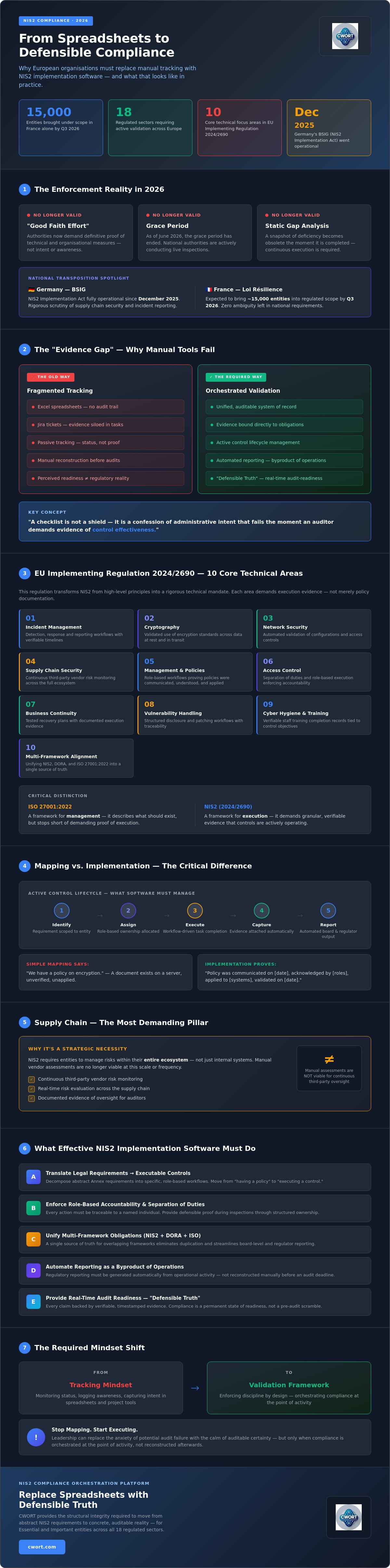
A checklist is not a shield; it is a confession of administrative intent that fails the moment an auditor demands evidence of control effectiveness. As of June 2026, the grace period for compliance has vanished, and national authorities are actively conducting inspections to ensure technical standards like 2024/2690 are fully operational. Relying on fragmented evidence across Jira and Excel creates a dangerous gap between perceived readiness and regulatory reality. To secure your organisation, you must deploy a sophisticated NIS2 implementation software Europe that replaces passive tracking with orchestrated validation.
You understand the anxiety of facing an audit without a defensible paper trail, especially as countries like Germany enforce the BSIG and France expands its regulated scope to 15,000 entities. This article promises to show you how to transition from manual spreadsheets to a single source of truth that satisfies both regulators and the board. We will explore how to automate your reporting and build a system of evidence-based proof that stands up to the highest level of scrutiny.
Key Takeaways
- Transition from passive compliance tracking to an active orchestration engine that binds evidence directly to your regulatory obligations.
- Understand why NIS2 implementation software Europe is critical for meeting the granular technical standards defined in the 2024/2690 Implementing Regulation.
- Eliminate the "Evidence Gap" by replacing fragmented spreadsheets and Jira tickets with a unified, auditable system of record.
- Enforce accountability through role-based execution and separation of duties to provide defensible proof of compliance during inspections.
- Unify complex frameworks like DORA and NIS2 into a single source of truth to streamline board-level reporting and audit preparation.
Table of Contents
- Navigating the Complexity of NIS2 Implementation in Europe (2026)
- The Impact of the NIS2 Implementing Act on Technical Standards
- The Critical Failure of Manual Tracking and Generic GRC Tools
- Orchestrating Compliance: A Framework for Defensible Implementation
- CWORT: The Strategic Platform for NIS2 Compliance Orchestration
Navigating the Complexity of NIS2 Implementation in Europe (2026)
The transition from the broad NIS2 Directive overview to the current enforcement era has redefined corporate accountability. In 2026, compliance is no longer a project with a finish line; it's a permanent state of operational readiness. Effective NIS2 implementation software Europe serves as the central orchestration engine, binding disparate evidence to specific regulatory obligations in real time. It moves beyond the administrative burden of manual trackers to provide a disciplined framework for execution. For "Essential" and "Important" entities, the cost of inaction has shifted from theoretical risk to active regulatory intervention.
The Evolving Regulatory Landscape for European Enterprises
National transpositions have matured, leaving no room for ambiguity. Germany's NIS2 Implementation Act (BSIG) has been operational since December 2025, whilst France's "Loi Résilience" is expected to bring approximately 15,000 entities under scope by the third quarter of 2026. Regulators now scrutinise supply chain security and incident reporting with unprecedented rigour. A "good faith effort" is no longer a valid defence against non-compliance. Authorities demand definitive proof of technical and organisational measures. This shift necessitates a transition from passive awareness to active validation across all eighteen regulated sectors.
Defining Implementation vs. Simple Mapping
Simple mapping identifies what you should do; implementation ensures you actually do it. A static gap analysis provides a snapshot of deficiency that becomes obsolete the moment it's completed. In contrast, an active execution workflow manages the entire lifecycle of a control, from initial assignment to final evidence capture. Professional NIS2 implementation software Europe ensures that every action is traceable and every claim is backed by verifiable data. This creates a state of "Defensible Truth," where regulatory reporting is an automated byproduct of secure operations rather than a manual reconstruction of past events.
Organisations must abandon the tracking mindset. They must embrace a validation framework that enforces discipline by design. Platforms like CWORT provide the structural integrity required to move from abstract requirements to concrete, auditable reality. By orchestrating compliance at the point of activity, leadership can replace the anxiety of potential failure with the calm of auditable certainty. Stop mapping. Start executing.
The Impact of the NIS2 Implementing Act on Technical Standards
The release of Commission Implementing Regulation (EU) 2024/2690 has transformed the Official text of the NIS2 Directive from a set of high-level principles into a rigorous technical mandate. This act specifies ten core areas of focus, including incident management, cryptography, and network security, that require more than just policy documentation. Whilst many organisations rely on ISO 27001:2022 as a foundation, it's often insufficient for the granular demands of NIS2. ISO provides a framework for management; NIS2 demands a framework for execution. A dedicated NIS2 implementation software Europe must bridge this gap by translating abstract legal requirements into verifiable technical controls.
Translating Annex Requirements into Execution Activities
Software must decompose the "Management and Policies" section into specific, role-based workflows. It isn't enough to have a policy on a server; you must prove that the policy was communicated, understood, and applied. For IT security and networks, the software must facilitate automated validation of configurations and access controls. This ensures that technical teams aren't just checking boxes but are generating the "Defensible Truth" required by auditors. Implementation software moves the organisation from a state of "having a policy" to a state of "executing a control."
The Supply Chain Security Challenge
Supply chain integrity is perhaps the most demanding pillar of the new standards. NIS2 requires entities to manage risks within their entire ecosystem, necessitating continuous monitoring of third-party vendors. Manual assessments are no longer viable for this level of oversight, which is why NIS2 implementation software Europe has become a strategic necessity for managing vendor risk. Effective software facilitates real-time risk evaluation and ensures that vendors adhere to the same rigorous standards as the primary entity. This involves Ensuring Compliance Evidence Integrity amongst your entire supplier base. Without a centralised orchestration platform, the risk of a weak link in the chain remains unacceptably high.
To see how these technical standards are managed within a unified environment, you might consider how a platform can orchestrate your regulatory obligations.
The Critical Failure of Manual Tracking and Generic GRC Tools
Spreadsheets are where compliance goes to die. Relying on Excel or generic project management tools for a high-stakes regulatory framework like NIS2 is a strategic liability that most European organisations can no longer afford. These tools provide a static snapshot of intent, yet regulators now demand proof of continuous execution. When an auditor asks for evidence of control effectiveness from six months ago, a manual search through emails and shared drives is a recipe for failure. Effective NIS2 implementation software Europe must replace these fragmented systems with a disciplined, immutable record of activity.
The "Evidence Gap" occurs when there is no direct, automated link between a regulatory obligation and the technical proof of its fulfilment. Manual reconstruction of audits is not just inefficient; it's dangerous. It relies on human memory and scattered documentation, both of which are prone to error and manipulation. Modern oversight, as detailed in ENISA's Technical Implementation Guidance for NIS2, requires a level of structural integrity that manual trackers simply cannot provide. You need a system that enforces accountability by design.
Why Jira is Not a Compliance Orchestration Tool
Jira is designed for software development, not for the rigorous demands of governance and risk management. It tracks tickets, not obligations. This creates "orphan evidence"—data that exists in isolation without a verifiable connection to a specific NIS2 requirement. Without a dedicated orchestration engine, your technical teams might complete tasks without ever producing the defensible proof required for board-level reporting. Understanding the Regulatory Compliance Workflow Automation pillar is essential for moving beyond simple task-tracking into true validation. Compliance requires a structured hierarchy that Jira's flat ticket system lacks.
The Hidden Cost of Manual Audit Reconstruction
The "Fire Drill" approach to audit preparation is a massive resource drain. It pulls senior engineers and security analysts away from their core duties to spend weeks hunting for evidence amongst fragmented toolsets. This manual effort increases the risk of human error and creates a significant "Separation of Duties" conflict. In a manual system, the person performing the task is often the same person reporting its success, which lacks the objective integrity auditors expect. A single orchestrated system removes this conflict by automating the validation process. It ensures that every control is executed, verified, and recorded without the need for a frantic, last-minute search for proof. Stop wasting talent on administrative archaeology. Start automating your defensible truth.
Orchestrating Compliance: A Framework for Defensible Implementation
Defensible compliance is not a byproduct of chance; it is the result of a disciplined, orchestrated framework. To survive a regulatory inspection in 2026, your organisation must move beyond the static mapping of ISO 27001 and embrace a system that enforces accountability at every level. True NIS2 implementation software Europe acts as the connective tissue between legal obligations and technical execution. This framework ensures that every security measure is not merely a policy on a shelf but a verified operational reality. Follow this five-step progression to establish a position of total auditable certainty.
- Step 1: Translate complex NIS2 obligations into granular, role-based execution activities that technical teams can act upon without ambiguity.
- Step 2: Enforce a strict separation of duties within the workflow to ensure that control performance and control validation remain independent and objective.
- Step 3: Bind evidence, such as logs, configurations, or screenshots, directly to control outcomes at the precise moment of execution.
- Step 4: Generate real-time, board-level dashboards that reflect actual control effectiveness rather than administrative progress.
- Step 5: Produce regulator-ready audit trails automatically, eliminating the need for manual reconstruction or "fire drill" preparations.
Binding Evidence to Control Outcomes
The technical process of binding evidence involves creating an immutable link between a specific file, log entry, or system screenshot and a corresponding NIS2 requirement. This creates a tamper-evident audit trail that proves exactly who did what, when, and how it satisfied the regulation. By shifting from a culture of "trusting" teams to "validating" outcomes, you remove the subjective risk inherent in manual reporting. Implementation software ensures that evidence is captured as a natural byproduct of the workflow, making it impossible to overlook critical validation steps during high-pressure periods.
Achieving Board-Level Transparency
Senior leadership requires a dashboard that speaks the language of business risk, not technical jargon. The ideal compliance interface translates technical data into a clear "Cyber Resilience" metric, allowing the board to see the organisation's true security posture at a glance. This turns compliance from a perceived technical burden into a strategic asset. For those managing cross-border obligations, looking at a NIS2 Compliance Platform UK provides a blueprint for how regional orchestration can be unified into a single global source of truth. Transparency at the top ensures that resources are allocated where they are needed most to maintain a defensible state.
To move your organisation from passive tracking to a state of definitive, evidence-based proof, request a demonstration of our orchestration platform today.
CWORT: The Strategic Platform for NIS2 Compliance Orchestration
CWORT is the enterprise-grade alternative to the passive utilities that currently plague the GRC market. It is not merely a repository for documents; it is a proactive orchestration engine designed for the high-stakes reality of 2026 regulatory enforcement. As a leading NIS2 implementation software Europe, the platform enforces discipline by design, driving accountability across complex, fragmented organisations. It replaces the administrative burden of manual oversight with a systematic approach that ensures every technical control is executed, validated, and recorded. In a landscape where national authorities demand definitive proof, CWORT provides the structural integrity required to maintain a state of total auditable certainty.
The platform’s unique strength lies in its ability to orchestrate multiple frameworks simultaneously. Whether your organisation is navigating DORA, NIS2, or ISO 27001, CWORT provides a unified environment where obligations are mapped once and executed everywhere. This cross-framework synchronisation eliminates redundant effort and ensures that your security posture remains consistent across all jurisdictions. It allows leadership to move from a fragmented view of risk to a single, defensible source of truth that produces audit-ready proof in seconds, not weeks.
From Obligation to Auditable Proof
Fragmented tools create dangerous blind spots that auditors will inevitably exploit. CWORT replaces these disconnected systems with a single orchestrated workflow that binds every activity directly to a regulatory requirement. This is particularly beneficial for consulting teams and regulated enterprises that must prove compliance across diverse technical environments. The platform ensures that no evidence is left "orphaned" or disconnected from its purpose. For those operating within the financial sector, CWORT’s capability in DORA Compliance Validation serves as a parallel framework, ensuring that resilience is validated at the point of activity rather than reconstructed after the fact.
Securing Your 2026 NIS2 Strategy
Your 2026 strategy must move beyond administrative tracking and embrace strategic validation. Passive monitoring is no longer a viable defence against the rigorous technical standards now in effect across Europe. CWORT acts as the meticulous guardian of your corporate standards, ensuring that policies are not just written but are demonstrably operational. By adopting an orchestration mindset, you replace the anxiety of potential failure with the confidence of auditable truth. Position your organisation as a leader in cyber resilience by deploying a system that values evidence over intent. The era of the checklist is over; the era of orchestrated validation has arrived.
Request a CWORT demonstration to see orchestrated NIS2 validation in action.
Securing Your Regulatory Future with Orchestrated Validation
The era of simple administrative tracking has ended. You must now provide definitive, evidence-based proof of control effectiveness to satisfy European regulators. By replacing fragmented tools like Jira and Excel with a unified system, you eliminate the dangerous "Evidence Gap" and secure your organisation against the rigorous scrutiny of 2026 enforcement. This transition from passive intent to active execution is the only way to meet the granular technical standards now in effect across the continent.
Deploying a sophisticated NIS2 implementation software Europe allows you to transition from a state of constant audit anxiety to one of controlled, auditable certainty. It's time to move beyond the checklist and embrace a system that produces regulator-ready, board-level proof as a natural byproduct of your secure operations. Orchestrate your NIS2 compliance with CWORT to unify your DORA and NIS2 obligations within an enterprise-grade framework. You can achieve total assurance through disciplined execution and a commitment to defensible truth.
Frequently Asked Questions
What is the difference between NIS2 implementation software and a standard GRC tool?
NIS2 implementation software Europe differs from standard GRC tools by focusing on active orchestration rather than passive administrative tracking. Whilst GRC tools serve as repositories for risk registers, implementation software enforces the execution of controls and binds evidence to obligations in real time. This ensures that compliance is a continuous operational state rather than a static snapshot that becomes obsolete immediately after an audit.
How does the NIS2 Implementing Act (EU) 2024/2690 change software requirements?
The Implementing Act (EU) 2024/2690 mandates specific technical and methodological requirements for sectors like digital infrastructure and managed service providers. Software must now translate these granular Annex requirements into actionable technical workflows. It's no longer sufficient to document a policy; the system must provide verifiable proof that technical standards for cryptography and network security are actively maintained across the organisation.
Can I use ISO 27001 software for NIS2 implementation?
ISO 27001 software provides a foundational management framework but often lacks the specific reporting and enforcement mechanisms required by NIS2. The Directive introduces rigorous incident reporting timelines and supply chain security mandates that go beyond the scope of a standard Information Security Management System (ISMS). You need a platform that bridges the gap between management standards and the specific regulatory execution required by national authorities.
How does evidence binding work in a compliance orchestration platform?
Evidence binding creates an immutable link between a technical output and a specific regulatory obligation at the moment of activity. When a task is performed, the platform automatically attaches logs, screenshots, or configuration files to the control outcome. This creates a tamper-evident audit trail that proves compliance without the need for manual reconstruction or frantic "fire drills" during a regulatory inspection.
What are the penalties for failing a NIS2 audit in 2026?
Penalties for non-compliance are severe, with "essential" entities facing fines of up to €10 million or 2% of total worldwide annual turnover, whichever is higher. "Important" entities face up to €7 million or 1.4% of turnover. Crucially, the Directive also introduces personal liability for board members, who can be held responsible for gross negligence if they fail to oversee and approve mandatory risk-management measures.
How does NIS2 implementation software handle supply chain security?
Professional NIS2 implementation software Europe facilitates the continuous monitoring and risk assessment of third-party vendors. It moves beyond annual questionnaires by integrating supplier compliance into the primary organisation's orchestration workflow. This ensures that every link in the supply chain adheres to the same rigorous standards, providing a unified and defensible view of ecosystem risk for senior leadership.
Why is separation of duties critical for NIS2 compliance?
Separation of duties ensures the integrity of your compliance data by preventing inherent conflicts of interest. In an orchestrated system, the individual responsible for executing a technical control is distinct from the person validating its effectiveness. This objective oversight is a core requirement for creating a defensible audit trail that regulators can trust, as it removes the risk of subjective or fraudulent reporting.
When potential misconduct is identified through these controls, maintaining independence is paramount. Organisations often complement their technical systems with services from Core Integrity, such as workplace investigation services Australia, to ensure that any internal breaches are handled with the same objective rigour required by NIS2 and other global standards.
Does NIS2 implementation software automate incident reporting?
The software streamlines the rigorous reporting requirements, including the 24-hour early warning and the 72-hour incident notification mandated by the Directive. It automates the collection of necessary technical data and ensures that reports are formatted to meet national competent authority standards. This reduces the risk of missed deadlines during a crisis and ensures that all communications are recorded for future audit validation.
Disclaimer
The content on this site is provided for general information and educational purposes only. It does not constitute legal, regulatory, financial, or professional advice. CWORT provides AI-assisted insights and workflow automation, but all compliance decisions remain the responsibility of your organisation and its management. Always seek qualified legal or regulatory guidance for decisions relating to the UK NIS Regulations, CAF, DORA, NIS2, ISO 27001, or other obligations.
Related posts
Streamlining Regulatory Compliance Processes: From Manual Tracking to Orchestrated Validation
Stop wasting money on manual compliance. Learn about streamlining regulatory compliance processes to reduce personal liability under DORA & NIS2 and gain aud...
Ensuring Compliance Evidence Integrity: A Strategic Guide for UK Enterprises in 2026
Master ensuring compliance evidence integrity for 2026. Our UK guide helps you move from risky spreadsheets to an audit-ready system for DORA & NIS2.
Managing Compliance Evidence in Excel: Comparison and Strategic Risks for 2026
Is managing compliance evidence in excel a risk for 2026? Learn why spreadsheets jeopardise DORA & NIS2 validation and get a roadmap to an audit-ready system.
Article by
Michael Iyiola
Co-Founder, CWORT
Michael Iyiola is a co-founder of CWORT and a Cyber and AI Security Engineer with deep experience in vulnerability management, detection engineering and operational resilience across UK critical national infrastructure, including rail, energy and financial services. At CWORT, he designs scalable, evidence-driven workflows that help teams meet modern regulatory and security demands.
Build Your Foundation of Auditable Certainty
Take control of your regulatory obligations and secure your infrastructure with CWORT.