Compare Software Options for Managing Multiple Compliance Frameworks

Michael Iyiola
Co-Founder, CWORT
Compare the top software for managing multiple compliance frameworks. Map controls, automate evidence, and simplify audits with our expert buyer's guide.
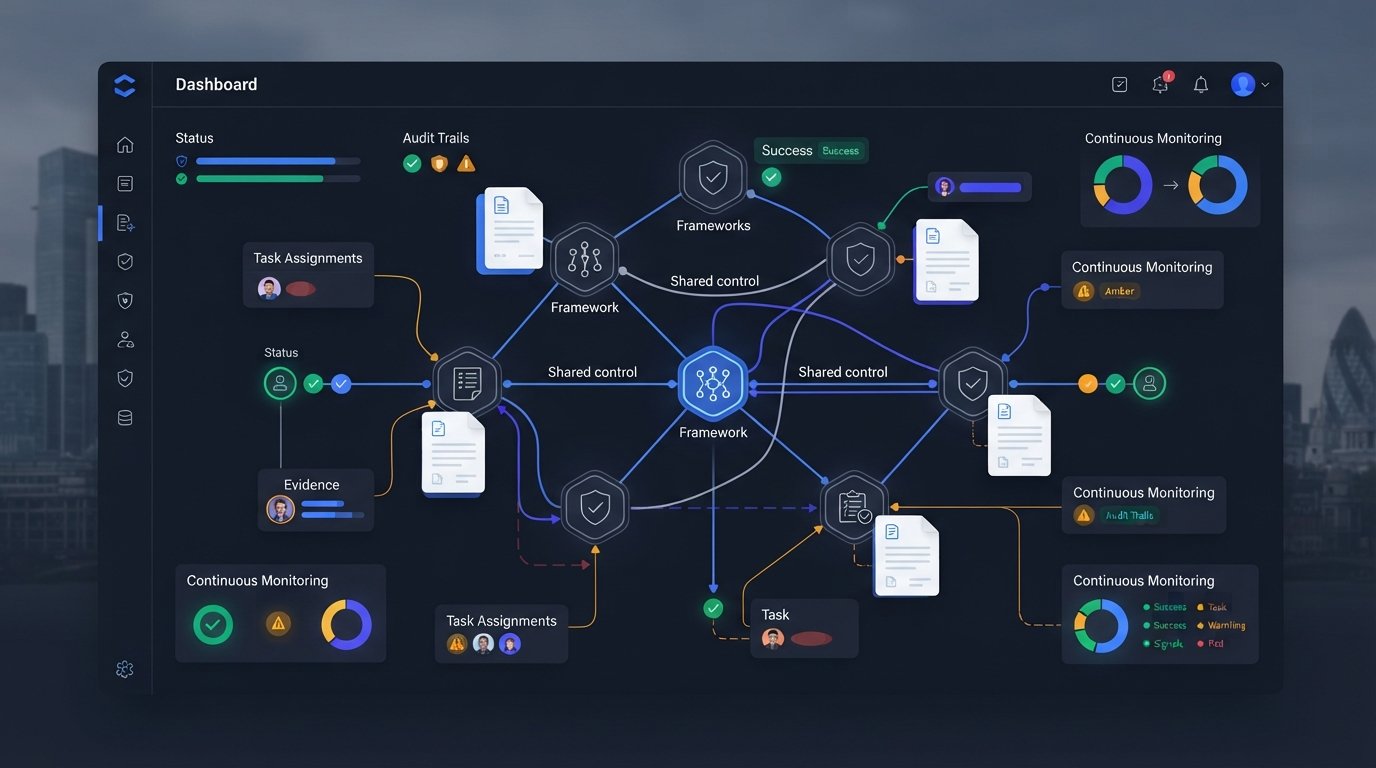
Managing several compliance frameworks in separate spreadsheets creates duplicated work and fragmented evidence. Software for managing multiple compliance frameworks brings requirements, shared controls, tasks and evidence into a structured system, with automation and continuous monitoring helping teams track control status across frameworks. Its purpose is to make compliance activity easier to coordinate and the evidence behind it easier to trace.
Frameworks can overlap without being interchangeable. One control may support several obligations, but each requirement still needs an appropriate mapping, owner and evidence trail. The right software makes those relationships visible while preserving framework-specific requirements, rather than flattening them into a generic checklist.
This article explains what regulatory compliance management software does and how multi-framework platforms support automation, continuous controls monitoring and framework management. It compares around ten options against practical selection criteria, including framework coverage, control mapping, implementation and expansion. You’ll also find a decision guide to help you assess which approach fits your organisation’s requirements, operating model and plans for future frameworks.
Key Takeaways
- Choose a platform that maps shared controls to each framework while preserving the distinct evidence and accountability each requirement needs.
- Use continuous controls monitoring to identify changes in control status and keep evidence traceable, rather than relying solely on periodic manual reviews.
- Scope your programme around current obligations, likely framework expansion, existing processes and the implementation effort your organisation can support.
- Compare options against framework coverage, automation, integrations, evidence management and the ability to adapt workflows to organisational policies.
- For DORA, UK NIS, NIS2 or ISO 27001 requirements, CWORT connects readiness and control mapping with structured compliance validation.
Table of Contents
- What Is Regulatory Compliance Management Software?
- Continuous controls monitoring
- What is multi-framework compliance software?
- Compliance automation and continuous monitoring
- Compliance software for managing multiple frameworks
- CWORT: DORA Compliance Readiness and Assessment
What Is Regulatory Compliance Management Software?
Regulatory compliance management software organises obligations, controls, evidence and actions in one platform. It helps teams track compliance activity and identify gaps across frameworks.
Continuous compliance tracking
Continuous tracking gives each requirement an owner, status and evidence trail, rather than relying on a spreadsheet updated before an audit. For example, a team can record a policy review as an action, assign responsibility and retain its approval evidence. This approach focuses on the progress and traceability of compliance work; automated monitoring focuses more directly on changes in control performance.
Automated evidence and control monitoring
Automated evidence collection can gather records from connected systems, while control monitoring checks whether defined processes continue to operate. For example, a platform might collect access-review records and flag a missed review for investigation. The key distinction is the trigger: evidence collection assembles records, while monitoring assesses activity against a control. Teams still need to validate whether collected evidence supports the requirement.
Cross-framework evidence reuse
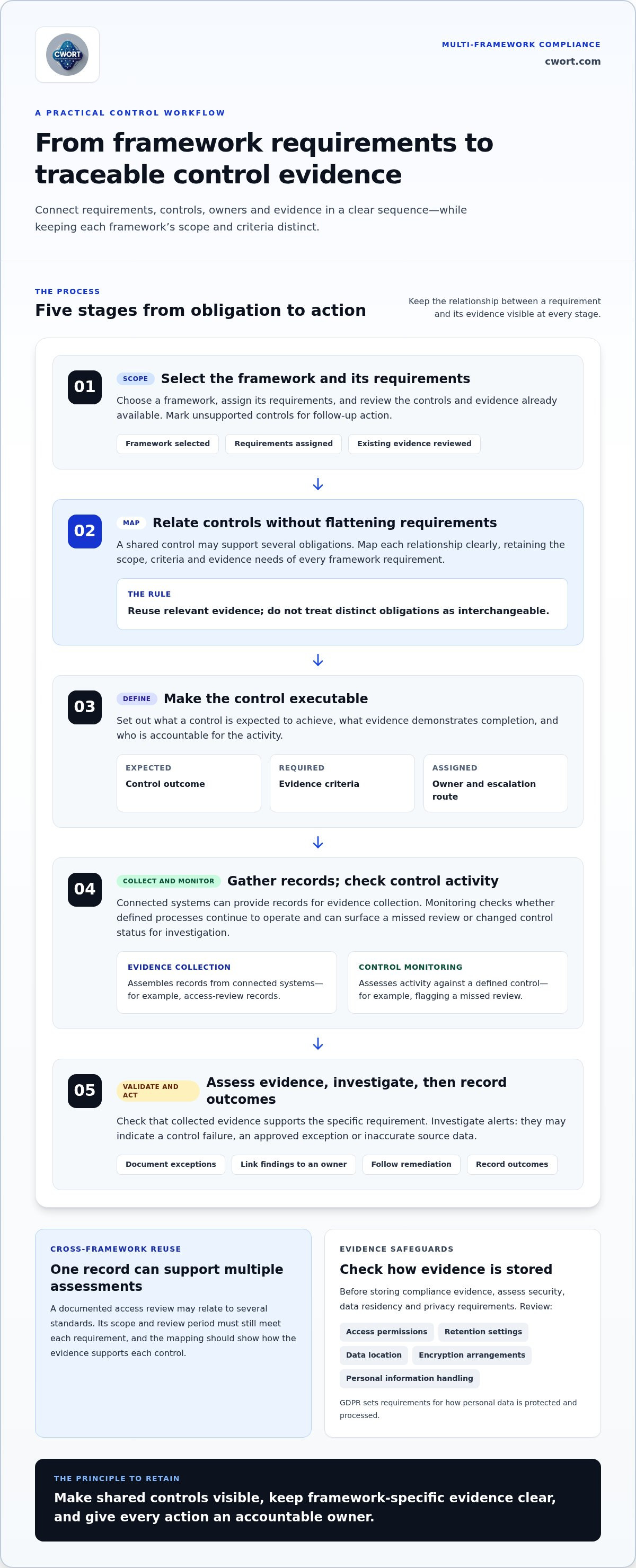
Control mapping connects related requirements across frameworks, so relevant evidence can support more than one assessment. A documented access review, for example, may relate to several standards, but its scope and review period must still meet each requirement. Reuse can reduce duplicate work, while clear mappings show how the evidence supports each control.
Before storing compliance evidence, assess security, data residency and privacy requirements. Review access permissions, retention settings, data location, encryption arrangements and the handling of personal information. GDPR sets requirements for how personal data is protected and processed.
Gap assessments compare mapped requirements with current controls and available evidence. A practical workflow is to select a framework, assign its requirements, attach existing evidence and mark unsupported controls for action. For an information security management system, ISO/IEC 27001:2022 is a standard, and organisations can seek voluntary third-party certification against it, according to the International Organization for Standardization.
Compare how clearly each platform links evidence to control outcomes, preserves framework-specific requirements and shows the status of execution.
Continuous controls monitoring
Continuous validation connects control requirements to defined activities, accountable owners and evidence. Teams can review execution status, document exceptions and follow remediation as work progresses, rather than relying only on a snapshot prepared for an audit. Clear control definitions matter: expected outcomes, evidence requirements and ownership must be explicit for validation to be meaningful.
Start with one control, such as periodic user access reviews. Define the expected review, identify the evidence that demonstrates completion, then assign an owner and escalation route. A monitoring platform can surface a missed review or changed status for investigation. People still need to assess whether the alert reflects a control failure, an approved exception or inaccurate source data.
Consistent control mapping helps teams relate shared objectives to requirements across frameworks. A control can connect to several obligations, while each mapping retains its own scope, criteria and evidence needs. For example, an access-control objective may relate to more than one framework, but the evidence and assessment criteria must still reflect each requirement. This improves visibility without treating distinct obligations as identical.
Clear accountability goes beyond assigning a name. A governed workflow should show who performs an activity, who reviews its evidence, how exceptions move to remediation and how outcomes are recorded. When evidence is incomplete, the finding should be linked to a responsible owner and a documented follow-up. This makes control status and accountability easier to examine.
Supplier agreements can create obligations that need ongoing oversight, such as service levels, reporting duties, renewal dates or evidence requirements. A compliance validation system can connect relevant obligations to controls and supporting evidence. Contract lifecycle management software, by contrast, organises contract documents, approvals and key dates. Connecting these processes helps teams relate contractual commitments to the controls used to assess them.
For each supplier, record the relevant contract clause, accountable relationship owner, control evidence and next renewal action. A missed service-level report, for instance, can trigger review of the related obligation and its risk assessment. Treat renewal as a governance checkpoint, not merely a diary reminder: reassess performance, open actions and changes to documented commitments before approving continuation.
- Define: specify the control outcome and acceptable evidence.
- Assign: name the control owner and reviewer.
- Monitor: connect relevant status signals to review workflows.
- Resolve: record exceptions, remediation actions and validation.
Compare platforms by their ability to preserve framework-specific mappings, trace alerts to owners and connect supplier commitments with control records. For organisations assessing structured control mapping and evidence workflows, compliance control mapping is a relevant next step.
What is multi-framework compliance software?
Multi-framework compliance software organises requirements, controls, evidence and reporting across standards within one compliance platform. For UK businesses, the best option is the one that supports required frameworks, fits the organisation’s size and sector, and can adapt to its policies. Shortlist 3-5 platforms suited to your organisation, then compare their capabilities against real programme needs.
Define scope before selecting software. List current obligations, business units, control owners and reporting audiences. Include frameworks you may add within 18 months when setting programme scope. For a UK organisation managing ISO 27001 alongside UK NIS requirements, for example, identify overlapping controls and obligations that need separate evidence. This creates a usable basis for selection and avoids buying capabilities that don’t support the intended operating model.
Use a staged implementation plan:
- Map requirements: document each framework, obligation, owner and existing evidence source.
- Assess gaps: identify unsupported controls, duplicated tasks and reporting requirements.
- Configure workflows: set responsibilities, approval routes, evidence fields and escalation rules.
- Run a pilot: test a defined set of controls with the teams who perform and review them.
- Expand and train: refine the process, then train control owners, reviewers and senior reporting teams.
Training should reflect each user’s role. Control owners need to understand how to complete assigned activities and provide supporting evidence; reviewers need to assess that evidence against mapped requirements. Give auditors a clear route to relevant records and reports, while limiting access according to their role. A pilot can reveal unclear instructions before wider adoption.
Implementation time depends on framework scope, integrations, data readiness, workflow complexity and internal decision-making. Enterprise GRC incumbents commonly require 6 to 18 months for implementation and professional services. Treat that as a planning consideration, not a delivery guarantee for every platform. A narrower deployment may still need careful mapping, configuration, migration and user adoption before reporting is dependable.
Assess implementation alongside platform capabilities. Compare framework coverage, control mapping, evidence handling, reporting, integrations, permissions and the process for adding frameworks. Ask how mapping changes are governed, who approves them and how updated requirements flow into existing activities. These choices determine whether the platform reflects operational practice or becomes another layer of documentation.
When selecting software for managing multiple compliance frameworks, look for a platform that supports your obligations and makes ownership, execution and evidence practical for the people using it. Start with a defined scope, test the workflow against real controls and expand once stakeholders can use it consistently.
Compliance automation and continuous monitoring
Automation can reduce repetitive compliance work, while continuous validation provides visibility into execution as it happens. The key distinction is whether a platform merely organises tasks or connects regulatory obligations to accountable activities, evidence and control outcomes.
Automation versus integrated GRC
Compliance automation handles defined activities, such as collecting evidence, sending reminders or updating a control record after a review. Integrated GRC connects those activities with risk registers, policies, ownership and reporting. For example, an ISO 27001 control failure can be linked to its risk, assigned for remediation and shown in management reporting. Compare platforms by how well they connect those records, not just by the number of automated tasks.
Automation is most useful when the underlying process is clearly defined. Specify the control, expected evidence and responsible owner, then establish how exceptions are handled. For example, a system can show that an approval activity is overdue, while a reviewer determines whether the status reflects an approved exception or work that still needs attention. This keeps the validation process focused on control outcomes.
Consider the evidence workflow. A system can collect records from connected tools, match them to a control and prompt review when evidence is missing or outdated. An efficiency example describes reducing manual evidence collection by 70%, potentially freeing hundreds of hours per year. Treat that as an example, not a forecast for every organisation: results depend on evidence sources, process design and the amount of manual work being replaced.
Remediation and integrations
Automation becomes operational when a finding leads to controlled remediation. A failed check can create an action, assign an owner, set a due date and retain the closure evidence. Integrations with identity, ticketing or document systems can supply relevant records and route tasks to existing workflows. Compared with standalone automation, integrated GRC can link the issue to its risks and reporting, but the organisation still needs to validate evidence and approve closure.
Map each integration before deployment. Record what information enters the compliance system, which control relies on it, who can access it and how missing data is handled. For example, if an access-review record is unavailable, the workflow should make that gap visible rather than imply the control is complete. Test data flows with control owners and reviewers before relying on the resulting reports.
Automation also needs maintenance. Regularly audit compliance software to ensure its mappings and workflows reflect current standards as frameworks evolve. Assign responsibility for reviewing changes, updating control criteria and testing affected automations. A change to an ISO 27001 mapping, for instance, should prompt review of related evidence requirements and reports. This governance prevents old rules from continuing unnoticed inside a technically functioning system.
Compliance software for managing multiple frameworks
Software for managing multiple compliance frameworks should connect regulatory obligations to controls, risk management, owners and evidence collection. The central test is whether it preserves each framework’s requirements whilst showing where controls overlap. That distinction matters as a programme grows: an example moves from 2 frameworks for 200 employees to 12 obligations across 2,000 employees.
Start by identifying the frameworks and regulations the organisation must manage. A useful platform should support required frameworks and adapt to internal policies, rather than forcing every obligation into a generic template. Relevant examples include ISO 27001, ISO 27701, GDPR, SOC 2 and NIS 2. Their inclusion in a platform’s catalogue matters only if the mapped requirements fit the organisation’s scope and operating practices.
Evaluate framework coverage and mapping carefully. In the platform evaluation criteria, coverage and mapping carry a 25% weighting. Examine how the system links a control to each requirement, records framework-specific differences and identifies unsupported obligations. For example, an access control may relate to multiple frameworks, but evidence scope and assessment criteria can differ. Clear mappings help internal teams explain those distinctions to auditors.
Separate ongoing compliance management from certification or examination. ISO/IEC 27001:2022 is an information security management system standard, and organisations can seek voluntary third-party certification against it, according to the International Organization for Standardization. SOC 2 is an examination of controls, with the resulting report issued by a licensed CPA firm. Software can organise controls and evidence, but those outcomes depend on their respective assessment processes.
Assess the platform against practical requirements:
- Coverage: required frameworks, regulatory obligations and policy customisation.
- Mapping: shared controls, framework-specific differences and traceable evidence.
- Operations: ownership, workflow, remediation and reporting for internal teams.
- Growth: the ability to add frameworks without rebuilding existing mappings.
Assess implementation effort, integrations, support needs and framework expansion alongside the software itself. Consider how existing systems provide evidence, whether migration preserves the audit history and who maintains control mappings as requirements change. If those processes are unclear, teams may end up duplicating work across systems.
Use this decision guide: choose a focused platform when your priority is a defined set of frameworks and clear execution workflows. Consider broader governance capabilities when compliance is closely connected to enterprise risk and other oversight processes. In either case, make sure evidence remains traceable and each framework’s obligations stay distinct. These are foundations for a defensible programme.
CWORT: DORA Compliance Readiness and Assessment
CWORT supports organisations that need to turn DORA requirements into structured compliance activity and auditable evidence. Its platform links obligations to controls, assigned actions and supporting evidence, helping teams organise validation across frameworks.
Use DORA Compliance Readiness and Assessment to structure DORA-focused work. For wider requirements, CWORT also offers UK NIS Compliance Management, NIS2 Readiness and Compliance Management, and ISO 27001 Readiness and Control Mapping. These offerings are relevant when teams need clearer control relationships, defined responsibilities or an organised view of readiness across applicable frameworks.
To discuss how CWORT could support your compliance programme, visit cwort.com.
Turn your compliance roadmap into accountable action
Make the next decision operational. Before selecting software for managing multiple compliance frameworks, identify who will own the programme, approve control mappings and resolve questions about evidence. These governance decisions shape how the platform will work after implementation, not just how it is configured at launch.
Then define what leadership needs to see, such as unresolved actions, execution status, evidence quality or progress against a framework. Agreeing reporting priorities helps teams build a system that supports decisions and accountability. A focused discussion can also clarify whether the immediate need is DORA readiness, assessment or managing obligations that span frameworks.
CWORT supports organisations with DORA, UK NIS and NIS2 compliance needs through its readiness, assessment and management offerings. If you’re ready to discuss how your requirements could translate into structured compliance work, contact CWORT to discuss your compliance needs. Set a clear direction now, and give your team a practical basis for moving forward.
Frequently Asked Questions
How to select the right security compliance software?
Test software against a real compliance scenario, not just a feature checklist. Simulate a supplier evidence request, an overdue review and a change of control owner. Check whether the system preserves the decision trail, applies role-based access and generates a usable audit output. Also assess how administrators update workflows while retaining approvals and the history of changes.
Which capabilities should the best multi-framework GRC platform include?
A strong platform connects obligations to controls, assigned activities and evidence, with clear roles and an auditable history. Check how it handles exceptions: can a reviewer record a reason, assign follow-up and retain the approval? Also assess whether evidence is linked to the relevant control and can be found through its framework mapping or owner. These capabilities make oversight more useful than a status dashboard alone.
Which platform is best for ISO 27001, SOC 2 and NIST CSF together?
The best fit is a platform that maps all three accurately and keeps their assessment outputs distinct. ISO 27001, SOC 2 and NIST CSF serve different purposes, so test a sample requirement from each against the platform’s workflows. NIST Cybersecurity Framework 2.0 has six Functions and no formal certification path. Confirm that reporting reflects the framework’s role in your programme, rather than treating every framework as a certification checklist.
What is compliance management software for multiple frameworks?
Software for managing multiple compliance frameworks connects obligations, control activities and evidence across frameworks. Teams can assign roles, complete structured activities and link evidence to mapped requirements. For example, an organisation preparing for an internal review and an external assessment can use one governed process while retaining the context needed to explain how each requirement was assessed.
Which software platforms support ISO 27001, SOC 2, GDPR, Cyber Essentials and NIS2?
Platform coverage varies, so assess whether each named framework has usable mappings and workflows, rather than relying on a general claim of multi-framework support. Ask for a demonstration using one requirement from ISO 27001, SOC 2, GDPR, Cyber Essentials and NIS2. Compare how each is scoped, assigned and reported, and whether the platform lets your team tailor internal policies without obscuring the original requirement.
How do leading multi-framework compliance platforms compare on features and ease of use?
Compare platforms using the same scenario: assign a control, attach evidence, record an exception, approve its resolution and generate a report. Note how many hand-offs the workflow requires and whether users can trace the resulting record to its source requirement. Have control owners and reviewers complete the test themselves. Their ability to use the workflow accurately is a more useful measure than a polished demonstration alone.
Which integrations should compliance management software support?
Prioritise connections to systems that hold evidence your controls rely on, such as identity and access management, asset records, ticketing, cloud services and document repositories. For each connection, establish what information is used, how changes are reflected and how missing records are shown. Trace one access change from its source into the compliance workflow, then confirm that a reviewer can inspect the evidence and its context.
How do compliance platforms map shared controls across multiple frameworks?
They link a common control objective to relevant requirements in each framework, while retaining separate criteria and evidence expectations for each mapping. For example, an access review may relate to several requirements, but its scope, frequency or approval evidence may differ. Review the mapping record for its rationale, owner and source reference. This helps auditors and internal reviewers understand why evidence is reused and where additional proof is needed.
Disclaimer
The content on this site is provided for general information and educational purposes only. It does not constitute legal, regulatory, financial, or professional advice. CWORT provides AI-assisted insights and workflow automation, but all compliance decisions remain the responsibility of your organisation and its management. Always seek qualified legal or regulatory guidance for decisions relating to the UK NIS Regulations, CAF, DORA, NIS2, ISO 27001, or other obligations.
Related posts
Regulatory Compliance Workflow Automation for UK Enterprise: A Strategic Guide
Ditch spreadsheets for DORA & NIS2. Our guide to regulatory compliance workflow automation delivers auditable certainty and board-level assurance for UK ente...
How to Demonstrate Control Effectiveness to Regulators: A Strategic Guide
Learn how to demonstrate control effectiveness to regulators with our guide. Shift from chaos to an evidence-based, audit-ready compliance programme today.
Reducing Audit Preparation Time and Costs: A Strategic Guide for UK Enterprises
Tired of costly audit seasons? Our guide for UK enterprises shows you how to stop the manual scramble, reducing audit preparation time and costs with automat...
Article by
Michael Iyiola
Co-Founder, CWORT
Michael Iyiola is a co-founder of CWORT and a Cyber and AI Security Engineer with deep experience in vulnerability management, detection engineering and operational resilience across UK critical national infrastructure, including rail, energy and financial services. At CWORT, he designs scalable, evidence-driven workflows that help teams meet modern regulatory and security demands.
Build Your Foundation of Auditable Certainty
Take control of your regulatory obligations and secure your infrastructure with CWORT.