Compliance as a Business Enabler Not a Cost Centre: Enterprise Strategic Guide

Michael Iyiola
Co-Founder, CWORT
See how treating compliance as a business enabler not a cost centre accelerates sales, eliminates audit fatigue, and turns assurance into commercial growth.

What if the multi-framework audits draining your engineering capacity could actually accelerate your commercial pipeline? For most enterprise leadership teams, wrestling with fragmented control tracking across static spreadsheets and disconnected Jira tickets feels like an unrelenting operational tax. Constant audit fatigue sets in whilst reactive security reviews continually stall go-to-market speed. When unprovable claims breed board-level friction during inspections, treating compliance as a business enabler not a cost centre sounds like wishful thinking. You aren't alone in feeling that escalating consultancy spend repeatedly fails to yield tangible operational improvements.
It doesn't have to work this way. In this strategic guide, you'll discover how modern enterprises transform regulatory compliance into a decisive commercial advantage through deterministic assurance. We examine how establishing an evidence-based operating model satisfies multiple regulators simultaneously, equips audit committees with reproducible, board-ready dashboards, and compresses enterprise sales cycles by turning verified operational resilience into immediate procurement credibility.
Key Takeaways
- Break free from the reactive audit trap by replacing fragmented spreadsheets with an orchestration layer that unifies low-level technical evidence across disparate tooling.
- Treat compliance as a business enabler not a cost centre to accelerate enterprise deal velocity and pass commercial procurement reviews with deterministic proof.
- Implement an "assess once, report many" framework crosswalk that maps individual operational controls to multiple global and UK regulatory standards simultaneously.
- Evaluate operational capacity alongside control design capability to prevent hidden workflow fatigue and safeguard ongoing organisational resilience.
- Arm board risk committees and executive sponsors with reproducible, auditor-ready intelligence that connects day-to-day cyber hygiene directly to enterprise growth.
Table of Contents
- The Cost Centre Trap: Why Traditional Compliance Stifles Growth
- The Strategic Pivot: Modern Compliance as a Core Business Enabler
- Architectural Blueprint: Unifying Multi-Framework Assurance
- Transforming Operating Models: From Administrative Burden to Organisational Resilience
- Delivering Executive Assurance: Board-Ready Intelligence with CWORT
The Cost Centre Trap: Why Traditional Compliance Stifles Growth
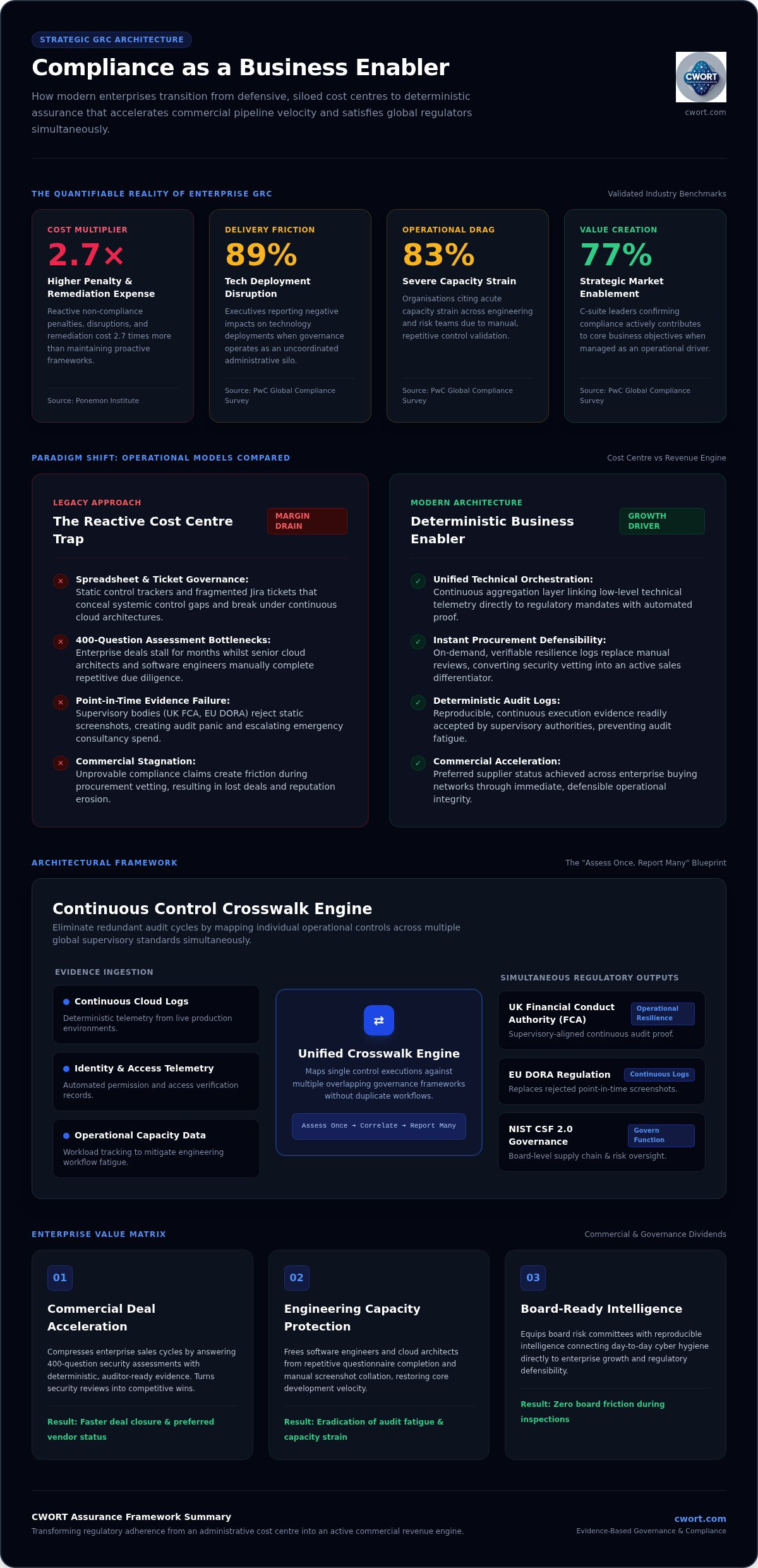
Enterprise leadership has historically viewed regulatory adherence as an unavoidable margin drain. It operated as an administrative tax paid to stay out of regulatory crosshairs, offering zero commercial return. Treating compliance as a business enabler not a cost centre requires dismantling this defensive posture. The Ponemon Institute found that non-compliance penalties, disruptions, and reactive remediation cost businesses 2.7 times more than maintaining proactive frameworks. Yet, legacy compliance practices remain notoriously reactive. They paralyse internal delivery, burn out engineering talent, and stall product releases.
The core problem lies in the disconnect between policy creation and operational reality. According to a PwC Global Compliance Survey, when governance runs as an uncoordinated administrative silo, 89% of executives report negative impacts on technology deployments, whilst 83% cite severe operational capacity strain. Regulatory compliance can't protect enterprise margins if it simultaneously breaks business momentum.
The Failure of Reactive Checklists and Spreadsheet Governance
Tracking high-stakes obligations through manual spreadsheets and fragmented Jira tickets conceals catastrophic control gaps. The discipline of governance, risk management, and compliance (GRC) was created to unify oversight, but static trackers break down when applied to continuous cloud architectures. Today's supervisory bodies, such as the UK Financial Conduct Authority and European supervisory authorities enforcing DORA, actively reject point-in-time screenshots. They expect deterministic, verifiable logs proving continuous control execution. Without automated aggregation, teams spend hundreds of hours scrambling across isolated systems, frantically trying to reconstruct historical proof before supervisory audits begin.
Commercial Friction: How Slower Assurance Stalls Revenue
Operational drag quickly turns into lost commercial revenue. Modern B2B procurement prioritises verifiable vendor resilience above speculative brand promises. When high-value prospects issue complex 400-question security assessments, reactive organisations freeze.
- Paralysed pipeline velocity: Deals stall for months whilst internal teams debate control definitions across fragmented toolsets.
- Resource depletion: Senior software engineers and cloud architects spend critical delivery sprints filling out repetitive third-party due diligence questionnaires.
- Procurement disqualification: Competitors offering instantaneous, defensible assurance win preferred supplier status by removing procurement friction.
Failing customer third-party due diligence carries severe financial damage. Reputational erosion spreads rapidly across enterprise buying networks. Recognising compliance as a business enabler not a cost centre means transforming your control baseline into an active commercial asset that proves operational resilience on demand.
The Strategic Pivot: Modern Compliance as a Core Business Enabler
Modern enterprises no longer view regulatory alignment through a purely defensive lens. Instead of treating assurance as an expensive checklist dictated by external auditors, high-performing organisations treat operational integrity as a core revenue engine. A recent PwC Global Compliance Survey revealed that 77% of C-suite leaders confirm compliance actively contributes to core business objectives and strategic market enablement. Shifting to this model means treating compliance as a business enabler not a cost centre, converting technical control proof into verifiable commercial trust.
When enterprise buyers evaluate potential partners, security vetting takes centre stage. The release of the NIST Cybersecurity Framework 2.0 solidified this dynamic by establishing "Govern" as a primary function, elevating supply chain oversight to board-level strategy. Organisations that present continuous, auditable resilience instantly outmanoeuvre competitors trapped in reactive compliance cycles.
Commercial Acceleration Through Audit-Defensible Trust
Transforming compliance into a front-line commercial asset fundamentally changes your sales velocity. Rather than bogging down high-value transactions with weeks of back-and-forth documentation, deterministic proof creates immediate buyer confidence.
- Accelerated sales velocity: Verified operational postures satisfy stringent vendor onboarding requirements without manual intervention.
- Institutional credibility: Regulated buyers in banking, healthcare, and critical infrastructure demand verifiable resilience before granting network access.
- Defensible market differentiation: Transparent, continuous assurance provides hard evidence that your organisation protects client data under disruption.
Eliminating security evaluation bottlenecks directly protects your gross margins and preserves enterprise deal momentum.
Operational Clarity: Connecting Controls to Strategic Objectives
Forward-thinking organisations reject fragmented control testing. Running isolated compliance checks across IT, security, and internal audit drains capacity and creates blind spots. PwC's Risk and Compliance Reimagined Report demonstrates that enterprises implementing horizontal control architectures achieve up to a 20% overall cost reduction across risk programmes, alongside 50% savings in specific workflow testing.
Adopting unified governance bridges technical telemetry with executive continuity goals. When engineering teams operate within unambiguous, deterministic guardrails, they build and deploy digital services faster without risking regulatory non-compliance. Organisations ready to modernise their control operations can request a platform demonstration to see how unified telemetry turns governance friction into commercial speed.
Positioning compliance as a business enabler not a cost centre gives boards the auditable certainty needed to pursue bold commercial initiatives, secure in the knowledge that operational foundations remain rock solid.
Architectural Blueprint: Unifying Multi-Framework Assurance
Point-solution sprawl cripples operational throughput. Navex and A-LIGN benchmark data shows that 58% of enterprises endure four or more compliance audits annually, with 35% facing over six. Subjecting engineering and security teams to disconnected audit cycles for every framework drains productive capacity. Treating compliance as a business enabler not a cost centre requires a shift from disjointed data collection to an orchestrated, evidence-based assurance architecture.
Solving this challenge requires an orchestration layer that sits directly above your operational tooling stack. Instead of ripping and replacing existing systems like SIEM, EDR, IAM, and vulnerability scanners, this layer aggregates telemetry into a single pane of governance. It converts raw configurations into deterministic, reproducible proof where identical operational inputs consistently produce identical, audit-defensible results.
Step 1: Consolidating Telemetry Above Point-Tool Silos
Fragmented point tools generate massive volumes of disconnected logs, but raw data is not audit evidence. An effective orchestration layer ingests disparate telemetry, harmonises the data, and translates raw configurations into human-readable control execution records. Crucially, the system enforces strict separation of duties between control operators who run systems, reviewers who verify execution, and independent assurance teams who validate results. This structural partition eliminates conflicts of interest before supervisory inspectors arrive.
Step 2: "Assess Once, Report Many" Multi-Regulation Mapping
Modern enterprises operate under multiple concurrent legal regimes. With the European Union enforcing DORA and the UK reforming NIS regulations through the Cyber Security and Resilience Bill, manual mapping causes severe operational fatigue. Organisations need a cross-walk engine that links a single operational control across 42 frameworks using a unified taxonomy. A robust baseline links 1,355 controls across 217 domains, ensuring that 98.6% of active controls carry verified regulatory cross-references. You assess a control once; the cross-walk engine reports compliance across ISO 27001:2022, NIS2, and DORA simultaneously, eliminating redundant testing cycles entirely.
Step 3: Binding Tamper-Proof Evidence to Control Outcomes
Subjective self-attestation carries zero weight during formal supervisory examinations. Defensible assurance requires binding immutable digital artifacts directly to specific control outcomes. Every configuration pull, administrative verification, and policy sign-off must produce a permanent audit history. If artificial intelligence is deployed, it must function strictly as an advisory assistant for drafting narratives and gap summaries. AI must never alter deterministic scoring calculations, safeguarding mathematical certainty across every regulatory inspection.
Operating with this degree of architectural precision turns compliance as a business enabler not a cost centre. It protects engineering hours, satisfies multi-jurisdictional scrutiny without duplicated effort, and provides immediate operational clarity.
Transforming Operating Models: From Administrative Burden to Organisational Resilience
Pristine governance policies look impressive in executive board packs, but theoretical elegance collapses without operational bandwidth. Controls fail not because teams misunderstand regulations, but because they lack the capacity to sustain them. Establishing compliance as a business enabler not a cost centre means closing the dangerous gap between control design and daily execution reality.
Organisations stumble when they assess capability whilst ignoring resourcing. A security team might possess the technical expertise to review privileged access, yet fail completely when inundated with unmanageable ticket volumes. True operational resilience requires an operating model built for continuous execution under strain.
Measuring Capability and Capacity Concurrently
Assessing capability determines whether your organisation possesses the technical skills and tooling to execute a control. Evaluating capacity measures whether teams have the operational time to maintain it consistently. When you assess both dimensions simultaneously, hidden operational bottlenecks surface immediately. Defensible governance produces dynamic heat maps that highlight where personnel shortages or manual workflows threaten compliance, allowing leadership to allocate budget directly where risk concentrates.
The Four-Stage Continuous Assurance Lifecycle
Modernising your assurance posture requires a structured, repeatable progression:
- Diagnose: Evaluate control baselines and surface capacity deficits across business units.
- Design: Architect a target operating model that aligns compliance guardrails with corporate revenue targets.
- Deliver: Execute governed remediation action plans with deterministic accountability and clear milestones.
- Demonstrate: Validate operational resilience through reproducible evidence records that eliminate external audit anxiety.
This closed-loop methodology turns reactive panic into predictable, ongoing control validation.
Custom Maturity Frameworks with BYOC Digitisation
Bespoke enterprise architectures rarely fit neatly into off-the-shelf templates. Forward-thinking organisations use Bring Your Own Content (BYOC) maturity assessments to ingest custom operating models into governed digital workflows. By establishing clear taxonomies, enterprises compare component-level security across disparate business units without losing operational nuance. When leadership can view unified maturity metrics across complex portfolios, governance shifts from an abstract drag to a strategic growth driver. To modernise your governance architecture, schedule an operating model assessment demo today.
Proving operational integrity at this granular level solidifies compliance as a business enabler not a cost centre, assuring both internal executives and external regulators that defensive claims rest on measurable operational reality.
Delivering Executive Assurance: Board-Ready Intelligence with CWORT
Executive leadership cannot direct commercial strategy using low-level technical telemetry. Board members and audit risk committees require clear commercial risk indicators rather than dense, raw firewall outputs. Bridging this communications gap turns compliance as a business enabler not a cost centre. By operating as a comprehensive orchestration layer sitting above point tooling, CWORT synthesises low-level configurations into board-level intelligence, delivering explainable assurance that satisfies corporate governors and external regulators alike.
When supervisors demand proof, legacy organisations lose weeks scrambling through fragmented repositories. CWORT eliminates this vulnerability through deterministic, reproducible scoring. The platform anchors its architecture across 1,355 controls within 217 domains, directly linked to 42 regulatory frameworks. Because 98.6% of active controls carry verified regulatory cross-references, executive teams can defend their operational posture under intensive regulatory examinations with mathematical certainty.
Replacing Audit Panic with Instant Assured Proof
Annual audit preparation should never disrupt revenue-generating initiatives. Frantic evidence gathering ahead of National Cyber Security Centre reviews or sector-specific inspections reveals structural disorganisation. CWORT provides instant, continuous assurance registers:
- Deterministic proof: Identical evidence yields identical audit-defensible proof every time, removing subjective guesswork.
- Zero audit reconstruction: Evidence attaches automatically to designated control mandates across all business units.
- Regulator acceptance: Transparent validation histories give external supervisors complete traceability from policy statement down to live infrastructure.
Empowering the Board and Risk Committees
Boardrooms require clear, commercial narratives to allocate capital effectively. Instead of presenting subjective maturity estimates, GRC leaders use CWORT to surface precise capability and capacity metrics. When executives see exactly which business units lack the operational bandwidth to execute controls, they can target remediation spend where exposure threatens continuity. Linking technical hygiene directly to strategic risk gives boards the confidence to enter new markets and sign high-value commercial partnerships rapidly.
Accelerate Your Strategic Transformation
Moving away from defensive compliance demands operational commitment and modern architecture. Organisations that automate evidence aggregation shorten sales cycles, satisfy institutional procurement vetting, and eliminate redundant testing. Operating with deterministic assurance firmly establishes compliance as a business enabler not a cost centre across your entire enterprise. To experience modern operating model intelligence first-hand, request a platform demonstration with the CWORT team today.
Transform Regulatory Demands into Commercial Velocity
Treating compliance as a reactive obligation drains enterprise resources, erodes team morale, and stalls revenue growth. By moving away from fragmented spreadsheets to an evidence-based orchestration layer, organisations secure a formidable market advantage. Defensible governance does not just protect your balance sheet from supervisory penalties; it accelerates procurement approvals, instils unshakeable institutional confidence, and empowers leadership to pursue bold commercial initiatives safely.
Positioning compliance as a business enabler not a cost centre requires deterministic certainty. With a unified taxonomy library spanning 1,355 controls across 217 domains linked to 42 regulatory frameworks, where 98.6% of active controls carry verified regulatory cross-references, CWORT transforms complex multi-standard obligations into reproducible, board-ready intelligence. You assess once and report across DORA, NIS2, UK NIS, NCSC CAF, and ISO 27001 simultaneously, ensuring identical operational evidence yields identical, audit-defensible outcomes every time.
Dismantle administrative drag and turn compliance assurance into your sharpest competitive edge. Request your tailored CWORT platform demonstration today and lead your market with verified operational resilience.
Frequently Asked Questions
How does viewing compliance as a business enabler differ from viewing it as a cost centre?
Viewing compliance as an enabler transforms regulatory posture into an active commercial asset that accelerates revenue. A cost-centre mindset treats governance as an administrative chore, creating friction that stalls product delivery. Treating compliance as a business enabler not a cost centre leverages audit-defensible operational resilience to pass enterprise procurement reviews quickly, unlock regulated commercial sectors, and build immediate buyer confidence.
Why do regulators and external auditors increasingly reject manual spreadsheet trackers?
Regulators reject spreadsheets because static rows cannot prove continuous operational execution. Disjointed files lack cryptographic integrity, fail to enforce separation of duties, and invite retrospective manipulation. Supervisory bodies like the FCA and Ofgem demand deterministic assurance. They expect immutable logs, verifiable digital artifacts, and live operational telemetry rather than unverified self-attestations assembled weeks after an event.
How does an orchestrated compliance posture shorten enterprise sales and procurement cycles?
Orchestration replaces tedious 400-question security spreadsheets with pre-validated, evidence-backed assurance packages. B2B institutional buyers evaluate operational resilience before signing high-value contracts. By delivering transparent, reproducible proof of control effectiveness immediately, enterprises eliminate months of administrative deadlock. This rapid verification satisfies customer vendor-risk teams and shortens procurement cycles significantly.
Can an enterprise map one operational control across multiple regulatory frameworks simultaneously?
Yes, modern governance platforms use multi-framework cross-walk engines to map individual controls across diverse mandates. A unified taxonomy library linking 1,355 controls across 217 domains enables organisations to assess a technical control once and validate it across 42 frameworks simultaneously. This includes DORA, NIS2, UK NIS, and ISO 27001, eliminating redundant control testing across IT teams.
What is the role of deterministic scoring in maintaining audit-defensible compliance proof?
Deterministic scoring guarantees that identical operational evidence consistently produces the exact same audit-defensible outcome. Unlike subjective auditor judgements or unpredictable black-box algorithms, deterministic rules are fully explainable and reproducible. If an external regulator or internal auditor re-runs the assessment using the same parameters, the result never changes. This reproducibility provides mathematical certainty during high-stakes supervisory examinations.
How does evaluating team operational capacity prevent compliance failures during audits?
Assessing capacity reveals whether teams possess the hours, staffing levels, and tooling coverage required to sustain controls under real-world pressure. Theoretical control design often looks flawless on paper, but controls collapse when operational teams suffer resource fatigue. Evaluating capacity alongside technical capability exposes hidden bottlenecks early, enabling leadership to allocate resources before unexecuted controls cause audit failures.
What steps are required to transition an enterprise from reactive compliance to continuous assurance?
Transitioning to continuous assurance requires implementing a four-stage operating lifecycle: Diagnose, Design, Deliver, and Demonstrate. First, evaluate control baselines and capacity deficits. Next, architect a target operating model aligned with strategic goals. Then, execute governed remediation workflows with explicit milestones. Finally, demonstrate ongoing resilience through immutable evidence registers, embedding compliance as a business enabler not a cost centre across every business unit.
Disclaimer
The content on this site is provided for general information and educational purposes only. It does not constitute legal, regulatory, financial, or professional advice. CWORT provides AI-assisted insights and workflow automation, but all compliance decisions remain the responsibility of your organisation and its management. Always seek qualified legal or regulatory guidance for decisions relating to the UK NIS Regulations, CAF, DORA, NIS2, ISO 27001, or other obligations.
Related posts
Regulatory Compliance Workflow Automation for UK Enterprise: A Strategic Guide
Ditch spreadsheets for DORA & NIS2. Our guide to regulatory compliance workflow automation delivers auditable certainty and board-level assurance for UK ente...
ISO 27001 Control Effectiveness Proof: Moving Beyond Static Certification to Defensible Validation
Move beyond static ISO 27001 certification. Discover how an ISO 27001 compliance validation tool delivers continuous, defensible proof for UK regulators.
The Evolution of the Enterprise GRC Validation Tool: From Tracking to Orchestration in 2026
Stop chasing compliance ghosts in spreadsheets. Create a single source of truth for compliance with GRC orchestration to master NIS2, DORA, and UK audit dema...
Article by
Michael Iyiola
Co-Founder, CWORT
Michael Iyiola is a co-founder of CWORT and a Cyber and AI Security Engineer with deep experience in vulnerability management, detection engineering and operational resilience across UK critical national infrastructure, including rail, energy and financial services. At CWORT, he designs scalable, evidence-driven workflows that help teams meet modern regulatory and security demands.
Build Your Foundation of Auditable Certainty
Take control of your regulatory obligations and secure your infrastructure with CWORT.