Compliance Manager Pain Points: Navigating the Regulatory Storm in 2026

Michael Iyiola
Co-Founder, CWORT
Facing key compliance manager pain points in 2026? Ditch risky spreadsheets for an automated, defensible system. Turn audit anxiety into auditable certainty.

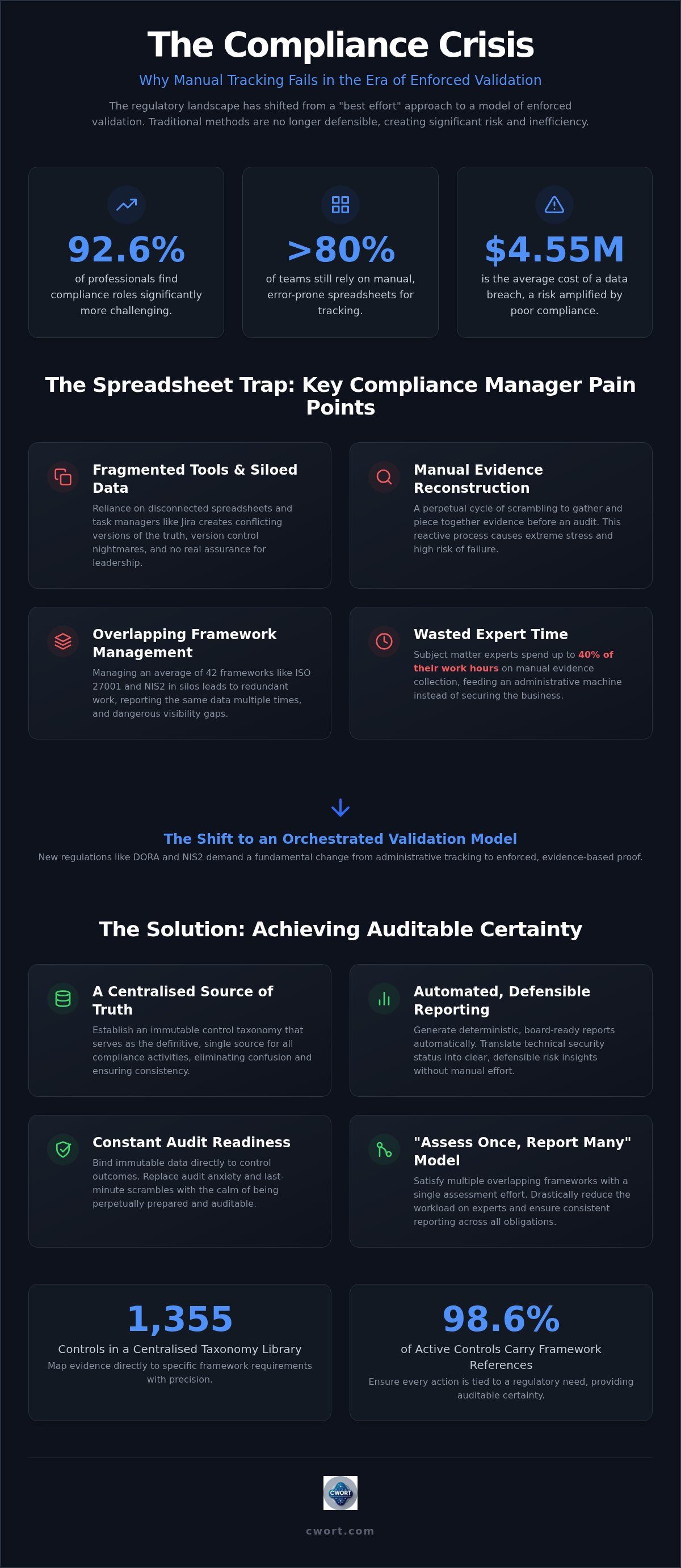
A 2026 Regology survey reveals that 92.6% of compliance professionals find their roles have become significantly more challenging, yet over 80% of teams still rely on manual spreadsheets. This reliance on fragmented tools is the root of the most persistent compliance manager pain points, leading to a perpetual cycle of manual evidence reconstruction and audit anxiety. You likely recognise the exhaustion of managing overlapping frameworks whilst struggling to provide the board with technically defensible reports. With the average cost of a data breach now exceeding $4.55 million, the "spreadsheet trap" is a systemic risk your organisation can no longer afford to ignore.
It's clear that tracking obligations in Jira or Excel doesn't equate to validating them. You need a system that enforces discipline by design rather than relying on the heroic efforts of subject matter experts. This article explores the structural failures of manual tracking and demonstrates how to transition to a defensible, orchestrated validation model. We'll examine how to establish a single source of truth across 42 frameworks and 1,355 controls, ensuring your maturity reports are automated, deterministic, and board-ready. Shift the focus. Move from administrative tracking to evidence-based proof to replace regulatory fatigue with auditable certainty.
Key Takeaways
- Understand how DORA and NIS2 have replaced "best effort" tracking with a mandatory requirement for enforced validation and technical proof.
- Address the most critical compliance manager pain points by transitioning from fragmented spreadsheets to a centralised, immutable control taxonomy.
- Eliminate the manual evidence reconstruction scramble by binding deterministic data directly to control outcomes for constant audit readiness.
- Bridge the capability-capacity gap with automated reporting that translates technical security status into defensible, board-level risk insights.
- Implement an orchestrated "assess once, report many" model to satisfy multiple overlapping frameworks whilst reducing the workload on subject matter experts.
Table of Contents
- The 2026 Regulatory Landscape: Why Traditional Compliance Management is Breaking
- The Spreadsheet Trap: Why Fragmented Tools are a Compliance Manager’s #1 Pain Point
- Audit Anxiety: The Pain of Manual Evidence Reconstruction
- The Strategic Friction: Board Reporting and the Capability-Capacity Gap
- Solving the Crisis: Transitioning to an Orchestrated Validation Model
The 2026 Regulatory Landscape: Why Traditional Compliance Management is Breaking
The regulatory landscape has shifted from a "best effort" approach to a model of enforced validation. For leadership, regulatory compliance is no longer an administrative task managed in the margins of a spreadsheet; it's a technical requirement for operational survival. Regulations such as DORA and NIS2 have moved the goalposts for ICT risk management by demanding proof of resilience rather than just policy documentation. This shift creates acute compliance manager pain points, as teams find themselves drowning in the hidden cost of regulatory fatigue whilst attempting to manage 42 or more frameworks simultaneously.
The distinction between compliance tracking and compliance validation is critical. Tracking merely monitors the progress of a task. Validation, however, provides deterministic evidence that a control is actually functioning as intended. If you can't prove it with immutable data, the regulator treats it as if it never happened. Reliance on "best effort" is a strategy for failure.
The Surge of Overlapping Obligations
Organisations today face a mountain of redundant work. Frameworks like ISO 27001, NIS2, and the UK NIS often require the same technical controls, yet they're managed in silos. This fragmentation amplifies compliance manager pain points, leading to the exhausting reality of reporting the same data five times to different stakeholders. Manual cross-walking between frameworks is not just inefficient; it's dangerous. It creates gaps in visibility that only become apparent during a high-stakes audit. When subject matter experts spend 40% of their work hours on manual evidence collection, they aren't securing the business; they're merely feeding the administrative machine.
Regulatory Scrutiny and the Demand for Evidence
Regulators have lost patience with self-attestation. The era of "taking your word for it" is over. Modern scrutiny focuses on technical standards validation, requiring immutable proof that controls are active and effective. This is where traditional methods fail. CWORT addresses this directly by translating abstract obligations into structured execution activities. By using a taxonomy library of 1,355 controls, it maps evidence directly to framework requirements. It replaces the anxiety of potential failure with the calm of auditable certainty, ensuring that 98.6% of active controls carry explicit framework references. This is how you transition from an administrative burden to a defensible reality.
The Spreadsheet Trap: Why Fragmented Tools are a Compliance Manager’s #1 Pain Point
Many organisations continue to rely on general-purpose productivity tools to manage high-stakes governance. This reliance is a strategic error. Spreadsheets are static, prone to human error, and lack the structural integrity required to survive a modern regulatory audit. They represent one of the most persistent compliance manager pain points because they offer no definitive version of truth. When data is scattered across disconnected workbooks, the view of risk becomes fragmented. This provides no actual assurance to leadership or regulators, intensifying existing compliance manager pain points.
Similarly, task management platforms like Jira are often misapplied as compliance engines. Whilst Jira is excellent for workflow tracking, it's not a compliance orchestration tool. It fails to enforce the rigorous mapping required for an effective compliance program because it doesn't bind evidence to specific control outcomes in an immutable way. Relying on these tools for audit readiness is a recipe for failure. They cannot provide the deterministic proof that today’s frameworks demand.
The Hidden Risks of Manual Tracking
Manual tracking creates a version control nightmare. In high-pressure environments, the question of who holds the latest control map often leads to conflicting answers. Shared drives and email chains are where evidence goes to die. They lack the immutable audit trail necessary for technical defensibility. This fragmentation hides critical control failures until it's too late to remediate them before an audit. Manual workflows also fail to enforce a clear separation of duties. When the same individual can both perform a task and "verify" its compliance within a spreadsheet, the system of oversight collapses. This lack of structural accountability is a primary driver of audit rejection.
Orchestration vs. Administration
True defensibility requires a shift from passive administration to active orchestration. A deterministic governance system prevents human error by design. It ensures that every action is recorded and mapped to a specific requirement. Instead of managing 217 domains across various disconnected files, an orchestrated platform centralises these into a single, explainable view. This approach replaces the "stale evidence" problem with real-time validation. By moving away from fragmented tools, you gain the ability to prove control effectiveness with total certainty. To see how a centralised taxonomy library can transform your audit readiness, request a platform demonstration today. Transitioning to an orchestrated model ensures that your evidence is always current, mapped, and ready for scrutiny.
Audit Anxiety: The Pain of Manual Evidence Reconstruction
The "Three-Week Scramble" remains one of the most debilitating compliance manager pain points. It is the frantic, last-minute attempt to pull subject matter experts away from their primary duties to manually reconstruct evidence from logs, emails, and static screenshots. This reactive approach is inherently flawed. It relies on human memory and fragmented data sources, neither of which satisfy the rigorous standards of a modern regulatory audit. When evidence is gathered in a vacuum, it lacks the context required to prove that a control was active and effective at the time of a specific event.
Regulators in 2026 have moved beyond accepting simple exports or self-attestations. They now routinely reject evidence that isn't explicitly bound to specific control outcomes. Proving "Control Effectiveness" under such scrutiny requires more than just showing that a tool exists; it requires demonstrating that the tool produced a specific, compliant result. Without a system to orchestrate this link, you're left with a collection of disconnected data points that fail to form a defensible narrative. Stop the scramble. Transition to a model where evidence is captured as a natural byproduct of operational execution.
Binding Evidence to Outcomes
Technical defensibility depends on the integrity of your data. Aggregating raw data from SIEM, EDR, and IAM platforms is only the first step. To be audit-ready, this evidence must be immutable, timestamped, and directly mapped to your control taxonomy. This process eliminates the ambiguity that leads to audit failure. It allows you to move from the defensive posture of "we think we are compliant" to the authoritative statement of "here is the auditable proof." By binding technical events to regulatory requirements, you ensure that every data point serves a specific purpose in your governance framework. It transforms abstract logs into concrete proof of resilience.
Generating Regulator-Ready Outputs
The administrative burden of manual report formatting is a significant drain on high-value resources. Compliance teams often spend days, or even weeks, translating technical security failures into slide decks for boards and external auditors. This manual reconstruction is not only slow but also prone to transcription errors that undermine your credibility. Automated dashboards solve this by providing real-time, deterministic visibility into your maturity levels. They allow for an "assess once, report many" capability that satisfies multiple stakeholders with a single source of truth. Maintaining this level of rigor is essential for Ensuring Compliance Evidence Integrity. When your reporting is a direct reflection of your live environment, you replace the anxiety of the audit cycle with the confidence of continuous readiness.
The Strategic Friction: Board Reporting and the Capability-Capacity Gap
Communication breakdown between technical practitioners and the executive board is a primary driver of compliance manager pain points. Boards require clear, risk-based insights to make informed capital allocation decisions. Strategic friction arises when technical teams provide granular data that lacks context or high-level summaries that lack technical defensibility. This disconnect leaves leadership with a false sense of security or unmanaged anxiety, neither of which is acceptable in a high-stakes regulatory environment.
The Capability-Capacity Gap represents a critical risk in 2026. Regulators now demand proof that an organisation possesses the specific skills and personnel volume to sustain controls over time. It isn't enough to show a control was active during a single point-in-time assessment; you must prove the operating model is resilient and sustainable. Treating your operating model as a measurable, auditable asset is the only way to satisfy these requirements. You must move from "reporting on compliance" to "orchestrating a sustainable capability."
Visualising Maturity with Heat-Map Dashboards
Static reporting is obsolete. Modern governance requires portfolio-level visibility that identifies sub-function failures before they escalate into breaches. Heat-map dashboards provide this clarity, but they must be built on deterministic data. A "Board-ready" report should be synonymous with an "Audit-defensible" one. If a heat map shows a green status, you must be able to drill down into the underlying evidence to prove that status is accurate. This level of depth ensures that reporting is not merely a cosmetic exercise but a rigorous validation of maturity across all 42 frameworks.
Proving Sustainability of the Operating Model
Maintaining compliance with frameworks like DORA or NIS2 requires constant vigilance and specific expertise. You must identify skills gaps within your team through a governed digital workflow. Adopting this method allows you to assess whether your team has the actual capacity to manage the 1,355 controls in the taxonomy library. By implementing Regulatory Compliance Workflow Automation, you bridge the gap between obligation and execution. Proactively managing these resources ensures that your compliance posture remains robust even as the regulatory storm intensifies. To see how our platform bridges the gap between technical status and board-level assurance, request a platform demonstration.
Solving the Crisis: Transitioning to an Orchestrated Validation Model
Transitioning to an orchestrated validation model is the only definitive way to resolve persistent compliance manager pain points. It requires a disciplined, four-step progression that moves your organisation from a state of reactive tracking to one of proactive proof. First, map your existing obligations to a centralised control taxonomy library. This step ensures that every requirement is accounted for within a structured hierarchy. Second, automate the delivery of evidence directly from operational tools such as SIEM and Vulnerability Management. This eliminates the manual reconstruction scramble discussed earlier. Third, enforce a strict separation of duties within a governed digital environment to prevent the structural failures common in manual workflows. Finally, focus on producing reproducible, deterministic results. These outputs must satisfy any regulator by providing an immutable audit history by design.
AI advisory plays a specific, supportive role in this new paradigm. Use AI to generate suggestions for control mapping or to identify potential gaps in your evidence chain. However, you must never allow AI to compromise audit integrity by acting as the final validator. Human oversight remains a non-negotiable requirement for accountability. This ensures that whilst AI improves efficiency, the final proof remains technically defensible and grounded in reality.
The CWORT Approach to Compliance Orchestration
CWORT serves as the orchestration engine that sits above your existing security stack. With 1,355 controls in the taxonomy library and 42 frameworks mapped as of June 2026, it provides a "ready-to-go" framework for UK enterprises. This system enables an "Assess Once, Report Many" methodology, where 98.6% of active controls carry explicit framework references. Deterministic scoring is central to this approach. It replaces subjective, human assessments with reproducible data, ensuring that your maturity scores are always audit-defensible and technically sound. This transition replaces the anxiety of potential failure with the calm of auditable certainty.
Next Steps: From Diagnosis to Demonstration
Moving from a fragmented tracking model to an orchestrated system requires a clear implementation path. Start by conducting a Compliance Maturity Assessment or a Compliance Gap Analysis to identify your most immediate vulnerabilities. These assessments provide the data necessary to design a target operating model that bridges the capability-capacity gap. Once your strategy is defined, you can begin the transition to a state of total assurance. To begin this transformation and see the orchestration engine in action, enquire about a CWORT pilot session. Establishing a defensible truth is a strategic imperative. Don't leave your regulatory survival to chance.
Securing Technical Defensibility in an Era of Enforced Validation
The 2026 regulatory landscape leaves no room for the ambiguity of spreadsheets or the friction of manual evidence reconstruction. These outdated methods are the primary drivers of compliance manager pain points, creating systemic risks that boards can no longer ignore. To survive the scrutiny of DORA and NIS2, organisations must shift from administrative tracking to an orchestrated validation model. This transition ensures that every control is active, every outcome is validated, and every report is technically defensible.
CWORT provides the structural integrity needed to navigate this storm. As a UK-based authoritative governance platform, it offers 1,355 controls mapped across 42 frameworks. It reduces the burden of manual audit preparation by binding evidence directly to outcomes, whilst ensuring your operating model is both measurable and sustainable. Move beyond the "three-week scramble" and replace audit anxiety with the calm of auditable certainty. Don't leave your regulatory survival to chance.
Orchestrate your compliance validation with CWORT and establish a single source of truth for your enterprise today.
Frequently Asked Questions
What are the biggest pain points for compliance managers under DORA?
Under DORA, the primary compliance manager pain points involve the transition from policy-based attestation to technical validation of ICT risk management. Managers must prove operational resilience across complex supply chains whilst managing 1,355 controls in a unified taxonomy. This requirement for continuous, evidence-based proof replaces the old model of annual audits, creating a significant administrative burden if handled through fragmented tools that lack a centralised, orchestrated view of truth.
Why is manual evidence gathering considered a high-risk activity?
Manual evidence gathering is high-risk because it lacks an immutable audit trail and is prone to human error during the "three-week scramble" before an audit. Regulators often reject manual screenshots or spreadsheets because they cannot prove that a control was active and effective at a specific point in time. This reactive process often results in stale data, which fails to provide the technical defensibility required for modern frameworks like NIS2 or DORA.
How does compliance orchestration differ from traditional GRC software?
Traditional GRC software functions primarily as an administrative repository for policies and static risk registers. Compliance orchestration, such as the CWORT platform, sits above your operational tools to aggregate live evidence from SIEM and EDR. It translates abstract obligations into structured execution activities. Whilst GRC tools track tasks, an orchestration engine validates outcomes, ensuring that 98.6% of active controls carry explicit framework references for total audit-readiness.
Can I use Jira or Excel for DORA compliance validation?
You cannot use Jira or Excel for DORA validation because they don't provide enforced governance or immutable evidence binding. These tools fail to provide a deterministic link between technical events and regulatory requirements. They lack the structural integrity to prevent subject matter experts from overwriting data, which undermines the separation of duties. Regulators require a system that enforces discipline by design rather than relying on manual, reversible entries in a spreadsheet.
What does "deterministic results" mean in the context of a compliance audit?
Deterministic results mean that identical evidence always yields the same compliance score, removing subjective human interpretation from the audit process. In a high-stakes audit, this reproducibility is essential for proving the integrity of your governance model. CWORT uses a fixed taxonomy of 1,355 controls to ensure that scoring is objective and transparent. This approach provides auditors with a clear, explainable path from raw technical data to a final maturity rating.
How do I prove separation of duties to a regulator?
Proving separation of duties requires a governed digital environment that utilises role-based and attribute-based access controls. You must demonstrate to a regulator that the individual performing a technical task cannot also be the one who validates its compliance status. An orchestrated system achieves this by recording every change in an immutable audit history. This ensures that oversight is enforced by the platform's architecture, providing definitive proof of accountability and internal discipline.
What is the "capability-capacity" gap in regulatory compliance?
The capability-capacity gap measures whether your organisation has both the specific skills (capability) and the necessary personnel volume (capacity) to sustain controls. Many compliance manager pain points stem from having the right tools but lacking the human resources to manage 42 overlapping frameworks simultaneously. Proving sustainability to a regulator requires identifying these gaps through a governed workflow, ensuring that your operating model remains resilient even during periods of high operational pressure.
How can I reduce the time spent on audit preparation?
You can reduce audit preparation time by moving to an "assess once, report many" model that binds evidence to outcomes in real-time. Instead of manually reconstructing reports, use an orchestration engine to automate the delivery of data from your existing security stack. This approach ensures you are always audit-ready, replacing the last-minute scramble with automated, board-ready dashboards. Centralising your 217 domains into a single taxonomy library eliminates redundant work across multiple frameworks.
Disclaimer
The content on this site is provided for general information and educational purposes only. It does not constitute legal, regulatory, financial, or professional advice. CWORT provides AI-assisted insights and workflow automation, but all compliance decisions remain the responsibility of your organisation and its management. Always seek qualified legal or regulatory guidance for decisions relating to the UK NIS Regulations, CAF, DORA, NIS2, ISO 27001, or other obligations.
Related posts
Streamlining Regulatory Compliance Processes: From Manual Tracking to Orchestrated Validation
Stop wasting money on manual compliance. Learn about streamlining regulatory compliance processes to reduce personal liability under DORA & NIS2 and gain aud...
Regulatory Compliance Workflow Automation for UK Enterprise: A Strategic Guide
Ditch spreadsheets for DORA & NIS2. Our guide to regulatory compliance workflow automation delivers auditable certainty and board-level assurance for UK ente...
Reducing Audit Preparation Time and Costs: A Strategic Guide for UK Enterprises
Tired of costly audit seasons? Our guide for UK enterprises shows you how to stop the manual scramble, reducing audit preparation time and costs with automat...
Article by
Michael Iyiola
Co-Founder, CWORT
Michael Iyiola is a co-founder of CWORT and a Cyber and AI Security Engineer with deep experience in vulnerability management, detection engineering and operational resilience across UK critical national infrastructure, including rail, energy and financial services. At CWORT, he designs scalable, evidence-driven workflows that help teams meet modern regulatory and security demands.
Build Your Foundation of Auditable Certainty
Take control of your regulatory obligations and secure your infrastructure with CWORT.