Compliance Risk Assessment: A Practical Guide for 2026

Michael Iyiola
Co-Founder, CWORT
Master your compliance risk assessment methodology with this 2026 practical guide. Connect obligations to controls and deliver defensible, auditable results.

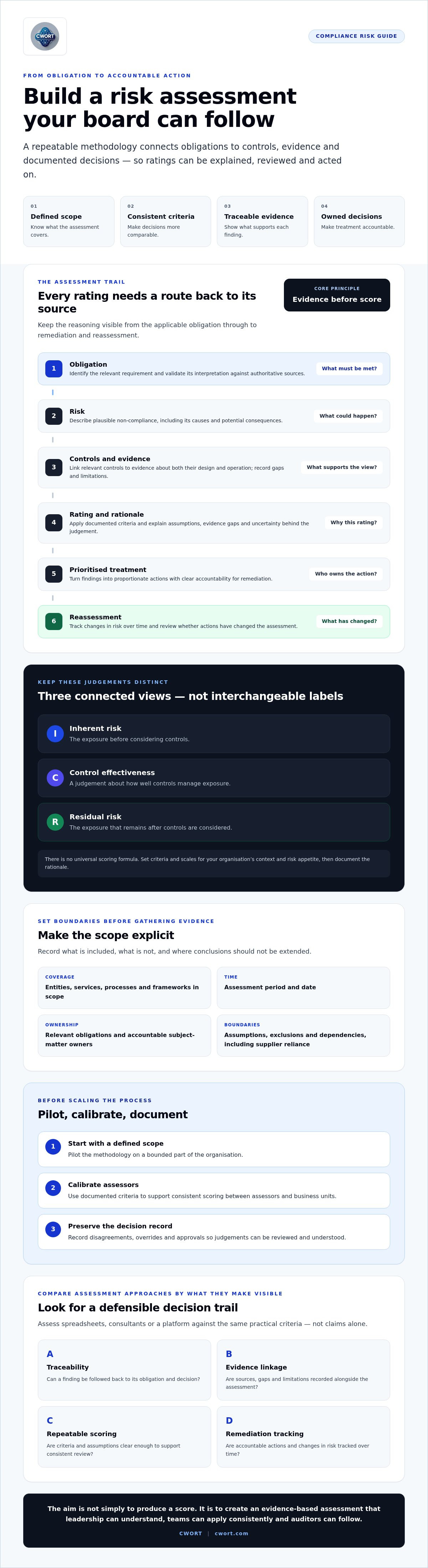
If two teams assess the same obligation and reach different risk ratings, which result can your board defend? A sound compliance risk assessment methodology makes the answer traceable: it connects obligations to controls, evidence and documented decisions, rather than relying on individual judgement alone.
Obligations, control records and supporting evidence often sit across disconnected tools, while scoring assumptions vary between assessors or business units. Even well-founded findings can lose momentum when no one is clearly accountable for remediation. The result is a risk picture that is difficult to compare, explain or act on.
This practical guide sets out a repeatable process for assessing compliance risks in line with your organisation’s scope and obligations. You’ll learn how to document evidence, scoring assumptions and uncertainty, prioritise proportionate actions, assign ownership and track changes in risk over time.
We’ll move from defining scope and identifying obligations to evaluating controls, recording defensible ratings and turning findings into accountable remediation. The aim is not simply to produce a score. It is to create an evidence-based assessment that leadership can understand, teams can apply consistently and auditors can follow.
Key Takeaways
- Use a compliance risk assessment methodology with documented criteria to make risk decisions more consistent and explainable.
- Follow a clear workflow from defining scope and identifying risks through control evaluation, prioritisation, treatment and reassessment.
- Record evidence, scoring assumptions, accountable roles and decisions so findings can be traced and reviewed.
- Pilot the process on a defined scope, then calibrate assessors and document disagreements, overrides and approvals before scaling.
- Compare assessment approaches by their traceability, evidence linkage, repeatable scoring and ability to track remediation, not by claims alone.
Table of Contents
- What does a compliance risk assessment methodology actually assess?
- How to apply a compliance risk assessment methodology step by step
- Which assessment approach is more defensible: spreadsheets, consultants or a platform?
- How can you implement the methodology and prevent unreliable risk ratings?
- How does CWORT support a repeatable, evidence-linked assessment lifecycle?
What does a compliance risk assessment methodology actually assess?
A compliance risk assessment methodology is the documented criteria and sequence an organisation uses to identify, analyse, evaluate and treat risks linked to its obligations. It defines what is assessed, how evidence is considered, how decisions are reached and who is accountable for action. In short: a defined scope, consistent risk criteria, traceable evidence and owned treatment decisions make compliance risks assessable and priorities defensible.
Keep the concepts distinct. A compliance risk is the possibility that an organisation will fail to meet an applicable obligation and face consequences. A control weakness is a gap in the design or operation of a measure intended to manage that risk. Non-compliance is an actual failure to meet an obligation. A cyber threat is a potential cause of harm, while business impact describes the consequences if an event occurs. These concepts may be connected, but they are not interchangeable. A threat can expose a control weakness, increasing the risk of non-compliance and wider business impact.
An assessment supports management decisions; it does not prove compliance or guarantee that a regulator will accept an organisation’s approach. Its value lies in making judgements transparent and reviewable. It should sit within broader governance, informed by relevant Enterprise risk management (ERM) frameworks, while reflecting the organisation’s own obligations and risk criteria.
What belongs within the assessment scope?
Set boundaries before gathering evidence. Specify the organisational entities, services, processes and frameworks in scope, alongside the assessment period. Identify relevant obligations and their accountable subject-matter owners, then check interpretations against authoritative sources. Record assumptions, exclusions and dependencies, such as reliance on a supplier’s control, as well as the assessment date. These details show precisely what the assessment covers and where its conclusions should not be extended.
How do risk, controls and evidence relate?
Build a traceable chain from each relevant obligation to the risk it creates, the controls intended to manage it, the evidence supporting the assessment and the people accountable for oversight and treatment. For example, a policy document may show that a control is defined. By itself, it does not show that staff follow it consistently or that it achieves its intended outcome. Evidence should support conclusions about both control design and operation.
Separate inherent risk, the exposure before considering controls, from control effectiveness, the judgement about how well those controls manage exposure, and residual risk, the exposure that remains. There is no universal scoring formula: criteria and scales should reflect the organisation’s context and risk appetite. Document the rationale, evidence gaps and uncertainty behind each rating so another assessor can understand the decision rather than inherit an unexplained score.
How to apply a compliance risk assessment methodology step by step
Turn the methodology into a controlled workflow. Agree the criteria before scoring begins, then preserve the decision trail from obligation to action. Consistent criteria make assessments more comparable and reproducible.
- Define scope. Decide which entities, services, processes, frameworks and period the assessment covers. The assessment lead records boundaries, assumptions, exclusions and dependencies. The output is an approved scope and assessment plan.
- Identify risks. Map verified obligations to relevant processes, services, assets and third parties. Describe plausible non-compliance scenarios, their causes and consequences, and the stakeholders affected. Subject-matter owners validate the obligation mapping. The record links each obligation to a risk statement, producing a reviewed risk register.
- Evaluate controls. Identify controls intended to address each risk and gather evidence about their design and operation. Control owners provide records, while the assessor checks whether evidence is current and relevant. Document sources, gaps and limitations. The output is a control assessment, not an assumption that a written procedure works in practice.
- Rate and prioritise. Apply pre-agreed likelihood and impact scales, risk appetite, thresholds and escalation rules. Record inherent and residual ratings separately, explain the rationale and note evidence confidence or uncertainty. A designated risk owner or governance forum approves material judgements. The output is a prioritised set of risks.
- Treat. Decide whether to reduce, accept, avoid or otherwise manage each priority risk, in line with organisational policy. The accountable risk owner records proportionate actions, an owner for each action, a target date and the intended outcome. The approved output is a remediation plan, including any accepted residual exposure.
- Reassess. Set review triggers and criteria, such as a material process change, new evidence or completion of an action. The assessment lead records the review date, changed evidence, revised ratings and approvals. The output is an updated assessment showing whether exposure has changed and why.
How should teams identify and analyse compliance risks?
Start with verified obligations, not a generic list of threats. Map each obligation to where it could be missed, who or what could cause failure, and the likely consequences for the organisation and affected stakeholders. Ask accountable subject-matter owners to validate the mapping against authoritative sources applicable to the organisation. Capture existing controls, but distinguish control descriptions from evidence that they operate consistently.
How should teams rate, prioritise and treat risks?
Define scale descriptions and escalation rules before assessors assign ratings. For example, clarify what distinguishes low likelihood from high likelihood, and which impact thresholds require senior review. Keep scoring definitions, rationale, evidence references, uncertainty, overrides and approvals together. This makes disagreement visible and reviewable instead of burying it in a score.
Where a governed workflow could help teams operationalise these steps, explore a CWORT platform demonstration as one option for evidence-linked assessment and remediation tracking.
Which assessment approach is more defensible: spreadsheets, consultants or a platform?
No tool or delivery model makes an assessment defensible by itself. Judge each against the same criteria: can reviewers trace decisions to evidence, reproduce ratings, govern access, reuse framework mappings appropriately and track remediation to closure? The right choice depends on the assessment’s scope, complexity and frequency, as well as the organisation’s capacity to maintain the process.
Spreadsheets offer flexibility and can work for a limited, stable assessment. Consultants bring specialist expertise and an external perspective, particularly when a team needs help interpreting a complex assessment scope. A governed platform can support repeatable execution across teams and assessment cycles. None transfers accountability: organisational leaders and risk owners remain responsible for decisions, approvals and ongoing treatment.
For context, the university compliance program framework provides an example of a programme approach that connects risk identification with monitoring. Use examples like this to inform process design, then test any approach against your own obligations and governance needs.
When can a spreadsheet-based assessment be sufficient?
A controlled template may be workable where the scope is bounded, requirements are stable and a named reviewer can check changes. Put safeguards around the file: assign an owner, restrict access, preserve change history and require documented approval. Without these controls, teams can score the same issue differently, work from outdated versions or store evidence separately from the decision it supports.
Manual tools are not inherently weak. The question is whether the process remains traceable and manageable as people, obligations and review cycles change.
What should a compliance assessment platform demonstrate?
Test capabilities against real assessment tasks, not vendor claims. Can the platform map shared controls across relevant frameworks while preserving framework-specific obligations? Can an assessor link evidence to a control outcome and see the rationale behind a rating? Ask whether identical evidence and criteria produce reproducible results, and whether the system provides appropriate access controls, separation of duties, audit history, usable exports and a clear route from findings to assigned remediation.
For example, CWORT supports deterministic scoring, role-based and attribute-based access, separation of duties and immutable audit history. Assess these features against your requirements; they do not replace setting risk criteria or validating framework interpretations. A sound compliance risk assessment methodology should remain clear even when the supporting tool changes.
How can you implement the methodology and prevent unreliable risk ratings?
A well-designed process can still produce weak results if teams apply it inconsistently. Pilot the methodology on a bounded scope, such as one service or business unit, before extending it across frameworks or the wider organisation. Use the pilot to test whether assessors understand the criteria, can locate the required evidence and know who approves decisions. Record issues and refine the process before scaling.
A numeric score is not objective simply because it looks precise. If one assessor interprets “high impact” differently from another, the number conceals judgement rather than removing it. Calibrate assessors using shared scenarios: have them rate the same case independently, compare results and discuss differences against the agreed criteria. Document disagreements, overrides, the rationale for them and who approved the final rating. Review consistency again as the process expands.
How do you improve scoring consistency and evidence confidence?
Define rating anchors through observable conditions, not unexplained labels. For example, describe the evidence or business conditions that distinguish one likelihood or impact level from another, based on the organisation’s approved scales. Assess evidence confidence separately from risk: an uncertain rating may reflect incomplete or outdated evidence, not necessarily a higher likelihood of non-compliance. Preserve the assessor’s rationale and use independent review for material or disputed judgements.
Set reassessment triggers as well as planned review points. Revisit an assessment after a material change to a service, process, obligation or control, following a relevant incident, or when new evidence could alter the conclusion. Record what changed, who reviewed it and whether the rating or treatment decision was updated. A schedule without trigger-based reviews can leave assessments out of date between review dates.
How do you turn assessment findings into controlled action?
Prioritise treatment using documented criteria that consider risk, business priorities, effort and expected value. Make the trade-offs visible: a lower-rated risk may still need attention if it affects a critical business priority, while an action’s effort should inform planning without obscuring the exposure it addresses.
Give every action an accountable owner, due date, status and closure evidence requirement. Define what will demonstrate completion and whether the remaining exposure needs a fresh assessment. Record accepted risks and escalations through authorised governance, including the decision-maker and review point, rather than relying on informal notes. This connects the assessment to controlled delivery and keeps ownership clear.
To see how a governed platform can support evidence-linked assessments and tracked remediation, request a CWORT demonstration.
How does CWORT support a repeatable, evidence-linked assessment lifecycle?
A defined compliance risk assessment methodology sets the criteria and decisions; a platform can help teams apply that methodology through a governed workflow. CWORT is an option for operationalising assessment, control mapping, evidence and remediation. It does not set an organisation’s risk appetite, interpret obligations on its behalf or replace accountable risk judgement.
The lifecycle can be understood as diagnose, design, deliver and demonstrate. Diagnose the scope, obligations, current controls and evidence. Design structured activities and map relevant controls to frameworks, retaining framework-specific requirements rather than treating them as interchangeable. Deliver the assessment by assigning work, recording evidence against control outcomes and tracking remediation. Demonstrate the resulting position through reviewable reporting that connects findings to supporting evidence and decisions.
CWORT supports deterministic scoring, so identical evidence produces the same result. That helps make outputs repeatable, while evidence linked to control outcomes gives reviewers a route back to the basis for a finding. Consistency does not make the underlying judgement automatic: teams still need agreed criteria, suitable evidence and authorised decisions.
What changes when assessments run through a governed workflow?
Instead of treating the assessment as a static report, teams can organise structured execution activities, assign owners, track status and maintain evidence at control level. Governance features include role-based and attribute-based access, separation of duties and immutable audit history. Together, these support clear responsibility and a record of changes to assessment information.
Existing operational tools remain relevant. They can continue to provide source evidence, while CWORT complements them by bringing obligations, control outcomes, evidence and tracked remediation into a broader compliance view. This distinction matters: a compliance platform should support orchestration and traceability, not require organisations to assume it replaces the systems where operational evidence is created.
How should a prospective team evaluate CWORT’s fit?
Start by mapping the organisation’s programme and intended scope to the platform’s workflow. Identify the frameworks involved, who needs access, what evidence must be linked to controls, and what reporting and remediation visibility leadership requires. Consider whether an optional pilot on a real sub-function would help test the process from assessment through evidence review and action tracking before broader adoption.
Assess the fit against your own criteria: framework mapping should preserve specific obligations, evidence governance should support review, and outputs should meet the needs of relevant decision-makers. A demonstration can help your team examine those requirements in context. Request a CWORT demo to explore how the platform may support your assessment lifecycle.
Make your next assessment consistent, traceable and actionable
A defensible compliance risk assessment methodology does more than assign ratings. It connects defined obligations to evidence, records why priorities were chosen and gives each remediation action an accountable owner. Pilot the process, calibrate assessors against shared criteria and reassess when evidence, controls or circumstances change.
Where the methodology needs a governed execution layer, CWORT is one platform option. Its deterministic scoring is designed to produce the same result from identical evidence, while separation of duties and immutable audit history support reviewable governance. As of June 2026, its control taxonomy covered 1,355 controls across 217 domains, linked to 42 frameworks and standards.
These capabilities can support repeatable assessment and reporting, but they do not replace your organisation’s risk judgement or responsibility for interpreting its obligations. See how the workflow could fit your programme: request a CWORT demo.
Start with clear criteria, preserve the evidence behind each decision and turn findings into owned actions. With that foundation, your team can build a more consistent and accountable approach to compliance risk.
Frequently Asked Questions
What is a compliance risk assessment methodology?
A compliance risk assessment methodology is a documented process for defining scope, identifying risks, evaluating controls and evidence, rating exposure, prioritising treatment and reviewing change. It makes criteria and assumptions explicit, assigns accountable roles and preserves the rationale behind decisions. This helps an organisation manage risks consistently and support assurance. It does not replace legal interpretation, prove compliance by itself or guarantee that an organisation meets every applicable obligation.
How do you conduct a compliance risk assessment step by step?
Start by defining the scope and applicable obligations, then identify relevant processes and plausible risk scenarios. Assess existing controls and supporting evidence before rating inherent and residual risk against documented criteria. Prioritise treatment, assign accountable owners and review progress. Record assumptions, rationale and approvals throughout. Set rating scales and review triggers to fit the organisation’s context, risk appetite and governance arrangements, rather than assuming one formula or timetable suits every assessment.
What is the difference between inherent and residual compliance risk?
Inherent risk is the exposure before relevant controls are considered. Residual risk is the exposure that remains after assessing controls designed and operating to manage it. Document the reasoning for both ratings, including the evidence used to judge control effectiveness and any uncertainty. Definitions and scoring scales can differ between organisations, so establish them in the methodology and apply them consistently instead of assuming a universal formula.
Can a spreadsheet be used for a compliance risk assessment?
Yes. A spreadsheet may be suitable for a limited assessment with a stable scope, named owners and a documented review process. Control access, maintain change history and agree how evidence and approvals will be recorded. As assessments extend across teams, frameworks or repeated cycles, version drift, disconnected evidence and inconsistent ratings can become harder to manage. Check whether the manual process still meets your traceability and governance needs before scaling it.
How often should a compliance risk assessment be reviewed?
Set a planned review cycle and define event-driven triggers; do not rely on a single annual exercise. Reassess when relevant obligations, services, processes, controls or risk conditions materially change, and after significant incidents where appropriate. Record why a review took place, what evidence changed and whether ratings or actions were updated. There is no single review cadence for every organisation, so document the rationale and check current regulatory requirements.
How can an organisation make compliance risk scores more objective?
Define observable rating anchors, likelihood and impact scales, thresholds and escalation criteria before assessment begins. Require assessors to record evidence, confidence, assumptions and the rationale for each judgement. Use calibration against shared scenarios and independent review for material ratings; retain explanations for disagreements, overrides and approvals. Scores still involve judgement, but clear criteria make decisions more consistent, reproducible and easier to explain to governance teams and reviewers.
What evidence should support a compliance risk assessment?
Use evidence relevant to the obligation, control and period being assessed, and record its source, date and limitations. Depending on the control, this may include approved records, operating logs, test results or confirmation from an accountable owner. Consider whether evidence is complete and reliable before drawing conclusions. A policy or control description can show intended design, but alone may not demonstrate that the control operated consistently or achieved its intended outcome.
Disclaimer
The content on this site is provided for general information and educational purposes only. It does not constitute legal, regulatory, financial, or professional advice. CWORT provides AI-assisted insights and workflow automation, but all compliance decisions remain the responsibility of your organisation and its management. Always seek qualified legal or regulatory guidance for decisions relating to the UK NIS Regulations, CAF, DORA, NIS2, ISO 27001, or other obligations.
Related posts
Enterprise Compliance Evidence Management: A 2026 Checklist for Regulated Firms
Is your firm ready for DORA & NIS2? Our 2026 checklist for enterprise compliance evidence management shows how to replace manual tracking with a defensible, ...
Real-Time Compliance Dashboards for Executive Decisions
See how real-time compliance dashboards for executives turn trusted data into clear risk signals, accountable actions and stronger regulatory oversight.
How to Demonstrate Control Effectiveness to Regulators: A Strategic Guide
Learn how to demonstrate control effectiveness to regulators with our guide. Shift from chaos to an evidence-based, audit-ready compliance programme today.
Article by
Michael Iyiola
Co-Founder, CWORT
Michael Iyiola is a co-founder of CWORT and a Cyber and AI Security Engineer with deep experience in vulnerability management, detection engineering and operational resilience across UK critical national infrastructure, including rail, energy and financial services. At CWORT, he designs scalable, evidence-driven workflows that help teams meet modern regulatory and security demands.
Build Your Foundation of Auditable Certainty
Take control of your regulatory obligations and secure your infrastructure with CWORT.