Continuous Audit Readiness: UK Enterprise Guide 2026

Michael Iyiola
Co-Founder, CWORT
Learn how achieving continuous audit readiness can replace audit fire drills. Our UK enterprise guide for 2026 shows you how to automate compliance for DORA.

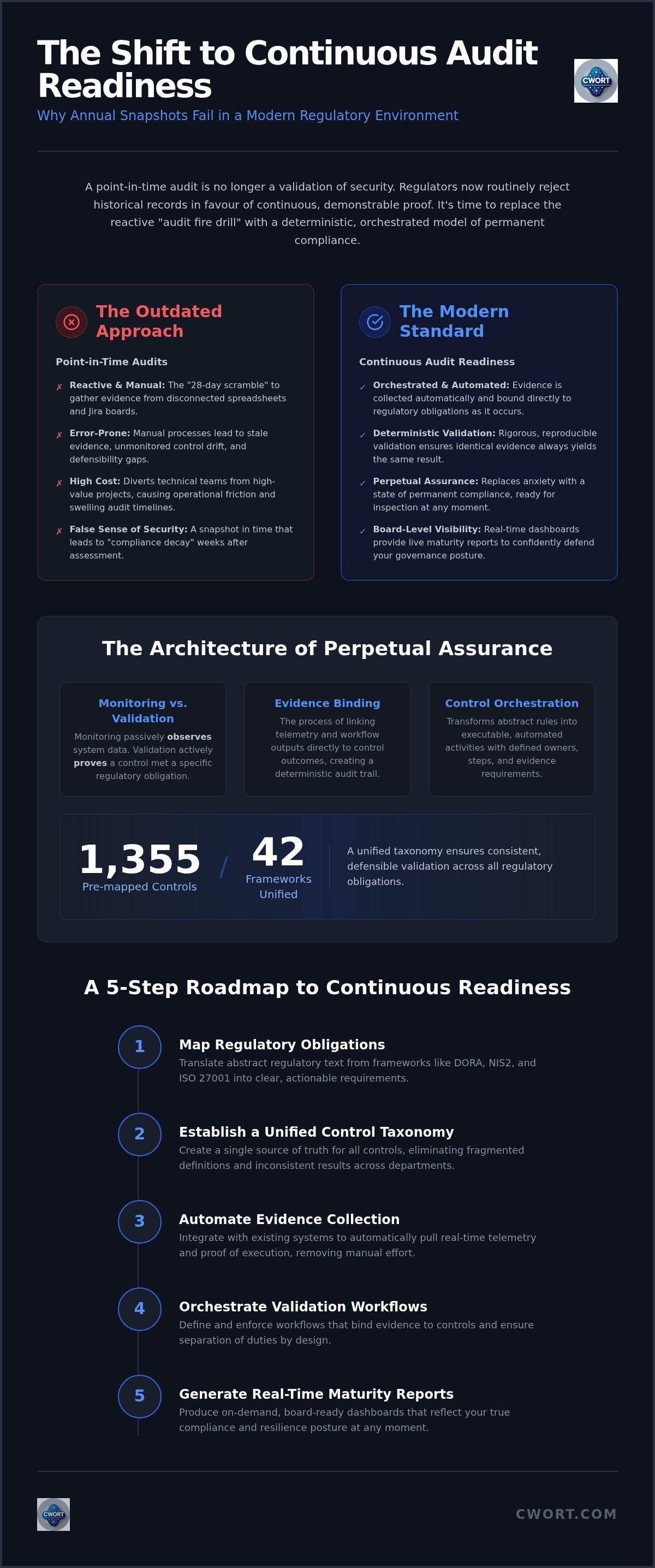
A point-in-time audit is no longer a validation of security. It is merely a record of historical intent that regulators now routinely reject in favour of continuous proof. You likely recognise the friction of the traditional cycle. Teams scramble to gather evidence across disconnected Jira boards and spreadsheets whilst internal audit timelines swell. This manual approach is not just slow; it is indefensible. Achieving continuous audit readiness requires a fundamental shift from administrative tracking to a deterministic state of orchestrated validation.
This guide provides the strategic framework to transition your enterprise into a state of permanent compliance. Replace the anxiety of potential failure with a reproducible governance system. We will explore how to automate evidence collection, enforce separation of duties by design, and deliver board-level dashboards that reflect your true maturity in real-time. By moving to a model of perpetual assurance, you ensure that your organisation remains resilient against the rigorous demands of DORA and the UK's 2026 regulatory environment.
Key Takeaways
- Learn why regulators now reject point-in-time snapshots and how to replace the reactive "audit fire drill" with a deterministic, orchestrated model.
- Identify the critical distinction between passive data monitoring and active control validation through the rigorous process of evidence binding.
- Master the five-step roadmap for achieving continuous audit readiness by mapping regulatory obligations to a unified, enterprise-wide control taxonomy.
- Evaluate why manual tracking in Excel fails to provide a defensible audit trail whilst orchestration platforms enforce accountability by design.
- Develop the capacity to generate real-time, board-ready maturity reports that demonstrate compliance across DORA, NIS2, and ISO 27001 simultaneously.
Table of Contents
- The Shift to Continuous Audit Readiness: Why Annual Snapshots Fail in 2026
- The Architecture of Perpetual Assurance: Moving Beyond Simple Monitoring
- Orchestration vs. Administration: Evaluating Your Compliance Tooling
- A 5-Step Roadmap to Achieving Continuous Audit Readiness
- CWORT: Orchestrating the Transition to Permanent Readiness
The Shift to Continuous Audit Readiness: Why Annual Snapshots Fail in 2026
The annual audit is an artifact of a slower era. In 2026, UK enterprises operate in an environment where regulators like the FCA, Ofgem, and the NCSC no longer accept point-in-time samples as proof of security. They demand longitudinal evidence that proves a control was effective every day, not just the day it was tested. This shift defines the transition to achieving continuous audit readiness, a state where compliance validation is permanent, deterministic, and backed by real-time telemetry. This approach replaces the reactive "Audit Fire Drill" with an orchestrated model that ensures every control is validated as it executes.
Traditional methods often lean on continuous auditing principles but fail in execution due to fragmented tooling and manual data entry. Achieving continuous audit readiness requires moving away from spreadsheet-based tracking toward a system that binds evidence directly to regulatory obligations. Without this orchestration, organisations suffer from "compliance decay," a phenomenon where security controls drift from their intended state within weeks of an annual assessment, leaving the business exposed to both cyber threats and regulatory penalties.
The High Cost of Point-in-Time Compliance
The "28-day scramble" is a familiar resource drain for most UK leadership teams. When an audit window opens, technical staff are pulled away from high-value projects to manually gather evidence across Jira, Excel, and legacy systems. This process is inherently error-prone and slow. Stale evidence and unmonitored control drift create a false sense of security that rarely survives a rigorous inspection. For the board, this lack of real-time visibility creates persistent anxiety. If you don't have a live view of maturity, you can't confidently sign off on risk statements or defend your governance posture to external stakeholders.
Regulatory Drivers: DORA, NIS2, and UK NIS
The regulatory environment has evolved to prioritise operational resilience over checkbox compliance. The EU’s Digital Operational Resilience Act (DORA) mandates continuous ICT risk management, requiring financial institutions to prove they can withstand and recover from disruptions. Similarly, the UK NIS framework and the NCSC’s Cyber Assessment Framework (CAF) expect organisations to demonstrate ongoing maturity. "Best efforts" are no longer sufficient for board-level accountability. UK boards are now held directly responsible for the integrity of their audit trails, making the shift to a systematic, orchestrated validation system a strategic necessity.
The Architecture of Perpetual Assurance: Moving Beyond Simple Monitoring
Monitoring is a diagnostic function, yet validation is a governance requirement. Whilst many organisations mistake real-time telemetry for compliance, the two are fundamentally different. Monitoring observes data points to ensure systems are operational. Validation proves that a specific control functioned exactly as intended to meet a regulatory obligation. To succeed in achieving continuous audit readiness, enterprises must shift from passive observation to active evidence binding. This process links telemetry directly to control outcomes, creating a deterministic record that leaves no room for auditor interpretation.
A robust architecture for perpetual assurance relies on a unified control taxonomy. Relying on fragmented definitions across different departments leads to inconsistent results and defensibility gaps. CWORT addresses this through a library of 1,355 controls mapped across 42 frameworks. This structure ensures that identical evidence always yields the same result, a concept known as deterministic validation. This level of rigour is supported by ISACA on Continuous Audit and Monitoring, which emphasises the need for integrated systems that move beyond traditional sampling methods.
The Role of Control Orchestration
Orchestration transforms abstract regulatory text into executable activities. Instead of treating a DORA requirement as a vague objective, an orchestrated system defines the specific steps, owners, and evidence required for validation. This approach enforces separation of duties at the point of execution, ensuring that the individual performing a task is not the one validating its success. Every action within this workflow produces a tamper-proof audit trail by design. By codifying these processes, you eliminate the human error inherent in manual evidence gathering and ensure that governance is a byproduct of daily operations.
Aggregating Evidence from the Security Stack
Effective validation requires a single compliance view that aggregates data from your existing SIEM, EDR, and IAM tools. This integration enables an "Assess Once, Report Many" philosophy. When a single piece of evidence validates a control common to ISO 27001, NIS2, and DORA, the system should automatically update the maturity status across all relevant frameworks. This reduces redundant work and ensures Ensuring Compliance Evidence Integrity remains a constant state rather than a periodic effort. To see how this orchestration functions in a live environment, you can request a platform demonstration to explore the mapping capabilities in detail.
Orchestration vs. Administration: Evaluating Your Compliance Tooling
Most organisations treat Governance, Risk, and Compliance (GRC) as a passive administrative exercise. These legacy tools function as digital filing cabinets, recording what has already happened rather than ensuring what should happen. In contrast, modern orchestration platforms are operational engines. They don't just track status; they enforce the execution of controls. Achieving continuous audit readiness depends on this shift from administration to orchestration. Without a system that actively manages the workflow of compliance, you are simply documenting your own decay.
Whilst AI is often marketed as a panacea, its role in compliance must be carefully governed. Relying on AI for decision-making introduces non-deterministic risks that UK regulators will likely challenge. CWORT utilises AI strictly as an advisory tool to surface insights, whilst ensuring final validation remains a human-driven, evidence-backed process. This discipline is paired with a "Bring Your Own Content" (BYOC) capability. This allows enterprises to retain their unique organisational IP whilst mapping it to a global control taxonomy, ensuring that your specific operational nuances aren't lost in a generic framework.
Why Spreadsheets are the Enemy of Readiness
Excel and Jira are excellent for general project management but catastrophic for compliance validation. They lack version control, immutable history, and the evidence protection required for a defensible audit trail. When a regulator demands proof, teams often fall into the "manual reconstruction trap," spending weeks trying to piece together fragmented data from various tabs and tickets. This is exactly what Regulatory Compliance Workflow Automation aims to solve. It creates a governed, digital environment where every action is logged in real-time, preventing the loss of evidence integrity that plagues manual trackers.
The Deterministic Advantage
For a maturity report to be credible, it must be deterministic. This means that identical evidence must always yield the same compliance score, regardless of who performs the assessment. Eliminating conjecture in board-level reporting is vital for protecting the CISO during regulatory scrutiny. Following ISACA's guide to continuous IT auditing, enterprises should move toward systems where risk indicators are linked to specific control targets. This level of rigour ensures that when you report maturity to the board, it is based on definitive evidence rather than subjective estimates. A deterministic system provides the "auditable certainty" required to withstand the high-stakes inspections of 2026.
A 5-Step Roadmap to Achieving Continuous Audit Readiness
Transitioning to a state of perpetual assurance requires a disciplined, phased execution. Achieving continuous audit readiness is not an overnight pivot; it is a structural redesign of how your organisation handles regulatory obligations. By following a linear roadmap, enterprises can move away from the chaos of manual evidence gathering toward a deterministic system that satisfies the rigorous demands of UK regulators in 2026. This process ensures that compliance is a byproduct of daily operations rather than a periodic interruption.
Step 1 & 2: Establishing the Foundation
Begin by mapping your obligations to a unified control taxonomy. Cross-walk the requirements of DORA, NIS2, and ISO 27001 to identify overlapping controls. This allows you to assess once and report across multiple frameworks, drastically reducing redundant effort. Once your obligations are mapped, design your Target Operating Model (TOM). This model must define clear ownership and accountability for every control domain based on your team's actual capability and capacity. Use an ISO 27001 Control Mapping Tool to generate a maturity assessment heat-map. This visualisation identifies immediate regulatory gaps and provides a prioritised list for remediation, ensuring your foundation is both robust and defensible.
Step 3 & 4: Operationalising the Workflow
Move from manual evidence uploads to automated telemetry ingestion. Orchestrate your evidence collection by integrating directly with your existing security stack, including SIEM, EDR, and IAM tools. This step ensures that evidence is bound to the control outcome in real-time. Validation must be deterministic; identical data must always yield the same result to eliminate subjectivity. Next, enforce governance by hard-coding separation of duties into your workflow. This design ensures that the individual executing a task cannot be the one validating it. By creating immutable audit logs for every action, you establish a reproducible process that survives staff turnover and maintains its integrity under intense scrutiny. This level of orchestration replaces the "scramble" with a steady state of auditable certainty.
The final stage involves producing regulator-ready outputs. Automated reporting dashboards should provide the board and external auditors with real-time visibility into your maturity levels. These outputs must be definitive and evidence-backed, removing the need for manual report compilation or guesswork. When your reporting is a direct reflection of orchestrated execution, you provide the "defensible truth" that 2026 regulators expect. If you are ready to transition your enterprise to this model, request a platform demo to see how these five steps are executed within a live environment.
CWORT: Orchestrating the Transition to Permanent Readiness
CWORT serves as the definitive orchestration layer for the modern enterprise. It does not merely track compliance; it validates it by sitting above your existing security stack to translate regulatory obligations into structured execution activities. The platform follows a rigorous lifecycle: Diagnose, Design, Deliver, and Demonstrate. This end-to-end approach ensures that compliance is a core operational output rather than a periodic interruption. By centralising execution, CWORT eliminates the need for manual evidence reconstruction, allowing leadership to focus on strategic risk management whilst maintaining a state of permanent auditability.
Our UK-based team provides the professional expertise required to navigate high-stakes environments, particularly within Critical National Infrastructure (CNI) and the financial sector. Achieving continuous audit readiness becomes a repeatable process when you replace fragmented trackers with a system designed for deterministic results. This ensures that your governance posture is always supported by definitive, evidence-based proof that satisfies both internal stakeholders and external regulators.
Deterministic Validation for High-Stakes Audits
CWORT provides the rigorous validation required for complex regulatory landscapes. The platform supports over 42 frameworks, including the NCSC CAF, UK NIS, and DORA. For organisations within critical sectors, leveraging dedicated NCSC CAF Assessment Software is essential for maintaining a defensible maturity posture. A central component of this is the Assurance Evidence Register, which offers senior leadership a tamper-proof record of every control execution. This register is vital for achieving continuous audit readiness, as it binds telemetry directly to framework requirements, ensuring that your audit trail is both immutable and transparent.
Building a Future-Proof Operating Model
The platform’s "Bring Your Own Content" (BYOC) capability allows enterprises to productise their proprietary maturity models. This ensures that your specific organisational IP and operational nuances are integrated into the governance workflow rather than being lost in generic templates. By providing continuous operating-model intelligence, CWORT significantly improves cyber resilience. You gain the ability to identify control drift before it becomes a compliance failure, moving the organisation into a state of auditable certainty. This proactive discipline is the hallmark of a mature enterprise. To witness how orchestrated validation can transform your governance, book a pilot to see CWORT in action and secure your path to permanent readiness.
Securing Your Enterprise with Perpetual Assurance
Transitioning from manual, error-prone evidence collection to an orchestrated state of compliance is no longer optional. UK regulators in 2026 demand definitive proof that controls function as intended every day, not just during a sample window. By achieving continuous audit readiness, you replace the anxiety of the audit cycle with the certainty of a defensible, deterministic governance system. This shift ensures that your organisation's maturity is always visible, verifiable, and above all, defensible.
CWORT provides the structural integrity needed to withstand the scrutiny of DORA, NIS2, and UK NIS. With 1,355 controls mapped across 42 frameworks, the platform delivers reproducible results that empower senior leadership to report maturity with total confidence. It's time to move beyond administrative tracking and embrace a model where evidence is a direct byproduct of execution. You don't have to face the next regulatory inspection with uncertainty.
Replace manual tracking with CWORT’s orchestrated compliance validation platform.
Secure your organisation's future by turning regulatory obligation into a state of permanent operational resilience.
Frequently Asked Questions
What is the difference between continuous monitoring and continuous audit readiness?
Monitoring is a diagnostic function that observes data points, whilst achieving continuous audit readiness requires a validation layer. Monitoring identifies system performance, but readiness proves that a control was executed correctly to meet a specific regulatory obligation. UK regulators now prioritise this validation because it provides longitudinal proof of security. CWORT bridges this gap by sitting above your security stack to translate telemetry into a governed, audit-ready state of permanent assurance.
How does continuous audit readiness help with DORA compliance?
DORA mandates that financial institutions demonstrate continuous digital operational resilience. CWORT supports this by mapping ICT risk management requirements to a structured execution workflow. The platform ensures that evidence for resilience testing and third-party risk is bound to specific DORA technical standards. This deterministic approach allows senior leadership to produce board-ready maturity reports that satisfy the rigorous scrutiny of 2026 regulatory inspections without the need for manual data reconstruction.
Can we achieve continuous readiness using Jira or spreadsheets?
Spreadsheets and Jira are inadequate for achieving continuous audit readiness due to their lack of version control and immutable history. These manual tools create a reconstruction trap where evidence must be gathered retrospectively, a process regulators often reject as indefensible. CWORT replaces these fragmented trackers with a governed digital environment. It enforces separation of duties and provides tamper-proof audit trails, ensuring your compliance posture remains resilient against staff turnover and human error.
What evidence do UK regulators expect to see for continuous compliance?
UK regulators, including the NCSC and FCA, expect to see longitudinal evidence that demonstrates sustained control effectiveness. They require an Assurance Evidence Register that shows a clear link between operational telemetry and regulatory obligations. Best efforts or periodic snapshots are no longer sufficient. You must provide a reproducible record that proves controls were operational and validated at the point of execution, maintaining full traceability across your entire digital estate.
How does CWORT handle multiple regulatory frameworks like NIS2 and ISO 27001 simultaneously?
CWORT utilises a library of 1,355 controls mapped across 42 frameworks to enable an assess once, report many capability. When you validate a control, the system automatically updates your maturity status across frameworks like NIS2, ISO 27001, and the NCSC CAF. This cross-walking eliminates redundant effort and ensures consistency in your reporting. It allows organisations to maintain a single source of truth for compliance whilst satisfying diverse regulatory requirements simultaneously.
Is AI used to determine our compliance status in CWORT?
AI in CWORT is strictly limited to an advisory role. It provides suggestions and insights to assist your team but never determines your final compliance status. This design ensures that all results remain deterministic and reproducible. UK regulators require explainable, evidence-backed proof of compliance that isn't influenced by black-box algorithms. By keeping AI in an advisory capacity, CWORT preserves the integrity and defensibility of your audit trails for senior leadership.
What is evidence binding and why is it critical for audits?
Evidence binding is the process of linking operational telemetry directly to specific control outcomes. It is critical for audits because it creates a tamper-proof connection between what happened and why it met a regulatory requirement. Without binding, evidence is merely a collection of files in a folder. Binding ensures that every piece of data is contextualised within your governance framework, providing the auditable certainty required to defend your maturity posture under intense scrutiny.
How long does it take to transition to a continuous audit readiness model?
The transition timeline depends on your organisational scale and existing maturity levels. Most enterprises begin with a short working session to map their programme, followed by a controlled pilot of 3 to 5 components. This phased approach allows you to validate the governed workflow before a full-scale rollout. By following a structured 5-step roadmap, organisations can typically move from manual tracking to an orchestrated model of perpetual assurance within a single reporting cycle.
Disclaimer
The content on this site is provided for general information and educational purposes only. It does not constitute legal, regulatory, financial, or professional advice. CWORT provides AI-assisted insights and workflow automation, but all compliance decisions remain the responsibility of your organisation and its management. Always seek qualified legal or regulatory guidance for decisions relating to the UK NIS Regulations, CAF, DORA, NIS2, ISO 27001, or other obligations.
Related posts
GRC Platform vs Compliance Validation Tool: Choosing the Right Architecture for 2026
GRC platform vs compliance validation tool: Is your GRC ready for 2026? Learn how automated validation provides the defensible proof needed for DORA & NIS2.
Jira for Compliance vs Orchestration: Why Task Tracking Fails Regulatory Audits
Discover why Jira fails DORA & NIS2 audits. In the debate of Jira for compliance vs orchestration, learn why task tracking isn't proof & how to automate assu...
Streamlining Regulatory Compliance Processes: From Manual Tracking to Orchestrated Validation
Stop wasting money on manual compliance. Learn about streamlining regulatory compliance processes to reduce personal liability under DORA & NIS2 and gain aud...
Article by
Michael Iyiola
Co-Founder, CWORT
Michael Iyiola is a co-founder of CWORT and a Cyber and AI Security Engineer with deep experience in vulnerability management, detection engineering and operational resilience across UK critical national infrastructure, including rail, energy and financial services. At CWORT, he designs scalable, evidence-driven workflows that help teams meet modern regulatory and security demands.
Build Your Foundation of Auditable Certainty
Take control of your regulatory obligations and secure your infrastructure with CWORT.