Digital Operational Resilience Testing: 2026 Guide

Michael Iyiola
Co-Founder, CWORT
Master digital operational resilience testing requirements ahead of 2026. Learn how to transform ICT validation scans into audit-defensible compliance proof.

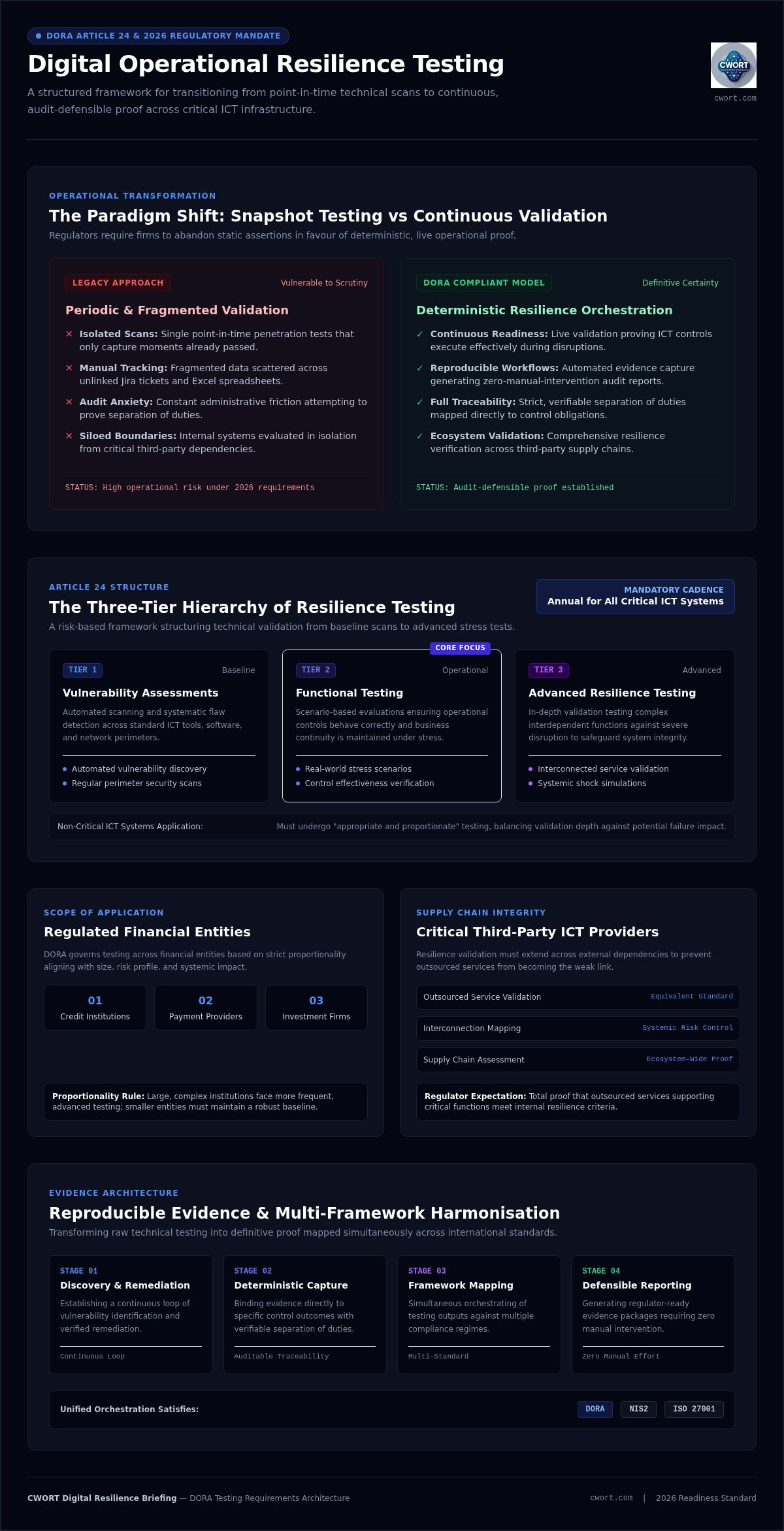
A successful penetration test isn't proof of compliance; it's merely a snapshot of a moment that has already passed. For firms facing the 2026 deadline, the reality is that meeting digital operational resilience testing requirements involves far more than periodic technical scans. You're likely struggling with fragmented data scattered across Jira tickets and Excel spreadsheets, whilst the pressure to prove a strict separation of duties during testing creates a constant state of audit anxiety. It's an exhausting cycle of manual reconstruction that leaves leadership vulnerable to regulatory scrutiny.
We understand that the gap between technical execution and regulator-ready evidence feels insurmountable. This guide will help you master the complex landscape of DORA testing obligations and show you how to transform technical validation into audit-defensible proof. We'll outline a clear hierarchy of testing requirements, provide a reproducible workflow for evidence capture, and demonstrate how to generate reports that require zero manual intervention. Transition from administrative tracking to definitive, evidence-based certainty by adopting a disciplined approach to your resilience programme that ensures total traceability.
Key Takeaways
- Transition from siloed security scans to an integrated resilience validation model that mirrors the high-stakes 2026 regulatory environment.
- Master the specific digital operational resilience testing requirements by categorising ICT assets into a clear hierarchy of vulnerability, functional, and advanced testing tiers.
- Ensure auditable certainty by moving beyond fragmented tracking in Jira or Excel towards a reproducible workflow for evidence capture.
- Adopt a deterministic orchestration approach to satisfy multiple frameworks simultaneously, including DORA, NIS2, and ISO 27001.
- Formalise the mandatory annual testing of all critical ICT systems to provide regulators with definitive, audit-defensible proof of operational integrity.
Table of Contents
- Understanding Digital Operational Resilience Testing Requirements under DORA
- A Hierarchy of Testing: Basic vs Advanced Requirements
- The Evidence Gap: Why Manual Tracking Fails Resilience Audits
- Designing a Reproducible Testing Programme for 2026
- Orchestrating Resilience: Turning Testing into Auditable Proof with CWORT
Understanding Digital Operational Resilience Testing Requirements under DORA
The Digital Operational Resilience Act (DORA) redefines the role of technical validation within the financial sector. It transitions digital operational resilience testing from a siloed, periodic security exercise into a mandatory pillar of corporate governance. Meeting digital operational resilience testing requirements is no longer just a technical exercise; it's a strategic necessity. Under this framework, firms can't rely on isolated penetration tests or quarterly vulnerability scans to satisfy auditors. Instead, they must implement a systematic validation of their entire operating model. The shift is clear: move from static, point-in-time reports to a state of continuous readiness. By 2026, regulators expect to see "live" evidence that proves controls actually work during a disruption, rather than mere assertions of their existence.
The Core Objectives of Article 24
Article 24 demands that financial entities establish a comprehensive testing programme as an integral part of their ICT risk management framework. This isn't a suggestion; it's a requirement to identify vulnerabilities across all critical ICT systems and services. You must move beyond basic scanning to embrace complex, scenario-based testing that reflects real-world threats. The goal is simple but rigorous: verify the effectiveness of your controls and ensure business continuity remains intact even under severe stress. This requires a shift in mindset where testing is treated as a continuous loop of discovery and remediation. Every test must yield deterministic results that can be mapped directly to regulatory obligations. By binding evidence to specific control outcomes, you move from a reactive posture to one of auditable certainty.
Scope of Application: Who Must Comply?
Compliance obligations for digital operational resilience testing requirements apply to a broad spectrum of entities, including credit institutions, payment providers, and investment firms. However, the application isn't uniform. Proportionality plays a critical role, meaning the frequency and depth of your testing should align with your firm's size, risk profile, and systemic importance. Large, complex institutions face more frequent, advanced testing obligations, whilst smaller firms must still demonstrate a robust baseline. Importantly, this scope extends to critical third-party ICT service providers. You must ensure that the outsourced services supporting your critical functions are subject to the same rigorous validation standards as your internal systems. Regulators require you to demonstrate that you've assessed the resilience of your entire supply chain, ensuring the collective ecosystem remains robust against systemic shocks.
A Hierarchy of Testing: Basic vs Advanced Requirements
DORA mandates a structured, risk-based approach to validation that moves beyond simple checklists. Meeting digital operational resilience testing requirements necessitates a tiered strategy that categorises efforts into three distinct levels: vulnerability assessments, functional testing, and advanced resilience testing. This hierarchy ensures that firms focus resources where they matter most. For all critical ICT systems and services, the regulation demands a minimum of annual testing. This isn't a suggestion; it's a hard obligation to prove that the systems supporting your most vital business functions remain robust under pressure. For non-critical systems, firms must apply "appropriate and proportionate" testing, balancing the depth of validation against the potential impact of a failure.
The 2026 regulatory landscape places a heavy emphasis on interconnectedness and supply chain integrity. You can no longer test your internal environment in isolation. Modern resilience requires you to validate the dependencies within your ICT ecosystem, ensuring that third-party providers don't become the weak link in your defensive chain. This shift requires a move from static point-in-time assessments to a dynamic model of continuous validation. To manage this complexity effectively, you might consider how to request a platform demonstration to see how orchestration simplifies these obligations.
Standard ICT Tools and Systems Testing
Baseline compliance begins with rigorous, automated scanning and vulnerability assessments designed to identify technical weaknesses before they can be exploited. These requirements extend to network security assessments and physical security audits that protect the infrastructure layer. Additionally, firms must conduct source code reviews and software compatibility testing to ensure that bespoke applications don't introduce hidden risks. These standard tools provide the foundation of your testing programme, offering the technical data needed to fuel higher-level resilience reports.
Threat-Led Penetration Testing (TLPT) Framework
Article 26 introduces the most stringent digital operational resilience testing requirements through the Threat-Led Penetration Testing (TLPT) framework. Reserved for firms of significant systemic importance, TLPT requires a sophisticated "Red Teaming" exercise conducted at least every three years. This process is managed by an internal "Control Team" who must maintain strict confidentiality to ensure the test remains a true reflection of real-world threat actor behaviour. You must prove the integrity of these exercises to national regulators, providing evidence that the scope was sufficiently broad and the methodology was technically sound. This advanced tier transforms testing from a compliance hurdle into a definitive proof of your organisation's ability to withstand a targeted cyber attack.
The Evidence Gap: Why Manual Tracking Fails Resilience Audits
The most common objection from security teams is that they already track testing activities in Jira or Excel. This assumption is a dangerous oversight. Regulators increasingly reject fragmented evidence during DORA audits because it fails to provide a holistic view of institutional risk. To meet digital operational resilience testing requirements, you must deliver a cohesive narrative that links technical validation directly to governance outcomes. Fragmented data lacks the structural integrity required for a high-stakes audit. If your evidence is scattered across multiple platforms, it's functionally non-existent when a regulator demands proof of resilience.
Testing data is highly perishable, leading to what we define as "evidence decay". Without an orchestration system that binds specific test results to control outcomes in real-time, the value of your testing vanishes. A vulnerability scan or penetration test result is only useful if it's tied to a verified, deterministic remediation action. You must maintain an immutable audit trail that captures the entire lifecycle of a test. This trail must prove exactly who executed the validation, what the specific findings were, and how the control was eventually verified as effective.
The Fragility of Spreadsheets in Testing Workflows
Spreadsheets are the enemy of auditable truth in modern finance. They lack robust version control and are notoriously prone to manual entry errors that compromise data integrity. Attempting to map a single test result to multiple regulatory obligations, such as DORA, NIS2, and ISO 27001, becomes a manual nightmare in a flat file. Whilst manual reconstruction of evidence might satisfy internal queries, it's a major red flag for auditors. It suggests a lack of systemic control and creates a significant risk of data omission during the reporting process.
Enforcing Separation of Duties during Testing
Compliance requires more than technical success; it demands procedural rigour. A non-negotiable part of digital operational resilience testing requirements is the enforcement of a strict separation of duties. You cannot permit the same team to execute a test and then validate their own remediation efforts. Manual systems frequently fail to prevent this "self-marking" behaviour, which fundamentally undermines the integrity of your results. For a detailed analysis of this obligation, read our article on Enforcing Separation of Duties Under DORA Requirements. Implementing a system that enforces these boundaries by design ensures that your testing remains objective and your evidence stays defensible.
Designing a Reproducible Testing Programme for 2026
Operationalising resilience requires more than a collection of security tools; it demands a disciplined, reproducible programme. You must move from ad-hoc validation to a systematic orchestration of your defensive posture. To meet the evolving digital operational resilience testing requirements, your programme must be built on five core pillars that ensure every action is traceable and every outcome is defensible. Start by mapping your ICT asset landscape to identify the critical functions that support your most vital services. Once identified, align your testing types with specific regulatory obligations to ensure no gaps remain in your coverage.
Establish a governed workflow for test execution and evidence capture that removes the possibility of human error or data manipulation. This workflow must lead directly into remediation tracking, ensuring that every identified gap is closed and validated by an independent party. Finally, use the resulting deterministic data to generate board-level maturity reports. These reports provide leadership with the auditable certainty they need to sign off on compliance with absolute confidence. Transitioning from fragmented activities to a unified system is the only way to maintain a state of continuous readiness.
Establishing a Risk-Based Testing Frequency
A static testing schedule is insufficient for a dynamic threat landscape. You must determine testing frequency based on the criticality of the system, with some requiring quarterly validation whilst others move to an annual cycle. Incorporate event-driven testing to account for major system changes or new threat intelligence. For a deeper look at these strategies, consult our DORA Compliance Validation: A Guide for Financial Institutions. This risk-based approach ensures that your resources are focused on the areas of greatest potential impact, providing a defensible rationale for your testing priorities.
Remediation and Control Re-Validation
A test is never complete until the remediation is validated. Closing the loop is the most difficult stage of the resilience lifecycle, yet it's the one regulators scrutinise most heavily. Use CWORT to track the delivery and status monitoring of improvements, ensuring that re-validation evidence is permanently bound to the original control gap. This creates a closed-loop system where issues are not just identified but definitively resolved. To see how this orchestration works in practice, you can request a platform demo today. This level of rigour transforms testing from a point-in-time assessment into a continuous cycle of improvement that satisfies even the most demanding auditors and secures your operating model.
Orchestrating Resilience: Turning Testing into Auditable Proof with CWORT
Compliance validation requires a shift from passive tracking to proactive orchestration. CWORT functions as the critical layer sitting above your existing security tooling, transforming raw technical data into definitive proof of governance. Whilst your scanners and monitors identify technical states, CWORT interprets these results against the complex landscape of digital operational resilience testing requirements. This transition is essential for firms that must move beyond mere administrative tracking. By providing a disciplined system of record, you replace the anxiety of potential audit failure with the calm of auditable certainty.
We operate on an "Assess once, report many" philosophy that is vital for multi-framework environments. Our taxonomy library contains 1,355 controls, with 98.6% of active controls carrying direct framework references to DORA, NIS2, and ISO 27001. This structure allows you to validate a single control and automatically populate evidence across every relevant regulatory obligation. Central to this approach is our deterministic scoring model. Identical evidence always yields the same defensible result, ensuring that your resilience posture is based on objective truth rather than subjective interpretation.
Binding Testing Evidence to Control Outcomes
Effective orchestration requires the aggregation of evidence from across your entire security stack, including SIEM, EDR, and vulnerability scanners. CWORT binds this technical output directly to specific control outcomes, creating a transparent link between execution and obligation. This process populates the assurance evidence register, which provides auditors with a single, immutable view of your testing history. To maintain the highest standards of data validity, you must prioritise Ensuring Compliance Evidence Integrity. By enforcing these rigorous standards, you ensure that every piece of evidence is both traceable and structurally sound.
Generating Regulator-Ready Resilience Reports
The final stage of the resilience lifecycle is the communication of your posture to senior leadership and national regulators. CWORT produces board-level maturity reports and audit-ready outputs that require zero manual reconstruction. Our heatmap dashboard offers a real-time visualisation of your resilience status, allowing executives to identify and address gaps before they become liabilities. This capability shifts the focus from granular technical hurdles to strategic risk management. To see this system in action, see how CWORT orchestrates DORA testing requirements and provides the structural integrity your organisation demands for 2026 and beyond.
Securing Your Operational Future: From Technical Validation to Auditable Truth
Mastering digital operational resilience testing requirements demands a transition from fragmented security scans to a disciplined orchestration layer. You've seen how manual tracking in spreadsheets creates an unacceptable evidence gap that regulators will no longer tolerate. By implementing a reproducible testing programme and enforcing a strict separation of duties, you transform technical validation into a strategic asset for senior leadership. The path to 2026 compliance requires a deterministic approach where every test result is bound to a specific control outcome with absolute traceability.
CWORT provides the structural integrity needed to replace administrative anxiety with auditable certainty. With 1,355 controls mapped across 42 frameworks, our platform delivers the deterministic, audit-defensible scoring that modern regulators demand. It's time to stop managing compliance through fragmented tools and start orchestrating your resilience with a system designed for high-stakes oversight. Replace your compliance spreadsheets with CWORT’s orchestrated validation platform today. You have the power to turn regulatory obligation into a definitive proof of institutional strength.
Frequently Asked Questions
What are the main digital operational resilience testing requirements under DORA?
The primary digital operational resilience testing requirements under DORA involve establishing a comprehensive, risk-based testing programme that validates every critical ICT system. This framework mandates a hierarchy of activities, including vulnerability assessments, network security audits, and functional testing. Entities must prove that their controls are effective during disruptions, transitioning from point-in-time scans to a model of continuous validation. This systematic approach ensures that resilience is built into the organisation's operating model rather than treated as a periodic administrative task.
How often must financial entities conduct resilience testing?
Financial entities must conduct resilience testing on all critical ICT systems and applications at least annually. DORA requires a disciplined schedule that aligns with the systemic importance of the specific function. Whilst critical systems demand yearly validation, non-critical systems follow a "proportionate" frequency based on their risk profile. Additionally, event-driven testing is required after any major system changes to ensure that updates don't introduce new vulnerabilities or compromise existing resilience benchmarks.
Which firms are required to perform Threat-Led Penetration Testing (TLPT)?
Threat-Led Penetration Testing (TLPT) is mandatory for financial entities identified by regulators as having significant systemic importance or a high-risk profile. Under Article 26, these firms must perform advanced Red Teaming exercises every three years at a minimum. The scope includes all critical functions and requires a dedicated internal Control Team to manage the exercise. This advanced validation provides definitive proof of an organisation's ability to withstand sophisticated, real-world cyber attacks from motivated threat actors.
Can we use internal teams for DORA resilience testing?
You can use internal teams for certain digital operational resilience testing requirements, provided you enforce a strict separation of duties. Regulators demand that the individuals executing the tests are independent from those responsible for the design and remediation of the ICT systems. For advanced TLPT, firms often use external testers to ensure objectivity. CWORT helps manage this by enforcing role-based access and immutable audit trails, preventing the self-marking behaviour that frequently invalidates internal testing results.
What evidence do regulators expect to see during a DORA testing audit?
Regulators expect to see an immutable assurance evidence register that binds technical test results directly to specific control outcomes. They reject fragmented data from spreadsheets or Jira tickets that lack context. Your evidence must include deterministic proof of test execution, detailed findings, and verified remediation actions. Using a system like CWORT ensures that every piece of validation is traceable and regulator-ready, providing a single, explainable view of your resilience posture during a high-stakes audit.
How does DORA testing differ from standard annual penetration testing?
DORA testing differs from standard annual penetration testing by focusing on integrated resilience rather than just technical vulnerabilities. Whilst traditional pentests identify security holes, resilience testing validates the entire operating model's ability to maintain continuity during a disruption. It involves more complex, scenario-based exercises and, for systemic firms, advanced TLPT. The shift moves from finding "bugs" to proving that the organisation can continue its vital functions despite a successful compromise or system failure.
What happens if we fail to meet the testing requirements by the deadline?
Failing to meet these requirements by the 2026 deadline exposes your firm to significant regulatory sanctions and administrative fines. Beyond the immediate financial impact, non-compliance signals a lack of operational maturity to the board and external stakeholders. Regulators may impose remediation orders that require intensive, costly manual reconstruction of evidence. Ultimately, the greatest risk is a loss of auditable certainty, leaving the organisation vulnerable to systemic shocks that could have been identified through a disciplined testing programme.
How can automation help in managing the DORA testing lifecycle?
Automation through an orchestration platform like CWORT replaces manual tracking with a governed digital workflow. It enables an "Assess once, report many" strategy by mapping a single test result across 1,355 controls and 42 frameworks. This eliminates the need for manual reconstruction of reports and ensures that evidence is always current. By automating the evidence capture and remediation lifecycle, you reduce the administrative burden whilst maintaining the deterministic results required for a successful DORA audit.
Disclaimer
The content on this site is provided for general information and educational purposes only. It does not constitute legal, regulatory, financial, or professional advice. CWORT provides AI-assisted insights and workflow automation, but all compliance decisions remain the responsibility of your organisation and its management. Always seek qualified legal or regulatory guidance for decisions relating to the UK NIS Regulations, CAF, DORA, NIS2, ISO 27001, or other obligations.
Related posts
CISO Guide to DORA Operational Resilience: Orchestrating Validated Compliance
Master validated compliance with our CISO guide to DORA operational resilience. Swap manual evidence gathering for an orchestrated, audit-ready security post...
Mastering the DORA ICT Risk Management Framework: A Reference Guide for 2026
Master the DORA ICT risk management framework for 2026. Our guide helps you build an auditable, evidence-based system and move beyond spreadsheets.
Choosing a DORA Operational Resilience Platform: Validation vs Documentation
Move beyond spreadsheets. Discover how a DORA operational resilience platform provides validated proof, not just documentation, for total, defensible assurance.
Article by
Michael Iyiola
Co-Founder, CWORT
Michael Iyiola is a co-founder of CWORT and a Cyber and AI Security Engineer with deep experience in vulnerability management, detection engineering and operational resilience across UK critical national infrastructure, including rail, energy and financial services. At CWORT, he designs scalable, evidence-driven workflows that help teams meet modern regulatory and security demands.
Build Your Foundation of Auditable Certainty
Take control of your regulatory obligations and secure your infrastructure with CWORT.