DORA Compliance Checklist for CISOs 2026: From Ticking Boxes to Auditable Orchestration

Michael Iyiola
Co-Founder, CWORT
Master your DORA compliance checklist for CISOs 2026. This guide shifts you from manual box-ticking to an audit-proof orchestration for supervisory oversight.

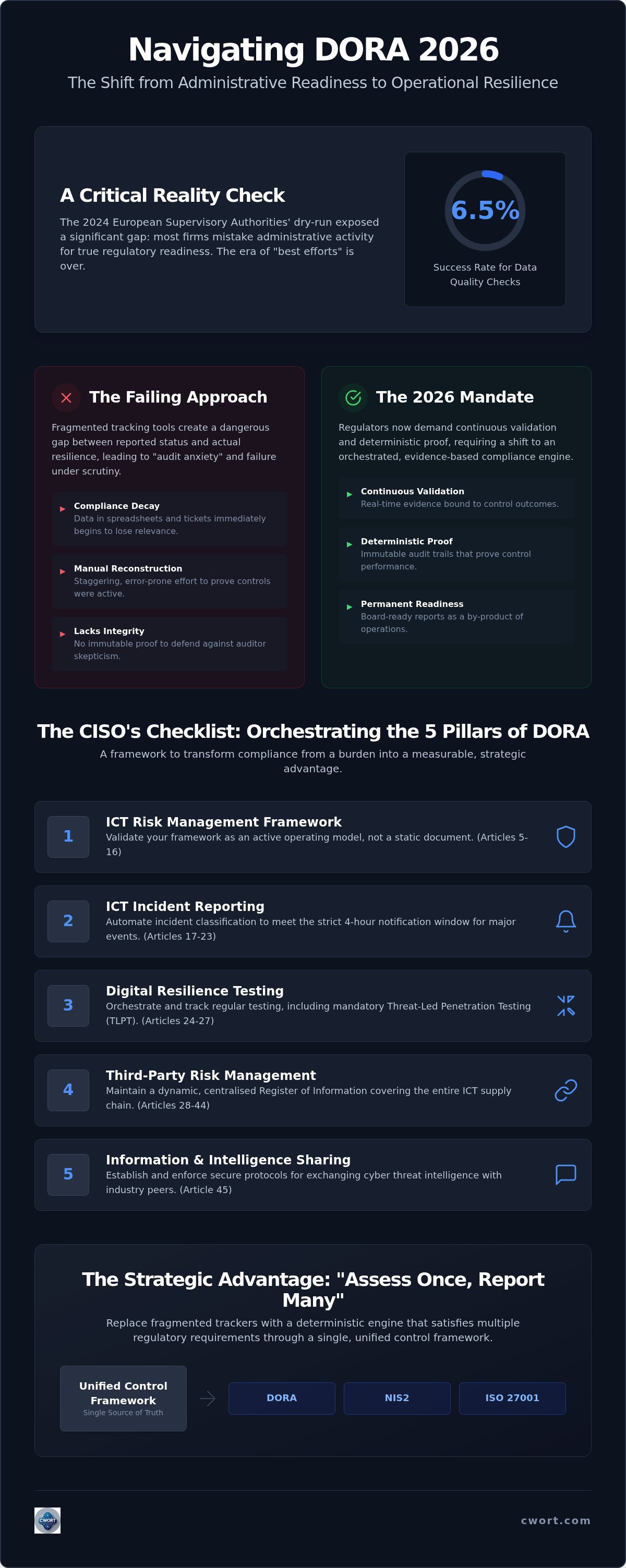
During the 2024 dry-run exercise conducted by the European Supervisory Authorities, only 6.5 per cent of nearly 1,000 firms successfully passed the data quality checks for their Register of Information. This statistic exposes an uncomfortable truth: most financial entities are still mistaking administrative activity for regulatory readiness. As we approach the critical March 2026 reporting deadlines, the era of "best efforts" has ended. You've likely realised that managing a DORA compliance checklist for CISOs 2026 across fragmented Jira tickets and Excel spreadsheets is no longer a viable strategy for survival.
We understand the pressure of manual evidence reconstruction and the anxiety of being unable to prove separation of duties to a skeptical auditor. This guide promises to shift your posture from reactive tracking to a deterministic, audit-defensible orchestration framework designed for the 2026 landscape. We will examine how to bind automated evidence to control outcomes and generate board-ready maturity reports without the usual manual labour. By the end of this article, you'll possess a blueprint for a reproducible assurance system that stands up to the most rigorous supervisory oversight.
Key Takeaways
- Transition from static readiness to a state of continuous validation to meet the intensified supervisory expectations of the 2026 regulatory landscape.
- Leverage a definitive DORA compliance checklist for CISOs 2026 to orchestrate ICT risk management and enforce automated incident classification protocols.
- Replace fragmented tracking tools with a deterministic engine that provides immutable proof and enforces separation of duties by design.
- Execute an "assess once, report many" strategy to satisfy DORA, NIS2, and ISO 27001 requirements through a single, unified control framework.
- Shift from manual evidence reconstruction to a measurable operating model that generates auditable, board-ready maturity reports on demand.
Table of Contents
- Beyond the 2025 Deadline: Why 2026 DORA Compliance Requires a Strategic Pivot
- The CISO’s 2026 DORA Checklist: Orchestrating the 5 Pillars
- The Proof Gap: Why Jira and Spreadsheets Fail DORA Audit Scrutiny
- Implementing an "Assess Once, Report Many" Strategy
- CWORT: Replacing Fragmented Trackers with a Deterministic Compliance Engine
Beyond the 2025 Deadline: Why 2026 DORA Compliance Requires a Strategic Pivot
The January 2025 deadline was a milestone of intent. By contrast, 2026 represents the era of execution. For the financial sector, the initial rush to claim readiness has been replaced by a more arduous requirement: the ability to withstand granular, supervisory scrutiny. Most firms have already realised that being "ready" is not the same as being "defensible". A static DORA compliance checklist for CISOs 2026 that exists only in a stagnant PDF or a disconnected spreadsheet will inevitably fail when an auditor demands proof of a specific control's performance from six months prior. Regulators are no longer interested in your plans; they are interested in your proof.
The Digital Operational Resilience Act (DORA) demands a transition from administrative oversight to operational resilience orchestration. Manual tracking systems suffer from compliance decay. Data enters a spreadsheet and immediately begins to lose its relevance as the underlying ICT environment shifts. This creates a dangerous gap between your reported status and your actual resilience. To survive 2026, you must pivot toward a deterministic model where evidence is bound to outcomes in real-time, ensuring your compliance posture remains accurate every hour of every day.
The Regulator’s Perspective in 2026
Expectations have shifted from historical snapshots to continuous validation. National competent authorities are now testing the functional reality of your operating model rather than the elegance of your policy documents. They require immutable audit trails that prove your controls were active during specific incident windows. In this environment, ensuring compliance evidence integrity becomes the primary hurdle. If you cannot prove that your evidence hasn't been tampered with or reconstructed after the fact, your entire compliance programme loses its credibility. Auditors now look for the "deterministic truth" of your security posture.
The Failure of Manual GRC Methods
Fragmented data across Jira tickets and Excel sheets is the primary driver of "audit anxiety" for the modern CISO. When an auditor asks for evidence of third-party risk management at scale, the manual effort required to reconstruct those trails is staggering. This labour-intensive process is prone to human error and lacks the structural integrity required for high-stakes reporting. Transitioning to evidence based compliance management eliminates this burden. By replacing task trackers with a validation engine, you move away from the frantic search for documents and toward a state of permanent audit readiness. This approach ensures that board-ready maturity reports are a byproduct of your operations, not a manual reconstruction project.
The CISO’s 2026 DORA Checklist: Orchestrating the 5 Pillars
Executing a successful resilience strategy in 2026 requires moving beyond mere policy documentation. A robust DORA compliance checklist for CISOs 2026 must align directly with DORA's five pillars to ensure every technical control serves a specific regulatory outcome. This alignment transforms compliance from a burden into a measurable business advantage. Follow these five essential steps to orchestrate your resilience posture:
- Step 1: Validate the ICT Risk Management Framework (Articles 5-16). Ensure your framework is an active operating model, not a static document.
- Step 2: Automate ICT Incident Classification and Reporting (Articles 17-23). Implement systems that can meet the strict 4-hour notification window for major incidents.
- Step 3: Orchestrate Digital Operational Resilience Testing (Articles 24-27). Schedule and track regular testing, including Threat-Led Penetration Testing (TLPT) for critical functions.
- Step 4: Centralise Third-Party Risk Management (Articles 28-44). Maintain a dynamic Register of Information that covers the entire supply chain.
- Step 5: Enforce Information and Intelligence Sharing (Article 45). Establish secure protocols for exchanging cyber threat intelligence with industry peers.
Pillar 1: ICT Risk Management as an Operating Model
Effective risk management isn't a one-time assessment; it's a continuous discipline. By mapping your specific DORA obligations to the 217 domains in the CWORT taxonomy, you ensure that governance oversight translates into granular accountability. Use DORA compliance validation to link high-level risk appetites to specific, evidenced control outcomes. This deterministic approach replaces vague "best efforts" with definitive, auditable proof of resilience. It forces a shift from optimistic reporting to evidence-based certainty.
Pillar 4: Third-Party Risk and the Register of Information
Supply chain oversight remains the most common point of failure in regulatory audits. Proving control over your ICT ecosystem requires more than just periodic contract reviews. You must automate the Register of Information for critical ICT providers and integrate their performance evidence into your central assurance register. This ensures your DORA compliance checklist for CISOs 2026 remains accurate even as your vendor landscape shifts. Managing this level of complexity at scale is impossible through manual labour alone. If you need to see how automation can simplify these requirements, you might view a structured orchestration demo to understand the path toward total assurance.
The Proof Gap: Why Jira and Spreadsheets Fail DORA Audit Scrutiny
Jira and Excel are ubiquitous in corporate environments, yet they are fundamentally insufficient for the 2026 regulatory climate. Whilst these tools excel at tracking administrative tasks, they fail to validate technical outcomes. The Official Text of the DORA Regulation mandates a level of ICT risk management that requires more than a simple "done" status. A DORA compliance checklist for CISOs 2026 managed in a flat file lacks the immutability and traceability that regulators now demand as standard. Subjective self-assessments are no longer acceptable. They are being replaced by deterministic scoring engines where 98.6 per cent of active controls carry direct framework references. In this model, identical evidence must yield the same result every time, ensuring absolute consistency across the enterprise and removing human bias from the reporting process.
The Separation of Duties (SoD) Challenge
Separation of Duties is a critical defensive layer and a core requirement for both DORA and NIS2 compliance platform UK standards. In a typical task tracker, any user with sufficient permissions can mark a control as complete, creating a significant audit risk. True orchestration enforces SoD through structured execution activities by design. It produces auditable proof that the individual performing a control is distinct from the one validating the outcome. This isn't just a policy statement; it's a structural enforcement that provides the "defensible truth" auditors seek when investigating operational resilience.
Evidence Binding vs. Simple Attachments
A simple PDF attachment in a Jira ticket is easily detached, modified, or lost in a sea of comments. It lacks the cryptographic context required for high-stakes audits. Evidence binding ensures that data is permanently linked to a specific control outcome at a precise point in time. This creates an immutable history for every change in your compliance status, allowing you to reconstruct your posture for any date in the past. Implementing regulatory compliance workflow automation is the only way to achieve this level of integrity at scale. Without it, your DORA compliance checklist for CISOs 2026 remains a manual liability rather than a strategic asset. Automation ensures that evidence is not just stored, but validated against expected outcomes, effectively closing the proof gap that manual methods inevitably leave open.
Implementing an "Assess Once, Report Many" Strategy
Compliance fatigue is a tangible systemic risk that drains resources and obscures actual security posture. When your teams are forced to answer identical questions for different regulatory bodies, the potential for error increases whilst productivity drops. A sophisticated DORA compliance checklist for CISOs 2026 must transcend siloed reporting. By adopting an "assess once, report many" strategy, you leverage a single set of control validations to satisfy multiple regulators simultaneously. This approach relies on a robust library of 1,355 controls across 217 domains, ensuring that every piece of evidence collected serves a broader assurance purpose.
The efficiency of this model lies in deterministic cross-framework mapping. Instead of treating DORA as an isolated event, you treat it as a component of your broader governance, risk, and compliance (GRC) architecture. This transition reduces the administrative burden on your technical teams and allows them to focus on maintaining resilience rather than filling out repetitive questionnaires. It turns compliance from a series of disjointed tasks into a unified, measurable operating model that provides a single version of the truth for all stakeholders.
Mapping DORA to the NCSC CAF
UK-based financial firms often find themselves caught between EU mandates and domestic expectations. Aligning DORA requirements with NCSC CAF assessment software allows you to identify overlapping controls early in the process. By streamlining evidence collection, you can produce board-level reports that reflect your holistic resilience posture across both frameworks. This dual alignment ensures that your UK operations remain compliant with local standards whilst meeting the rigorous demands of EU oversight without doubling your workload or your evidence storage requirements.
ISO 27001 and DORA: A Unified View
ISO 27001:2022 provides a strong foundation for information security, but it doesn't fully cover the operational continuity requirements of DORA. Using an ISO 27001 control mapping tool bridges this gap by linking security standards directly to resilience regulations. Because 98.6% of active controls in the CWORT system carry relevant framework references, you can automatically surface the DORA-specific gaps within your ISO-certified environment. This unified view provides the definitive proof auditors require to validate your ICT risk pillar. To see this cross-mapping in action, you should request a platform walkthrough to understand how to eliminate redundant reporting cycles.
CWORT: Replacing Fragmented Trackers with a Deterministic Compliance Engine
Traditional GRC tools often act as passive repositories for outdated documents. By contrast, CWORT functions as a proactive orchestration layer that sits above your existing security stack, including SIEM, EDR, and IAM systems. It translates abstract regulatory obligations into a measurable, auditable operating model. This transition is essential for any DORA compliance checklist for CISOs 2026, as it replaces subjective "self-assessments" with deterministic results. In a deterministic system, identical evidence must always yield the same score. This level of rigour ensures that your compliance posture is based on definitive truth rather than optimistic interpretation, providing the certainty required for high-stakes supervisory audits.
Generating board-ready maturity reports has historically been a labour-intensive process involving manual data reconstruction and cross-departmental chasing. CWORT eliminates this burden by aggregating evidence in real-time. Because the system enforces a disciplined structure, these reports are a natural byproduct of your daily operations. Leadership receives an uncompromisingly objective view of the organisation's resilience, allowing for strategic decision-making based on validated data rather than fragmented spreadsheets. This shifts the focus from administrative tracking to definitive, evidence-based proof of operational integrity.
The 7-Step Validation Workflow
Systematic execution is the only path to reproducible assurance. Our workflow moves through a linear progression designed to enforce accountability at every stage. It begins with blueprint configuration and moves through structured execution activities to calculate both maturity and confidence scores. This process allows you to identify critical gaps and prioritise improvements based on actual business risk. By tracking progress within a governed digital environment, you ensure that every remediation action is documented and every reassessment is conducted against a consistent standard. This disciplined approach ensures your DORA compliance checklist for CISOs 2026 remains an active driver of resilience.
Building Audit-Defensible Assurance
Regulators in 2026 require more than high-level summaries; they demand the ability to "drill down" into the granular evidence supporting every claim. CWORT provides senior leadership with an explainable view of compliance effectiveness whilst offering auditors a transparent path from dashboard metrics to cryptographic proof. This transparency builds trust with supervisory authorities and demonstrates a professional maturity that manual trackers simply cannot match. If your organisation is still relying on fragmented data to prove resilience, it's time to transition to a more robust framework. You can Request a DORA Compliance Readiness Assessment today to secure your path toward auditable certainty.
Securing Strategic Assurance in the Age of Supervision
The 2026 regulatory environment has fundamentally redefined the standard for operational resilience. Success no longer depends on the initial implementation of a policy, but on the ability to maintain a state of permanent audit readiness. By transitioning from fragmented trackers to a deterministic validation engine, you replace administrative anxiety with the calm of auditable certainty. A robust DORA compliance checklist for CISOs 2026 must prioritise immutable evidence binding and the enforcement of separation of duties by design.
Operating with 1,355 controls mapped to 42 different frameworks, CWORT ensures that your compliance posture is both reproducible and defensible under the most rigorous scrutiny. Our deterministic scoring model guarantees that identical evidence always yields the same result, removing the subjectivity that often leads to regulatory failure. It is time to move beyond the limitations of manual labour and embrace a systematic approach to governance.
Orchestrate your DORA compliance with CWORT to secure your organisation's future. You have the tools to turn regulatory obligation into a definitive competitive advantage.
Frequently Asked Questions
Is a DORA compliance checklist enough for a 2026 audit?
No. In 2026, checklists are merely administrative artifacts. Regulators now require deterministic evidence of operational resilience rather than static declarations. A simple DORA compliance checklist for CISOs 2026 fails to prove continuous validation or the integrity of historical data. You must demonstrate that your operating model actually functions under stress, providing immutable audit trails that link technical controls directly to specific regulatory outcomes.
How does DORA compliance differ from NIS2 for UK financial firms?
DORA is a lex specialis, meaning it overrides NIS2 for the financial sector. Whilst NIS2 provides a broad cybersecurity framework for essential entities, DORA introduces more granular requirements for ICT risk management, incident reporting, and third-party oversight specific to financial markets. UK firms operating in the EU must comply with both, though DORA's sector-specific rules are significantly more prescriptive regarding operational continuity and resilience testing.
Can I use Jira or Excel to manage DORA separation of duties?
You cannot effectively enforce Separation of Duties (SoD) using flat files or task trackers. These tools lack the structural discipline to prevent a single user from both performing and validating a control. DORA requires auditable proof of SoD by design. Unlike fragmented spreadsheets, a dedicated orchestration engine enforces these boundaries through governed workflows, ensuring that execution and validation remain strictly independent and cryptographically verifiable for auditors.
What are the penalties for non-compliance with DORA in 2026?
Penalties are severe and designed to enforce immediate remediation. Regulators can impose periodic penalty payments of up to 1 per cent of the average daily worldwide turnover for the preceding business year. Additionally, administrative fines can reach €10 million or 5 per cent of total annual turnover. Beyond financial loss, firms face "naming and shaming" public statements and the potential withdrawal of authorisation to operate within the European Union.
How often should the ICT risk management framework be reviewed under DORA?
DORA Article 6 mandates that the ICT risk management framework must be reviewed at least once a year. However, reviews must also occur following any major ICT incident or as a result of supervisory instructions. In the 2026 landscape, a static annual review is often insufficient. High-maturity firms use continuous validation to ensure their framework evolves alongside their threat profile, maintaining a state of permanent audit readiness.
Does DORA require threat-led penetration testing (TLPT) for all firms?
No, TLPT is not mandatory for every entity. Regulators identify specific "significant" financial entities based on their size, systemic importance, and risk profile to undergo these advanced tests every three years. Whilst smaller firms are exempt from TLPT, they must still perform regular digital operational resilience testing, including vulnerability assessments and open-source analyses, to satisfy the broader requirements of the ICT risk management pillar.
How can I automate DORA incident reporting to meet the 4-hour deadline?
Automation requires an integration layer that aggregates data from SIEM and EDR tools into a centralised classification engine. When a major incident is detected, the system must automatically trigger the 4-hour initial notification workflow. This removes the manual labour of data gathering and ensures reports are generated based on deterministic evidence. Meeting this strict timeline is impossible without a structured DORA compliance checklist for CISOs 2026 that is integrated into your response playbook.
What is the "Assess Once, Report Many" approach in CWORT?
This strategy leverages a library of 1,355 controls mapped across 42 frameworks to eliminate redundant work. By performing a single assessment, the platform automatically cross-walks the evidence to satisfy DORA, NIS2, ISO 27001, and NCSC CAF requirements. This reduces compliance fatigue and ensures that 98.6 per cent of active controls carry direct framework references, allowing you to provide tailored reports to different regulators from a single, validated version of the truth.
Disclaimer
The content on this site is provided for general information and educational purposes only. It does not constitute legal, regulatory, financial, or professional advice. CWORT provides AI-assisted insights and workflow automation, but all compliance decisions remain the responsibility of your organisation and its management. Always seek qualified legal or regulatory guidance for decisions relating to the UK NIS Regulations, CAF, DORA, NIS2, ISO 27001, or other obligations.
Related posts
DORA Compliance Validation: A Guide for Financial Institutions
Master DORA compliance validation. Our guide shows you how to replace risky manual tracking with an automated, auditable system for definitive regulatory proof.
CISO Guide to DORA Operational Resilience: Orchestrating Validated Compliance
Master validated compliance with our CISO guide to DORA operational resilience. Swap manual evidence gathering for an orchestrated, audit-ready security post...
Challenges of DORA Compliance for Financial Institutions in 2026: A Strategic Guide
Facing the challenges of DORA compliance for financial institutions? Our 2026 guide helps you move from manual tracking to automated validation for total ass...
Article by
Michael Iyiola
Co-Founder, CWORT
Michael Iyiola is a co-founder of CWORT and a Cyber and AI Security Engineer with deep experience in vulnerability management, detection engineering and operational resilience across UK critical national infrastructure, including rail, energy and financial services. At CWORT, he designs scalable, evidence-driven workflows that help teams meet modern regulatory and security demands.
Build Your Foundation of Auditable Certainty
Take control of your regulatory obligations and secure your infrastructure with CWORT.