DORA Requirements for Payment Institutions: 2026 Guide

Michael Iyiola
Co-Founder, CWORT
Understand DORA requirements for payment institutions. Learn how to map obligations, assign control ownership, and build audit-ready evidence in our guide.

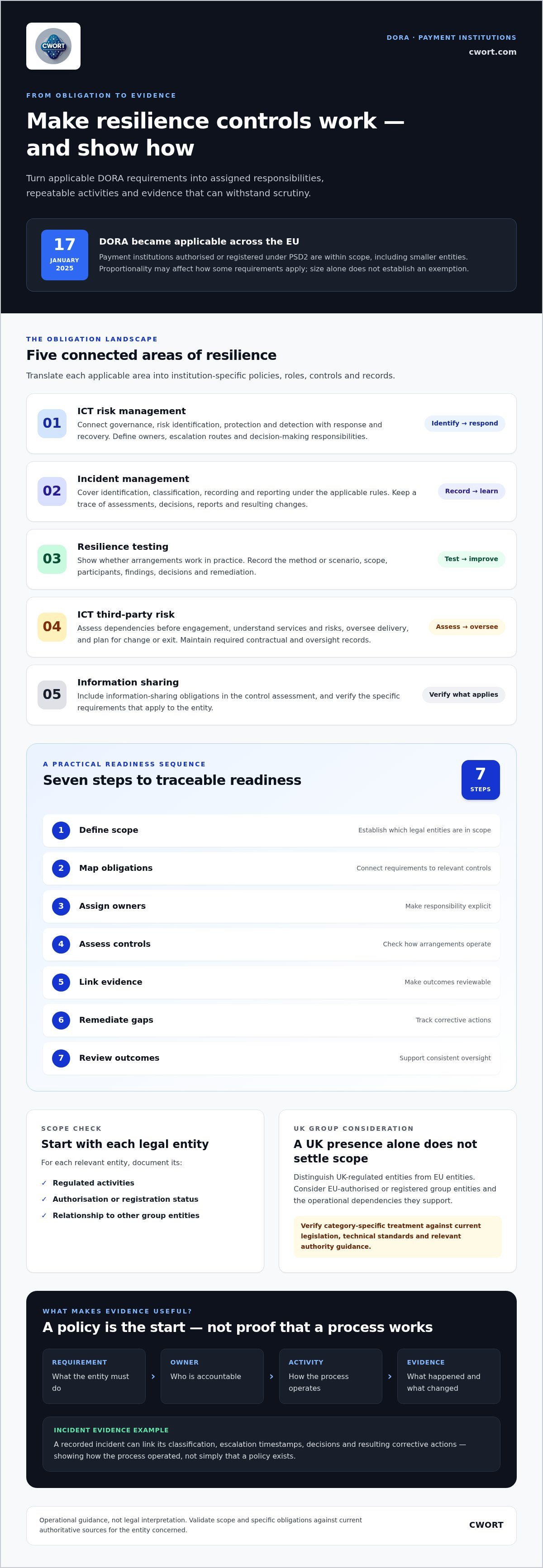
Could your institution show, control by control, that its DORA obligations are working, not simply documented? Understanding the DORA requirements for payment institutions is only the first step. The harder task is turning them into assigned responsibilities, repeatable activities and evidence that can withstand scrutiny.
It can be difficult to establish which obligations apply when work spans risk, compliance, technology and operations. DORA has applied across the EU since 17 January 2025, including to payment institutions authorised or registered under PSD2. For UK groups, the relevant question is which entities fall within scope; a UK presence alone doesn’t settle it. Proportionality may affect how some requirements apply, but it doesn’t remove the need for a clear, governed approach.
This guide sets out the principal DORA obligation areas, explains how to assign ownership and build traceable evidence, and compares manual tracking with a governed validation workflow. It also shows how to connect controls, accountable owners and evidence across existing tools, giving compliance teams, risk leaders and decision-makers a consistent view of implementation.
Key Takeaways
- Identify which DORA obligations apply to your payment institution, taking account of its regulatory status and any relevant proportionality provisions.
- Turn the DORA requirements for payment institutions into owned controls across ICT risk, incident management, resilience testing, third-party risk and information sharing.
- Compare spreadsheets, ticketing tools and governed validation workflows by how well they support ownership, separation of duties, evidence linkage and change history.
- Build readiness in sequence: define scope, map obligations, assign owners, assess controls, link evidence, remediate gaps and review outcomes.
- Use a unified view of control status and evidence to support consistent reviews across compliance, risk and leadership teams.
Table of Contents
- What DORA means for payment institutions: scope, purpose and accountability
- The core DORA requirements payment institutions must put into operation
- How to compare DORA implementation approaches for a payment institution
- A practical sequence for assessing and evidencing DORA readiness
- How CWORT can support DORA evidence and compliance validation
What DORA means for payment institutions: scope, purpose and accountability
The Digital Operational Resilience Act (DORA) is an EU regulation intended to strengthen financial entities’ ability to manage ICT risk and withstand, respond to and recover from ICT-related disruption. It became applicable on 17 January 2025. Payment institutions authorised or registered under PSD2 are within DORA’s financial-entity scope, including smaller entities. The regulation’s wider context is outlined in the Digital Operational Resilience Act (DORA) overview.
For UK organisations, the distinction between a UK-regulated entity and an EU entity matters. A UK payment institution should not assume DORA applies directly to it simply because it provides payment services. It should also account for any EU-authorised or registered entity within its group and the operational dependencies it supports. Establish the position of each legal entity before deciding which DORA requirements for payment institutions apply.
Which payment institutions should assess DORA applicability?
Start with a documented scope assessment. For each relevant legal entity, record its regulated activities, authorisation or registration status, and relationship to other group entities. Then compare those facts with DORA’s scope and current supervisory arrangements. Proportionality may affect how certain requirements apply, but don’t infer an exemption or reduced obligation from size alone. Verify category-specific treatment against current legislation, technical standards and guidance from the relevant authorities.
What does operational resilience mean under DORA?
Operational resilience under DORA is an entity’s ability to manage ICT risk and maintain or restore critical services when disruption occurs. It depends on more than security technology. Governance sets direction and accountability; operational processes coordinate response and recovery; technical controls help protect systems, information and service delivery. Together, these elements should support the services the institution depends on and provides.
A regulatory obligation describes what an entity must do. Evidence of effective implementation shows how it does it, who is responsible and whether the arrangements operate as intended. A policy alone cannot demonstrate that an incident process works or that a recovery capability has been tested. Practical implementation connects requirements to accountable owners, repeatable activities, control outcomes and reviewable evidence.
This is operational guidance, not legal interpretation. Use it to organise assessment and implementation work, then validate scope and specific obligations against current authoritative sources for the entity concerned. For a wider view of mapping and evidencing obligations across an institution, see the DORA compliance validation guide.
The core DORA requirements payment institutions must put into operation
DORA’s requirements are organised around connected areas of resilience, not a single cybersecurity checklist. Payment institutions need to translate applicable obligations into institution-specific policies, roles, controls and records. The practical test is whether staff can follow the process and whether the institution can show what happened.
For example, a policy may require incidents to be escalated promptly. Evidence that the process operates could include a recorded incident, its classification, escalation timestamps, decisions and resulting corrective actions. These records should connect the stated requirement to accountable people and actual outcomes.
How should ICT risk management and incident handling be addressed?
Establish a connected lifecycle. Governance sets accountability; risk identification highlights threats and dependencies; protection and detection help manage exposure; response and recovery guide action during disruption. Define owners, escalation routes and decision-making responsibilities for each stage, so the arrangements can be tested rather than assumed.
Incident arrangements should cover identification, classification, recording and reporting under the applicable DORA rules. Classification criteria and reporting timelines depend on current requirements, so verify them against the relevant technical standards and supervisory guidance. Keep records showing how an incident was assessed, who made decisions, what was reported and what changed afterwards.
What do resilience testing and ICT third-party risk involve?
Testing should show whether resilience arrangements work in practice, not just confirm that a plan exists. Record the scenario or method, scope, participants, findings, decisions and remediation. DORA provides for different testing approaches, with advanced threat-led penetration testing applying to entities identified under the relevant rules. Don’t assume every payment institution has the same testing obligations; verify which methods apply to its category and circumstances.
Manage ICT third-party risk across the service lifecycle: assess dependencies before engagement, understand the services and risks involved, oversee arrangements during delivery, and plan for changes or exit. Maintain the required contractual and oversight records, including the Register of Information where applicable. A supplier inventory alone does not demonstrate effective oversight. Link each material dependency to its owner, assessment, controls and review evidence.
How should information-sharing arrangements be handled?
DORA treats information and intelligence sharing as a distinct area of digital resilience. Assess relevant arrangements and opportunities to exchange cyber threat information, but don’t present participation in a particular sharing initiative as universally mandatory. Record the institution’s approach, governance and any applicable safeguards.
Across all five areas, connect each obligation to an owner, a repeatable activity and evidence of the outcome. A governed validation workflow can bring those links into a reviewable view alongside existing operational records. See how DORA evidence validation can fit into a structured readiness approach.
How to compare DORA implementation approaches for a payment institution
The right approach turns obligations into accountable work and lets reviewers trace decisions and evidence over time. When evaluating methods for DORA requirements for payment institutions, apply the same practical tests: clear ownership, separation of duties, evidence linked to control outcomes, change history and useful reporting.
Tools support execution; they don’t establish compliance or prove a control is effective. A completed task or uploaded document is meaningful only when it relates to a defined requirement, has been reviewed appropriately and reflects how the process operates.
When can spreadsheets or ticketing workflows fall short?
Spreadsheets and ticketing systems can support bounded tasks, especially when scope is limited and owners maintain consistent records. Problems arise when teams use different status definitions, duplicate evidence or update separate trackers without a reliable link between the obligation, control and outcome. Reviewers may then need to reconstruct who did what, when and why from scattered files and tickets. No format is automatically rejected; governance and traceability matter.
What distinguishes a governed validation workflow?
A governed workflow structures obligations, assigns execution, supports separation of duties and binds evidence to control outcomes. Assess whether it preserves changes, produces repeatable scoring from consistent evidence and provides reporting suited to operational teams and leadership. Use these as evaluation criteria rather than assumptions about any tool’s capabilities. Integrations can bring records from existing security and operational tools into a unified view without replacing those systems.
Use the comparison to pinpoint where your current method loses accountability or traceability. Strengthen those links before adding another layer of tooling. The objective is a reviewable chain from requirement to owner, activity, evidence and outcome, not a technology purchase for its own sake.
A practical sequence for assessing and evidencing DORA readiness
Turn the DORA requirements for payment institutions into a controlled sequence of decisions and outputs. Each step should leave a record that supports the next, from defining the relevant entity to reviewing whether remediation has worked.
- Define scope. Record the legal entities, activities, dependencies and basis for the applicability assessment. Check category-specific treatment against current authoritative sources.
- Map obligations. Build a control map connecting each verified obligation to relevant policies, processes, systems and evidence expectations. Record the source and version used, so the mapping can be reviewed when requirements change.
- Assign owners. Name an accountable owner for each control and identify who performs, reviews and approves the work. Apply separation of duties where appropriate, and document roles and hand-offs.
- Assess controls. Record whether each control is designed, implemented and operating. A policy or procedure can evidence design; it doesn’t, by itself, show that staff follow it consistently.
- Evidence outcomes. Link dated records to the relevant control, assessment period and outcome. Design evidence might include an approved procedure; operating evidence might include completed reviews, logs or test results. Record the evidence source and any review performed.
- Remediate gaps. Create an owned action for each gap, with its documented risk, business impact, target completion criteria and status. Retain the evidence supporting status changes and closure decisions.
- Review and reassess. Schedule governance reviews and reassess controls when relevant changes, incidents or findings arise. Keep review decisions, updated mappings and follow-up actions together as a continuing record.
How should obligations connect to controls and owners?
Map from verified obligations, not from existing documents alone. A policy may support several controls, while one control may depend on multiple teams or services. Record those relationships and distinguish a control’s intended design from its implementation and operating status. Preserve the chain so reviewers can trace an obligation through ownership and execution to the outcome.
How can gaps become tracked remediation and review?
Make actions testable. “Improve incident readiness” is too broad. Specify the control gap, accountable owner, evidence needed to close it and criteria for review. Reassessment then confirms whether the action addressed the underlying issue, rather than merely whether a task was marked complete. Treat this as recurring governance, not a one-off preparation exercise.
A defined sequence makes readiness easier to oversee and evidence. A DORA readiness demonstration can show how structured activities and linked evidence support this workflow.
How CWORT can support DORA evidence and compliance validation
Once obligations and owners are defined, the operational challenge is keeping execution and evidence connected. CWORT is an enterprise compliance validation platform that sits above existing security and operational tools. It maps obligations to structured activities, supports role controls and separation of duties, and links evidence to control outcomes. Teams can use it to orchestrate implementation and validation of DORA requirements for payment institutions without replacing their underlying operational systems.
The distinction matters. A document repository can store policies and records, but may not show which obligation a record supports, who reviewed it or what outcome the evidence demonstrates. CWORT’s assurance evidence register tracks evidence and status at control level, helping teams create a traceable basis for assurance, audit and leadership review.
What evidence and reporting can a governed platform organise?
Mapped controls can support reporting across frameworks, but a shared control does not make regulatory obligations identical. Each mapping still needs to reflect the relevant requirement and the institution’s interpretation of its scope. CWORT’s June 2026 taxonomy snapshot contains 1,355 controls across 217 domains and 42 frameworks or standards; 98.6% of active controls carried framework references in that snapshot. These are platform-wide taxonomy figures, not counts of DORA requirements or DORA-specific coverage.
Deterministic scoring is designed to produce reproducible results from identical evidence. This supports consistent review while keeping assessment criteria and evidence quality visible to the people responsible for validation. AI advisory may offer suggestions, but those suggestions don’t alter deterministic assessment results.
How can teams assess fit without confusing tooling with compliance?
Assess workflow fit against the institution’s defined scope, control model, roles and evidence practices. Consider whether activities have accountable owners, whether reviewers can distinguish execution from approval, and whether evidence remains linked to outcomes as records change. Existing operational tools can continue to perform their functions, while relevant evidence feeds a more unified view for compliance, risk and leadership teams.
A platform supports assessment and execution; it doesn’t provide legal advisory services or determine an institution’s regulatory obligations. The institution remains accountable for its obligations and regulatory judgements. Use current authoritative requirements to inform the control mapping, and have accountable people review whether the evidence supports the conclusions drawn.
See how these workflows could apply to your readiness process. A CWORT demonstration can show structured activities, control-level evidence and validation reporting in context.
Turn DORA obligations into demonstrable resilience
Effective implementation starts with clarity: establish which obligations apply, map them to controls, assign accountable owners and keep evidence linked to outcomes. The DORA requirements for payment institutions become more manageable when readiness is treated as an ongoing governance process, not a collection of disconnected documents.
CWORT supports that process with a control-level assurance evidence register that tracks evidence and status. Its deterministic assessment approach is designed to produce reproducible results from identical evidence, while an integration layer can present relevant evidence from existing operational tools. These capabilities help teams build a reviewable picture of execution; they don’t replace the institution’s regulatory judgement or responsibility for its controls.
Move from scattered records to a structured view of ownership, evidence and progress. Request a CWORT demonstration to explore how a DORA readiness workflow could support your institution. Clear accountability and traceable evidence help teams approach implementation with greater control and confidence.
Frequently Asked Questions
Does DORA apply to payment institutions?
Yes, DORA applies to payment institutions within its financial-entity scope, including institutions authorised or registered under PSD2 in the EU. Smaller or exempted institutions aren’t automatically outside the regulation, although proportionality and specific treatment may be relevant. For a UK organisation, assess each legal entity’s authorisation, activities and group structure. A UK presence alone doesn’t determine whether DORA applies, but an EU-regulated entity in the group may be in scope.
What are the main DORA requirements for payment institutions?
The main DORA requirements for payment institutions cover ICT risk management; ICT-related incident management, classification and reporting; digital operational resilience testing; ICT third-party risk; and information and intelligence sharing. Institutions need to translate applicable obligations into policies, accountable roles, controls and records. Sharing arrangements are a distinct area, but participation in a particular information-sharing initiative should not be assumed to be universally mandatory. Check current rules for specific obligations.
When did payment institutions have to comply with DORA?
DORA became applicable across EU Member States on 17 January 2025. Payment institutions in scope have been required to comply since that date; it wasn’t a future deadline or a voluntary preparation period. UK institutions should determine whether the regulation applies to any relevant EU-authorised or registered entity in their structure, and check current authoritative sources for the obligations affecting that entity.
What evidence should a payment institution retain for DORA?
Retain records connecting applicable obligations to implementation and outcomes. Examples include approved policies, control assessments, named owners, incident records and decisions, testing plans and results, third-party assessments, relevant contractual records, remediation actions and review approvals. Distinguish design evidence, which shows how a control is intended to work, from operating evidence, which shows it was performed. Link each item to its control, status, date and review where relevant.
Does DORA require payment institutions to use compliance software?
No. DORA requires applicable entities to meet their obligations, not to use a particular compliance platform or software format. Spreadsheets, ticketing tools or general governance systems may support the work if they provide sufficient ownership, traceability and reviewable records. A governed validation platform can organise obligations, activities and evidence across existing tools, but technology alone doesn’t establish compliance or prove that a control works effectively.
How often must payment institutions test digital operational resilience under DORA?
Testing frequency and methods depend on the applicable DORA requirements and the institution’s circumstances. Significant financial entities identified under the relevant rules must conduct threat-led penetration testing at least once every three years; microenterprises are excluded from that advanced TLPT requirement. This doesn’t mean every payment institution has the same testing schedule. Confirm the entity’s category, applicable standards and current supervisory guidance before setting its programme.
Can one DORA control support more than one regulatory framework?
Yes, a control may support obligations across more than one framework if it addresses each relevant requirement. Map the control to the specific obligations and retain evidence showing how it meets each one. Don’t assume similar wording makes requirements identical or that one piece of evidence proves compliance across the board. Clear framework references, control outcomes and review records make cross-framework reporting more traceable and defensible.
Disclaimer
The content on this site is provided for general information and educational purposes only. It does not constitute legal, regulatory, financial, or professional advice. CWORT provides AI-assisted insights and workflow automation, but all compliance decisions remain the responsibility of your organisation and its management. Always seek qualified legal or regulatory guidance for decisions relating to the UK NIS Regulations, CAF, DORA, NIS2, ISO 27001, or other obligations.
Related posts
CISO Guide to DORA Operational Resilience: Orchestrating Validated Compliance
Master validated compliance with our CISO guide to DORA operational resilience. Swap manual evidence gathering for an orchestrated, audit-ready security post...
DORA Separation of Duties Enforcement: Moving from Policy to Validated Proof
Achieve effective DORA separation of duties enforcement. This guide shows how to replace manual tracking with an automated system for validated, audit-ready ...
DORA Technical Standards Compliance: Moving from Regulatory Theory to Validated Execution
Struggling with DORA technical standards compliance? Move beyond spreadsheets to a validated framework that provides real-time, auditable evidence for regula...
Article by
Michael Iyiola
Co-Founder, CWORT
Michael Iyiola is a co-founder of CWORT and a Cyber and AI Security Engineer with deep experience in vulnerability management, detection engineering and operational resilience across UK critical national infrastructure, including rail, energy and financial services. At CWORT, he designs scalable, evidence-driven workflows that help teams meet modern regulatory and security demands.
Build Your Foundation of Auditable Certainty
Take control of your regulatory obligations and secure your infrastructure with CWORT.