DORA Technical Standards Compliance: From Regulatory Theory to Auditable Proof

Michael Iyiola
Co-Founder, CWORT
Struggling with DORA technical standards compliance? Learn how to replace manual tracking with automated, auditable proof for the 2026 regulatory review.

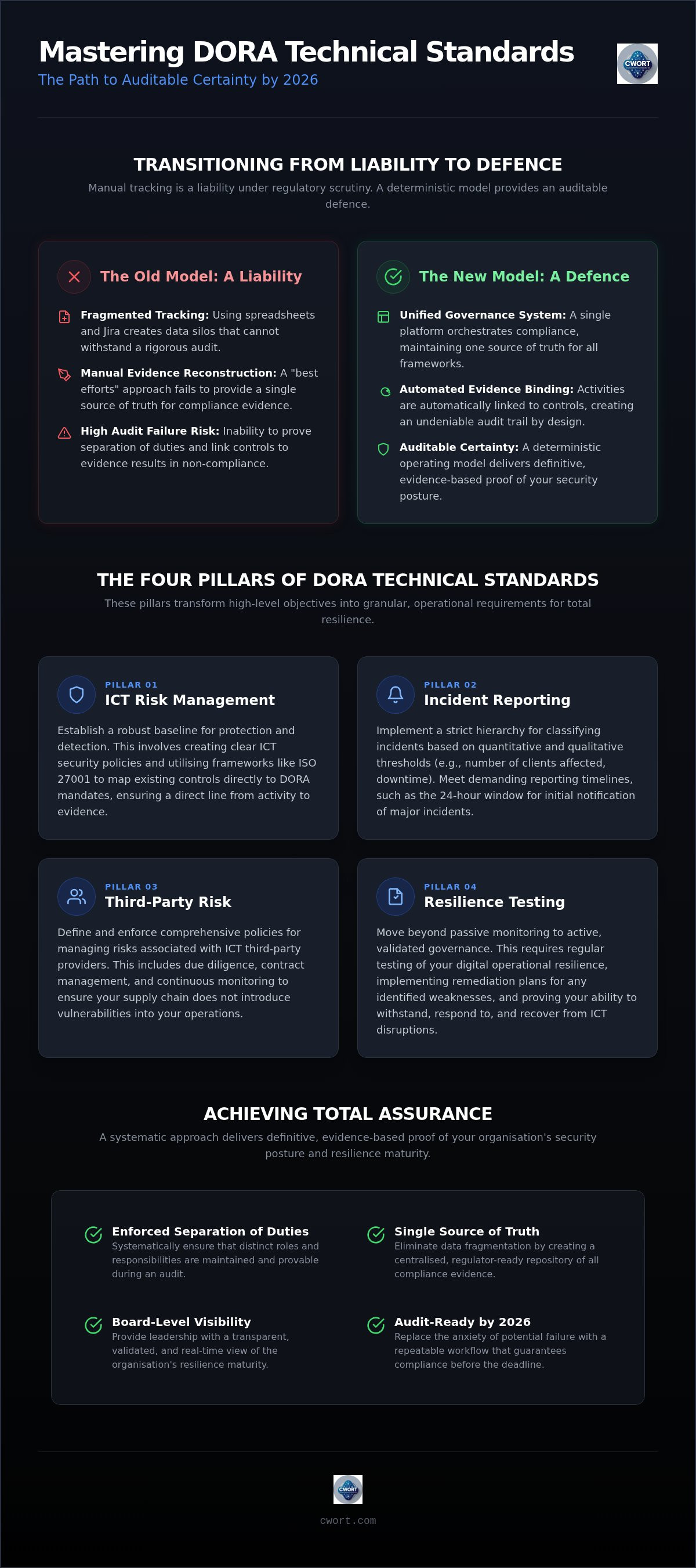
By the time the 2026 audit deadline arrives, a spreadsheet of "best efforts" will be a liability rather than a defence. Most financial entities have already realised that fragmented tracking across Jira and Excel cannot withstand the scrutiny of a rigorous regulatory review. You likely feel the pressure of proving separation of duties whilst struggling to maintain a single source of truth for evidence. Mastering DORA technical standards compliance requires a shift from administrative tracking to a disciplined, deterministic operating model that enforces accountability by design.
This article provides the blueprint to transition from theoretical compliance to auditable certainty. You'll learn how to replace manual processes with automated evidence binding and regulator-ready reporting. We will examine the path toward total assurance, moving from high-level strategic challenges to the granular execution required for board-level visibility of your resilience maturity. It's time to replace the anxiety of potential failure with a systematic approach that delivers definitive, evidence-based proof of your organisation's security posture. By orchestrating these requirements into a repeatable workflow, you move beyond mere obligation into a state of professional maturity.
Key Takeaways
- Decode the role of Regulatory Technical Standards (RTS) and Implementing Technical Standards (ITS) in bridging the gap between high-level law and operational execution.
- Recognise why manual evidence reconstruction in spreadsheets is a liability that fails the scrutiny of 2026 regulatory audits.
- Master DORA technical standards compliance by shifting to a deterministic operating model that translates abstract obligations into structured, defensible activities.
- Enforce separation of duties and automated evidence binding to provide the board with a transparent, validated view of your resilience maturity.
- Transition from fragmented point-tools to a unified governance system that orchestrates compliance across multiple frameworks whilst maintaining a single source of truth.
Table of Contents
- Understanding the DORA Technical Standards (RTS and ITS) Landscape
- The Four Pillars of DORA Regulatory Technical Standards
- The Compliance Evidence Gap: Why Manual Tracking Fails RTS Audits
- Orchestrating a Validated DORA RTS Execution Workflow
- Proving DORA Technical Standards Compliance with CWORT
Understanding the DORA Technical Standards (RTS and ITS) Landscape
The Digital Operational Resilience Act (DORA) represents a fundamental pivot in financial regulation. Historically, regulators focused primarily on solvency and capital adequacy to ensure market stability. By 2026, the priority shifts decisively toward operational resilience. This means that maintaining sufficient capital is no longer enough; firms must prove they can withstand, respond to, and recover from ICT-related disruptions that threaten the continuity of financial services.
The European Supervisory Authorities (ESAs), comprising the EBA, ESMA, and EIOPA, act as the architects of this regime. They develop the technical standards that translate high-level legal text into actionable requirements. These standards fill critical regulatory gaps, ensuring that every financial entity follows a uniform set of rules for ICT risk management and incident reporting. Achieving DORA technical standards compliance is not optional. It is a mandatory requirement for all in-scope entities, including those operating within or providing services to the UK and EU financial sectors.
The Distinction Between RTS and ITS
Regulatory Technical Standards (RTS) define the substantive requirements of the Act. They establish the "what" of compliance, such as the specific criteria for ICT risk management frameworks, third-party risk policies, and remediation plans. Conversely, Implementing Technical Standards (ITS) define the "how" by providing standardised templates and formats for incident reporting and maintaining registers of information. Distinguishing between the two is vital for effective resource allocation. Whilst technical teams focus on the substantive controls in the RTS, compliance functions must ensure that data is formatted according to the ITS templates. Failing to recognise this distinction leads to fragmented data sets that auditors will inevitably reject during a review.
Timeline for Compliance in 2026
The path to 2026 requires a disciplined progression from initial assessment to full validation. Firms must move beyond simple gap analysis and start generating auditable proof of their resilience. By the time the deadline arrives, regulators will expect a deterministic operating model that produces consistent, repeatable results. The consequences of failing to reach this "audit-ready" threshold include significant fines and public reputational damage. UK regulators will maintain a zero-tolerance enforcement posture regarding non-compliance with technical standards from the start of 2026. This timeline leaves no room for administrative delays. Organisations must prioritise DORA technical standards compliance now to ensure their evidence is bound to their controls before the first audit cycle begins.
The Four Pillars of DORA Regulatory Technical Standards
DORA technical standards compliance rests upon four distinct yet interconnected pillars. These pillars transform high-level resilience objectives into a granular set of operational requirements that every financial entity must orchestrate. As noted by EIOPA on DORA, these standards ensure that the entire financial ecosystem can withstand systemic ICT shocks. Achieving this state requires a transition from passive monitoring to active, validated governance.
ICT Risk Management and Simplified Frameworks
Establish a robust baseline for protection and detection by implementing clear ICT security policies. These protocols are the foundation of your defensive posture. For smaller organisations, simplified frameworks provide a proportional approach without sacrificing necessary rigour. To streamline this process, many firms utilise ISO 27001 control mapping tools to align their existing security investments with DORA mandates. This ensures every control is mapped to a regulatory obligation, providing a direct line from activity to evidence.
Incident Classification and Reporting Timelines
The RTS for incident reporting introduces a strict hierarchy of classification. You must categorise incidents as "Major" based on specific quantitative and qualitative thresholds, such as the number of affected clients or service downtime duration. The pressure is immense. A 24-hour initial notification window leaves no room for manual deliberation or internal debate. Automating the classification process is essential. It removes human error and ensures reporting timelines are met with precision, preventing the regulatory friction that follows a missed deadline.
Managing Third-Party Dependencies
Supply chain visibility is a core requirement for 2026. You must maintain a comprehensive "Register of Information" detailing all ICT service providers, including their role in supporting critical functions. Managing these dependencies requires strict subcontracting conditions. You cannot simply trust your primary vendors; you must verify the resilience of the entire multi-tiered supply chain. Proving DORA technical standards compliance in this area requires a systematic approach to vendor risk that extends beyond basic contract reviews.
Ensuring these pillars are auditable requires more than just a checklist. If you are ready to move from fragmented tracking to a validated operating model, you can request a demo of CWORT to see how we orchestrate these requirements into a single source of truth.
The Compliance Evidence Gap: Why Manual Tracking Fails RTS Audits
Fragmented tracking across Jira and Excel no longer satisfies the 2026 regulatory threshold. These tools lack the native structural integrity required to withstand a high-stakes audit, primarily because they cannot prove the provenance of the data they contain. Achieving DORA technical standards compliance requires a level of rigour that manual systems simply cannot sustain over time. When data is scattered across disconnected silos, the board is forced to rely on unvalidated summaries rather than definitive, deterministic proof. This creates a dangerous "Evidence Gap", which is the space between a well-written policy and the auditable proof that the policy was actually executed.
Manual systems fail to enforce essential DORA separation of duties, leaving organisations vulnerable to internal oversight failures. Without a system that mandates specific workflows, there's no guarantee that the person executing a control isn't also the one validating its success. This lack of structural discipline is exactly what auditors look for when assessing the maturity of an operating model. Relying on human memory or manual reconstruction during an audit is a high-risk gamble that boards can no longer afford to take. Defensible truth requires a system that prevents these conflicts of interest by design.
The Failure of Spreadsheet-Based GRC
Static spreadsheets remain the most common point of failure in modern governance. They're inherently unable to keep pace with dynamic and evolving threats, providing only a snapshot of the past rather than a real-time view of resilience. Version control nightmares and immutable audit trail gaps are impossible to reconstruct months after the fact, leaving auditors with more questions than answers. Regulators in 2026 demand deterministic proof of control effectiveness. They want to see that identical evidence yields the same result every time, a level of consistency that manual data entry can never achieve.
Orchestration vs. Mere Documentation
Build a "system of execution" rather than just maintaining a "library of policies". Orchestration ensures that evidence is bound to specific control outcomes at the point of action, rather than being gathered as an afterthought during an audit fire-drill. This proactive approach significantly reduces the "compliance tax" on operational teams by eliminating the need for retrospective evidence gathering. Instead of spending weeks hunting for logs across different tools, the proof is generated as a natural byproduct of the daily workflow. This shift ensures that your DORA technical standards compliance isn't just a theoretical exercise, but a defensible reality that withstands the most rigorous regulatory scrutiny.
Orchestrating a Validated DORA RTS Execution Workflow
Transitioning from theoretical obligation to auditable proof requires a structured, step-by-step orchestration of activity. This isn't about simply checking boxes; it's about building a deterministic workflow that ensures every requirement is met with objective evidence. To achieve DORA technical standards compliance, organisations must move beyond passive tracking and implement a system that enforces discipline by design. This process begins with the translation of abstract legal text into a library of structured activities that operational teams can execute with precision.
The path to total assurance follows a logical progression of execution:
- Translate: Convert DORA RTS obligations into granular, actionable tasks. Utilising a comprehensive library, such as the 1,355 controls available in CWORT, ensures no regulatory gap is overlooked.
- Assign: Define clear ownership for every activity. Enforce a strict separation of duties to ensure that accountability is embedded at the point of action.
- Aggregate: Pull evidence directly from your existing technical stack, including SIEM, EDR, and IAM tools. This creates a central, immutable register of proof.
- Validate: Test evidence against deterministic control models. This ensures that identical evidence always yields the same result, removing human subjectivity from the scoring process.
- Generate: Produce board-level and regulator-ready reports automatically. This eliminates the need for manual data reconstruction before an audit.
Enforcing Rigour through Separation of Duties
Avoiding the "self-assessment trap" is critical for maintaining the integrity of your governance model. When executors are permitted to grade their own work, the resulting data is inherently biased and often rejected by auditors. Implementing independent validation steps within your workflow ensures that every control is verified by a party not involved in its execution. By leveraging regulatory compliance workflow automation, you embed these checks into the process itself. This systematic enforcement of discipline replaces the anxiety of potential failure with the calm of auditable certainty.
Binding Evidence to Control Outcomes
Proving compliance requires a "golden thread" that links high-level policy directly to granular proof of execution. This technical process involves linking specific system logs, screenshots, or configurations to a DORA requirement at the moment the activity occurs. Evidence protection and defensive content processing ensure that this proof remains untampered and defensible. Every RTS article must be supported by a validated outcome, providing a transparent and explainable view of resilience maturity. This level of detail is what allows leadership to move from mere administrative tracking to definitive, evidence-based proof.
If you are ready to replace fragmented spreadsheets with a disciplined system of execution, request a demo of the CWORT platform to see this workflow in action.
Proving DORA Technical Standards Compliance with CWORT
CWORT functions as a proactive orchestration system that enforces discipline by design, moving beyond the limited scope of point-tools like SIEM or EDR. Whilst these technical tools provide essential data, they lack the governance layer required to translate technical logs into regulatory proof. By sitting above your existing technical stack, CWORT provides a unified, explainable view of your entire security posture. This structural integrity is essential for achieving DORA technical standards compliance, as it bridges the critical gap between raw system output and the specific requirements of the Regulatory Technical Standards.
The platform enables an "assess once, report many" strategy that is vital for firms managing overlapping mandates. With 98.6% of active controls carrying specific framework references, you can easily map your DORA activities to other standards such as the NCSC CAF, NIST, or ISO 27001. This multi-framework cross-walk ensures that a single validated action satisfies multiple regulatory obligations, drastically reducing the administrative burden on your risk and compliance teams. It transforms compliance from a series of isolated fire-drills into a continuous, repeatable process of professional maturity.
Deterministic Scoring and Audit Defensibility
Subjectivity is the primary cause of audit failure. When different auditors or internal teams can interpret the same evidence in different ways, your compliance posture becomes an opinion rather than a fact. CWORT eliminates this risk by using a deterministic scoring model. In this system, identical evidence must always yield the same result, ensuring that your scores are objective, consistent, and defensible. This process is supported by the taxonomy library of 1,355 controls, providing the granular detail needed to satisfy the most rigorous scrutiny. Central to this approach is the Assurance Evidence Register, which maintains an immutable record of every validated outcome, creating the "golden thread" of proof that regulators expect in 2026.
Board-Ready Reporting and Strategic Visibility
Senior leadership requires a high-level view of resilience that avoids technical jargon whilst maintaining absolute accuracy. CWORT translates complex RTS data into intuitive maturity heat-maps, providing the board with a clear understanding of both organisational capability and capacity. This strategic visibility ensures that resource allocation is based on validated gaps rather than guesswork. This disciplined approach also prepares organisations for the evolving regulatory landscape, including the specific requirements of a NIS2 compliance platform UK. By orchestrating DORA technical standards compliance through a single source of truth, you replace the anxiety of potential failure with the calm of auditable certainty.
Securing Your Operational Resilience for 2026
Transitioning from regulatory theory to auditable proof requires a fundamental shift in how your organisation manages evidence. Replace the fragmented chaos of spreadsheets with a disciplined system that enforces accountability by design. By orchestrating your workflow, you ensure every requirement is backed by deterministic evidence rather than subjective opinion. Mastering DORA technical standards compliance is no longer just a legal obligation; it is a strategic opportunity to build a transparent, resilient enterprise.
CWORT provides the structural integrity needed to withstand the most rigorous audits. Leverage our taxonomy library of 1,355 controls and a deterministic scoring model to ensure identical evidence always yields the same result. Our platform delivers board-ready maturity reports that translate technical execution into clear, strategic visibility for senior leadership. Stop treating compliance as a manual fire-drill and start building a repeatable, defensible operating model.
Orchestrate your DORA compliance with CWORT today to replace regulatory anxiety with the certainty of validated truth. Your path to 2026 readiness is within reach.
Frequently Asked Questions
What are the main DORA Regulatory Technical Standards (RTS) I need to worry about?
The most critical RTS cover ICT risk management frameworks, incident classification criteria, threat-led penetration testing (TLPT), and third-party risk management. These standards provide the granular requirements that fill the gaps in the primary DORA legislation. You must prioritise the RTS on ICT security policies and the classification of major incidents. Failing to address these specific technical mandates leaves your organisation exposed during a rigorous regulatory review.
How does DORA RTS differ from the high-level Regulation text?
The high-level DORA Regulation establishes the legal principles whilst the RTS provide the substantive technical requirements for execution. Think of the Regulation as the mandate and the RTS as the operational blueprint. Whilst the primary text sets the objectives, the RTS define the specific criteria for control effectiveness. Distinguishing between them is essential for resource allocation; you cannot achieve DORA technical standards compliance by following the high-level text alone.
Can I use my existing ISO 27001 controls for DORA RTS compliance?
You can certainly leverage existing ISO 27001 controls, but they must be mapped specifically to DORA requirements. Most financial entities use a multi-framework cross-walk to ensure their security investments satisfy both standards. Since 98.6% of CWORT controls carry framework references, you can use the "assess once, report many" capability. This approach ensures that your ISO evidence is bound to DORA obligations without duplicating the operational effort.
What is the deadline for complying with DORA technical standards in 2026?
The definitive deadline for full compliance is the start of 2026. By this date, UK and EU regulators expect financial entities to have moved from assessment to a validated, auditable operating model. There's no grace period for technical standards; your evidence must be bound to your controls before the first audit cycle begins. Organisations that miss this window face significant fines and public reputational damage as regulators adopt a zero-tolerance posture.
Is automated evidence binding required for a DORA audit?
Whilst the law doesn't explicitly mandate automation, providing deterministic proof without it is nearly impossible. Regulators in 2026 demand a "golden thread" from policy to evidence that manual systems cannot reliably maintain. Automated evidence binding ensures that every control outcome is validated at the point of action. Without this automation, your audit defence relies on manual reconstruction, which is prone to error and often rejected by modern auditors.
What happens if our firm fails to meet the RTS for third-party risk management?
Failing to meet the RTS for third-party risk management triggers severe regulatory sanctions and public notices of non-compliance. You must maintain a comprehensive Register of Information for all ICT providers, including subcontracting conditions for critical functions. Regulators view supply chain visibility as a core component of systemic stability. If you cannot prove control over your multi-tiered supply chain, your firm will be deemed a resilience risk to the wider financial ecosystem.
How do the ESAs monitor compliance with these technical standards?
The European Supervisory Authorities (ESAs) monitor compliance through periodic audits, mandatory incident reporting, and the review of information registers. They use the standardised templates defined in the Implementing Technical Standards (ITS) to ensure consistency across the sector. Your organisation must be prepared to submit validated data on demand. This monitoring process is designed to identify firms that rely on "best effort" documentation rather than a disciplined, deterministic governance system.
Why is separation of duties so important in DORA RTS execution?
Separation of duties is the cornerstone of DORA technical standards compliance because it prevents the "self-assessment trap". You must ensure that the individual executing a control is not the same person validating its success. This independent verification builds regulator trust and ensures the integrity of your compliance data. Implementing these checks within your workflow enforces a level of professional rigour that makes your resilience maturity both explainable and defensible during an audit.
Disclaimer
The content on this site is provided for general information and educational purposes only. It does not constitute legal, regulatory, financial, or professional advice. CWORT provides AI-assisted insights and workflow automation, but all compliance decisions remain the responsibility of your organisation and its management. Always seek qualified legal or regulatory guidance for decisions relating to the UK NIS Regulations, CAF, DORA, NIS2, ISO 27001, or other obligations.
Related posts
DORA Technical Standards Compliance: Moving from Regulatory Theory to Validated Execution
Struggling with DORA technical standards compliance? Move beyond spreadsheets to a validated framework that provides real-time, auditable evidence for regula...
DORA Technical Standards Compliance: A Strategic Guide to RTS and ITS Validation
Achieve DORA technical standards compliance with confidence. Learn to validate RTS/ITS and generate the evidence-based proof regulators demand for 2026.
DORA Compliance Validation: A Guide for Financial Institutions
Master DORA compliance validation. Our guide shows you how to replace risky manual tracking with an automated, auditable system for definitive regulatory proof.
Article by
Michael Iyiola
Co-Founder, CWORT
Michael Iyiola is a co-founder of CWORT and a Cyber and AI Security Engineer with deep experience in vulnerability management, detection engineering and operational resilience across UK critical national infrastructure, including rail, energy and financial services. At CWORT, he designs scalable, evidence-driven workflows that help teams meet modern regulatory and security demands.
Build Your Foundation of Auditable Certainty
Take control of your regulatory obligations and secure your infrastructure with CWORT.